
An AI development company builds software that uses artificial intelligence to solve a business problem. AI development services cover the full path: choosing the use case, preparing data, building and testing the system, and keeping it working after launch.
AI consulting services cover the step before that. A consultant helps you decide where AI fits and whether it is worth building.
What does an AI development company build?
Most projects fall into four groups.
| System type | What it does | Example |
| Generative AI applications | Writes or summarizes text, images, or code | Drafting support replies |
| Retrieval and enterprise search | Answers questions from your own documents | An assistant for internal policies |
| AI agents and automation | Completes multi-step tasks across tools | Checking and routing invoices |
| Predictive machine learning | Forecasts or classifies from data | Predicting customer churn |
Each group needs different data and different testing. Most projects also need ordinary software around the AI, such as interfaces, databases, and integrations.
That is why the categories overlap. DesignRush lists AI companies separately from software development companies, yet many software firms sell artificial intelligence services and many AI specialists build the whole application.
Which AI development services can you outsource?
The most common AI development services include:
Use-case discovery and AI consulting
The company reviews your processes, data, and goals, then ranks possible AI use cases by value and feasibility. A good AI consulting company also tells you where AI adds nothing.
You receive: a ranked use-case list, a feasibility assessment, and a roadmap.
Data assessment and preparation
The team checks whether your data is available, accurate, and legally usable for the task. Then it cleans, labels, or connects the data through pipelines. Large data projects can overlap with big data analytics companies.
This step determines many projects. In a Gartner survey, 63% of organizations either lacked the right data practices for AI or weren’t sure they had them. Gartner predicts that through 2026, organizations will abandon 60% of AI projects that lack AI-ready data.
Proof of concept
A proof of concept tests one narrow question on your real data, such as whether a model can sort your support tickets accurately enough. It shows the idea can work. Production still needs integration, security, and reliability work.
Generative AI, RAG, and AI agents
Most generative AI projects build on existing large language models. A generative AI development company often adds retrieval-augmented generation (RAG), which pulls relevant passages from your documents into each answer so responses stay tied to your sources.
Agents go a step further and take actions, such as updating records or sending messages. An AI agent development company should use fixed rules wherever they work and limit what the agent is allowed to do.
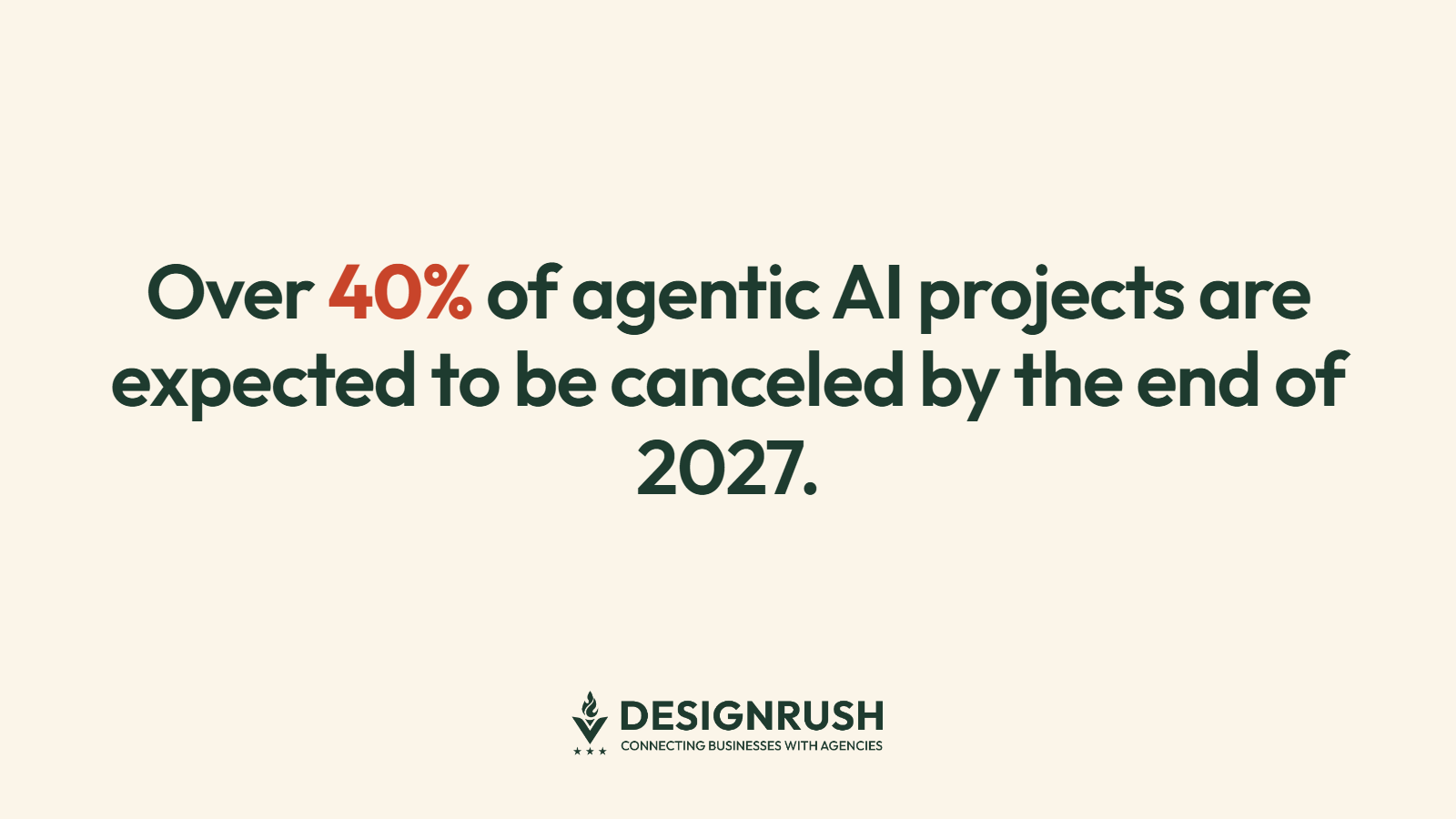
Agents carry real delivery risk. Gartner predicts that over 40% of agentic AI projects will be canceled by the end of 2027 due to rising costs, unclear business value, or weak risk controls.
Integration and customization
An AI software development company connects AI features to your products and systems, such as a CRM, help desk, or website. Customization ranges from prompt design to fine-tuning a model on your own examples. A custom AI development company should explain why customization is needed before adding it.
Evaluation and testing
AI can give confident, wrong answers. Evaluation measures quality against agreed test cases before launch: accuracy, factual errors, safety, bias, and difficult edge cases. Agree on the test cases and the passing bar before development starts. No provider can promise perfect accuracy on every input.
Monitoring and maintenance (MLOps)
After launch, data changes, providers update their models, and quality can drift. MLOps covers deploying, versioning, and monitoring models in production. For systems built on third-party models, it also means tracking API changes and usage. Hosting work may involve cloud consulting companies.
Should you use an existing model or build your own?
Most business projects use an existing model through an API.
| Approach | When it fits |
| Integrate an existing model | Common tasks such as summarizing, drafting, or answering questions |
| Add retrieval (RAG) | Answers must come from your own documents or data |
| Fine-tune a model | You need consistent behavior, style, or format and have enough good examples |
| Train a custom model | No available model handles the task well, and your data and budget justify training |
Each step down the table adds data, testing, compute, and maintenance work. An artificial intelligence development company should explain why it recommends a given option for your case.
What data will you need to provide?
It depends on the system:
- A RAG assistant needs current, relevant documents.
- A predictive model needs historical records with known outcomes.
- Fine-tuning needs high-quality examples of the task.
You will also need people who can check the results.
Before sharing anything, confirm:
- Where the data is stored and processed
- Who can access it
- Whether any model provider can keep it or train on it
- What happens to it when the contract ends?
Terms differ by provider and plan. For sensitive data, involve your legal and security teams, and consider an outside review from cybersecurity companies.
Do you need AI consulting or AI development?
Choose consulting if you still need to decide where AI fits, which data you have, and how to measure value. Choose development if the problem, the data, and the success criteria are already clear.
Some providers do only one. An AI agency focused on strategy may hand the build to a development partner. Many offer both, starting with a short consulting phase.
What do you keep paying for after launch?
AI systems have running costs that grow with usage: model or API fees, cloud hosting, vector databases, monitoring tools, and human review of outputs. Ask for usage estimates and the assumptions behind them.
Someone also has to watch quality, update prompts and data, and respond when a provider changes its model. Agree on who does this before launch. The AI development pricing guide explains how to budget for it.
What AI development services are scoped separately?
Scope for AI development services varies by provider.
| Item | How it is usually scoped |
| Discovery and feasibility | Often a separate first phase |
| Proof of concept | Often a separate phase before the full build |
| Production build | The main development engagement |
| Evaluation framework | Included or scoped separately |
| Data cleaning and labeling | Often scoped separately |
| Monitoring and maintenance | Often a separate ongoing agreement |
| Model and API usage, cloud, databases | Third-party cost |
| Legal review of data use and IP | Specialist service |
Which AI services fit your problem?
- You know AI could help but not where. Start with AI consulting services.
- You want to test an idea first. Run a proof of concept on your own data.
- Staff waste time searching documents. Consider a RAG assistant over your internal knowledge.
- A repetitive process spans several tools. Consider workflow automation or an AI agent, with human approval at key steps.
- You want to predict outcomes. Consider a predictive machine learning model.
- You are adding AI to a product. You need model integration plus evaluation and monitoring.
To compare providers, read the guide to choosing an AI development company.