
Our directory of the best IoT companies in the USA is grounded on our five ranking criteria, reviewed by 12 executive experts, and informed by over 1,400 client reviews. This provides you with a consistent way to compare and select top providers.
Organic rankings are determined by five factors: top services, reviews, portfolio, awards/press, and team expertise. Sponsored listings pay for a placement that appears above organic positions. Sponsorship does not affect star ratings or review content - read more on our methodology page.
Flyaps
VerifiedVerified by the DesignRush team for authenticity and credibility.Award WinnerRecipient of a Best Design Award for outstanding work.AI & Cloud Software Engineering
Flyaps is an AI & cloud engineering company headquartered in New York, with delivery teams in Ukraine and Poland. For 12+ years, we've helped early-stage startups scale into unicorns and modernized legacy businesses into IT leaders...
Top Services:
- Software Development
- AI Development
- IT Services
- DevOps Consulting
- Cloud Consulting
- Show more
- Location
- New York City, New York
- Number of Employees
- Under 49
- Average Hourly Rate
- $49/hr
- Minimal Budget
- $25,000 - $50,000
- Portfolios Count
- 9 Projects Listed
Data sourced from the agency's DesignRush profile, its website, and other relevant accountsFlyaps Services
Data sourced from the agency's DesignRush profileNetSpark IP & Telecom MyersBiz Net Yaana Airbyte Nextgen Clearing JOIN Relocate Shoelace Wireless
Flyaps Reviews & Testimonials

Python Django Review from Andrew Stetsenko
We partnered with Flyaps to build the GlossaryTech Chrome Extension from scratch, including the backend for tech terminology analysis. The goal was to help recruiters, sales professionals, and other non-technical specialists in IT quickly understand the technical terms they encounter every day.The first release shipped back in 2017, long before today's AI tools were available off the shelf. Flyaps built a custom tokenization layer on top of NLTK library to resolve the ambiguity problem - distinguishing "Go" the language from "go to the shop," or "Swift" the framework from the adjective, while also correctly recognizing multi-token terms like "Ruby on Rails" or "Amazon Web Services". It was a pragmatic, precise solution that made the extension genuinely usable from day one.The outcomes have validated that early bet. GlossaryTech now holds "Featured" status in the Chrome Web Store, has passed 25,000 downloads, and consistently serves 10,000+ weekly active users and 2,000+ daily active users. For a niche professional tool, that level of organic, sustained engagement is rare - and it traces directly back to the technical foundation Flyaps put in place.Beyond the engineering, what stood out was how Flyaps engaged with the product itself. They contributed to architecture decisions, flagged edge cases early, and treated scope conversations with honesty rather than upsell. Communication was straightforward throughout, deadlines were met, and the codebase has held up well as we've extended the product over time.I'd recommend Flyaps to anyone looking for a partner who combines solid engineering with genuine product thinking. They've been central to GlossaryTech's success and continue to be a team we trust.

Software Development Review from Dariia Ryzhova
Our collaboration with Flyaps has lasted for several major projects, of which I personally worked with them on two. I am very satisfied with the level of expertise (both technical and domain), the involvement and responsibility of the teams, and the quality of delivery. We successfully brought 2 major products to life together. Flyaps teams have diverse specializations, so I had the opportunity to attract consultants from different fields: software developers, including high-level architects, DevOps, QA, and business analysts.The teams have a modern technology stack and are experienced in Agile development. This allowed for smooth integration with internal teams and processes. It is also important to note that Flyaps provides technical consulting on demand, and this was very valuable service as well. Overall, I can recommend working with Flyaps as a reliable and high-quality partner.
ТОВ ХОТНАЙТС's Review Sourced from Google
Flyaps delivered outstanding results for our e-commerce store! They built a visually stunning and high-performing website that perfectly captures our brand. Since launching, our site speed has improved by over 60%, and we've seen a noticeable increase in our conversion rate. Their team's technical expertise is top-notch, and the new admin panel they created has made managing our operations so much easier. I am happy to recommend this team of professionals.
Reviews verified by DesignRush and sourced from the agency's profile View All Reviews

IoT Companies by City
IoT Companies by State
Popular Services
Hiring Guide: How to Choose the Best IoT Companies in the USA
What can the top IoT companies in the US do for businesses?
With the right US IoT development partner, businesses can improve operational efficiency, user experience, and resource management, translating into measurable cost savings and stronger service performance.
And the proof is in the data.
A study reports that manufacturers experience 52% lower unplanned downtime and 35% lower mean time to repair by implementing an IoT maintenance solution.
Public-sector facilities are also seeing the advantages of IoT solutions, recording a 61% faster incident resolution time and 45% fewer false alarms.
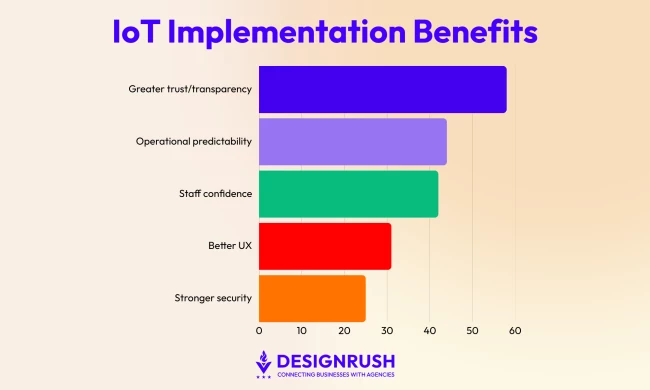
Beyond financial impact, businesses are encountering non-financial gains, with 58% citing improved trust and transparency among their customers and auditors.
44% stated they achieved operational predictability, 42% mentioned higher staff confidence, 31% highlighted enhanced user experience, and 25% reported stronger security and compliance posture.
What is the typical payback period for IoT projects?
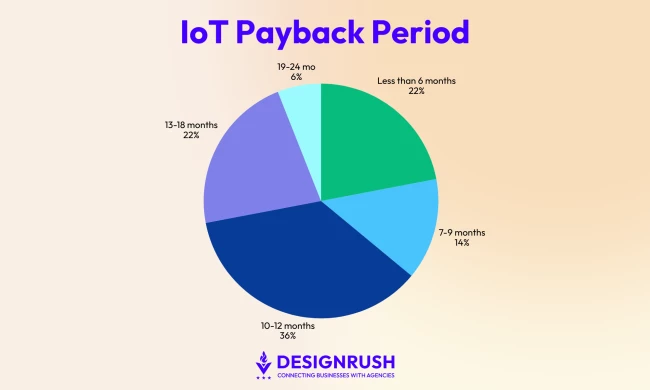
Industry research shows that 72% of businesses report payback within 12 months or less. Additionally, IoT projects with low integration thresholds and that are directly connected to profit and margins recoup their investment in less than 9 months.
On the other hand, complex IoT projects with stringent regulatory and security requirements and diverse legacy systems have a payback period of 13-24 months.
Below are the median improvements that surveyed organizations experienced after IoT implementation:
- 67% reduction in complaints, lockouts, and emergency calls, leading to lower customer compensation and service level agreement penalties.
- 40% faster response and repair speed time from incident to shut down, resulting in less overtime and night emergency shifts.
- 28% decrease in service downtime caused by unplanned equipment shutdowns.
- 20% savings in energy and consumables by optimizing HVAC systems.
- 26% increase in throughput/space utilization, leading to more efficient order processing and higher revenue.
- 37.5% higher work quality through automated processes and quality checks.
How to choose the best US provider for your business?
To choose the best American Internet of Things company for your business, consider following these steps:
- Clarify project details
Define the business problem you aim to solve, and set specific goals, success metrics, budget range, and timeline. - List providers with experience
View the company’s service list, tech stack, and case studies to verify that it is familiar with your industry and target IoT solution. - Practice due diligence
Assess its credibility and reliability by examining its client reviews and references, certifications, vendor partnerships, and recognitions. - Prepare a request for proposal (RFP)
Detail your project scope, technical requirements, and target users in your RFP, and send it to your top candidates. - Interview the development team
Inquire about the IoT company’s approach and methodology, and ask them specific questions about how they’ll tackle your project. - Deliberate your options
Understand that IoT development is an investment, so take time to evaluate your of USA IoT providers. Aside from technical expertise, consider also cultural fit, client service quality, and value for money.
If you want a curated list of the top IoT companies, visit our Marketplace and submit your requirements. We’ll connect you with providers who closely match your criteria for free!
How to find the best US IoT companies on DesignRush that fit your budget?
We’ve built a list of top USA IoT companies on DesignRush across multiple price points, so you can identify a vendor that's within your budget.
| High budget: $50,000+ |
|
| Low budget: $25,000-$50,000 |
|
Beyond budget, our agency directory allows you to filter agency profiles by location, area of expertise, agency reviews, client types, team size, and hourly rates.
What questions should be asked before hiring an IoT company?
Ask these questions before hiring an IoT company to confirm its expertise in executing your desired solution:
Relevant Background
- What type of IoT solution do you specialize in?
- Can you share a project with a production deployment similar to ours? What are the KPIs and outcomes?
- How familiar are you with developing solutions in our industry? Can you help me attain regulatory compliance?
Services and Processes
- Can you describe your entire IoT solution process, including hardware and tech stack selection?
- What is your approach to network infrastructure management?
- How do you handle system integration, quality assurance, and security?
Relevant to Your Project
- How do you ensure the scalability of our IoT system architecture?
- How will you track and report the performance of our IoT solution?
- Who owns the intellectual property, data, and access credentials of my system after the end of the contract?
- What’s included in the post-launch service level agreement (SLA)? Do you offer monitoring, incident response, and security patching?
Sources
DesignRush sustains a directory of over 40,000 agencies categorized by service category, location, expertise, and reviews. We build our database in two ways:
- Our dedicated team of agency experts actively searches the web for top-performing companies. We then pull information from their websites, online presence, and client testimonials to verify their status and qualifications prior to listing.
- The agencies listed get notified of their profiles on the website and they can choose to claim it or not, which suggests their availability for more collaborations.
Agencies can also reach out to DesignRush and must go through the verification process prior to being listed.

Why companies trust DesignRush
Every agency is independently vetted before it can be listed or ranked
 4.8
 4.8
Some agencies pay for sponsored placement, clearly labeled and held to the same vetting standards.
IoT Companies FAQs
What services do the Internet of Things companies in the US provide?
Leading Internet of Things (IoT) companies based in the USA provide end-to-end development services that cover product strategy and planning, design and development, deployment, and long-term maintenance.
Specifically, they offer the following:
- IoT consulting: Providing expert guidance on planning, building, and optimizing IoT solutions to strategically achieve business goals and maximize return on investment (ROI).
- IoT hardware and firmware development: Building the system’s physical components (e.g., sensors and gateways) and the embedded software that runs on devices, enabling secure data collection, connectivity, and over-the-air (OTA) updates.
- IoT app development: Creating software that controls and manages data from the IoT device, and often includes UI/UX design, hardware integration, cloud engineering, and analytics.
- System integration: Incorporating the IoT ecosystem (e.g., devices, sensors, apps, and data platforms) into the business's IT infrastructure (e.g., enterprise resource management) and ensuring reliable data flow and workflows.
- IoT security: Implementing data encryption, device authentication, ongoing patching, and other cybersecurity best practices to protect the IoT system’s devices, network, and data from digital threats.
How long does it take for an IoT company to complete a project in the US?
The timeline for top IoT companies in the USA to complete a project depends on the hardware, connectivity, security, regulatory, and integration requirements.
Generally, a smart home system can take 6-8 months, while an Industrial IoT (IIoT) solution with predictive analytics has a timeline of 12-18 months. A patient monitoring solution, on the other hand, requires 1-2 years.
Here’s a timeline of the IoT development process:
| Stage | Tasks |
Planning and research |
|
Prototyping |
|
Development |
|
Testing and iteration |
|
Deployment |
|
How much do these US companies charge?
On average, the hourly rate of an IoT development team based in the US starts at $100 to $200. However, more specialized and senior teams can charge over $900 per hour.
Here is an approximate IoT project budget range:
| Type | Estimated costs | Features |
| MVP/Pilot App | $50,000-$100,000 |
|
| Basic IoT App Production | $100,000-$200,000 |
|
| End-to-End IoT | $200,000-$500,000 |
|
| Enterprise IoT | Over $500,000 |
|
What factors affect IoT development costs?
The cost of IoT development in the US varies greatly depending on project complexity, core features and functions, targeted devices and platforms, data volume, processing needs, and compliance requirements.
Cloud services, system integration, and ongoing maintenance also impact overall billing.
Here are some of the top factors that impact IoT development costs:
- Code reuse for cross-platform apps often has 30-40% lower costs compared to building separate native apps for multiple platforms.
- Pre-built libraries and software development kits can reduce development effort and time, resulting in approximately 15-20% lower project rates.
- Open-source libraries can reduce licensing costs and custom build effort, leading to a 15-20% lower billing.
- Ongoing maintenance and updates are an additional 10-30% of initial development costs and are billed annually.
Additionally, security and regulatory compliance certification can add $1,200 to over $95,000 to the IoT development billing, depending on your requirements. For instance, HIPAA compliance costs $80,000-$120,000, and typically includes legal fees and employee training.
What are the most common industries that work with IoT providers?
All industries benefit from working with top IoT companies. However, research shows that these sectors have the highest IoT growth based on the projected 2021–2030 market growth (CAGR):
- Automotive: 25.1%
- Manufacturing: 24.9%
- Transportation: 21.7%
- Aero-Defense: 15.6%
- Industrial: 20.5%
- Consumer: 12%