Our directory of product design agencies in the USA allows you to connect with 700+ verified specialists, renowned for turning product ideas into buildable solutions. Each agency is reviewed for real-world design experience and has been evaluated by 12 industry experts.
List of Best Custom Product Designers in the USA
3 Companies-Rankings updated: September 05, 2026
DesignRush vets product design companies based on professional qualifications and verified client feedback to help you choose confidently. Some listings may include paid placements.
Digital Kitchen is a global creative agency that excels in crafting captivating stories and immersive experiences to engage and move audiences...
Top Services:
Content Marketing
Branding
Video Production
Advertising
Social Media Marketing
Show more
Location
Chicago, Illinois
Number of Employees
50 - 99
Minimal Budget
$50,000 & Up
Portfolios Count
4 Projects Listed
Digital Kitchen Services
Content Marketing
Branding
Video Production
Advertising
Social Media Marketing
Digital Marketing
Product Design
Creative Services
Web Design
Data sourced from the agency's DesignRush profile, its website, and other relevant accounts
Amazon
Mercedes-Benz Stadium
HBO
Data sourced from the agency's DesignRush profile
Digital Kitchen Reviews & Testimonials
Sandra L. Cross Platform App Developer at Undisclosed
5.0★
Digital Marketing Review from Sandra L.
Digital Kitchen has helped me with multiple projects in my company. Learning and tutoring are significant angles to the development of a representative. Generally speaking incredible experience. Incredible customers and great culture. I was truly delighted by working scholarly a great deal stuff. Well done.
Tracie C. Software Developer at Undisclosed
5.0★
Digital Marketing Review from Tracie C.
They are an incredible company, comprising great talent. The best quality about DK is the ability and acknowledgment that it has pulled in throughout the years. Not exclusively will you work with industry pioneers in configuration, movement, and experiential orders, you'll have the option to be a basic part to the inventive procedure. No real cons however the board should give additional regard for the imaginative procedure. I worked at Digital Kitchen full-time for over 4 years and I adored it and it has helped me a great deal.
Louisimene Castor Review from Google
5.0★
Louisimene Castor's Review Sourced from Google
I love to pbs kids ready to learn from between the lions or sesame Street library promos from 2006-2007 from shorts and others
Reviews verified by DesignRush and sourced from the agency's profile View All Reviews
SG Cartel is a global creative services coalition headquartered in Los Angeles, specializing in fashion, luxury, beauty and premium lifestyle. We build culturally resonant brands through creative strategy, storytelling and narrative architecture, graphic design, campaign concepting and content production...
Top Services:
Branding
Media Buying
Package Design
Web Design
Graphic Design
Show more
Location
Los Angeles, California
Number of Employees
Under 49
Average Hourly Rate
$200/hr
Minimal Budget
$50,000 & Up
Portfolios Count
5 Projects Listed
SG Cartel Services
Branding
Media Buying
Package Design
Web Design
Graphic Design
Product Design
Content Marketing
Web Development
Advertising
Data sourced from the agency's DesignRush profile, its website, and other relevant accounts
Founded in 2003, AREA 17 is an independently owned digital product agency with studios in Paris and New York. Inspired by the brains visual cortex, we transform sensory data into meaningful digital experiences...
Top Services:
Branding
Product Design
Digital Services
Web Design
eCommerce Development
Show more
Location
New York City, New York
Number of Employees
50 - 99
Average Hourly Rate
$172/hr
Minimal Budget
$50,000 & Up
AREA 17 Services
Branding
Product Design
Digital Services
Web Design
eCommerce Development
Mobile App Development
AI Development
Data sourced from the agency's DesignRush profile, its website, and other relevant accounts
What services do product design companies in the USA provide?
Product design companies in the USA provide a spectrum of services aimed at creating new digital or physical products that solve particular user problems. Their expertise is often sought after for assessing whether a proposed solution is feasible from both a technical and a business perspective.
As part of their portfolio, product design firms offer product/user research services, user experience (UX) design, user interface (UI) design, industrial design, prototyping, usability testing, manufacturing, and launch support.
In terms of demand, the research, strategy, and conceptgeneration segment remains dominant, accounting for over39% of the revenue share. As for applications on the rise, the consumablesand accessories segment is projected to witness a CAGR of 11.06% over the forecast period until 2030.
How much does a product design agency charge in the US?
Product design can cost from $5,000 to over $40,000, depending on the project type and how much detail goes into it. When it comes to price per project type, the cost starts around $2,000 for research and can exceed $50,000 for detailed development.
Based on these estimations, here’s what price ranges businesses can anticipate:
Phase
Estimated cost range
R&D
$5,000-$20,000
Conceptual design
$10,000-$30,000
Prototyping
$15,000-$40,000
Product designers typically charge in one of three ways:
By the hour: Charging for each hour spent on the project
A fixed project fee: A single charge for the whole project, regardless of the time spent
A retainer fee: A pre-agreed sum paid regularly to reserve the designer's services over a certain period
What timelines does the service typically follow?
The timeline will depend on the product type and its complexity, and it will vary from product to product. Typically, product design can take from a few weeks to several months and up to 1 year.
The breakdown by phases usually looks like this:
Discovery phase: Between a few days to over 2 weeks
Wireframing: 30-80 days
Iterative design: Depends on the wireframing, it typically takes as 1.5x longer
Responsive design: Depends on the iterative design time, it typically takes as 0.63x longer
What does a typical product design process look like?
A typical product design process follows a structured set of 10 steps to turn an idea into a high-quality, market-ready product.
The process usually looks like this:
Brainstorming: Teams generate and evaluate ideas to solve a specific problem, encouraging creativity before selecting the most viable concept.
Defining the product: The team clarifies the product’s purpose, core problem, and key features, focusing on what matters most and avoiding unnecessary complexity.
User and market research: Designers and analysts study users, competitors, and market trends to ensure the product meets real user needs and has long-term value.
Sketching concepts: Early sketches explore design directions and layouts before committing significant time or resources.
Prototyping: A basic version of the product is created to show structure, functionality, and user interaction, helping catch issues early.
Specifications and requirements: Detailed documentation defines features, technical requirements, timelines, costs, and responsibilities for development.
Pre-production samples/MVP: Initial samples (or MVPs for software) are built to test feasibility, usability, and readiness for production.
Testing and validation: The product is tested with users and stakeholders to identify flaws, gather feedback, and make improvements.
Development and production: The product is fully built using defined specifications, often with agile methods to manage tasks and priorities.
Quality assurance: Final checks ensure the product meets quality standards, works as intended, and aligns with requirements before and after launch.
What kind of results can businesses expect from a product designer?
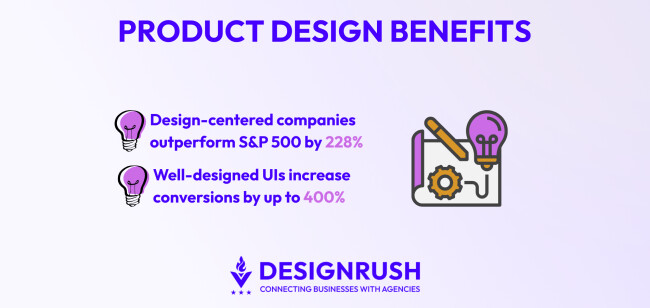
If a product features a top design, businesses can achieve 32% faster revenue growth and 56% higher total returns. Design-led organizations are also twice as likely to outperform industry benchmarks on innovation and customer satisfaction.
In addition, well-designed products are shown to reduce development and support costs by improving usability and lowering error rates. Studies show that fixing usability issues early can cost up to 10× less than addressing them after launch.







 Proposals