
To choose a content marketing agency, check whether it understands your audience, can show strategy behind its work, and has writers and reviewers who know your subject. Then confirm how it uses AI, checks facts, and measures results.
This guide assumes you know what content marketing services include.
Does the agency understand your audience and the buying cycle?
Content works when it answers the questions buyers have at each stage. Ask the agency how it would learn about your buyers and what it would need from your sales and support teams.
A strong discovery process usually covers your sales process, common objections, and what makes customers choose you. A process focused mainly on keywords and posting frequency may miss important buyer context.
How should you evaluate its published work?
Read several full pieces the agency wrote for clients similar to you. Check whether they say something specific and useful.
According to research from the Content Marketing Institute 2025 Benchmarks Report, 70% of marketers state that possessing industry expertise is a primary driver of top-performing content programs, while 77% prioritize high-quality execution.
Evaluating published work reveals whether an agency brings true industry depth or relies on generic fluff.
| What to check | Strong evidence | Weak evidence |
| Depth | Specific examples, data, and expert input | General advice found everywhere |
| Accuracy | Sources cited and claims you can verify | Unsupported statistics |
| Audience fit | Language matched to the reader | Generic tone for every client |
| Purpose | Clear link to a business goal | Content with no next step for readers |
Confirm which parts the agency actually produced. A client may have supplied research or heavily edited the final draft.
Can it demonstrate strategy rather than just content production?
Ask for an anonymized content strategy or editorial plan from a past client. Look for audience definitions, topic priorities with reasons, and goals for each type of content.
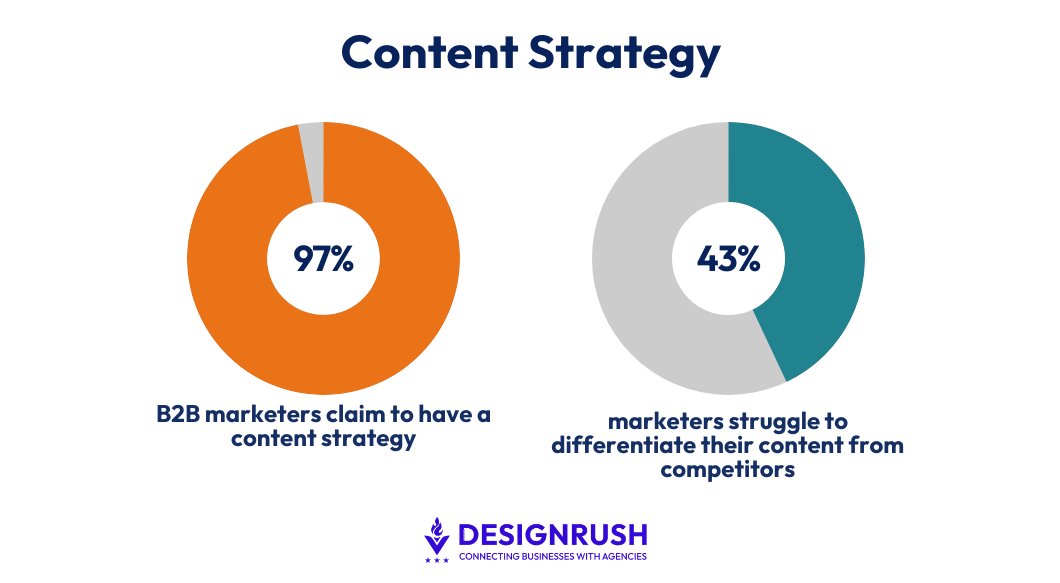
The Content Marketing Institute B2B Trends Report reveals that while 97% of B2B marketers claim to have a content strategy, 43% still struggle to differentiate their content from competitors. Having a strategy does not necessarily mean that the content is distinctive. Ask an agency to explain how its audience insights and topic priorities would distinguish your content, rather than treating a strategy document as proof of differentiation.
Who researches and writes the content?
Ask who will write your content, whether they are employees or freelancers, and what experience they have in your field. Ask whether the same writers will stay on your account.
Also ask who edits the work. An editor who reviews structure, clarity, and accuracy can make a large difference to quality.
Does the agency have enough subject matter expertise for your industry?
Technical, medical, legal, and financial topics often require deeper subject-matter knowledge and stronger review. Ask how the agency gets it: specialist writers, interviews with your experts, or outside reviewers.
Clarify how much of your experts' time the process needs. Expert interviews often improve quality, but they require your team's availability.
How does its editorial and factual review process work?
Ask the agency to walk through the steps a piece takes from brief to publication. Look for a defined review stage, source checking, and a clear revision process.
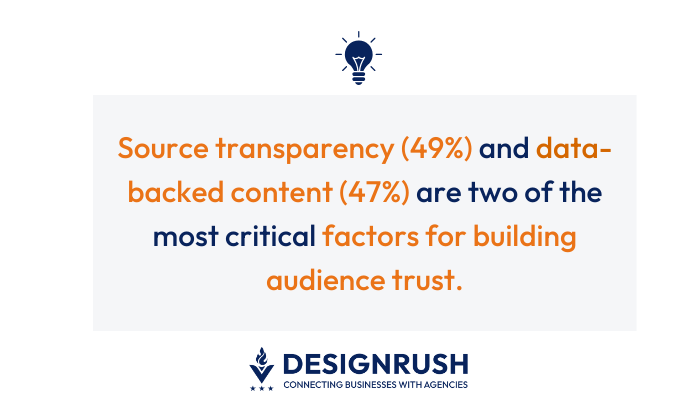
According to Statista’s Content Marketing Trend Study, source transparency (49%) and data-backed content (47%) are two of the most critical factors for building audience trust. For regulated or technical industries, confirm who signs off on factual accuracy and compliance because that responsibility usually remains with your company.
For regulated industries, clarify who signs off on accuracy and compliance. That responsibility often stays with your company.
How does it use AI in research and content production?
Agencies may use AI tools for research, outlines, or drafts. The key question is how humans review and add value to that work.
The Content Marketing Institute B2B Trends Research highlights that while 95% of organizations use AI tools and 87% report higher productivity, only 58% report improved content quality, and just 39% see improved content performance.
When evaluating an agency's AI practices:
- Ask for its written AI policy and disclosure guidelines.
- Clarify which specific production steps involve AI vs. human oversight.
- Ask how factual accuracy is validated to prevent hallucinated data.
- Confirm how your confidential business information and IP are protected within generative tools.
How will content be distributed and measured?
Ask which channels the agency will use to promote content and who manages them. Then ask which metrics it will report and how they connect to your goals.
Statista’s Content Marketing Trend Study notes that collaboration with specialized agencies is now cited by 35% of organizations as essential for scaling expertise, with regular performance evaluation remaining a top priority.
Traffic and engagement metrics can show attention. Leads, sales conversations, and influence on deals can show business value. Many organic content programs build results over time, so agree on realistic review points.
Agree which metrics match your goals and when to review them, recognizing that organic content programs can build results over time.
Who owns the finished content and source materials?
Clarify in the contract exactly which rights your company receives to the content it pays for, when those rights transfer, and what remains licensed or owned by others. Also clarify rights to images, interview recordings, and research data.
If AI tools were used, ask whether that affects rights, provider terms, or reuse under the contract. Seek legal advice where ownership or licensing is material to your business.
What content-agency red flags should you watch for?
The following red flags may indicate issues with strategy, execution, or reporting:
- Volume-based promises with no strategy. Many pieces of thin content may not help your goals.
- No defined review process for factual, technical, or regulated content. Errors can damage trust in your brand.
- Unclear AI use. You may not know how your content was produced or whether it was reviewed.
- Writers with no experience in your field and no access to your experts. Content may stay generic.
- Reports that show only traffic when your goal is leads or sales. Traffic can demonstrate reach, but it does not establish whether content supports those business outcomes.
- Unclear content ownership. Reusing your own content later may be restricted.
How should you compare your final candidates?
Compare your shortlisted agencies across the following criteria to make a more informed choice.
| Factor | What to compare |
| Audience understanding | Questions asked and strategy samples |
| Published quality | Depth, accuracy, and fit of real work |
| Team | Writers, editors, and subject-matter access |
| Process | Editorial review and AI policy |
| Measurement | Metrics tied to your goals |
| Terms | Deliverables, revisions, ownership, and notice period |
A short-paid trial, such as two or three pieces with full review, can show how the agency works with your team. Before it starts, agree how you will assess depth, accuracy, audience fit, editorial review, and revisions. Use the content marketing pricing guide to compare fees alongside that agreed scope.