
Knowing how to choose a branding agency starts with one habit: judge the reasoning behind the work as closely as the work itself. A strong agency can explain why each name, color, and message fits the client’s strategy. Your taste will play a part in the final choice, so check the evidence first.
This guide covers what to evaluate, which evidence to request, and the questions to ask a branding agency before you sign.
What kind of branding expertise does your project require?
Branding agencies differ more than their portfolios suggest. Before you hire a branding agency, define what your project needs. That makes it easier to build a shortlist in the branding agencies directory.
- Strategy-led or design-led. Some agencies start with research and positioning. Others start with visual design. A rebrand after a merger needs strong strategy. A visual refresh may need mainly design.
- Audience. Consumer brands, B2B companies, and nonprofits speak to buyers in different ways. Experience with your type of audience shortens the learning curve.
- Complexity. One company brand is simpler than a family of products, regions, or sub-brands. Multi-brand work needs experience with brand architecture.
- Verbal and visual. If you need messaging and tone of voice, check that the agency has writers on staff.
How should you evaluate a branding portfolio beyond whether you like the designs?
Branding portfolios are designed to impress. Look past the presentation and check what the agency actually solved.
| What to check | Strong evidence | Weak evidence |
| The problem | Clear starting point, such as a merger or a confusing offer | No context beyond the client name |
| The reasoning | Links between strategy and design choices | Mood words with no explanation |
| Real use | Photos of the brand on live products, sites, or stores | Only mockups on generic business cards and billboards |
| Range | Projects with different personalities | Every client looks like the agency’s house style |
| Comparable work | Clients with a similar audience or complexity | Only unrelated industries or sizes |
Mockups are normal in branding presentations. Live applications are stronger proof because they show that the identity survived real production and real teams.
Awards and famous client names show visibility. To judge fit, ask what the agency delivered for those clients and how close that work is to yours.
Do the case studies show strategic reasoning or only final visuals?
A strong case study connects each major decision to the strategy. For example, it explains why a color supports the positioning or why a name suits the audience.
Ask the agency to walk you through one project from research to final identity. Among the questions to ask a branding agency, this walkthrough often reveals the most about how the team thinks. Notice whether it talks about customers and competitors or only about aesthetics.
How should a branding agency research your market, customers, and competitors?
Research quality affects whether the strategy reflects market evidence or mainly internal opinions. Ask which evidence the agency plans to use, what research it will conduct, and what reliable customer or market research you can provide.
For a strategy-heavy engagement, the agency should explain how it will incorporate leadership, market, competitor, and customer evidence. That may involve new interviews or surveys, or reliable research your company already has. The important point is that positioning should not rest on internal assumptions alone.
Where confidentiality allows, ask for an anonymized research summary from a past project. If files cannot be shared, the agency should explain one recent study in detail.
Can the agency handle both verbal and visual identity?
Many studios are design-first. They may deliver a strong logo system with a thin messaging section.
If you need verbal identity, ask to see a tone of voice guide or messaging framework from a past project. Check who writes it: a dedicated writer, a strategist, or the designer.
How can you tell whether the identity will work beyond the presentation deck?
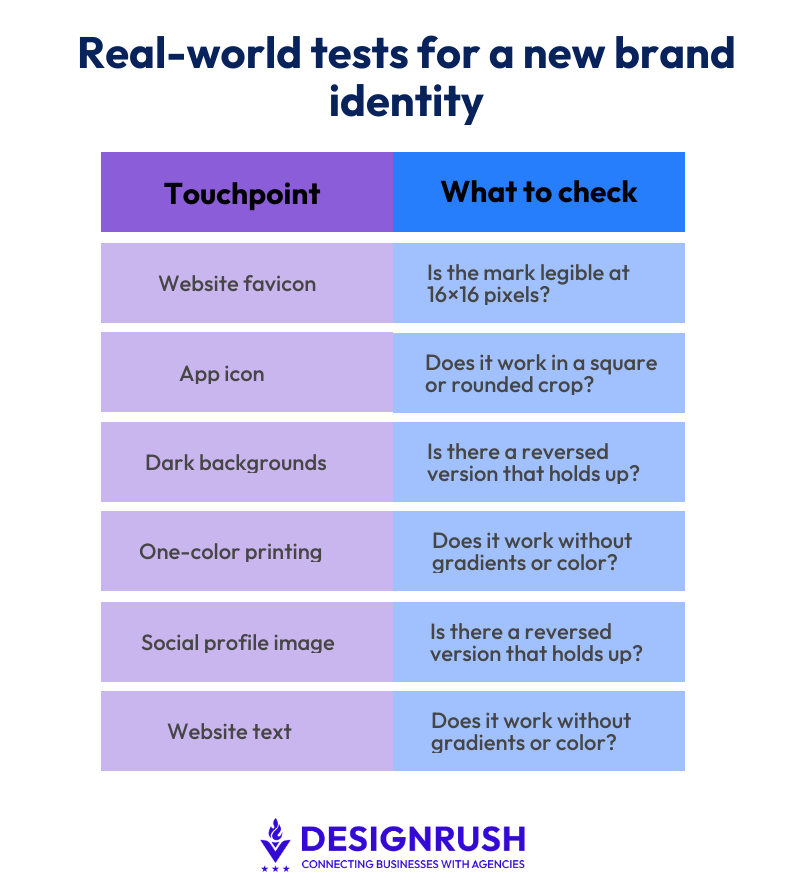
An identity has to work in small and difficult places. These include website favicons, app icons, dark backgrounds, one-color printing, and social media profile images.
Ask how the agency tests its work in these settings and how it checks color contrast for readability and accessibility. If brand colors will be used for website text, WCAG sets a minimum contrast ratio of 4.5:1 for normal-size text. Useful evidence includes applications across several real touchpoints, including small and practical ones.
When the agency presents concepts for your project, ask to see each one in these small settings, too. Each concept should come with a clear rationale that links it to the strategy.
Who will work on your project?
A branding team often includes a strategist, a creative director, designers, and a writer. The creative director who presents the pitch may not lead daily work.
Ask for named roles in the proposal. Ask who leads research, who makes final design decisions, and who you contact each week.
What should you receive and own when the project ends?
Ownership problems in branding often appear years later, when you need a file or want to change a logo. Check these items in the contract before you hire a branding agency.
| Item | What to check |
| Copyright | What rights transfer to the client, when they transfer, and what rights or licenses remain with the agency or third parties |
| Unused concepts | Who owns concepts you did not choose, and whether the agency can reuse them |
| Master files | Vector logo files, editable source files, and guideline files |
| Fonts | Whether required font licenses cover the intended users, channels, and uses, and who is responsible for obtaining them |
| Images | Stock or commissioned images licensed for your planned use |
| Trademark | Who performs preliminary screening and who is responsible for formal legal clearance before launch or registration |
In the US, a commissioned work counts as a work made for hire only under specific conditions, including a written agreement that says so, as the U.S. Copyright Office explains. Ask how the contract transfers rights, and have qualified counsel review the terms.
The branding pricing guide explains how these items can change the total cost.
Questions to ask a branding agency
The questions below ask for evidence the agency can show. They work well in calls and written requests.
- Which past project is closest to ours in audience and complexity, and what did your team deliver on it?
- What market and customer evidence will you use, and how will it shape the strategy?
- How many concepts will you present, and how many revision rounds are included at each stage?
- Can you show the brand in live use as well as in mockups?
- Who on your team writes messaging and tone of voice?
- Which files will we receive, and when do rights transfer to us?
- Who owns the concepts we do not choose?
- Which fonts and images need licenses, and whose name will each license be in?
- How do you handle trademark checks when you develop names?
What branding proposal red flags should you watch for?
These signals raise real risk in a branding project. Context matters, so ask follow-up questions before you decide.
- Logo concepts before any research on a full rebrand. For a small visual refresh, this can be fine. For a rebrand, it suggests that the design will not be grounded in strategy.
- Free concepts during the pitch. They are done before any research into your business, so they cannot reflect your strategy. They can also anchor your team to an early idea.
- No rationale in case studies. The agency may struggle to defend its choices to your stakeholders.
- Unclear concepts and revision rounds. This often leads to disputes and extra fees.
- Unclear IP and usage rights. If the proposal leaves out the ownership items above, ask for them in writing before you sign.
- Names presented as legally clear based only on basic availability checks. Preliminary naming research is not a substitute for formal trademark review by qualified counsel where legal clearance is needed. The USPTO notes that a comprehensive clearance search also covers state registers and unregistered marks already in use.
How should you choose between two strong agencies or creative directions?
When two agencies look strong, compare them on the same criteria. Price is one factor among several.
| Factor | What to compare |
| Strategic depth | Quality of research plan and positioning work |
| Relevant experience | Clients with a similar audience or brand structure |
| Verbal capability | Writers on staff and messaging samples |
| Real-world proof | Identities in live use across many touchpoints |
| Team | Named strategist, creative director, and designers |
| Terms | Concepts, revisions, copyright, and file handover |
When choosing between creative directions, judge each one against the strategy brief. Ask which direction better expresses your positioning to your audience. For high-stakes launches, testing directions with a small group of customers can reduce risk.