
The right PPC agency ties ad spend to profit, sets up reliable tracking, and leaves you in control of your ad accounts. Reviews help you build a shortlist. Evidence from real accounts helps you choose.
In this guide, we show you how to choose a PPC agency: what to check, what evidence to ask for, and which warning signs matter.
Does the agency know your platforms and business model?
Start with platform fit. A team that runs strong Google search campaigns may have little skill with LinkedIn lead ads or Amazon product ads.
Ask which platforms make up most of the spend the agency manages, then ask for an example on your main platform. If Google Ads is your only channel, the Google Ads agencies list narrows your search.
Business model matters just as much. Ecommerce, local services, and B2B software use different campaign types, tracking setups, and success metrics.
How do you judge a PPC case study?
A useful case study shows the starting point, what changed, and a result tied to business value.
| Element | Strong evidence | Weak evidence |
| Starting point | Budget range, prior results, and main problems | No baseline |
| Time frame | Clear dates or number of months | “Over time” |
| Metric | CPA, ROAS, qualified leads, or revenue | Clicks, impressions, or CTR only |
| Actions | Specific changes, such as a new structure or tracking fixes | “We optimized the account” |
| Context | Other factors that may have affected results | Results credited to the agency alone |
Percentages need a base. A 300% jump in leads means little if the account started at five leads a month. Ask for the actual numbers or ranges.
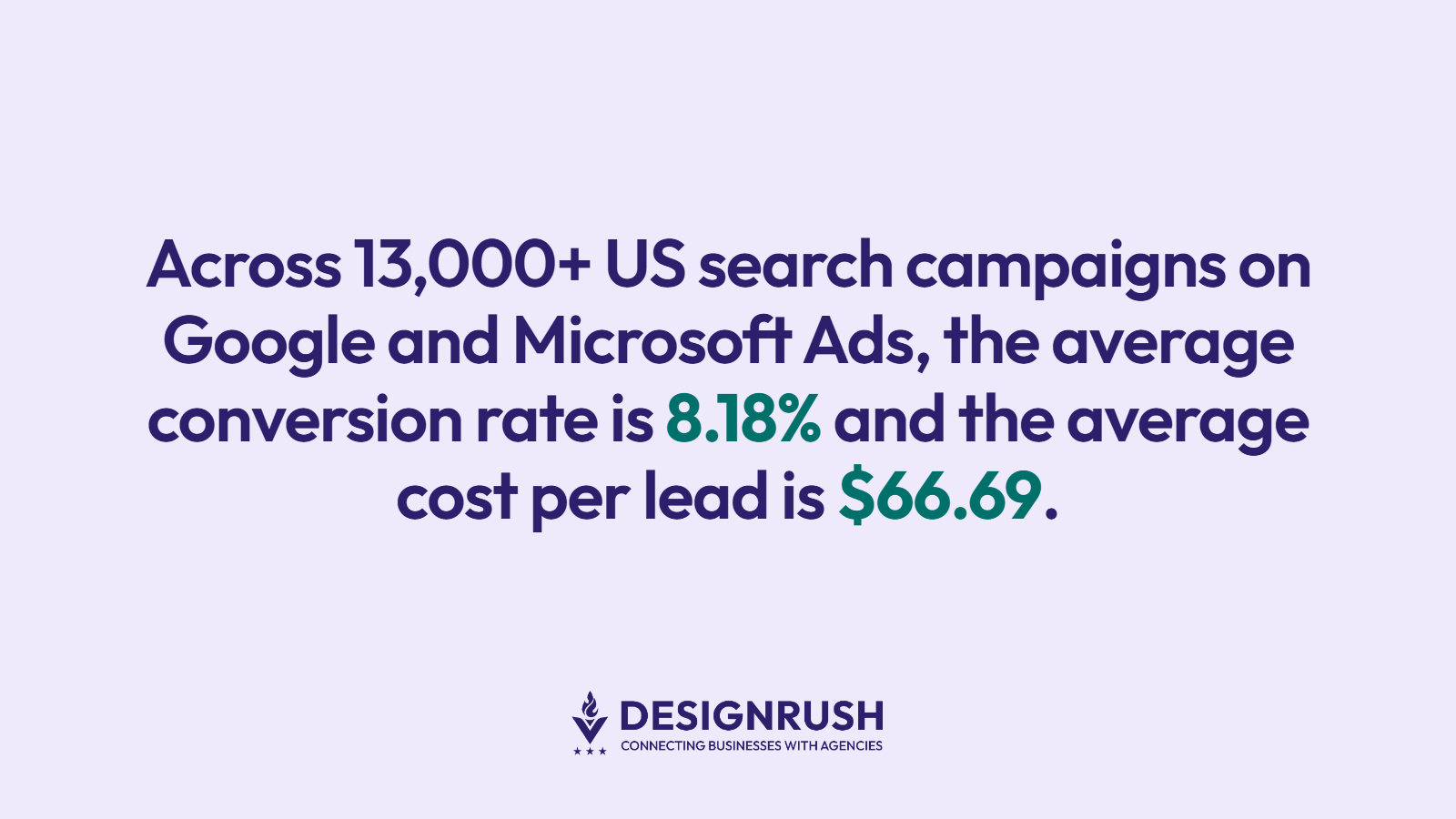
Benchmarks help you sanity-check claims. Across more than 13,000 US search campaigns on Google and Microsoft Ads, WordStream’s 2026 benchmark report found an average conversion rate of 8.18% and an average cost per lead of $66.69. Results vary by industry, so compare any claim with your sector.
Logos, years in business, and badges such as Google Partner add context. They don’t show that the agency can improve your account.
Does the agency understand your profit?
Cheap clicks and a high click-through rate don’t pay the bills. Profitable PPC starts with what a lead or sale is worth to you.
A strong agency asks about margins, average order value, lead-to-customer rate, or customer lifetime value. It uses those numbers to set a target CPA or ROAS.
Test this on the first call: ask how the agency would set your target cost per lead. A number given before it knows your economics is a guess.
How will it set up conversion tracking?
Automated bidding learns from conversion data, so bad data leads to bad bidding. A credible agency checks your tracking before it touches campaigns. It confirms which actions count as conversions, removes duplicates, and connects your CRM where possible.
For lead generation, ask whether it can import qualified leads or closed deals back into the ad platform. That helps bidding favor leads that become customers.
- Strong evidence: a written tracking plan that lists each conversion action, its value, and its source.
- Weak evidence: “We’ll install the pixel.”
Who will own your ad accounts and data?
Your company should own its ad accounts, billing, tracking tags, audiences, and historical data, with admin access held in-house. The agency gets the access it needs to manage campaigns. Google Ads offers several access levels, including read-only, standard, and admin.
Watch two setups closely:
- The agency runs ads from an account it owns. When you leave, you can lose years of data, audiences, and conversion history.
- The agency’s manager account is set as the owner of your account. Admins of an owner manager account can edit who has access to your account. Ask for ownership to stay with you.
Keep at least two admins on your side. Google warns that an account with only one admin can lose access to its tags if that person becomes unavailable.
How does the PPC agency manage the account week to week?
Ask the agency to describe its routine in concrete terms:
- Search terms. How often does it review the search terms report, and who decides which terms to block?
- Bids and budgets. Which bid strategies does it use, when does it change targets, and how does it prevent overspend?
- Testing. What did it test in a recent account, and what did it learn? A good answer names a specific test and its result.
If you already run ads, offer read-only access for a short audit. The findings show how the team thinks. After you hire, Google Ads change history shows up to two years of account changes and, when each person uses their own login, who made each one.
What should PPC reporting show you?
Good reporting ties ad activity to business results. It also explains what the agency changed and what comes next.
| Business outcome metrics | Diagnostic metrics that need context |
| Cost per acquisition or cost per qualified lead | Impressions |
| Return on ad spend or revenue | Clicks |
| Conversion rate by campaign | Click-through rate |
| Lead quality from your CRM | Impression share without business context |
| Budget pacing against plan | “Engagement” without a definition |
Diagnostic metrics help, as long as the report also shows outcomes. Ask for an anonymized sample report.
Who will manage your account day to day?
The person selling may not be the person running your account. Ask who builds campaigns, who reviews changes, and who joins your calls. Ask how many accounts the manager handles, since workload affects testing and response times.
Questions to ask a PPC agency before you hire
Ask for evidence the agency can show. Use these questions on calls and in your request for proposals:
- Which account is closest to ours in industry, platform, and budget, and what did you change in the first 90 days?
- How would you set our target cost per lead or target ROAS, and what do you need from us?
- Which conversions would you track, and how would you check that the data is accurate?
- Can you show a sample monthly report and how you log account changes?
- Who will manage our account day to day, and how many other accounts does that person handle?
- Whose name and billing will be on the ad account, and what happens to our access if we leave?
- How do you handle ad spend? Do you add any fee on top of media costs?
- What would you do in the first month if results dropped sharply?
Specific examples, processes, and numbers count as evidence. Treat phrases such as “data-driven optimization” as a cue to ask for details.
What should you check in a PPC contract?
| Term | What to check |
| Fee basis | Flat fee, percentage of spend, or a mix; our PPC pricing guide explains each model |
| Minimum term | Length of the first commitment and whether it renews automatically |
| Notice period | How many days you must give to end the contract |
| Ad spend handling | Who pays the platform and whether any markup applies |
| Account and data access | Who controls ad accounts, billing, tags, and first-party data, and what access the agency keeps |
| Creative rights | Your rights to ads, images, and landing pages produced during the engagement |
| Setup fees | What a one-time setup fee covers and whether it is refundable |
| Performance guarantees | What exactly is promised and what happens if it is missed |
| Exit handover | Access removal, report exports, and transfer of assets |
A fair exit clause states the notice period, lists the assets and report exports you receive, and ends the agency’s access only after the handover is complete.
What red flags should you watch for when hiring a PPC agency?
Each of these warning signs raises real risk. Ask follow-up questions before you rule out an agency:
- It wants to own your ad account. You may lose your data and history when you leave.
- It won’t explain how it handles ad spend. Unclear billing can hide fees on media costs.
- It reports clicks and impressions only. Its reporting may not connect to business results.
- It recommends a budget before asking about your margins. The number isn’t tied to your business.
- It skips the tracking review. Changes made on bad data can make results worse.
- It guarantees a CPA, ROAS, lead volume, or revenue figure without stating conditions. Those results depend on factors outside its control, such as competitor bids and your sales process.
- It can’t show how it reports and logs account changes. You will have little visibility into its work.
A higher fee is not a red flag by itself, and neither is a long first call. Judge the quality of the answers.
How should you compare your finalists?
Score your finalists on the same criteria. A lower fee can be poor value if the scope leaves out tracking, reporting, or ongoing management.
| Factor | What to compare |
| Platform and industry fit | Experience on your main platforms and with your business model |
| Quality of evidence | Case studies with baselines, time frames, and business metrics |
| Proposed approach | First 90-day plan, tracking review, and testing plan |
| Team | Named account manager, seniority, and account load |
| Tracking and reporting | Conversion plan and sample report quality |
| Ownership and access | Accounts in your name and a clear exit handover |
| Commercial clarity | Fee basis, spend handling, term, and notice period |
If two agencies are close, a short paid audit can show how each team thinks about your account. You can compare more PPC management companies in the PPC agencies directory.