Everything You Need to Know Before Hiring the Best Pay Per Click Agencies
What can pay per click agencies do for your business?
Unlike SEO, which takes months to rank, PPC gives your business immediate visibility at the top of search results. This matters because 67.6% of Google clicks go to the top three results, which are largely paid placements. For buying intent searches, 65% of clicks go to ads rather than organic results.
A PPC agency makes sure your brand appears exactly when users are ready to act. Even when users do not click, ad visibility increases brand awareness by an average of 33%.
Beyond placement, agencies reduce your costs.
By improving Google Ads Quality Score through better keywords, ads, and landing pages, agencies help you pay less per click than competitors. In 2026, accounts using agency-led AI bidding saw 32% higher conversion rates than those using manual bidding, while proper keyword match-type management reduced CPA by up to 20%.
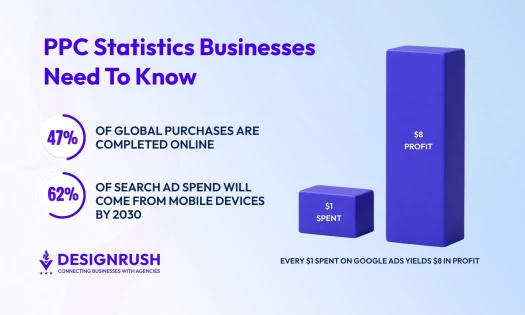
The financial upside is clear. On average, businesses earn $2 in revenue for every $1 spent on Google Ads. Agencies use benchmarks to push performance beyond global averages, tailoring strategy by industry rather than guessing.
Agencies provide the benchmarks needed to decide whether a campaign is actually winning or losing. In 2026, the global average Cost Per Lead (CPL) is $198.44, but effective agencies do not aim for averages. They design campaigns to beat industry-specific benchmarks based on intent, competition, and deal value.
| Industry | Average Conversion Rate | CPL Benchmark |
| Animals & Pets | 16.3% | < $100 |
| Automotive Repair | 12.6% | ~$28 |
| Home Improvement | 10.2% | ~$92 |
| E-Commerce | 8.25% | ~$91 |
| Legal Services | 9.27% | ~$131 |
| Financial Services | 6.47% | > $650 |
PPC agencies also manage the full buying cycle. Most users do not convert on the first visit, so agencies run remarketing campaigns that follow high-intent visitors across the web. Retargeted users are 50% more likely to convert than those reached through organic traffic alone.
For retail brands, agencies prioritize Google Shopping, which now captures over 85% of clicks in retail search campaigns. For lead-driven businesses, they build and optimize dedicated landing pages. Applying structured CRO frameworks typically increases conversion rates by 2 to 5 times.
In short, PPC agencies control your visibility, budget efficiency, and conversion results; traffic is just the starting point.
How can you choose the best PPC agency?
In order to choose the right agency for your business, we would recommend evaluating their technical capabilities, industry focus, and transparency. Here is how you'll do it:
- Define specific business objectives
Before reaching out to agencies, establish SMART (Specific, Measurable, Actionable, Relevant, Timely) goals, such as achieving a 20% increase in qualified leads or a specific ROAS target, to ensure the agency's strategy aligns with your bottom line. - Verify experience and case studies
Look for agencies with a proven track record in your industry, as they will already understand your audience's search intent, the competition, and the average cost-per-click (CPC) for your sector. - Request an account audit
A reputable PPC agency should offer to audit your existing PPC accounts to identify wasted spend, tracking errors, and growth opportunities before you sign a contract. - Check reporting and communication frequency
Choose a partner that provides real-time performance dashboards, not just static monthly reports, ensuring you have continuous visibility into KPIs such as CPA and pipeline contribution. - Look for pricing transparency
Ask for clear fee structures, whether it's a flat monthly retainer, a percentage of ad spend, or a performance-based value model. - Interview the account manager
Meet the specialist who will manage your campaigns daily to gauge their expertise and ensure a strong cultural fit with your team.
Transparency around expectations is one of the clearest signals of a good PPC partner. Danielle Denman, Senior Pay Per Click Analyst and Small Business Lead at SmartSites, explains that reputable agencies start by grounding strategy in the numbers, looking at average cost per click for the industry, expected conversion rates, and the available budget to estimate a realistic cost per conversion.
If those numbers do not support the outcome a business expects, a strong agency will say so and adjust the approach, whether that means focusing on awareness first or recommending a lower-cost platform. This level of upfront honesty helps you avoid wasted spend and is a strong indicator that the agency is focused on results rather than sales promises.
Pick the agency that ticks the most boxes, not the one with the loudest pitch.
Which businesses benefit most from PPC?
In 2026, the businesses that use PPC mostly fall into two main categories: those with the highest total volume of spend (like eCommerce) and those with the highest cost per individual click due to high competition (like Legal and Finance).
Overall, approximately 65% of small and mid-sized businesses currently run PPC campaigns, with retail and e-commerce dominating the total market share.
Top Industries by Total Ad Spend
These sectors spend the most money because they rely on high-volume traffic to drive daily sales or leads.
- Retail & eCommerce: Retail accounts for roughly 19% of total digital ad spend. It is driven by Google Shopping Ads, which now account for over 85% of all retail clicks.
- Technology & SaaS: Projected to be the fastest-growing sector in 2026 with a 10.3% increase in spend. Companies like Salesforce and HubSpot spend millions monthly to maintain visibility.
- Financial Services & Insurance: This sector spends heavily because the lifetime value of a customer is very high. A single insurance lead can be worth thousands of dollars over time.
- Travel & Hospitality: With travel fully rebounded in 2026, this industry has seen a 12% higher conversion rate than in previous years, leading to massive budgets for platforms like Expedia and Booking.com.
Industries with the most expensive clicks (CPC)
While these industries might not have the same click volume as a shoe store, they pay the most per person who clicks their ad. In these fields, competition is huge.
| Industry | Average CPC (Search) | Reason for High CPC |
| Legal Services | $6.75 to $9.21 | High settlement values (e.g., personal injury) |
| Consumer Services | $6.40 | Urgent needs (plumbing, HVAC) where users click the first ad |
| Technology/SaaS | $3.80 | Intense competition for the enterprise software contract |
| Finance & Insurance | $3.44 to $5.44 | High customer lifetime value and strict competition |
High-Performance Niche Users
Some industries use PPC because they have unusually high conversion rates, making the investment very safe.
- Dating & Personals: A massive 9.64% conversion rate, the highest across major industries.
- Automotive Services: Holds a conversion rate of nearly 14.67%. People searching for brake repair are almost always ready to book immediately.
- Dermatology & Dental: These personal services see conversion rates around 9% due to extremely high local intent.
Where do businesses spend the most?
- Google Ads: Still the king, holding 80.2% of the global PPC market.
- Amazon Ads: Now captures 11.3% of total digital spend, primarily used by CPG (Consumer Packaged Goods) and Retailers.
- Meta (Facebook/Instagram): Remains the primary choice for B2C (Business-to-Consumer) and brand awareness, representing an 18.7% share.
- TikTok: Rapidly growing, with 31% of PPC professionals now including it in their standard media mix.
What red flags to avoid when choosing a paid media agency?
Watch for these warning signs of low transparency, poor expertise, or weak results when choosing a paid media agency:
- Guaranteed results
Any agency that guarantees a specific number of leads, sales, or a precise ROAS is a major red flag, as paid media involves external variables like competitor bids and platform algorithm shifts that no one can fully control. - Refusal to grant account ownership
You should always own your ad accounts (Google Ads, Meta Business Manager, etc.); if a PPC agency insists on running ads through their own internal account, they are effectively holding your data hostage and making it impossible for you to leave without losing all historical performance data. - A one-size-fits-all packages
PPC companies that sell fixed packages rarely offer a custom strategy. The result is often a set it and forget it approach that fails to account for your unique business goals or market nuances. - Focus on vanity metrics
If an agency's reporting shows impressions, likes, or clicks rather than results like conversions, CPA, and revenue, they are likely hiding a lack of real business impact behind big, meaningless numbers. - Hidden pricing
Be wary of PPC companies that cannot clearly explain their management fees vs. your ad spend. A lack of billing transparency often masks hidden markups on your media spend or undisclosed service charges. - Excessive client loads per manager
If an account manager is responsible for more than 10 or 15 accounts, they simply do not have the time to deeply optimize and A/B test your campaigns. - Long-term contracts
Avoid agencies that attempt to lock you into long contracts with no easy exit. Good agencies are confident in their results and work on short, flexible agreements.
What questions to ask before hiring a pay per click agency?
Before hiring a PPC agency, use these questions to vet their expertise, transparency, and alignment with your specific business goals.
Relevant Background
- How many years of experience does your core PPC team have?
- Do you have documented case studies or references specifically within my industry?
- What is your agency's current client retention rate?
- Are your specialists certified in Google Ads, Microsoft Advertising, and Meta Ads?
- Why do clients typically stop working with your PPC agency?
Services and Processes
- Who will be my daily point of contact, and how much experience do they have?
- What is your specific process for keyword research and negative keyword management?
- How do you handle ad copy creation and creative A/B testing?
- How often will we have strategy calls to review performance and adjust goals?
- What is your approach to integrating PPC with other channels like SEO or Social?
Related to Your Project
- Who will own the ad accounts and data if our partnership ends?
- What specific KPIs will you use to measure the success of my project?
- What is your recommendation for my initial monthly ad spend based on my revenue goals?
- Do you have any direct conflicts of interest with current clients in my vertical?
- What is the opt-out or termination clause in your contract if performance targets aren't met?










.png)


























































 4.7
4.7 4.7
4.7
 Proposals