Looking for the best reputation management companies in the USA to protect and strengthen your brand? We’ve curated a list of top agencies backed by a 4.5 average rating from 404 verified reviews. Compare them by budget or services to find the best reputation management agency for your needs.
Find a Top Reputation Management Company in the USA for Your Next Project
Reputation management companies on DesignRush are assessed for ORM expertise, service effectiveness, and authentic client reviews. Some online reputation management listings may be paid.
FTP Agency is an experiential marketing agency that creates custom experiential vehicles and mobile pop-ups so your brand's message is not just seen, it's felt...
Top Services:
Event Marketing
Branding
Creative Services
Reputation Management
Design Services
Show more
Location
New York City, New York
Number of Employees
50 - 99
Average Hourly Rate
$100/hr
Minimal Budget
$25,000 - $50,000
Portfolios Count
1 Project Listed
FTP Agency Services
Event Marketing
Branding
Creative Services
Reputation Management
Design Services
Digital Strategy
Data sourced from the agency's DesignRush profile, its website, and other relevant accounts
Reputation management directly affects revenue and trust.
Reputation management typically includes:
Monitoring brand sentiment across search engines, review platforms, social media, news sites, and online communities
Managing reviews and ratings, including responding to feedback and encouraging positive customer experiences
Improving search visibility by promoting favorable content and addressing harmful or misleading material when appropriate
Crisis and issue response to contain negative press, complaints, or reputational risks
Content and presence management to ensure brand-owned channels accurately reflect company values and messaging
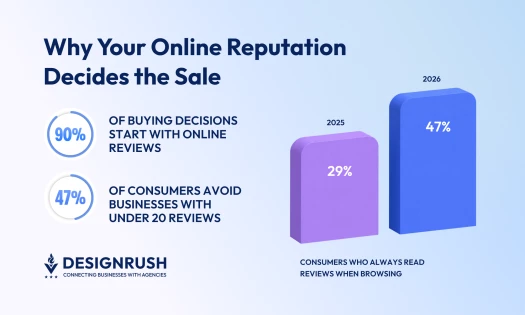
In the U.S., 67.7% of consumers say online reviews influence purchasing decisions, and buyers read an average of 9-10 reviews before making a purchase. Poor brand perception can cost businesses up to 14.7% in lost revenue, while positive reviews increase trust and conversions.
How much do reputation management companies in the USA charge?
Reputation management pricing in the United States ranges between $100 and $500 per hour or $5,000 and $20,000 per engagement. Final billing will depend on agency scope, engagement size, and time commitment. Here’s what you can expect:
Average hourly rate: According to DesignRush data, the top reputation management firms charge an average of $107 per hour.
Lower minimum budgets: 19.5% of agencies accept projects with a minimum budget under $1,000.
Higher minimum budgets: Only 0.7% of agencies require a minimum project budget of $50,000, showing that fewer agencies operate at that entry point.
Typical engagement cost: Online reputation management solutions generally range from $5,000 to $20,000.
Time commitment: These engagements typically involve 50-200 hours spread over several months, depending on the scope and complexity.
Can a business rebuild trust after reputational damage?
Yes, they can absolutely rebuild trust after reputational damage.
Research shows that 90% of consumers trust brands more when they openly acknowledge mistakes, and thoughtful responses to negative reviews lead 33% of customers to update or remove critical feedback.
Companies with mature reputation management strategies recover up to three times faster, often within weeks rather than months, by addressing issues head-on instead of staying silent.
If you’re in this situation, a reputation management agency will help you do the following:
Assess the impact by tracking sentiment, reviews, customer churn, and revenue signals.
Align internal stakeholders so leadership, legal, PR, and support teams share one consistent response.
Respond transparently with explicit acknowledgment and visible corrective actions.
Engage directly with feedback to demonstrate accountability and regain confidence.
Reinforce positive trustsignals by amplifying verified reviews, testimonials, and earned coverage.
What’s the difference between brand management and reputation management?
Brand management and reputation management influence how a company is perceived, but they serve different purposes. Specifically, brand management focuses on the image a company intentionally creates.Reputation management, on the other hand, reflects how a company is actually perceived based on real-world behavior.
Here’s a more detailed breakdown of their differences:
Brand Management
Reputation Management
Brand identity, positioning, and messaging
Visual elements like logos and design systems
Customer experience across marketing channels
Customer reviews and ratings
Employee and leadership actions
Media coverage and public response to issues
How brands handle feedback, complaints, and crises
With 81% of US consumers saying they must trust a brand before buying, both brand management and reputation management play a crucial role in revenue and growth.
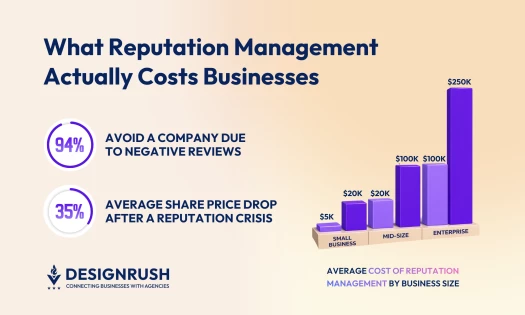
Is reputation management different for small businesses vs. large enterprises?
Yes, reputation management looks very different for small businesses and large enterprises, mainly due to visibility and risk exposure.
For small businesses, it’s highly immediate and localized. Most customers discover small brands through search results and reviews, and 90% of consumers say positive reviews influence their buying decisions.
With fewer brand touchpoints and limited margin for error, even a small number of negative reviews can directly impact sales. As a result, these companies have their reputation management provider focus on:
Monitoring and responding to reviews
Local search visibility and credibility
Consistent customer experience and feedback
As for large enterprises, reputation management operates at a broader level. It typically involves:
Cross-functional coordination across PR, legal, HR, and leadership
Ongoing media and sentiment monitoring
Governance, leadership visibility, and crisis preparedness



 Proposals