A software development company plans, builds, tests, launches, and maintains software made for your business. Custom software development services usually cover discovery, architecture, front-end and back-end development, integrations, testing, deployment, and ongoing support.
Custom software is often used when off-the-shelf tools do not meet the requirements well enough, or when integration, differentiation, control, or workflow needs justify a bespoke build. Examples include internal platforms, customer portals, SaaS products, and systems that connect several existing tools.
What does a software development company build?
A software development company builds working software and the technical foundation behind it. Depending on scope, that foundation can include application code, databases, APIs, infrastructure configuration, automated tests, deployment processes, technical documentation, and integrations with other systems.
Common projects include web applications, customer portals, internal tools, SaaS platforms, APIs, data-driven and AI-enabled applications, and modernized versions of older systems. Mobile apps often go to mobile app development companies, though a software development firm may build both.
You can compare providers in the directory of software development companies.
What software development services can a company provide?
Product discovery and requirements
Discovery defines what to build and why. The team studies users, business goals, existing systems, and constraints, then turns them into requirements and priorities.
A simple project may need only a short discovery phase. A platform with several user roles, integrations, or regulatory requirements usually needs more work before anyone can estimate development reliably.
What you receive: a requirements document or product backlog, user stories, priorities and assumptions, and often a rough estimate and roadmap.
Architecture and technical planning
Architecture decides how the system is structured, which technologies to use, where data is stored, how access is controlled, and how the product will grow. Early choices here affect cost and flexibility for years, since an architecture that suits an MVP can be hard to change once the product scales.
What you receive: an architecture overview, technology stack decisions, data models, and integration and infrastructure plans.
Front-end and back-end development
Front-end development builds what users see and click. Back-end development builds the server logic, databases, authentication, and APIs that power it. Full-stack teams cover both. Work is usually split into small units, so features can be built, reviewed, tested, and demonstrated as the project progresses.
API and system integration
Integration connects your software with other tools, such as payment systems, CRMs, ERPs, identity providers, or data warehouses. Integration effort can be substantial because outside systems have their own APIs, data models, permissions, limits, and reliability constraints. A good proposal names each important integration so its effort is visible in the estimate.
QA and testing
Quality assurance (QA) checks that the software works correctly and continues to work after changes.
Depending on the product and scope, QA may include manual testing, automated unit and integration tests, regression and performance testing, accessibility checks against the WCAG standard, and security testing for common risks such as those in the OWASP Top 10.
Some buyers add an independent team from the software testing companies list for extra assurance.
DevOps and deployment
DevOps covers the tools and processes used to build, release, operate, and monitor software. Depending on scope, this can include code repositories, automated build and release pipelines (CI/CD), infrastructure configuration, cloud environments, deployment, monitoring, and recovery procedures.
The goal is repeatable releases that do not depend on one developer’s memory.
Many teams track this work with DORA’s software delivery metrics, which measure how quickly and safely changes reach production. Larger cloud work may involve cloud consulting companies.
Legacy modernization
Modernization updates older systems that are hard to maintain or scale. The work can mean moving to the cloud, rewriting parts of the code, improving integrations, or replacing the system in stages while the old one keeps running. For these projects, migration planning and data integrity can matter as much as new development.
Maintenance and support
After launch, software may need bug fixes, security and dependency updates, performance work, and operational support. New features are typically treated as product enhancements with their own estimates and priorities, so agree where maintenance ends and feature work begins. Post-launch support may be covered by a separate software development services agreement with defined response times and scope.
What deliverables should you receive during development?
Working software is the main deliverable of custom software development services. The documentation, access, tests, and deployment materials around it strongly affect how easily your team or another vendor can maintain or extend it later.
| Deliverable | Why it matters |
| Requirements and backlog | Records what was agreed and why |
| Architecture documentation | Explains how the system fits together |
| Source code in a repository | A core deliverable in many custom software engagements, subject to the contract and third-party license terms |
| Test suite and QA evidence | Helps verify behavior and reduce regression risk as the system changes |
| API documentation | Lets other systems and teams connect safely |
| Deployment setup and scripts | Supports repeatable releases and reduces reliance on undocumented manual steps |
| Environment and access list | Shows where everything runs and who controls it |
| Release notes | Tracks what changed in each version |
If the team uses iterative sprint-based delivery, it may provide these items gradually and demonstrate working features at regular reviews. Other delivery models may use different milestones.
Agree on repository access, documentation, and ownership before development begins, since these terms are harder to settle at the end of a project. Ask any software development services company which of these items it delivers by default.
Does software development include product design and UI/UX?
Sometimes. A custom software development agency may include product or UI/UX designers, while other providers expect you to supply designs or hire a separate UI/UX design agency.
For products where ease of use drives success, such as SaaS tools for non-technical users, design depth matters: user research, flows, prototypes, and usability testing. For back-office systems used by a small, trained team, lighter design work may be enough.
Confirm which design tasks the proposal covers, including wireframes, prototypes, interface design, and revisions.
What is the difference between custom development, staff augmentation, and a dedicated team?
The same custom software development services can be delivered through different engagement models. They differ in who manages the work and who is responsible for the result.
| Model | How it works | Who manages delivery |
| Project-based development | The company delivers an agreed product or scope | The vendor typically leads delivery within the agreed scope |
| Dedicated team | A stable vendor team is assigned to your engagement | Shared, often with priorities led by your product owner |
| Staff augmentation | A software development agency supplies individual developers who join your existing team | Your company |
Project-based work suits clear scopes. Dedicated teams suit long-term products that keep evolving. Staff augmentation suits companies with strong internal technical leadership that need more hands.
Providers focused on that model are listed among staff augmentation companies, and teams in other countries are often sourced through outsourcing companies.
What normally happens after the software launches?
Launch starts a new phase of work. Real-world use may surface defects and performance issues that only appear at real traffic volumes, requirements can change, and the technologies the software depends on continue to evolve.
Before launch, agree on:
- Who monitors the application and infrastructure
- Who responds when something breaks, and how quickly
- Who controls hosting, domains, repositories, and other accounts
- Which updates count as maintenance and which count as new features
- What documentation and training your team receives
Hosting, licenses, and third-party services continue as running costs. The software development pricing guide covers how to budget for them.
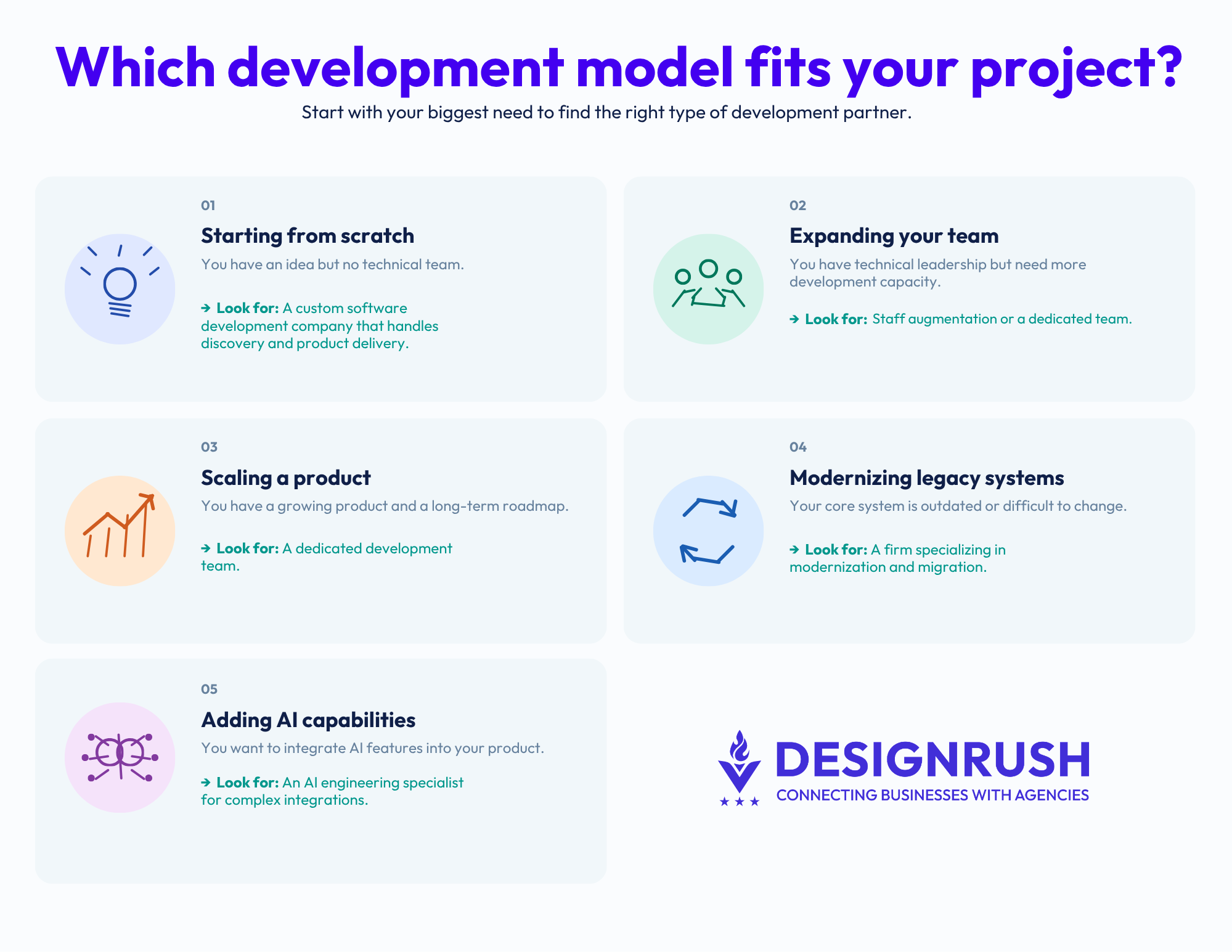
Which development model fits your project?
Select a development model according to your requirements:
- You have an idea but no technical team. A custom software development company that starts with discovery and can deliver the product end to end may fit.
- You have a CTO or established technical leadership and need more delivery capacity. Staff augmentation or a dedicated team may fit, depending on how much management you want to keep in-house.
- You run a growing product with a long roadmap. A dedicated team can fit when you need stable capacity over an extended period.
- Your core system is old and hard to change. A custom software development firm with modernization and migration experience may fit if the main challenge is replacing, re-platforming, or incrementally updating that system.
- You want to add AI features to your product. Relevant AI engineering experience becomes important, especially when the work involves custom data, evaluation, or model integration. Specialists in the AI companies list may fit better for complex AI work.
To compare vendors, read the guide to choosing a software development company.