
The right UI/UX design agency can show real research, clear reasoning, and validated designs on work similar to yours. Ratings and reviews help you build a shortlist. Evidence from past work helps you decide which agency fits your product, team, and budget.
This guide explains how to choose a UI/UX design agency using evidence you can inspect, from case studies and research files to handoff examples and contract terms.
What type of UI/UX agency does your product need?
Before you evaluate a UI/UX agency’s portfolio, define the type of agency you need. This step removes poor fits before you spend time on calls.
- Product type. A marketing website, a SaaS platform, a mobile app, and an internal enterprise tool need different skills. A team that designs strong landing pages may have little experience with permissions, data tables, or multi-step workflows.
- Product stage. A new product needs discovery and validation. A live product needs auditing, analytics review, and careful changes that keep what users already know.
- Industry requirements. Healthcare, finance, public sector, and other regulated products may face privacy, security, accessibility, or procurement requirements. Relevant experience can help an agency identify those constraints earlier.
- Design only or design plus build. Some firms only design. Others also code. Decide which model you want before you compare proposals.
Our UI/UX design directory lets you filter agencies by industry, location, and minimum budget. Use those filters to narrow your list before you review portfolios.
How should you evaluate a UI/UX design portfolio?
Judge a portfolio by the thinking it shows. Polished screens show visual skill, and the case study around them shows whether the agency can solve a usability problem.
| What to evaluate | Strong evidence | Weak evidence |
| Problem and goals | Explains the original usability problem, business goals, and project constraints | Shows finished screens without explaining what needed improvement |
| Research and decisions | Shows what the team learned, which options it tested, and why it rejected some of them | Claims extensive research without methods, findings, or changes |
| Relevant experience | Covers similar workflows, technical requirements, or product complexity | Relies on attractive visuals, client logos, or projects with little relevance to yours |
| Measured results | Reports outcomes with a baseline, a measurement period, and other changes made at the same time | Claims higher conversions or engagement without explaining how they were measured |
Client logos and design awards show reputation. A famous logo may relate to one small campaign page, so ask what the agency actually delivered for that client.
Ask the agency to walk you through the project closest to yours. Find out what the team was responsible for, what the client team did, which design decisions were difficult, and how the final solution was evaluated.
How can you tell whether an agency actually does UX research?
Ask to see a real research output where confidentiality allows. An anonymized interview guide, research plan, or findings report can show how the team works. If the agency cannot share files, ask it to walk you through a recent study in detail.
Then ask practical questions. Which methods would it use for your project? Who recruits participants and covers their incentives? How many sessions does it usually run? Which design decision changed because of research on a recent project?
For usability studies, small rounds are normal. Nielsen Norman Group recommends about five participants per round and several rounds over the project, with more people when the product serves distinct user groups. A credible agency can explain its numbers in those terms.
- Strong evidence: named methods, a participant plan, and an example of a finding that changed the design.
- Weak evidence: “research” that consists of a competitor review and a stakeholder workshop. Those are useful inputs, and they still say little about how your users behave.
For research-heavy projects, compare your shortlist with specialist UX research agencies.
How should an agency validate its designs before handoff?
A credible agency should have a clear validation method before expensive development work begins. Problems found in a prototype are cheaper to fix than problems found in code.
The right method depends on the project. It can include usability or prototype testing, a heuristic review against principles such as Nielsen’s 10 usability heuristics, an accessibility evaluation against WCAG 2.2, or structured stakeholder validation.
Also ask when validation happens. A team that tests early can revise a prototype before the same issue spreads across multiple screens or reaches development.
- Strong evidence: the agency names the method it would use for your project, explains who will take part, and shows what changed after validation on a past project.
- Weak evidence: “We validate with the client,” with no method behind it. Stakeholder approval is useful, and it still leaves open whether real users can complete key tasks.
What should you look for in its design system and developer handoff process?
Handoff can expose gaps in otherwise strong design work. Developers may receive screens that look finished but leave out states, spacing rules, responsive behavior, or interaction details.
Ask how the agency prepares files for developers. A strong handoff covers reusable components, screen states such as loading and error states, layouts for different screen sizes, and notes on how each flow behaves.
Also ask whether the agency supports developers during the build and reviews the result against the designs. If your developers work in-house, invite one of them to the evaluation call.
- Strong evidence: a real or anonymized handoff file with components, states, and annotations.
- Weak evidence: a link to final screens with no specifications.
Who will actually work on your project?
The people leading the sales process may not be the people doing the work. Ask for the names or roles of the delivery team in the proposal.
Depending on scope, a UI/UX project may involve a UX researcher, a UX designer, a UI designer, a product designer, and a project manager. Smaller agencies may combine several roles, which is fine as long as the team has the skills your project requires.
Before hiring, clarify three things:
- Who makes the decisions? Identify the person responsible for UX strategy and final design decisions, and confirm how involved senior designers will be.
- Will anyone outside the agency contribute? Ask whether freelancers or partner studios will handle any work and who oversees its quality.
- What happens if a team member leaves? The agency should explain how decisions are documented and how another team member would take over access and context.
Strong evidence: named roles, seniority, and a continuity plan in the proposal.
Weak evidence: “our team” with no names, roles, or responsibilities.
What should the proposal say about files, ownership, revisions, and scope changes?
A clear proposal protects both sides. Check each item below before you sign.
| Item | What to look for | Risk if missing |
| Scope | Number of screens or flows, platforms, and breakpoints | Disputes about what “the app” includes |
| Research | Methods, number of sessions, who recruits participants | Research shrinks to one workshop |
| Revision rounds | How many rounds per stage, and what counts as a round | Extra fees or stalled approvals |
| Change requests | How new requests are priced and approved | Budget grows without clear decisions |
| File access and transfer | When editable source files move to or are shared with a workspace your company controls | Ongoing access depends on the agency |
| IP and usage rights | What rights transfer to the client, when they transfer, and any third-party restrictions | Unclear rights to modify or reuse designs |
| Handoff and design QA | What support developers receive and for how long | Gaps between design and built product |
| Third-party costs | Fonts, stock images, testing tools, participant incentives | Unexpected invoices |
File access and transfer deserve special attention. If editable source files remain only in the agency’s workspace, you may create avoidable access dependency. Ask when and how the final files will be transferred or shared with your team.
Two quotes with the same headline price can cover very different work. The UI/UX design pricing guide explains how to compare them line by line.
What are genuine red flags when hiring a UI/UX agency?
Before you hire a UI/UX design agency, watch for signals that raise delivery risk for your specific project.
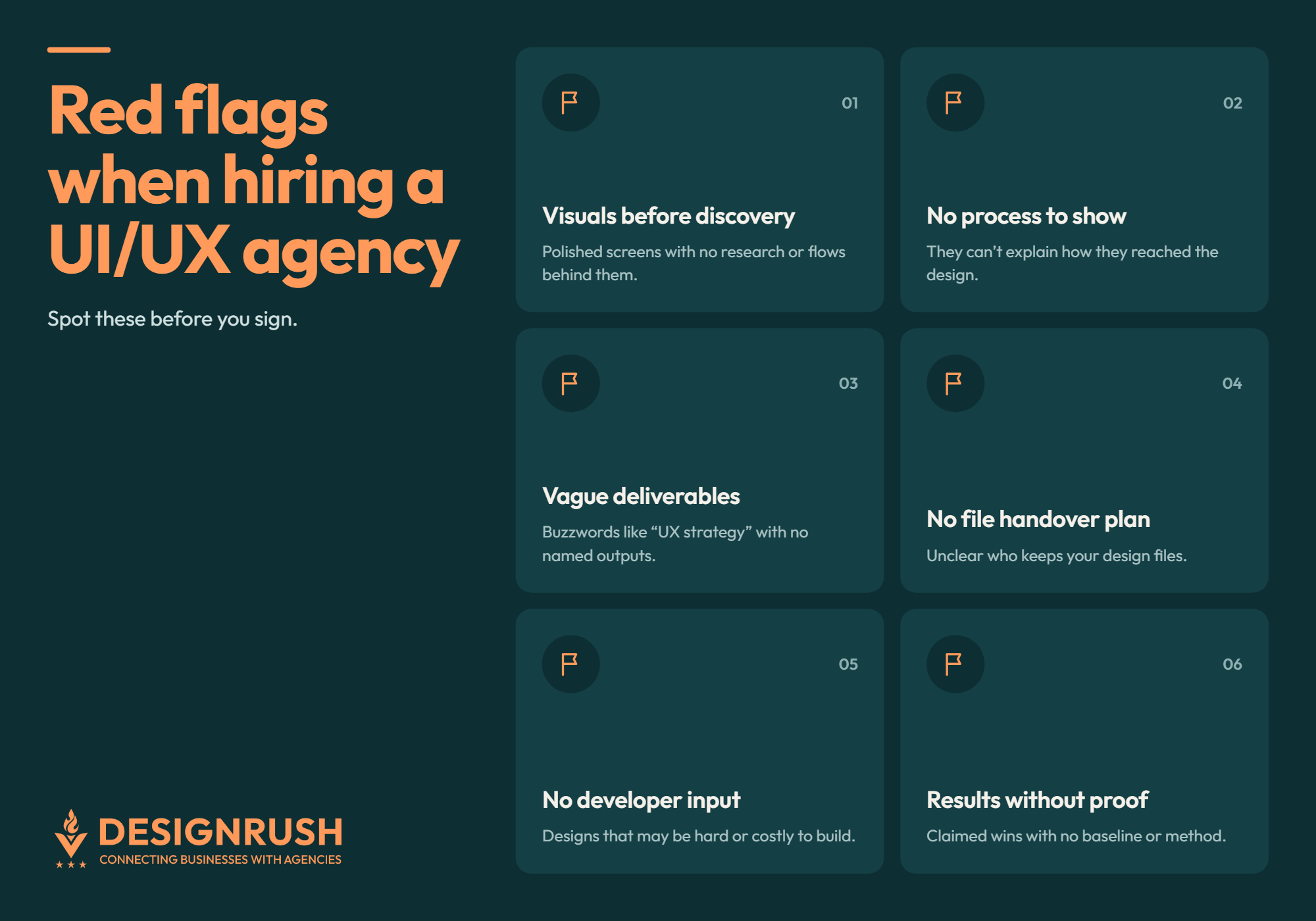
- Final visuals before discovery on a complex product. For a small visual refresh, this can be fine. For a new SaaS product, it may indicate that the proposed scope is missing research, requirements, or flow design.
- No way to explain the process behind the visuals. An agency doing substantive UX work should be able to explain its intermediate process and, where confidentiality allows, show anonymized examples.
- Vague deliverables. Phrases such as “UX strategy” or “user-centered design” with no named outputs make it hard to hold the agency to a standard.
- No plan for file transfer. If the agency avoids the question, you may lose access to your designs later.
- No developer input or handoff plan on a technically complex product. Without coordination, the design may include patterns that are difficult or costly to build.
- Results without method. A claimed conversion lift with no baseline, time frame, or test design cannot be checked.
- Some signals are less useful than they look. A fast proposal does not prove a template approach, and a small team does not prove limited skill. Judge each signal together with the evidence behind it.
How should you choose between two strong UI/UX agencies?
When two agencies look equally strong, compare them on the same criteria side by side. Price is one factor, and it should not decide the outcome alone.
| Factor | What to compare | Evidence to request |
| Relevant experience | Projects closest to yours in type and complexity | One comparable case study each |
| Research approach | Methods, participant plan, and who recruits where research is in scope | A research plan or anonymized past output |
| Validation | How and when designs are tested | A sample usability test report |
| Handoff quality | Components, states, specifications, responsive behavior, and design QA | A real or anonymized handoff example |
| Team | Named roles, seniority, and continuity plan | Team list in the proposal |
| Scope clarity | Screens, revisions, and change process | Line-item scope |
| Ownership | File transfer and IP terms | Contract clauses |
| Cost for scope | Price compared with what is actually included | Itemized quote |
If the choice remains close, ask to meet the actual delivery team or speak with a relevant client reference.
For a complex engagement, a paid discovery phase can be a useful way to test the working relationship before committing to the full scope.