
UI/UX design projects can cost from $5,000 for a focused UX audit to $150,000 for a complex app or product design engagement.
The final cost depends on what you’re designing, how much research and testing you need, the number of screens and workflows, and the support required during development.
To help you plan a realistic budget, we’ve organized the agencies’ estimates by project type, work hours, hourly rates, and budget level. You’ll also see which scope changes can increase costs and what to include in your brief to get a more accurate quote.
How much does UI/UX design cost by project type?
The type of project makes a substantial difference to your budget.
Reviewing an existing interface generally takes less work than designing a new product that needs research, user flows, prototypes, and testing.
Website redesigns, UX audits, and design systems
- UX audit: $5,000 to $15,000
- Design system: $10,000 to $35,000
- Website redesign: $25,000 to $75,000
[Source: DigitlHaus Agency, DesignRush UI/UX Design Pricing Survey, 2026.]
For a detailed breakdown of what agencies provide, see our UI/UX design services guide.
Mobile app and SaaS product design
- Mobile app design: $25,000 to $150,000
- SaaS or web app product design: $25,000 to $150,000
[Source: Essential Designs, DesignRush UI/UX Design Pricing Survey, 2026.]
These ranges cover projects with different levels of complexity.
A focused mobile app with a few core workflows needs less design work than a platform with several user types, permissions, dashboards, and integrations.
When comparing proposals, check whether they include user research, wireframes, visual design, prototypes, usability testing, and developer handoff.
How many hours does a UI/UX design project take?
Project hours help explain where your budget goes. The estimates below cover three types of UI/UX projects.
| Design phase | Website redesign | Mobile app | SaaS / web app |
| User research | 25 hrs | 25 hrs | 30 hrs |
| Wireframing and UX flows | 35 hrs | 45 hrs | 65 hrs |
| UI design | 50 hrs | 35 hrs | 80 hrs |
| Prototyping and usability testing | 25 hrs | 65 hrs | 40 hrs |
| Total | 135 hrs | 170 hrs | 215 hrs |
[Source: Essential Designs, DesignRush UI/UX Design Pricing Survey, 2026. Totals are calculated from the submitted phase estimates.]
What are typical UI/UX designer hourly rates?
Hourly pricing matters when you need ongoing design support, consulting, or additional work outside an existing project agreement.
- Junior designer: $50
- Mid-level designer: $85
- Senior / lead designer: $105
- UX researcher: $85 to $120
- Design director/strategy: $100 to $120
- Blended/average rate: $85
[Source: Essential Designs, DesignRush UI/UX Design Pricing Survey, 2026.]
More senior roles typically carry higher rates because they involve greater design responsibility, strategic input, or specialized expertise.
The lowest hourly rate does not guarantee the lowest final cost. A quote depends on who does the work, how many hours they need, and which activities are included.
Ask each agency to explain the expected team composition, estimated hours by role, and whether project management and revision rounds are covered.
What can you get for your UI/UX design budget?
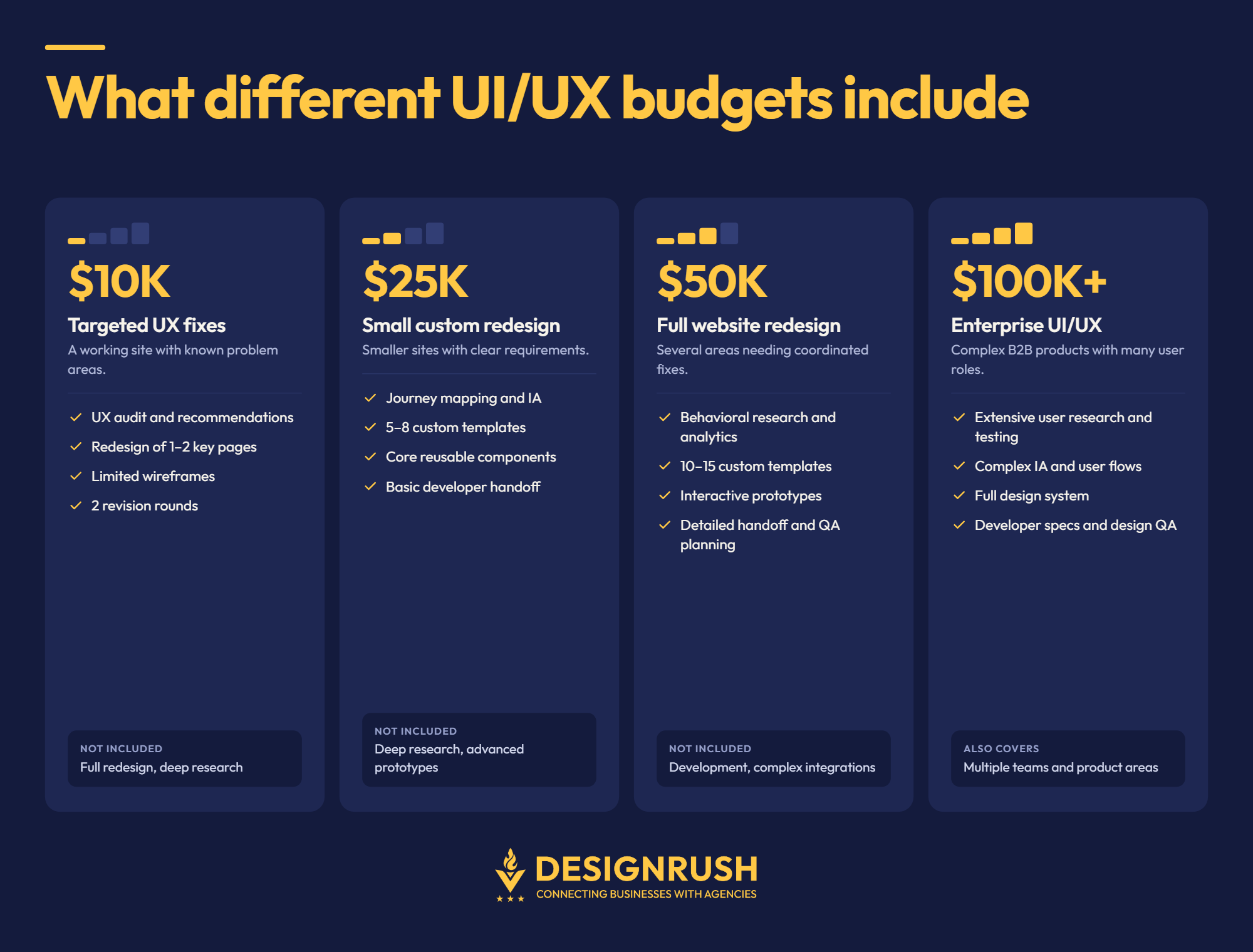
A $10,000 engagement and a $100,000 engagement may both be described as UI/UX design, but they can cover very different amounts of work. The four scenarios below focus on website and eCommerce design.
| Budget | Typical scope in the survey | Unique templates | Revisions |
| $10,000 | Targeted UX improvement | 1 to 2 | 2 rounds |
| $25,000 | Smaller custom redesign | 5 to 8 | 2 rounds |
| $50,000 | Comprehensive redesign | 10 to 15 | 2 to 3 rounds |
| $100,000+ | Enterprise-level engagement | Extensive, including interaction states | Not specified |
[Source for the table and the four scenarios below: DigitlHaus Agency, DesignRush UI/UX Design Pricing Survey, 2026.]
$10,000: Targeted UX improvements
At this level, you’re typically improving a limited part of an existing website.
What you may get:
- Initial discovery, stakeholder consultation, and competitive analysis
- UX audit and conversion improvement recommendations
- Limited wireframing
- Desktop and mobile redesign of 1 to 2 important page templates
- Two revision rounds and final Figma files
Usually outside scope: A complete website redesign, extensive customer research, large usability studies, a comprehensive design system, and development.
This budget makes sense when you already have a functioning website and know which areas need attention.
$25,000: Smaller custom website redesign
A $25,000 budget supports a broader UX and UI engagement with more custom templates.
What you may get:
- Discovery, UX strategy, and competitive research
- Customer journey mapping and information architecture
- Wireframes and custom desktop and mobile designs for approximately 5 to 8 templates
- Foundational reusable design components
- Two revision rounds and basic developer handoff documentation
Usually outside scope: Extensive qualitative research, large usability studies, advanced prototypes, complex B2B functionality, and comprehensive design systems.
This scope can work for a smaller eCommerce redesign where the main requirements are already understood.
$50,000: Comprehensive website redesign
At this level, the agency can address more of the customer experience, from research through detailed design.
What you may get:
- Discovery, strategy, analytics review, and behavioral research
- Customer journeys, information architecture, and detailed wireframes
- Custom desktop and mobile UI for approximately 10 to 15 templates
- Conversion-focused improvements and reusable components
- Interactive prototypes for important journeys
- Stakeholder reviews, two to three revision rounds, and detailed handoff planning
The scope may also include planning for design QA during development.
Usually outside scope: Website development, large-scale research programs, major changes after approval, complex integrations, and complete enterprise component libraries.
This budget is more suitable when several parts of the website need coordinated UX and visual improvements.
$100,000+: Enterprise-level UI/UX design
Larger budgets support more research, more complex interfaces, and coordination across multiple teams or product areas.
What you may get:
- Extensive discovery, stakeholder workshops, user research, and customer interviews
- Analytics, market and competitor research, personas, and journey maps
- Complex information architecture, wireframes, and user flows
- Custom desktop, tablet, and mobile designs with extensive interaction states
- Design systems, interactive prototypes, usability testing, and accessibility-focused design
- Detailed developer specifications, design QA, and implementation collaboration
This level may cover complex B2B purchasing experiences, account management, and interfaces with multiple user roles.
Usually outside scope: Development unless separately contracted, third-party licensing, unlimited scope changes, and ongoing optimization after launch.
What factors increase UI/UX design costs?
Even with a defined scope, extra requirements and changes can increase the final price.
- Additional screens or user flows: $1,000 to $2,500
- Design system expansion: $1,000 to $10,500
- Extra research or usability testing rounds: $1,000 to $5,500
- Design direction changes after approval: 10% to 25%
- Rush or compressed timeline: 20% to 35%
[Source: DigitlHaus Agency, DesignRush UI/UX Design Pricing Survey, 2026.]
Common causes of budget overruns
Some additional costs build up gradually as requirements change or approvals take longer than expected.
- Scope creep in screens or features: 10% to 30%
- Late requirement changes: 10% to 25%
- Accessibility (WCAG) remediation: 5% to 20%
- Third-party tool or platform changes: 5% to 20%
- Excess revision rounds: 5% to 15%
- Stakeholder feedback delays: 10%
[Source: DigitlHaus Agency, DesignRush UI/UX Design Pricing Survey, 2026.]
The biggest risks often involve changes to work the team has already approved.
For example, adding a new user role may affect navigation, permissions, forms, and several existing screens. A late change to the design direction may require the team to revisit components and completed layouts.
How can you prevent UI/UX design scope creep?
The best time to control additional costs is before design begins. Confirming requirements during discovery and quoting takes more planning upfront and leaves fewer open questions about what the team needs to deliver.
Before approving a proposal, agree on:
- The number of screens, templates, and user flows
- The platforms and responsive layouts covered
- Research and usability testing activities
- Revision rounds and approval responsibilities
- Design system requirements
- Developer handoff and implementation support
- How the agency prices additional requests
Make sure you understand what counts as a new requirement.
For example, changing the text on an approved screen may be a small revision. Adding a new workflow with several screens can require additional UX and UI work.
Ask the agency to document its change-request process and obtain your approval before starting work outside the agreed scope.
How can you get a more accurate UI/UX design quote?
Agencies can estimate work more accurately when you provide clear requirements.
A finished specification is optional. Explain the product, its users, and what you expect the design team to deliver.
Prepare the following information:
| Brief item | What to provide |
| Product goals | What you want to improve and how you’ll measure success |
| Target users | Who uses the product and their main tasks |
| Existing materials | Current designs, research, analytics, and brand guidelines |
| Platforms | Website, iOS, Android, or multiple platforms |
| Scope | Approximate screens, templates, user flows, and features |
| Design system | Whether you need reusable components and documentation |
| Accessibility | Applicable standards and requirements |
| Handoff | Developer specifications and implementation support |
| Timeline and budget | Expected launch date and available budget range |
Ask each agency to break down research, UX design, UI design, prototyping, testing, and handoff in its proposal. You should also request a list of exclusions and the rates or process used for additional work.
That gives you a clearer basis for comparing offers, especially when two agencies propose similar prices but different deliverables.
Our guide to choosing a UI/UX design agency explains how to assess proposals, portfolios, research methods, and developer handoff before deciding.
Find a UI/UX design agency within your budget
The estimates in this guide give you a starting point for planning your UI/UX budget. Your actual quote will depend on the product’s complexity, research requirements, design scope, and the level of support you need.
When comparing providers, look at what each price includes. An agency offering more thorough research, validation, and developer handoff may cover work that another provider quotes separately.
Browse the UI/UX design agencies directory and filter by industry, location, and minimum budget to find providers that match your project.