
- Agency: Merman and Taylor Swift Productions
- Category: Video Design — Short Film
- Location: London, United Kingdom
- Project Brief: Create a short video for Taylor Swift’s “Patient Zero” that combines cinematic storytelling, atmospheric visuals, and deliberate pacing to build an emotionally driven narrative.
Most music videos rely on performance and fast cuts to sell a track. Merman and Taylor Swift Productions' "Patient Zero" behaves like a prestige short film, and you can feel it in how Emmanuel Lubezki’s camera bypasses flashy edits to sit heavily in the tension.
The cinematography moves fluidly between large, lonely rooms and suffocating close-ups. When the lens tightens on Dakota Johnson and Colin Farrell inside a brutalist concrete house or out in a snowy graveyard, the frame pulls you directly into their psychological space rather than leaving you to watch from a distance.
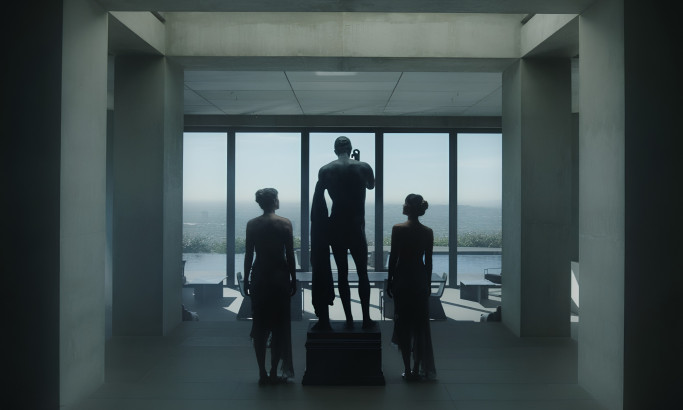
The production design does heavy atmospheric lifting. The cold, boxed-in concrete interiors contrast sharply with a warm, crowded candlelit ballroom, allowing each space to actively dictate the emotional temperature. Visual motifs like cramped cars, reflective panes of glass, and strategic mirrors all quietly reinforce themes of entrapment and a partner who feeds off someone else's shine.
Layered into this claustrophobia is a brilliant supernatural dynamic: Taylor Swift plays the ghost of Farrell’s late wife, haunting Johnson. Far from a simple haunting, Swift functions as an ominous guardian angel. She sleeps beside Johnson, knocks over drinks to warn her away, and chillingly holds back Johnson’s hair while she falls ill — hinting that the toxic relationship itself is literally poisoning her through tainted coffee and wine.
Visual parallels anchor the narrative. Swift and Johnson mirror each other meticulously through split shots, matching hairstyles, and parallel flashbacks that reveal Johnson is enduring the exact same cycle of abuse and isolation that Swift once did. When a newspaper clipping reveals that Swift — a wealthy heiress — died under suspicious circumstances leaving her fortune to Farrell, the stakes crystallize.
This is an "I had him first" song subverted into a dark psychological warning rather than a petty diatribe against a replacement partner. The symbolism deepens near the end: two women framing a figure in a statue scene symbolize the survivor and the trapped, while an underwater reach plays out like a rescue that just barely misses.
The final sequence reframes the entire viewing experience. When Johnson visits a snow-covered headstone bearing the inscription "Beloved Wife and Daughter" with a wedding photo propped in front of it, every prior scene shifts in meaning. It closes out a dark romantic thriller wrapped in the glossy veneer of a Hollywood movie, a clever nod to the recurring show-business motifs woven throughout Swift's album.