
To choose a mobile app development company, test the apps it has already launched, confirm it has the right platform skills, and make sure the contract and account setup give your company clear control or transfer rights over code, developer accounts, and production assets. Then check how the team handles testing, privacy, and support after launch.
If you plan to hire a mobile app development company, these checks matter because an app has to keep working across changing devices, operating systems, store policies, and third-party services long after the first release.
Does the company have the right native or cross-platform expertise?
Start with the approach your app needs. Ask the company which approach it recommends for your app and why. A good answer ties the recommendation to your features, audience, device requirements, performance needs, timeline, and budget.
Be careful if a company recommends the same technical approach for every project without explaining the trade-offs. That may reflect its own delivery specialization more than the needs of your product.
Also ask who will work on the recommended platform or framework. A company may advertise both native and cross-platform development while having much deeper experience in one.
How should you evaluate apps the company has already launched?
Mobile development gives buyers an advantage that many software projects lack: you can often download the finished work yourself. Pick several relevant apps from the company’s portfolio and complete the core flows on your own phone. Screenshots say little about stability.
| What to check | Where to look |
| Speed and stability | Use the app on your own phone, including on a weak connection |
| Ease of use | Complete a core task, such as signing up or checking out, without help |
| Recent updates | Update history in the store listing |
| User feedback | Recent reviews, especially repeated complaints about crashes or logins |
| Complexity | Payments, accounts, offline use, or real-time features similar to yours |
| Company role | Ask whether the company built the whole app or one part |
An overall star rating can mislead. Ratings often reflect pricing, customer service, content, or business decisions the development company did not control. Repeated technical complaints are the signal worth raising with the company.
An app that has not been updated in a long time may no longer reflect the company’s current work. Ask which apps it still maintains.
Can the team validate the product before full development begins?
Before you hire an app development company for a new or unvalidated product, ask how it reduces uncertainty before large-scale development. That can mean discovery, a clickable prototype, a technical proof of concept, or a focused MVP.
Ask how it decides which features go into the first release. A company that agrees to build every feature on your list without questions may cost you more later.
How does it test apps across devices and operating system versions?
Ask which devices and OS versions the company tests on and how it chooses them. A credible plan may combine real-device testing, device-cloud services, emulators or simulators, and usage data about the devices your audience has.
If the app relies on payments, offline use, notifications, location, camera access, or background activity, those behaviors should be part of the testing scope.
Also ask whether it uses crash reporting after launch and who watches those reports. For an app the company already maintains, ask for its crash-free rate and how that number changed after recent releases.
How does it handle security, privacy, and sensitive user data?
Some apps collect personal data, location, payment information, health data, or other sensitive information. Ask what your app will collect and how the company protects relevant data on the device, in transit, and on backend systems. Also ask how credentials and API keys are stored and who handles security issues after launch.
Both app stores require privacy disclosures. Apple’s app privacy requirements cover data collected by third-party partners, including analytics tools, advertising networks, and SDKs added to the app.
Ask who prepares these disclosures, who keeps them current, and how the company tracks what each third-party tool collects. Health, finance, children’s, and other sensitive app categories may face additional platform, security, privacy, or regulatory requirements.
Vague answers on privacy deserve scrutiny. Accurate disclosures require the team to understand its own code and every third-party service inside the app.
Who owns the code, developer accounts, and project files?
Where practical, your organization should control its Apple and Google developer accounts and grant the agency only the access it needs. This reduces transfer risk and keeps store access with the business if the relationship changes.
If the company publishes the app under its own developer account, moving it later requires the platform’s formal app-transfer process.
Apple’s app transfer process keeps the app available for download and preserves its ratings and reviews. The app must meet Apple’s transfer criteria first, and Google Play has its own transfer requirements. Confirm the ownership and transfer plan before signing.
The contract and access model should also state who owns or controls the source code, design files, repositories, backend and cloud environments, domains, analytics and crash-reporting tools, and production credentials, plus how each will be handed over if the engagement ends.
Will the company manage app store submission and rejection issues?
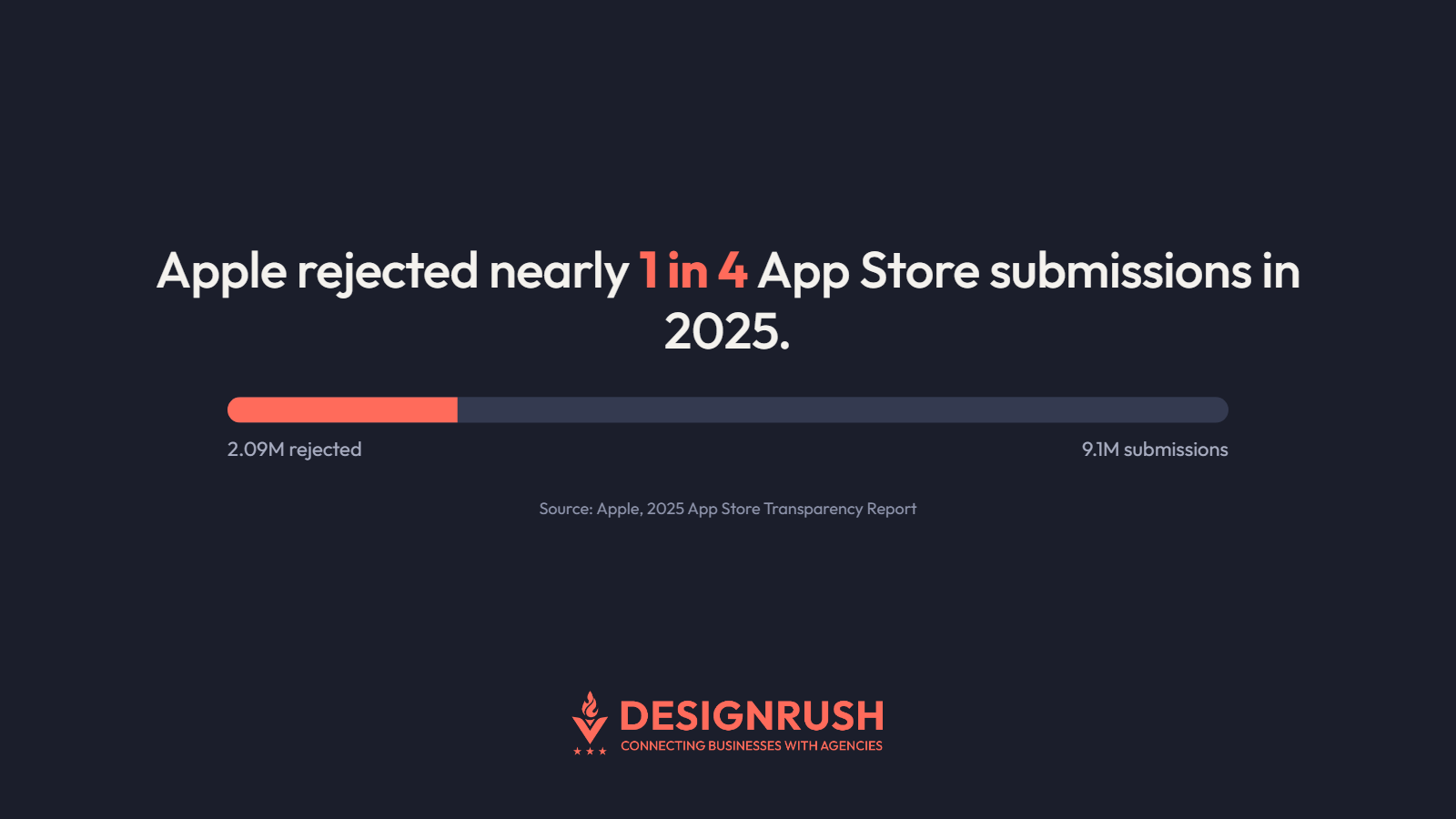
Rejection is a routine part of store release. According to Apple’s 2025 App Store Transparency Report, App Review evaluated about 9.1 million submissions in 2025 and rejected about 2.09 million, roughly 23%. Apple counts submissions, so one app can be rejected more than once on its way to approval, and more than 387,000 submissions were approved after an earlier rejection.
Apple’s performance guidelines, which cover issues such as app completeness and accurate metadata, were cited in about 1.35 million rejections, more than any other section.
Ask whether the company handles submission and responds to reviewers. An experienced team prepares builds, store metadata, screenshots, privacy answers, and test accounts so reviewers have what they need.
Ask about a past rejection: why it happened, what had to change, who communicated with the reviewer, and whether the launch date moved. No company can guarantee approval. Relevant submission experience can reduce avoidable launch delays.
What support will you need after launch?
Apps need ongoing testing and maintenance as operating systems, devices, dependencies, and store policies change. Apple and Google also raise their minimum build and target requirements every year, so an unmaintained app can fall far enough behind that its next update needs extra work before either store will accept it.
Ask what the company’s maintenance plans include, how quickly it responds to critical crashes, and how compatibility work is handled around major OS releases. Also ask whether there is a warranty period for fixing its own defects after launch and what qualifies as a defect.
What app development red flags should stop you from signing?
Pay attention to the following warning signs:
- The app will be published under the vendor’s developer account with no clear transfer plan. This creates avoidable dependency on the vendor for store ownership and handover.
- A precise fixed quote for a complex app after minimal discovery. Unless the scope is already well defined, the estimate may omit important assumptions, backend work, integrations, or testing.
- No mention of the backend when the app requires accounts, shared data, integrations, notifications, payments, or server-side logic. A substantial part of the work may be missing from the proposal.
- Portfolio apps that are removed from stores or poorly reviewed for crashes. Ask what happened before you decide.
- No device and OS testing plan. Problems on common devices may only surface after launch, in front of users.
- Store submission is listed, with no owner for rejections. Launch dates slip when nobody is responsible for reviewer feedback.
- No plan for OS updates or maintenance. Your app may break after the next major OS release.
- Vague answers on user data and privacy. This can create app-review, policy, security, and compliance risk.
None of these signs should be judged in isolation. The risk depends on your product and on how clearly the company explains its approach.
How should you compare your final candidates?
Once you have a shortlist from the mobile app development companies directory, compare each candidate on the same factors.
| Factor | What to compare |
| Platform fit | Native or cross-platform skill matched to your app |
| Live apps | Quality and stability of apps you tested |
| Validation | Discovery, prototype, or MVP approach |
| Backend and testing | Server-side capability and device testing plan |
| Privacy | Data handling, third-party SDKs, and store disclosures |
| Store experience | Submission process and rejection handling |
| Ownership | Developer accounts, code, and infrastructure under client control or covered by clear transfer and handover terms |
| Support | Maintenance plan, OS compatibility approach, and any post-launch defect-fix or warranty terms |
Price matters, so compare it against the included scope. A lower quote can cost more later if backend work, testing, store submission, maintenance, or production ownership is missing. The app development pricing guide explains why app estimates can differ widely.