
Mobile app development costs from around $8,000 for a simple app to $950,000 or more for an enterprise app, based on pricing data top app development companies shared with DesignRush.
Where your project falls within that range depends on the type of app, the platforms it runs on, the features it launches with, and what it costs to keep running after launch.
The sections below break down each factor, so you can set up a realistic budget before you request proposals.
How much does it cost to develop a mobile app?
M TECHUB, one of the app development companies on DesignRush, estimates $15,000 to $150,000 for a simple app and $200,000 to $950,000 for an enterprise app.
| App type | Pricing |
| Simple app | $15,000 to $150,000 |
| Cross-platform app | $45,000 to $250,000 |
| Native iOS and Android | $75,000 to $350,000 |
| Complex app | $95,000 to $500,000 |
| Enterprise app | $200,000 to $950,000 |
App type gives you a starting point, while features, integrations, backend complexity, and platform strategy determine where the project falls within the range.
A focused app with authentication and a basic backend may stay near the lower end. Real-time features, several user roles, custom infrastructure, AI functionality, or complex business-system integrations push the project higher.
Screen count shows the difference too. M TECHUB sizes a focused cross-platform MVP at around 8 to 15 core screens and a production-ready product at 20 to 35 or more.
Is native app development more expensive than cross-platform?
Often, yes, when you need separate native apps for both iOS and Android.
Net-Craft estimates 545 hours for separate native iOS and Android development, compared with 260 hours for a cross-platform app.
| Phase | Simple app | Cross-platform app | Native iOS and Android |
| Discovery & UX design | 20 hrs | 30 hrs | 50 hrs |
| Development | 60 hrs | 180 hrs | 400 hrs |
| QA & device testing | 15 hrs | 40 hrs | 80 hrs |
| App store launch | 5 hrs | 10 hrs | 15 hrs |
| Total | 100 hrs | 260 hrs | 545 hrs |
Development accounts for most of the difference in Net-Craft’s estimate: 400 hours for native iOS and Android compared with 180 for cross-platform development. QA also rises from 40 to 80 hours.
At Net-Craft’s flat $65 hourly rate, 545 hours comes to about $35,400, which closely matches its $35,000 starting price for native iOS and Android development.
Separate native builds can therefore cost more because much of the implementation and testing has to be handled for each platform. That does not mean native is the more expensive option for every project.
What are typical mobile app development hourly rates?
M TECHUB reports rates ranging from $30 per hour for QA engineers to $90 per hour for native iOS and Android developers.
| Role | Rate (USD/hr) |
| QA engineer | $30 to $50 |
| UI/UX designer | $45 to $70 |
| Cross-platform developer | $50 to $80 |
| Backend developer | $55 to $85 |
| Native iOS / Android developer | $60 to $90 |
| Blended rate | $60 |
A blended rate is one average applied across the whole project team. It makes an estimate easier to check, because you can multiply the total hours by a single number.
Do all app development companies charge by the hour?
Not always. Some agencies price a build as a fixed monthly rate for a dedicated team. Chop Dawg, for example, starts at $5,000 per month for design and $7,500 per month for development.
Under this model, the process stays the same at every budget level. The budget determines how many people work on the app and for how long. Chop Dawg’s projects start around $25,000, and first-time clients usually spend $35,000 to $75,000.
Scope still moves the total. A two-sided marketplace typically costs $50,000 to $75,000 even as a lean MVP, because the buyer, seller, and admin sides work like several apps in one.
How long does each phase take?
With monthly pricing, the timeline drives the budget. Chop Dawg plans its builds around these stages:
| Phase | Typical duration |
| Pre-production | 2 to 4 weeks |
| Design | 2 to 3 months, ending in a non-functional prototype |
| Development | 2 to 3 months for a lean scope, longer as scope grows |
| QA and device testing | Alongside development, plus a dedicated phase before submission |
| App store launch | 30 to 45 days for review, revisions, and resubmission |
A typical build runs about 4 to 7 months from kickoff to store submission, and each launch includes a 30-day bug and maintenance window.
A non-functional prototype can also be bought on its own. For founders who are not ready to build, Chop Dawg prices one at $5,000 to $15,000 over one to three months.
Delays on the client side extend the timeline, and the cost with it. Missed meetings and slow decisions are the most common timeline movers the agency sees.
For larger projects, DesignRush’s analysis of enterprise app budget and timeline overruns covers where budgets and schedules break.
What do you actually get for each app development budget?
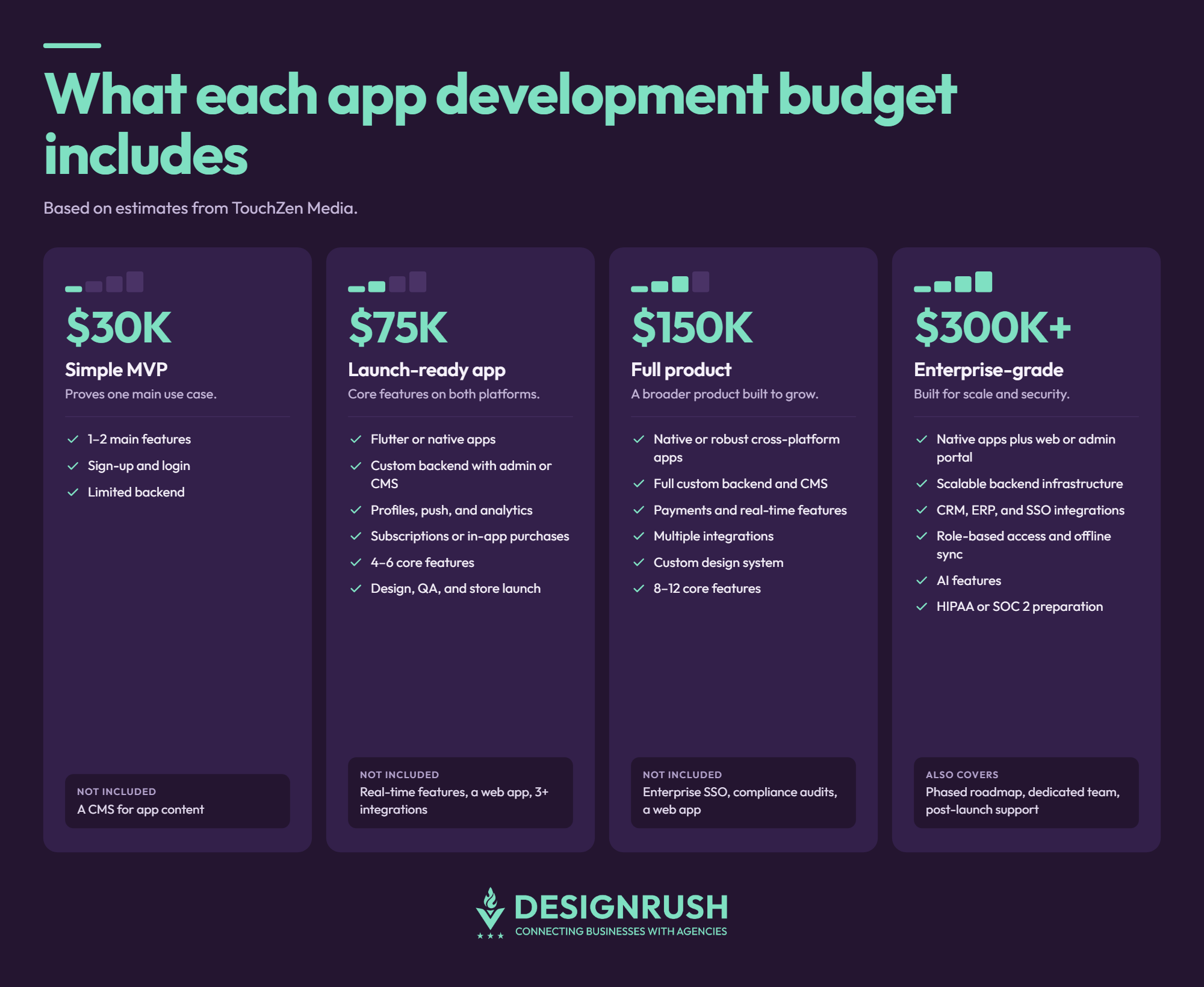
Budget determines how many features the app can launch with, how sophisticated the backend is, and which integrations fit into the initial scope. The breakdown below comes from TouchZen Media.
$30,000 budget
A $30,000 project can cover:
- A simple app with one or two main features
- Sign-up and login
- A limited backend
- No CMS for managing app content
At this level, the project proves one main use case.
$75,000 budget
This budget can cover:
- A cross-platform Flutter app or native apps on both platforms
- A custom backend with a basic admin panel or CMS
- Authentication and user profiles
- Push notifications and analytics
- Subscriptions or in-app purchases
- Four to six core features
- UI/UX design
- QA and app store launch
Real-time functionality, more than one or two third-party integrations, and a separate web app fall outside this example scope.
$150,000 budget
At this level, you can get a broader product with:
- Native iOS and Android apps or a robust cross-platform build
- A full custom backend
- Admin dashboard or CMS
- Payments or subscriptions
- Real-time features such as chat or live data
- Multiple integrations
- A custom design system
- Eight to 12 core features
- Full device QA and analytics
Enterprise SSO, compliance audits, and a companion web app may still require additional scope.
$300,000+ budget
A $300,000+ budget can support an enterprise-grade product with native apps, a web app or admin portal, scalable backend infrastructure, CRM, ERP, and SSO integrations, role-based access, offline synchronization, AI features, and security or compliance work such as HIPAA or SOC 2 preparation.
TouchZen also associates this level with a phased roadmap, a dedicated team, and an included post-launch support period.
What increases mobile app development pricing?
Adding work after the original scope is approved can increase the final project cost substantially.
TouchZen Media estimates that adding a second platform later can add 40% to 70% of the original build cost.
| Trigger | Rate applied |
| Second platform added later | 40% to 70% of original build or $70/hr |
| New features mid-project | $70/hr, scoped per feature |
| Third-party SDK or API changes | $70/hr, typically $1,500 to $5,000 |
| Payment or compliance integration | $5,000 to $20,000 |
| Additional device or OS testing | $70/hr, typically $1,000 to $4,000 |
| App Store or Google Play rejection rework | $70/hr, typically $500 to $3,000 |
| Rush / compressed timeline | 25% to 50% increase |
Store rejection costs depend on why the app was rejected. For example, TouchZen fixes issues caused by its own work at no additional fee, while rework due to store policies or app content may be billed separately.
Other change-order triggers can include design revisions after approval, additional user roles, new admin functionality, changing backend providers, content migration, or localization.
What does it cost to maintain an app after launch?
The budget continues after launch. Net-Craft estimates maintenance and support at $175 to $1,750 per month.
| Ongoing cost | Typical range |
| Maintenance and support | $175 to $1,750/month |
| Cloud hosting and backend | $75 to $950/month |
| Third-party services | Up to $950/month |
| OS update compatibility | $750 to $4,500/year |
| Feature update or new release | $950 to $10,000/sprint |
OS compatibility work covers updates needed when Apple or Google releases major operating system changes.
Hosting, payment services, maps, messaging tools, analytics, and other third-party services may also continue generating costs after launch. These are often external expenses even when the app development company manages them, and they grow with the size of the app and the number of services it depends on.
Net-Craft quotes hosting, maintenance, and third-party fees separately from the build at every budget level it describes. Ask each agency exactly which ongoing costs its proposal includes.
How can you get a more accurate quote faster?
App development companies can estimate more accurately when they receive a clear scope.
Before reaching out, prepare:
- The platforms you need: iOS, Android, or both
- Whether you also need a web app or admin portal
- Your preference for native or cross-platform development, if you have one
- Core features for the first release
- Features that can wait for later releases
- Required user roles
- Payment providers, SDKs, APIs, and business-system integrations
- Real-time, offline, or AI functionality
- Security or compliance requirements
- Who will manage hosting, maintenance, and OS updates after launch
- Your target launch date
- Your realistic budget range
Deciding on platforms before development begins is particularly important, since adding a second platform later is one of the costliest change orders.
A clear first-release scope also makes quotes easier to compare. If one agency prices four core features and another prices 12, their totals are not estimates for the same product.
Looking for mobile app development companies within your budget? Browse DesignRush’s directory and filter by budget range, hourly rate, and verified client reviews.