
A mobile app development company turns an app idea into a working product for iOS, Android, or both. Mobile app development services usually include product discovery, UX/UI design, development, backend and APIs, testing on real devices, app store submission, and maintenance after launch.
The exact mix of services mobile app development companies provide depends on your product, its features, and whether you already have in-house design, backend, or technical resources.
What does a mobile app development company handle from idea to launch?
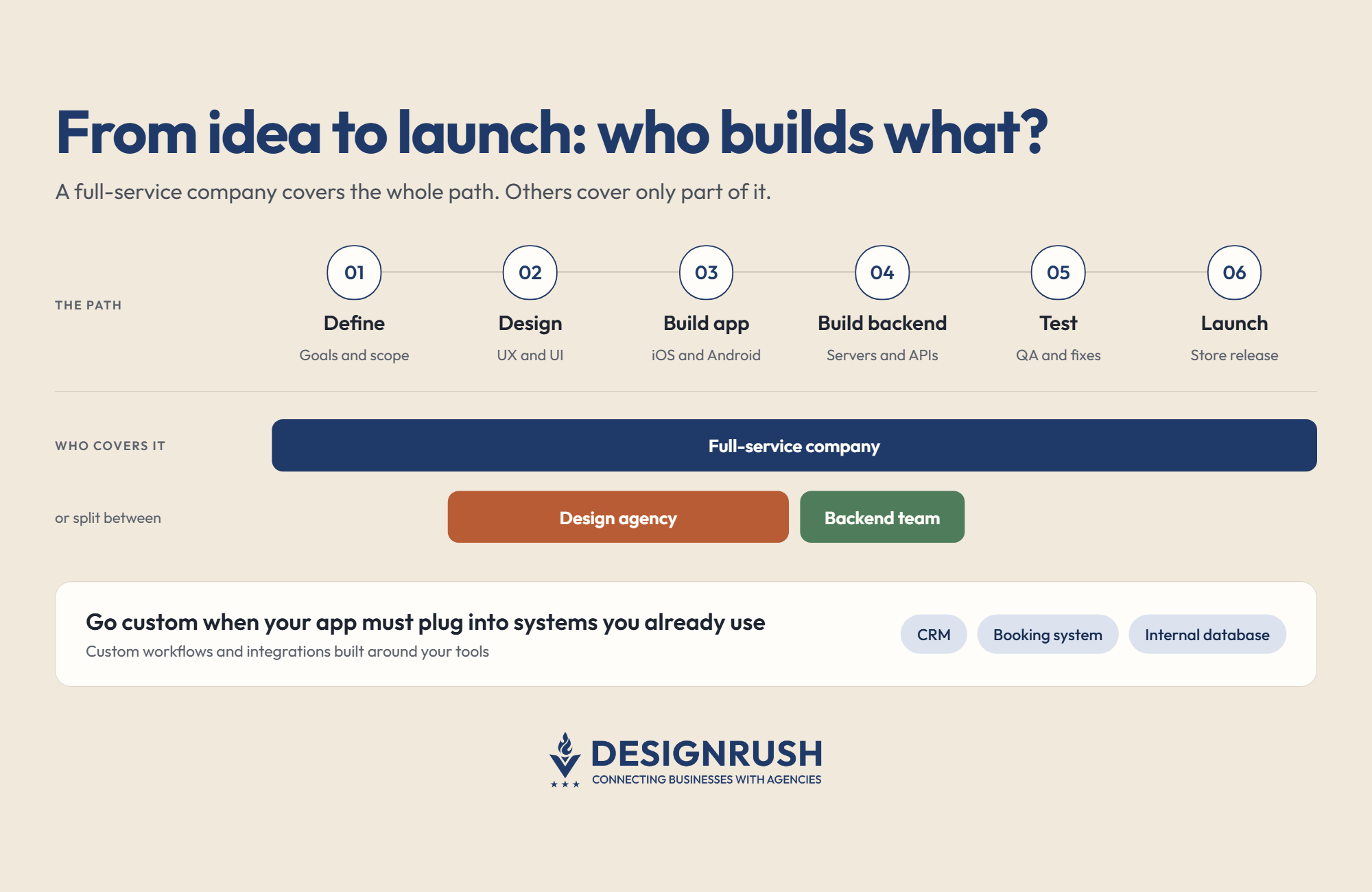
A full-service mobile app development company can manage the whole path: defining and designing the app, building the mobile and server-side components, testing them, and preparing the product for store release.
Some firms handle only part of that path. A mobile app development agency may focus on design and front-end work, while another team builds the backend.
A custom mobile app development company fits best when the product needs workflows, integrations, or features built around your business, such as connections to an existing CRM, booking system, or internal database.
Which services are included in app development?
Typical app development services include:
Product discovery
Discovery defines who the app is for, which problem it solves, and which features matter first. For a new product, it also separates the features needed at launch from ideas that can wait for later versions.
What you receive: a feature list, user flows, a roadmap, and an estimate.
UX/UI design and prototyping
Design creates the screens and interactions. Mobile design follows platform conventions, such as Apple’s and Google’s design guidelines, so navigation, gestures, and permission requests feel familiar to users. Prototypes let you test the flow before development.
iOS, Android, or cross-platform development
This is the core build. The team writes the app code using a native or cross-platform approach. The next section explains the difference.
Backend and APIs
Many apps need a server-side component for user accounts, data, notifications, payments, integrations, or other shared logic. Depending on the product, backend work can represent a substantial part of the overall scope.
QA and device testing
Apps may need to work across many device models, screen sizes, and operating system versions. Testing commonly covers core functions and performance and, where relevant, battery use, accessibility, interruptions, permissions, and behavior on slower or unreliable connections.
Testing only on the developers’ own phones is rarely enough for an app meant for a broad audience. Some teams add a provider from the software testing companies list for wider device coverage.
App store submission
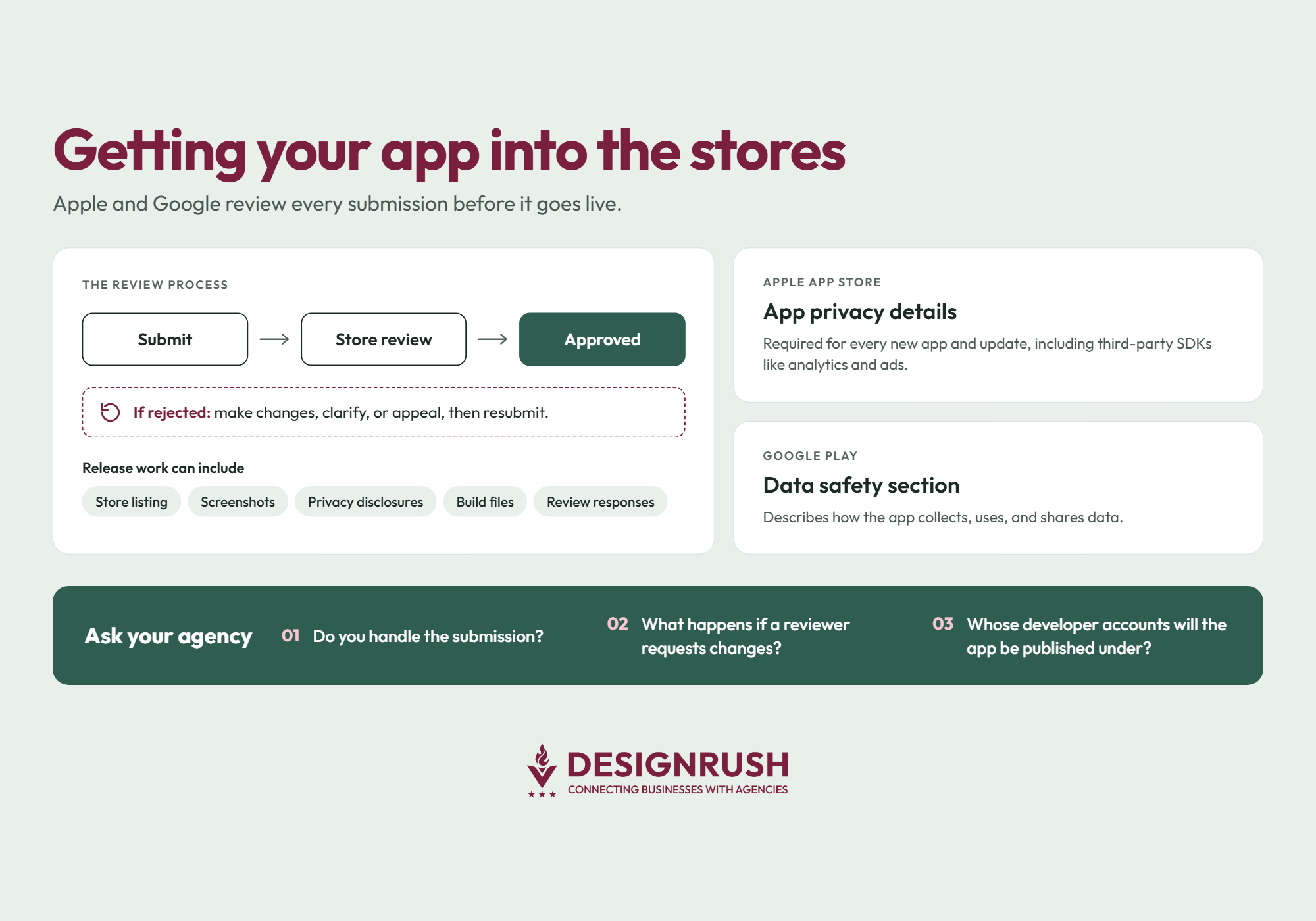
Apple and Google apply store-review and policy processes to app submissions. Release work can include store listings, screenshots, privacy disclosures, build files, and responses to review feedback. A rejected submission may require changes, clarification, or an appeal before approval.
Both stores also require privacy information. Apple asks for app privacy details with every new app and update, including the data practices of third-party code such as analytics and advertising SDKs. Google Play requires a Data safety section that describes data collection, use, and sharing.
Confirm whether the app development agency handles submission, what happens if a reviewer requests changes, and whose Apple and Google developer accounts the app will be published under.
Maintenance
After launch, an app needs bug fixes, crash monitoring, security patches, dependency and SDK updates, compatibility work, and new features. Providers sell this part of their mobile app development services as a monthly plan, a block of development hours, or separate work as needed, so agree on the model before launch.
What is the difference between native and cross-platform app development?
| Approach | How it works | Typical fit |
| Native | Separate platform-specific implementations for iOS and Android | Apps needing deep platform integration, specialized device capabilities, or platform-specific optimization |
| Cross-platform | A shared codebase covers substantial parts of both iOS and Android apps | Products targeting both platforms where shared implementation is a good technical fit |
Cross-platform development can reduce duplicate work by sharing substantial parts of the codebase across iOS and Android. Native development uses platform-specific toolchains and can be advantageous when an app depends heavily on platform-specific APIs, performance characteristics, or device capabilities.
Many companies offer both. A capable app development company should be able to explain why its recommendation fits your product. Platform specialists are listed among iPhone app developers and Android app developers.
Do app developers build the backend too?
Many do, but some focus only on the app. Backend work can include databases, APIs, user authentication, business logic, admin panels, cloud infrastructure, and hosting.
If your app connects to existing business systems, backend and integration work may be substantial. In that case, firms from the software development companies list sometimes build the backend while a mobile team builds the app. Either way, the proposal should state who builds and hosts the backend.
Does app development include UI/UX design?
Often, yes. Depending on scope, app development services may include the full design process or start from designs your own team supplies. Depth also varies. One provider may mainly turn requirements into screens, while another runs research, prototyping, and usability testing and delivers a full design system.
For consumer apps where usability is central to adoption and retention, deeper product and UX work may be important. Some buyers bring in a specialist UI/UX design agency for design and hand the result to developers. If you already have designs, confirm that the development team will review them for technical feasibility before coding starts.
What happens after the app reaches the App Store or Google Play?
Launch starts a new cycle. You collect user feedback and crash reports, fix issues, and release updates.
Store requirements also change every year.
Under Apple’s SDK requirements, apps uploaded to App Store Connect since April 28, 2026, must be built with Xcode 26 or later using the iOS 26 SDK or newer.
Under Google Play’s target API level rules, new apps and updates submitted since August 31, 2026, must target Android 16 (API level 36) or higher. Existing apps must target at least Android 15 (API level 35) to stay available to new users on newer devices.
An app that nobody updates falls behind these requirements, so OS compatibility work belongs in the maintenance plan. Running costs continue too, including hosting, third-party APIs or messaging services, and developer program or account fees where applicable.
What is usually outside the core scope?
Two proposals for mobile app development services can cover very different work.
| Item | How it is commonly scoped |
| Discovery, design, and app development | Commonly part of a full app engagement |
| Backend and APIs | Commonly part of a full app engagement, if stated |
| Device testing and store submission | Commonly part of a full app engagement |
| Admin dashboard for your team | Often separately scoped |
| Post-launch maintenance | Often separately scoped |
| App store optimization (ASO) | Often separately scoped |
| Hosting, APIs, and developer accounts | Third-party cost |
| User acquisition and app marketing | Specialist or adjacent service |
Backend, maintenance, and store account ownership deserve particular attention because they are easy to overlook when comparing proposals.
When should you build an MVP instead of the full app?
An MVP, or minimum viable product, is the smallest version that solves the core problem for real users. It helps you learn what users want before you invest in every feature.
- Your idea is new and untested. An MVP with a focused feature set may help you validate the core use case before building more.
- You are replacing an existing app with known users. The first release may need broader feature parity because existing users already depend on established workflows.
- You need to demonstrate the product before a full build. Depending on what investors or stakeholders need to evaluate, a clickable prototype or focused MVP may be enough.
- Your app is an internal tool for staff. A focused first release built around the highest-value workflow may be more useful than launching every planned feature at once.
For budgets, see the app development pricing guide. To compare vendors, read the guide to choosing a mobile app development company.