
Web design can cost between $5,000 and $200,000, depending on who builds your site, how complex it needs to be, and what features it requires. This guide breaks down every cost factor, so you can budget accurately before signing with an agency.
By website type
The biggest pricing variable is the type of website you need, with costs typically ranging from around $5,000 for simple template-based sites to $200,000+ for enterprise platforms. Simple brochure sites cost a fraction of what complex, high-traffic systems require, and the gap is significant.
| Website type | Ideal for | Cost |
| Template-based design | Small businesses, blogs, simple eCommerce | $1,000 to $5,000 |
| Custom design | Medium-sized businesses, service providers | $5,000 to $30,000+ |
| Enterprise website | Large corporations, high-traffic sites | $50,000 to $200,000+ |
By a service provider you hire
Beyond the website type, who you hire has a direct impact on both cost and outcome, with total spend ranging from as little as $100 for DIY builds to $500,000+ for full-service agency projects. Each option comes with different tradeoffs in cost, quality, and strategic depth.
| Provider | Cost |
| DIY (yourself) | $100 to $3,000+ |
| Freelancer | $15 to $80/hour |
| Agency | $50 to $500/hour or $10,000 to $500,000/project |
- DIY builders are the most affordable but offer limited customization and no strategic input.
- Freelancers bring specialized skills at a mid-range price, though availability and industry experience can vary.
- Agencies cost the most but deliver full-team execution: design, development, SEO, and strategy under one roof.
By core website elements
Regardless of who you hire, every website includes baseline costs, typically ranging from about $10/year for a domain to $2,000+ for website maintenance, with ongoing expenses for hosting and security. These are recurring costs you carry for as long as the site is live.
| Element | Cost |
| Domain name | $10 to $50/year |
| Web hosting | $2 to $300+/month |
| SSL certificate | Up to $150/year |
| Website maintenance | $500 to $2,000+/year |
Most hosting providers include a free SSL certificate in their plans. Premium SSL is only necessary if your site handles sensitive financial or medical data.
Additional costs
As requirements expand, budgets follow. Most projects start lean, then grow through add-ons like custom development, integrations, and ongoing marketing support, which can add anywhere from a few hundred dollars to tens of thousands on top of the base project.
These are not edge cases. They are standard scope extensions, so plan for them upfront instead of treating them as exceptions.
| Element | Cost |
| Custom development | $1,000 to $50,000+ |
| Plugins & add-ons | $500+/month |
| Content creation | $50 to $5,000/month |
| eCommerce features | $2,000 to $20,000+ |
| SEO services | $500 to $5,000+/month |
| Mobile customization | Up to $3,000+ |
| Custom visuals | Up to $10,000+ |
| Third-party integrations | $100 to $2,000+ |
| Analytics tools | $500+/month |
SEO and content creation are the two most underestimated line items. A well-designed site that isn't optimized for search or populated with quality content will struggle to generate traffic regardless of how it looks.
By industry
Industry-specific requirements, such as compliance standards, booking systems, secure portals, and streaming infrastructure, can significantly shift the cost ceiling. Use these ranges as a baseline when evaluating agency proposals in your sector.
| Industry | Cost Range |
| eCommerce & Retail | $5,000 to $50,000+ |
| Professional Services | $3,000 to $30,000+ |
| Healthcare | $7,000 to $70,000+ |
| Financial Services | $10,000 to $80,000+ |
| Real Estate | $5,000 to $40,000+ |
| Media & Entertainment | $7,000 to $50,000+ |
| Travel & Hospitality | $5,000 to $45,000+ |
| SaaS & Tech | $10,000 to $100,000+ |
| Education | $5,000 to $40,000+ |
| Nonprofits | $3,000 to $20,000+ |
Healthcare and financial services sit at the higher end due to regulatory compliance requirements. HIPAA, data encryption, and secure client portals all add significant development complexity and cost.
By location
It's worth noting how web design prices shift with location. Offshore agencies, particularly those based in India, offer a compelling middle ground: full-service design, UX strategy, and development at a fraction of US rates. Ungrammary, a Mumbai-based agency, reports a blended rate of $40/hr, and their budget breakdowns reflect how far that difference stretches in practice:
- $5,000: Not a standard engagement. Existing clients can get 2-3 landing pages with development, no CMS.
- $10,000: App MVP design, or a basic 5 to 10-page website; typically design only, with development included only for smaller 5-page sites.
- $25,000: App MVP with development, or a conversion-led website up to 20–30 pages with full strategy and UX, though development is excluded at this page count.
- $50,000+: Custom product design and development.
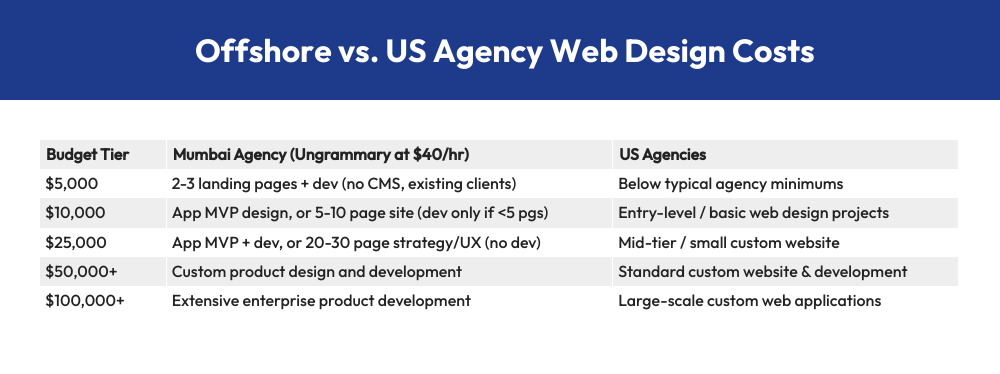
The key pattern: design labor is significantly cheaper offshore, but development costs remain substantial even at these rates.
How much does web design cost in the US?
Web design agency projects in the US typically run between $7,000 and $100,000+, depending on the complexity of the site, the depth of strategy involved, and how much custom development is required.
The pricing benchmarks below are based on data from leading US web design agencies reflecting real client quotes rather than platform estimates.
Hourly rates by role
Agencies bill by the hour for out-of-scope work, change orders, and additional features. Rates vary significantly by seniority. According to Creative Web, a mid-tier agency's blended rate, the weighted average across all roles on a project, typically lands around $145/hr.
| Role | Rate (USD/hr) |
| Junior / production | $60 to $85 |
| Mid-level | $95 to $120 |
| Senior / lead | $145 to $180 |
| Creative director/strategy | $190 to $255 |
| Average hourly rate | $145 |
Price ranges by website type
Agency pricing in the US typically starts around $7,000 for a basic, small-scale website and exceeds $100,000 for enterprise-level platforms with custom development and integrations, based on data from Rudo and other leading agencies.
These ranges reflect real project quotes before full scope definition. The spread at the higher end is driven by complexity, integrations, and the level of strategic and technical work involved.
| Website type | Pricing |
| Simple website (1 to 5 pages, no CMS) | $7,000 to $10,000 |
| Small business (5 to 15 pages, CMS) | $10,000 to $15,000 |
| Mid-complexity (15 to 40 pages, custom CMS, basic integrations) | $15,000 to $30,000 |
| Complex website (custom features, multiple integrations) | $30,000 to $80,000 |
| Enterprise/custom platform | $60,000 to $100,000 |
Hours per project type
Understanding where the hours go explains why agency quotes land where they do. A complex platform can exceed 500 hours across discovery, design, development, and QA, reflecting the real workload required at scale, according to Digital Silk.
| Project type | Strategy | Design | Dev | QA | Total |
| Simple website (1–5 pages) | 8 | 40 | 80 | 10 | 138 hr |
| Mid-complexity (15–40 pages) | 12 | 80 | 150 | 19 | 261 hr |
| Complex / custom platform | 20 | 120 | 300 | 60 | 500 hr |
Cost per additional page
Most agencies charge for additional pages once you exceed the base scope. Expect around $1,500 per page for template-based layouts and about $2,500 per page for fully custom designs.
The difference comes from design and development effort. Template pages reuse existing structures, while custom pages require new layouts, interactions, and more build time.
What you actually get at each budget level
Budget tiers reflect the depth of strategy, quality of execution, and how much post-launch support is built into the project. According to Creative Web, these are the typical breakdowns by budget level.
$5,000 budget
- Framer-based site (faster, low maintenance)
- 3–5 pages, custom design within framework, contact form, basic SEO, analytics, and hosting setup
- Limited revisions
- Timeline: 2 to 3 weeks
$10,000 budget
- Custom WordPress build (8–15 pages)
- Structured design, two revision rounds, standard integrations (CRM, forms, social)
- Solid SEO foundation (architecture, internal linking, schema), mobile-first, basic performance, and accessibility
- Editor training included
- Timeline: 5 to 7 weeks
$25,000 budget
- Strategy-led project
- Full discovery (workshops, content audit, Information Architecture (IA)), bespoke design system, proper content modeling
- Multiple integrations (CRM, automation, payments), strong SEO structure, WCAG 2.2 AA accessibility, and performance optimization
- Content migration + editorial review
- 2 months post-launch support
- Timeline: 10 to 14 weeks
$50,000+ budget
- Enterprise-level execution
- Multi-stakeholder discovery, brand alignment, and detailed requirements
- Custom design system + bespoke development (plugins where needed)
- Complex integrations (CRM, ERP, APIs, SSO), full accessibility audit, and large-scale performance work
- Cross-team training
- 3 to 6 months post-launch support, often an ongoing retainer
- Timeline: 4 to 6+ months
What increases web design pricing
Once a project is underway, these are the most common reasons for the price increases. Design direction changes and late-added features are the most disruptive and preventable, with thorough scoping upfront.
| Trigger | Rate applied |
| Design direction change after approval | $145/hr |
| Additional pages added | $400 to $500/page |
| New features or functionality | $100 to $145/hr |
| Platform or tech stack change | $145/hr |
| Rush / compressed timeline | +25 to 50% premium |
| Integrations not in the original scope | $146/hr |
| Out-of-scope plugin licensing or legacy data migration | Varies |
Common scope overruns
Final costs most often increase due to client-side delays, added features mid-project, and under-scoped integrations; the same issues agencies consistently flag across projects.
These overruns are predictable and largely preventable with locked content, clear requirements, and a defined scope before development begins.
| Cause | Typical cost increase |
| Client-side content delays or changes | 10% to 15% |
| Excess design revision rounds | 5% to 15% |
| New features added mid-project | 15% to 30% |
| Underestimated integration complexity | 10% to 25% |
| Additional pages beyond the agreed scope | +5% to 25% |
| Third-party tool issues or replacements | 5% to 10% |
How to get a more accurate quote faster?
Agencies quote faster and more accurately when they receive a clear brief upfront. Before reaching out, prepare:
- A list of every page type you need
- Examples of sites you like and why
- Your CMS preference, if you have one
- The content you already have versus what needs to be created
- Your launch deadline
- Your realistic budget range
An agency that receives this information can give you a meaningful number within 48 hours. One that receives “we need a new website” will spend two weeks asking clarifying questions or quote conservatively high to cover the unknowns.
Looking for web design companies within your budget? Browse DesignRush's directory — filter by budget range, specialty, and verified client reviews.