
A lead generation company finds potential customers and delivers them to your sales team as contacts, qualified leads, or booked meetings. Lead generation services can include audience definition, data sourcing, outreach by email, phone, or LinkedIn, lead qualification, appointment setting, and CRM handoff.
What you receive depends on how the company defines a "lead." That definition shapes the whole engagement.
What does a lead generation company actually deliver?
Lead generation companies deliver contact data, leads, qualified leads, appointments, and opportunities. They will deliver one or more of those outputs.
Each one sits at a different point in your sales process:
Output | What it means | Who does the next step |
Contact data | Names and details of people who match your target profile | Your team starts outreach |
Lead | A contact showing a defined level of interest, according to the criteria agreed for the campaign | Your team qualifies them |
Qualified lead | A lead that meets the agreed qualification criteria, such as company fit, role, need, or timing | Your sales team follows up |
Appointment | A booked meeting with a qualified prospect | Your sales team runs the meeting |
Opportunity | A prospect your sales team accepts as a real deal | Your sales team works to close it |
A low price per contact and a high price per appointment can describe similar effort at different stages. Compare offers by the output they deliver. The lead generation pricing guidecovers pricing models.
DesignRush lists these providers in the lead generation companies directory.
Which lead generation services can you outsource?
ICP and audience definition
An ideal customer profile (ICP) describes the companies and people likely to buy. It covers industry, company size, region, job titles, and buying signals. Every other service a B2B lead generation company provides depends on it.
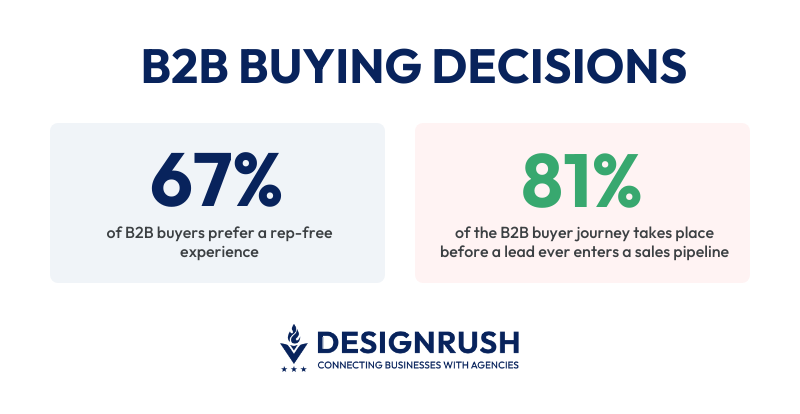
Modern B2B buying decisions involve complex buying committees: according to Gartner research, 67% of B2B buyers prefer a rep-free experience, while Dreamdata reporting highlights that 81% of the B2B buyer journey takes place before a lead ever enters a sales pipeline.
Data sourcing and prospect research
The lead generation agency builds lists of contacts that fit your ICP. Sources may include data providers, public information, and manual research. List quality varies widely, so verification matters, especially as generating quality prospects grows increasingly competitive.
Cold email outreach
The lead gen agency writes and sends email sequences to prospects. Some providers use dedicated sending domains or subdomains and gradually ramp up sending volume to isolate outbound-email deliverability risk from the primary corporate domain. This setup is not universal, so clarify ownership and configuration.
Technical setup directly impacts performance, given that platform benchmarks from Instantly show average B2B cold email response rates floating around 3.4% to 5.1%.
Cold calling and LinkedIn outreach
Callers or sales development reps contact prospects by phone. LinkedIn outreach uses connection requests and messages. LinkedIn prohibits unauthorized bots, scraping, and automated messaging, so clarify which tools the provider uses and whether they comply with platform rules.
When executed properly, paid social channels stand out: data from Dreamdata shows that LinkedIn Ads delivered a 121% return on ad spend for B2B marketers.
Lead qualification and appointment setting
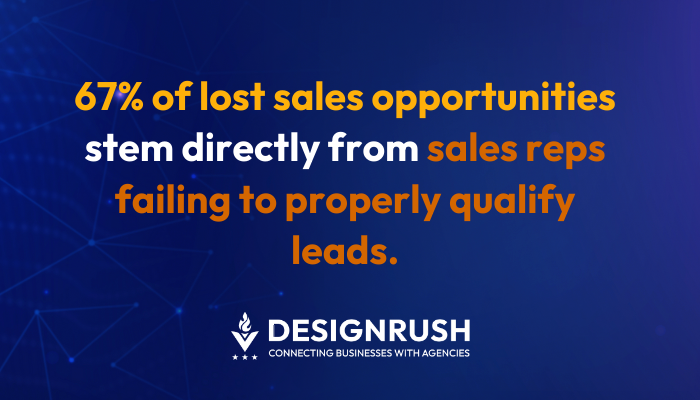
Qualification checks whether a prospect meets your criteria. Appointment setting books meetings on your sales team's calendars. Strong qualification prevents costly sales drop-offs, as a study cited by Landbase Benchmarks indicates that 67% of lost sales opportunities stem directly from sales reps failing to properly qualify leads.
CRM setup and handoff
The B2B lead generation agency passes leads into your CRM with notes and history. Some providers also set up fields, stages, and reports.
Reporting and optimization
Reports from a sales lead generation company may show outreach volume, reply rates, booked meetings, and lead acceptance by your sales team. Optimization adjusts targeting and messaging based on results.
What is the difference between inbound and outbound lead generation?
Outbound lead generation contacts people who have not reached out to you, through email, calls, or LinkedIn. Inbound lead generation attracts people who find you, through content, search, ads, and offers.
Inbound work often involvesPPC agencies,content marketing agencies, orSEO agencies. B2B lead generation services often focus on outbound. Some providers, such as a full-service lead generation marketing agency, combine both.
Does a lead gen agency close sales for me?
In many engagements, no. The provider's work commonly ends at a qualified lead or booked meeting. Your sales team runs the conversation and closes the deal.
Some providers offer outsourced sales teams that go further. Clarify where the handoff happens before work starts.
Who owns the lead data and prospect lists?
Ownership varies by contract and data source. Some data providers license contacts for a limited use instead of selling them outright.
The buyer should clarify who owns the lists, outreach history, and replies after the contract ends. In paid lead models, also clarify whether the same lead is sold to other companies.
Privacy and outreach rules differ by country and channel. Examples include CAN-SPAM for U.S. commercial email, GDPR and ePrivacy rules that may apply to EU/EEA direct marketing, and TCPA-related rules for certain U.S. telemarketing calls and texts. Clarify with your legal team which rules apply to your campaigns.
Which services are included, and which may cost extra?
The core engagement fee usually covers the work itself, but the total cost depends on how the extras are billed.
Some items are one-time setup costs, while others, such as data and software licenses, recur every month for as long as the campaign runs.
When a provider passes through third-party costs, ask whether they add a markup and whether those tools stay with you if the contract ends.
It also helps to ask how the provider handles leads or meetings that don’t meet your agreed criteria, since some offer replacements or credits and others don’t.
Item | How it is commonly scoped |
ICP definition and messaging | Commonly part of the engagement |
Outreach execution and qualification | Commonly part of the engagement |
Reporting | Commonly part of the engagement |
Prospect data | May be included or billed as a third-party cost |
Sending domains and inboxes | Often a setup cost |
Outreach and calling software | May be included or billed separately |
CRM setup or cleanup | Often separately scoped |
Paid ads for inbound leads | Specialist or adjacent service, plus media spend |
Which lead generation services do I need?
The right lead generation services depend on where your sales process is breaking down, so start by matching your current situation to one of the scenarios below:
- You have a sales team but too few conversations. You may need outbound outreach with appointment setting.
- You have no clear target market yet. You may need ICP work and testing before scaling outreach.
- Your team has good data but no time to reach out. You may need outreach execution only.
- Buyers already search for your product. You may get better results from inbound channels such as search ads or SEO, often run by a lead generation marketing company.
- Your leads pile up unworked. You may need qualification and CRM handoff more than new leads.
To compare providers, read the guide to choosing a lead generation company.