Our directory highlights top event marketing agency options in the US, evaluated across five core ranking criteria and reviewed by a team of 12 experts, with support from over 100 verified client reviews - helping you identify the right partner with confidence.
Discover Event Marketing Companies in the US
Event marketing companies are evaluated based on strategic expertise, execution quality, and verified client feedback to help businesses choose confidently. Some listings may include paid placements.
Strategic UX and design.Bespoke, multi-platform programs.Connection and engagement.Authentic storytelling and public relations.Leveraging our experience, humility, and values, Anomali by Design connects with peoplewherever they're at, agnostic of circumstance...
Top Services:
Design Services
Product Design
UI/UX Design
Digital Marketing
Social Media Marketing
Show more
Location
Chicago, Illinois
Number of Employees
Under 49
Average Hourly Rate
$180/hr
Minimal Budget
$25,000 - $50,000
Portfolios Count
3 Projects Listed
Anomali by Design Services
Design Services
Product Design
UI/UX Design
Digital Marketing
Social Media Marketing
eCommerce Development
Event Marketing
Web Design
Graphic Design
Digital Strategy
Data sourced from the agency's DesignRush profile, its website, and other relevant accounts
What types of businesses usually work with these types of companies?
They serve a wide range of industries, including:
B2B technology and SaaS companies represent a significant portion of the market, using events to demonstrate products and generate qualified leads. According to statistics, corporate events, including trade shows, seminars, and product launches, account for 27.8% of the global events industry market.
Enterprise servicesfirms rely on conferences and executive briefings to build relationships with decision-makers.
Consumer brands invest heavily in experiential activations to create memorable interactions with their target audiences.
Fintech companies use events to build trust in an industry where credibility matters enormously.
Healthcare and pharmaceutical organizations host educational conferences and product launches with strict compliance requirements.
Educational institutions and associations depend on annual conferences as major engagement and revenue drivers.
Media companies produce events ranging from intimate networking sessions to massive festivals.
Trade associations bring entire industries together through exhibitions and annual meetings.
Event marketing companies typically provide the following services:
Event strategy development: Aligning event goals with business objectives and audience needs
Experiential marketing: Creating immersive brand experiences that drive emotional connection
Trade show management: Covering design, staffing, logistics, and lead capture
Product launches: Orchestrating memorable reveals that generate buzz and coverage
Conference production: Speaker management, session programming, and attendee experience
Brand activations: Pop-up experiences, sponsorship activations, and guerrilla marketing
Logistics coordination: Venue selection, vendor management, and timeline execution
Production services: Staging, audiovisual, lighting, and technical direction
Post-event reporting: Analytics, ROI measurement, and recommendations
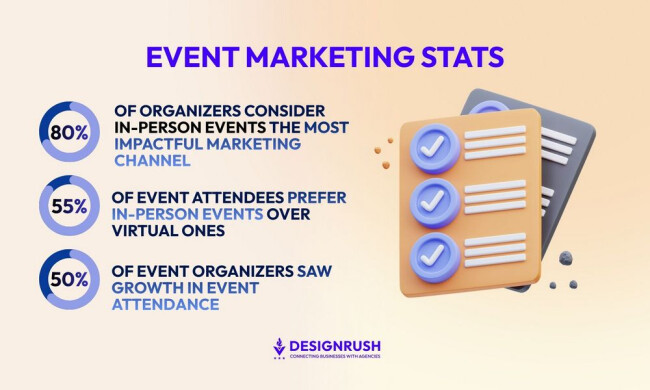
According to Bizzabo's 2024 data, 78% of organizers identify in-person events as their organization's most impactful marketing channel, driving demand for these specialized services.
How much does event marketing cost?
The costs vary significantly based on scale, complexity, and objectives. According to Amex report, on average, 14% of a marketing budget goes toward event marketing. Furthermore, according to statistics, U.S. companies spend approximately $122 billionevery year on event marketing.
Event size
Cost
Small events (intimate product launches, executive dinners, or localized brand activations)
$15,000-$40,000
Mid-sized events (regional conferences, multi-day trade show presences, or larger product launches)
$75,000-$250,000
Large-scale or multi-city events, including national conferences, major experiential campaigns, or flagship annual events
$500,000+
According to GoGather's benchmarking data, the typical conference budget in the United States is approximately $1.89 million, accommodating an average of 601 attendees, with a per-person expenditure of about $3,144.
What additional costs should I expect when working with these types of agencies?
Beyond base agency fees, several additional expenses commonly arise during event execution.
Typical additional costs include:
Venue rental: One of the largest line items, varying dramatically by location and prestige
Travel and accommodation: For staff, speakers, and sometimes attendees
Event staffing: Registration personnel, brand ambassadors, and technical crew
Permits and insurance: Required for many public or large-scale events
AV equipment: Sound systems, screens, lighting, and technical infrastructure
Catering: Food and beverage accounting for roughly 30% of the total budget
Insurance coverage: Liability and cancellation protection
Post-event content: Photography, videography, and content repurposing
According to GoGather's data, food and beverage alone accounts for 29.9% of the total conference budget, with an average spend of $565,000, translating to approximately $940 per attendee.
The additional costs typically add 25% to 50% to base budgets, depending on event scope and production requirements.
How long does it take to plan and execute an event marketing campaign?
Event planning timelines depend heavily on scale and complexity.
Type of event
Timeline
Simple activations or smaller gatherings
6 -8 weeks
Corporate events
3-6 months
Larger conferences, major trade show presences, or experiential campaigns
9-12 months (planning should begin 12-18 months before the event)



 Proposals