
A client who hired you for web design or paid ads now wants to rank in the map pack. You don't have a local SEO specialist, and hiring one takes months you don't have.
We’re going to go through two options: build the capability in-house or white-label it to a fulfilment partner.
Which one wins depends almost entirely on how many local clients you have and how many you can realistically sell. This guide runs the math, then names five providers worth shortlisting if partnering is the answer.
White Label Local SEO: Key Findings
- White labeling is cheaper below roughly nine accounts in the model, while bringing SEO in-house becomes more practical closer to 15 stable accounts.
- A 100% wholesale markup can still leave just a 15% margin once account management, reporting, tools, and rework are included.
- Provider strengths vary: Boostability combines fulfillment with sales support, WebSpero specializes in AI-search visibility, and The HOTH offers flexible à la carte SEO delivery.
What White Label Local SEO Actually Is
White label local SEO is local search work performed by a specialist provider and sold by an agency under its own brand. The agency owns the contract, pricing, and client relationships. The provider handles production and does not appear to the end client.
You pay a wholesale rate per client per month. You set the retail price. The difference, minus your own costs, is what you keep.
White label and reseller describe the same arrangement from different angles:
- The first emphasizes whose brand appears on the work.
- The second emphasizes the wholesale-to-retail transaction.
Most providers use the terms interchangeably.
Why the White Label Local SEO Model Works for Both Sides
Understanding the incentives on both sides helps explain why white-label partnerships can remain stable and where the trade-offs sit.
What You Get as the Reseller
You avoid the cost and delay of hiring in-house.
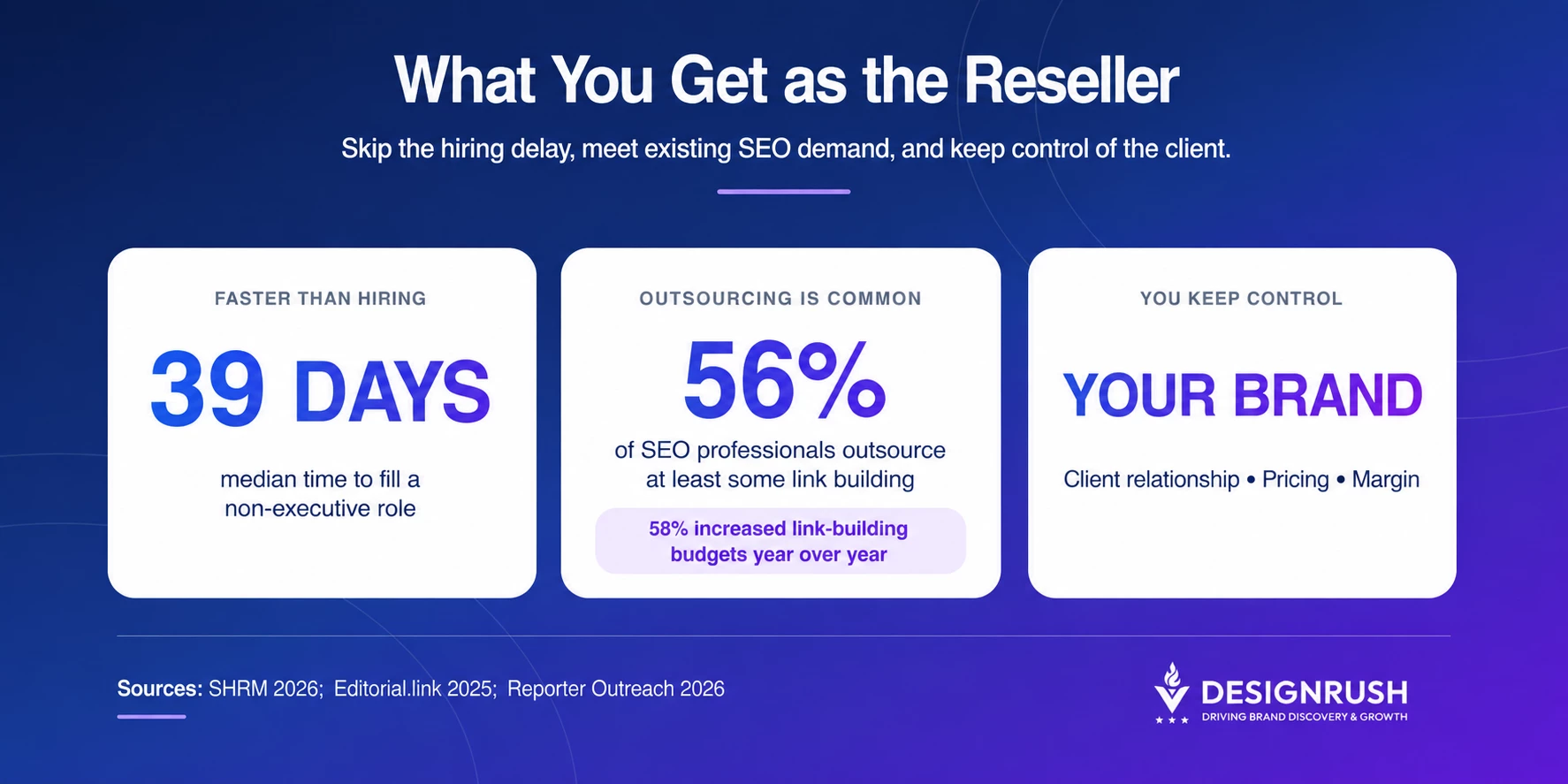
SHRM puts the median time to fill a non-executive role at 39 days in 2026, before onboarding and ramp time. A white-label partnership can close that gap much faster. We’re talking about the total cost below.
Outsourcing is already common in SEO.
Editorial.link’s 2025 survey found 56% of SEO professionals outsource at least some link building, while a 2026 Reporter Outreach survey found 58% increased link-building budgets year over year.
You also keep control of the client relationship, brand, pricing, and margin. Fixed wholesale costs make unit economics predictable, although no reliable independent benchmark exists for typical white-label margins.
What the Provider Gets
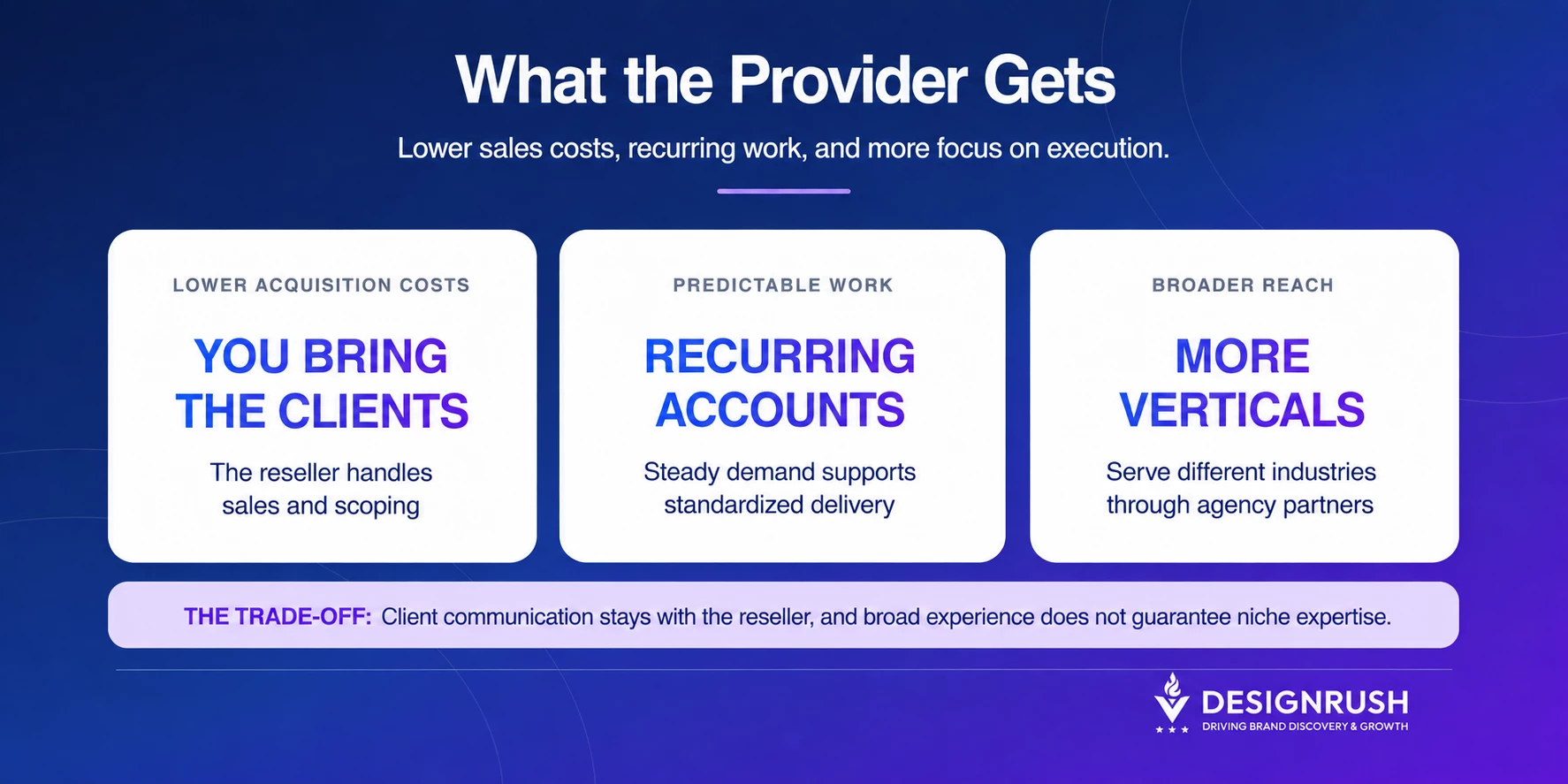
Providers benefit from lower acquisition costs and predictable recurring work. You handle sales, scoping, and client management, allowing them to standardize delivery and focus on execution.
They can also serve multiple industries through reseller partners without building separate brands in each.
The trade-off is that client communication remains your responsibility, and broad experience across verticals does not guarantee expertise in yours.
What's Included in White Label Local SEO Services
The tiers differ in volume and frequency rather than in kind, so when you are comparing quotes, compare units, for example, how many citations, how many pages, how many links per month and not only service names.
- Local SEO audit that covers a baseline assessment of the profile, website, citations, and competitors.
Check whether the provider performs it only during onboarding or repeats it quarterly.
- Google Business Profile setup and optimization covering categories, services, attributes, posts, photos, and NAP accuracy.
Confirm what access they require and who retains ownership of the profile.
- Citation building and NAP cleanup to keep business names, addresses, and phone numbers consistent across directories and correct inaccurate listings.
Ask how many citations the package includes each month and whether cleanup costs extra.
- Local content strategy and production for city pages, service landing pages, and supporting content.
Clarify expected word counts, who writes the content, and whether someone reviews it before publication.
- Review generation and management through review-request workflows, monitoring, and drafted responses.
If the provider will respond directly, make sure the process complies with Google’s requirements for third parties acting on behalf of a business.
- Local and geo-relevant link building through editorial placements, directories, and local partnerships.
Ask exactly where and how the provider sources links, since unclear sourcing can introduce quality and spam risks.
- Rank tracking and white-label reporting through keyword or geo-grid tracking and branded dashboards.
Confirm whether you receive live dashboard access, scheduled reports, or both.
Two additional notes on scope that catch resellers out:
- Anything requiring CMS or hosting access, including technical fixes, page publishing, and schema, depends on your client granting it, and delays there are the most common cause of a slow first month.
- And a provider still selling Google Business Profile Q&A management as a monthly line item is working from an outdated sheet: Google discontinued the Q&A API on 3 November 2025.



In-House vs. White Label Local SEO for Agencies: What It Costs and What You Keep
Both routes arrive at very different cost structures, and the gap between them moves with the number of accounts you are running.
What follows breaks each route into three questions: what it costs to operate, what you actually keep once your own time is counted, and what you are obliged to tell your client either way.
Every figure is illustrative, and the point is the structure, so replace each line with yours.
Building the Capability In-House
What It Costs
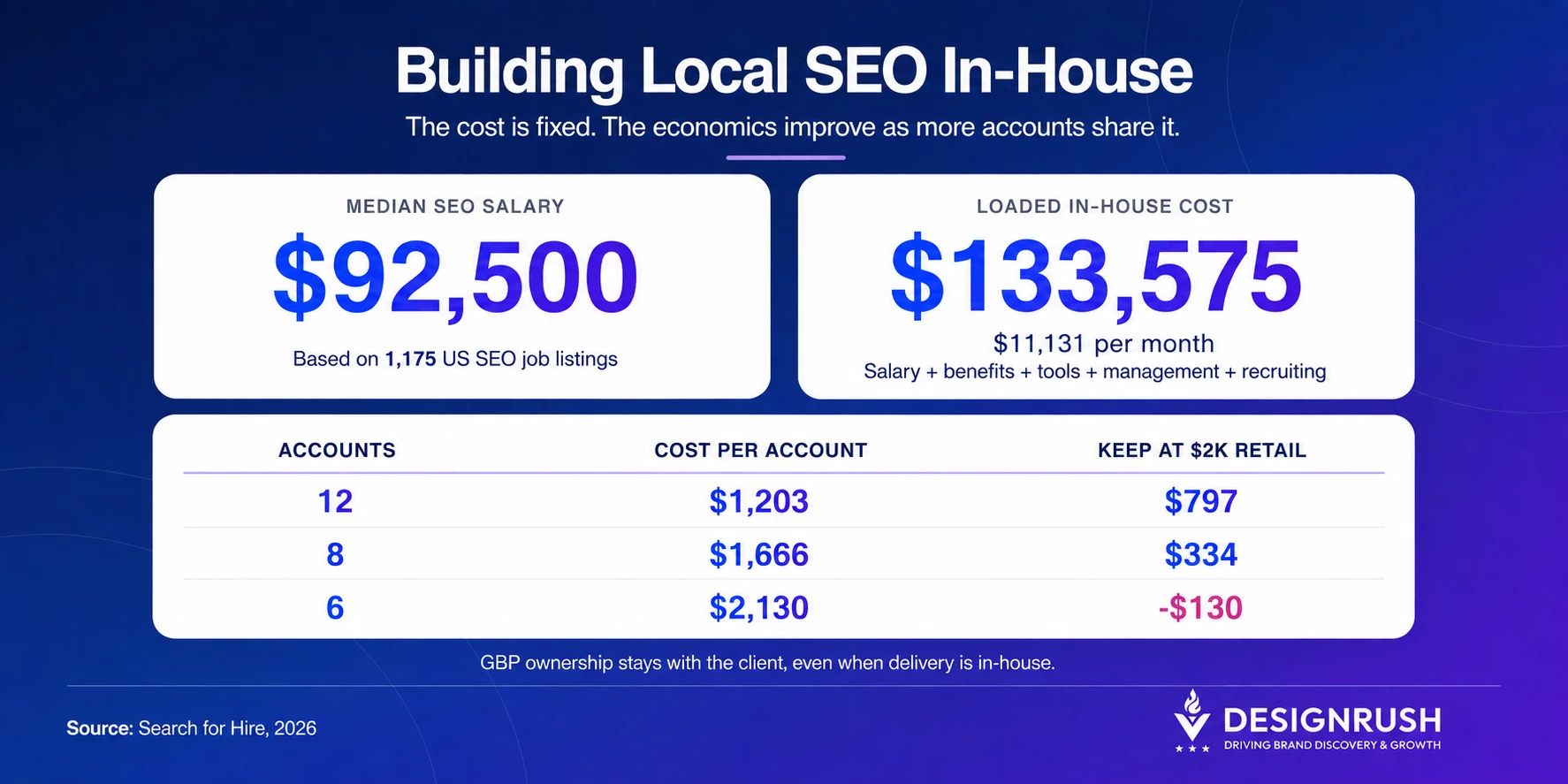
Start from the salary and work outward. Search for Hire’s 2026 analysis of 1,175 US SEO job listings found a median salary of $92,500, with the middle 50% ranging from $72,500 to $125,000.
- Specialist salary (median, 1,175 US listings): $92,500
- Employer taxes and benefits at 25%: $23,125
- Tools, data and rank tracking: $4,800
- Management time (2 hrs/week at your rate): $10,400
- Recruitment, amortized over 24 months: $2,750
- Annual loaded cost: $133,575
- Monthly: $11,131
That figure is fixed. What moves is how many accounts you divide it across, plus the per-account time that exists whichever route you take:
At capacity | Specialist cost per account | Plus AM, comms, sales amortisation, rework | Total per account |
12 accounts | $928 | $275 | $1,203 |
8 accounts | $1,391 | $275 | $1,666 |
6 accounts | $1,855 | $275 | $2,130 |
What You Keep
Everything above your retail price minus that per-account figure. At twelve accounts billed at $2,000, you keep roughly $797 each, which is the best margin of any route in this guide.
At eight, you keep $334. At six, you are $130 underwater on every account paying for capacity you have not sold.
You also keep the capability itself. It compounds, it differentiates you, and it does not walk out with a vendor relationship. But it does walk out with the employee, which is the risk you are swapping for.
What You Have To Disclose
Less than most agencies assume, but not nothing, and specifically not nothing just because the work is internal.
Google's Business Profile third-party policies apply to any party managing a profile it does not own. An in-house agency team is still a third party in Google's framework.
That means:
- Your client retains ownership or co-ownership of their Business Profile at all times.
- If you charge a management fee, you tell them in writing, before you start and on invoices, that Business Profile itself is free.
- You link Google's "Working with a third party" notice somewhere discoverable on your site.
- You get explicit approval before responding to reviews on their behalf.
- You do not guarantee placement.
That is the baseline and it applies to you whether you built the team or bought it.
White-Labeling The Delivery
What It Costs
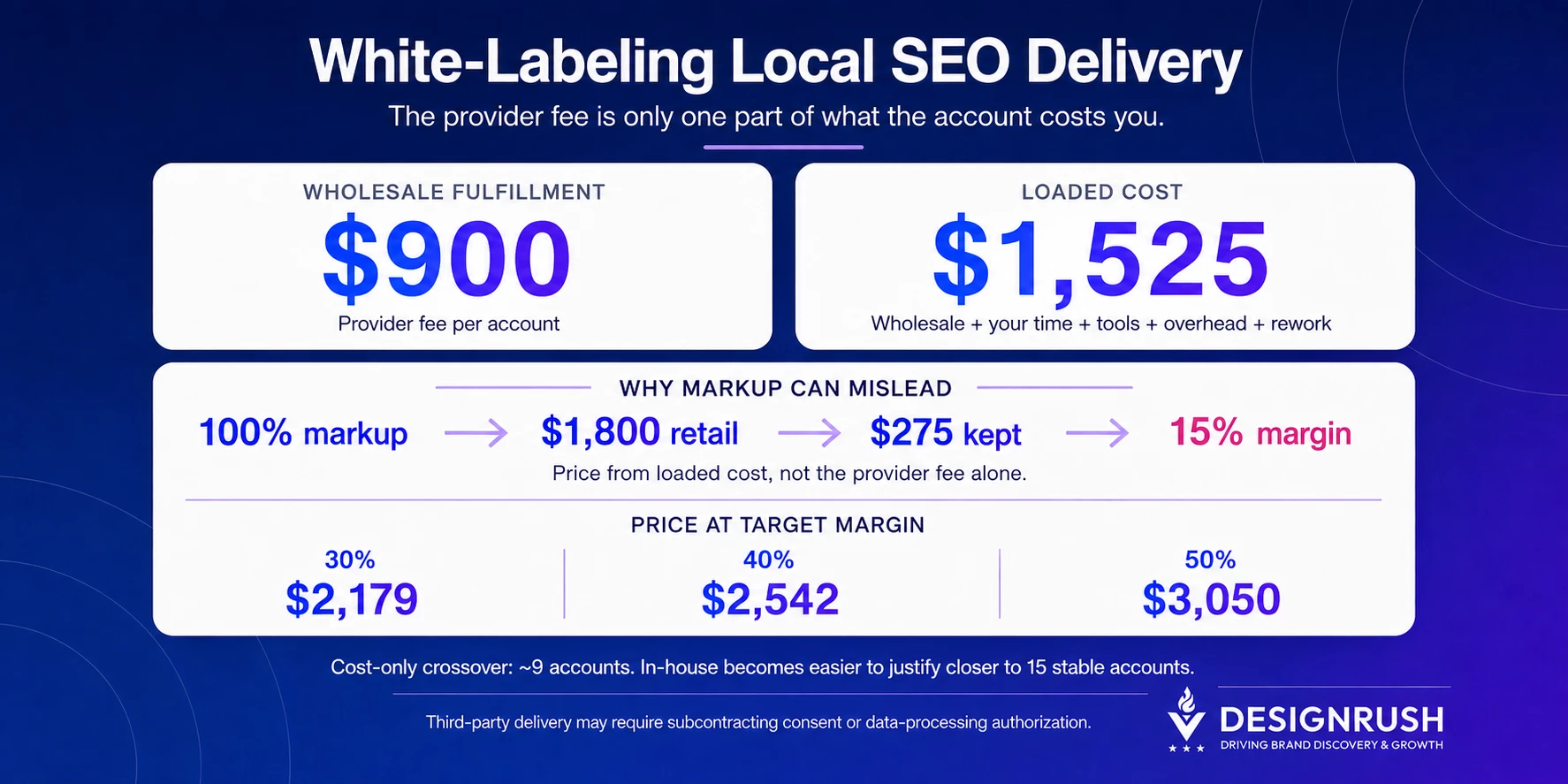
When you price white-label local SEO, separate what the provider charges you from what the service actually costs you to deliver. The wholesale fee is only one part of that cost because you still spend time on client communication, reporting, account management, and any work that stays in-house.
There is no independent benchmark for white-label local SEO pricing, so published industry averages need some caution. Most come from providers selling the service themselves.
To put a realistic value on your own time, we sampled 50 consecutive listings from DesignRush’s US local SEO directory, which contained 3,083 companies in August 2026.
Among the agencies that disclosed pricing, the median advertised rate was $99 per hour, while the middle 50% ranged from roughly $28 to $125. Two-thirds also listed minimum engagements between $1,000 and $10,000.
Those figures represent retail agency pricing, not wholesale white-label rates, and they come from self-reported listings rather than a random market sample.
Their value is therefore as a pricing anchor rather than an industry benchmark. For the cost model below, the $99 median gives us a reasonable basis for valuing your agency’s own time at about $100 per hour instead of choosing an arbitrary figure.
- Wholesale fulfilment: $900
- Account management (2 hrs at $100): $200
- Reporting and QA (1 hr): $100
- Client communication (1.5 hrs): $150
- Sales and onboarding, amortized over 12 months: $75
- Tools and overhead allocation: $50
- Rework allowance: $50
- Loaded cost per account: $1,525
This is flat and it does not care whether you have three accounts or thirty.
What To Charge
You may have stumbled upon white-label pricing guides recommending marking up the provider’s fee by 50% to 100%, which would turn a $200 wholesale package into a $300 to $400 client fee or a $900 package into $1,350 to $1,800.
The problem is that this approach treats the provider’s fee as your entire cost when it is only one part of what you spend to service the account.
The difference becomes clear once you include your own delivery costs. If the provider charges $900 and you apply a 100% markup, your client pays $1,800.
If your loaded cost, including account management, reporting, communication, tools, onboarding, and expected rework, reaches $1,525, you keep only $275.
That leaves a 15% contribution margin, despite applying what sounds like a generous 100% markup.
Lower-priced packages can leave even less room. If you buy a service for $200 and charge $400, spending just one hour a month on the client at the $99 median agency rate brings your loaded cost to roughly $320 before additional tools or rework.
You are left with about $80, or a 20% contribution margin.
A more reliable approach is to set the price from your total cost:
- Calculate the loaded cost of each account by adding the wholesale fee to the value of your time spent on account management, reporting and client communication, plus tools, onboarding, sales costs, and a reasonable allowance for rework.
- Set the contribution margin you need the account to produce after those delivery costs. For example, if you require a 30% margin, build the price around that target rather than applying an arbitrary markup to the provider fee.
- Calculate the retail price as loaded cost ÷ (1 − target margin). At a loaded cost of $1,525, that means charging about $2,179 for a 30% margin, $2,542 for 40%, or $3,050 for 50%.
- Use your loaded cost to establish the minimum price the account can sustainably support, then consider what the outcome is actually worth to the client.
Rankings.io CEO Chris Dreyer argues that SEO pricing should reflect ROI as well as delivery cost: “Pricing isn’t about time; it’s about results.”
A local SEO campaign that generates high-value legal cases, for example, can create substantially more value than the same increase in traffic for a lower-ticket business. Factor customer value, conversions, and potential ROI into the final price, while keeping your loaded cost as the floor you do not discount below.
This is why two agencies buying the same white-label package, or even two clients receiving similar work, can reasonably end up at different prices.
What You Keep
At a $2,000 monthly client fee and a loaded delivery cost of $1,525, the account contributes $475 per month. Raise the client fee to $2,400 with the same delivery cost and that contribution increases to $875.
With white labeling, this per-account cost remains relatively consistent as you add clients because you are buying delivery account by account.
That changes when you compare white labeling with hiring in-house.
Using the costs in our model, the two options break even at roughly nine accounts.
Below that point, white labeling costs less because you are not carrying a full-time salary; above it, an in-house hire becomes cheaper per account as the fixed employment cost is spread across more clients.
Nine accounts should not automatically trigger a hire, however, because that calculation measures cost alone. It does not account for recruitment and ramp time, unused capacity if demand falls, or the delivery risk created when several accounts depend on one employee.
For that reason, the decision should depend on sustained workload rather than simply reaching the mathematical break-even point.
In this model, moving closer to 15 stable, forecastable accounts gives you more room to justify the fixed cost and operational risk of bringing delivery in-house.
What You Have to Disclose
Everything in the in-house list above, plus two obligations that only exist because a third party is now involved:
- Subcontracting consent. Check whether your own client agreement permits you to subcontract at all. Many are silent; some prohibit it without written consent. This is a contract question, not a Google one.
- Sub-processor authorization. Where UK or EU data protection law applies, Article 28 of the GDPR requires a processor to obtain the controller's prior specific or general written authorization before engaging another processor, to notify the controller of intended changes, and to bind the sub-processor to equivalent obligations by contract.
Your provider does not need to appear in client-facing reports or communications simply because they perform the work, but you cannot promise complete invisibility when your contract or applicable data protection rules require the client’s knowledge or authorization.
Top White Label Local SEO Agencies
We give more weight to case studies that connect SEO improvements with leads, transactions, or revenue.
As Omniscient Digital’s Co-Founder Alex Birkett explains, SEO measurement should ultimately map to a meaningful business metric rather than stopping at traffic.
- Boostability: Best for Scalable White-Label SEO
- WebSpero: Best for Agencies Whose Clients Need AI-Search Visibility
- Wildnet Technologies: Best for Fulfilment Across Multiple Channels
- The HOTH: Best for Buying Individual Deliverables Without a Retainer
- SEO Sherpa: Best for Competitive and International Markets
1. Boostability: Best for Scalable White-Label SEO
Boostability provides white-label SEO and local marketing for agencies that want to outsource fulfillment while keeping services under their own brand.
Its offering covers local SEO, Google Business Profile optimization, content, link building, and AI search visibility, with different partnership models depending on how much of the delivery and client relationship the agency wants to manage.
Sales support is also included for partners at no additional cost. Boostability can join prospect calls as an extension of the agency’s team or operate fully under its brand, giving agencies support with both selling SEO and delivering it.
- Agency services:
- SEO
- Digital Marketing
- PPC
- Web Design
- Minimum budget: Under $1,000
- Notable clients: 11th Street Coffee, Mizuta & Associates Physical Therapy, Bob Leverone Photography
What Clients Say
Reviewers who are themselves agency owners describe the white-label mechanics working as intended.
One agency partner reports offering SEO under his own brand with clients seeing ranking improvements, and singles out transparent reporting and named account managers.
Another describes an eight-year relationship, citing competitive rates and a team that takes initiative on work the client hasn't asked for.
A direct client reported organic traffic moving from roughly 300 to 2,400 over three months, verified against their own Analytics and Semrush data rather than the supplied dashboard.
What Sets the Agency Apart
The clearest example comes from a digital services agency that offered web development, advertising, and PPC but had no dedicated SEO offering.
Instead of hiring an internal SEO team, it used Boostability for fulfillment, reporting, retention, and sales support, launching the new service within two weeks.
Boostability reports that the partnership produced:
- 2 SEO accounts in the first month, increasing to 84 by month three.
- $1.5 million in revenue during the first 12 months.
- $200,000 in average monthly revenue after scaling.
- Recurring contract renewals managed through Boostability’s renewal team.
2. WebSpero: Best for Agencies Whose Clients Need AI-Search Visibility
WebSpero Solutions provides SEO, local optimization, paid media, and development services, with a separate white-label SEO offering for agencies.
Its strongest differentiator is its dedicated Generative Engine Optimization practice, which covers AEO, LLM SEO, and Google AI Overviews rather than treating AI visibility as an add-on to traditional SEO.
That makes it particularly relevant for agencies whose clients are starting to ask about visibility beyond Google’s conventional search results and want evidence that a fulfillment partner has already worked on AI-search campaigns.
- Agency services:
- SEO
- Digital Marketing
- Public Relations
- Social Media Marketing
- Minimum budget: $1,000-$10,000
- Notable clients: BYJU'S, BetterHelp, Media.Net, Betway, Couture Candy
What Clients Say
WebSpero has a 5.0 rating across 35 DesignRush reviews and 4.9 across 115 Google reviews. DesignRush reviewers consistently mention responsive communication, regular reporting, and a willingness to adjust strategy as campaigns develop.
One client reported seeing improvement within 60 days after spending close to a year with a previous provider, while another specifically highlighted its support with GEO, SEO, and market-specific local optimization.
What Sets the Agency Apart
WebSpero stands out for publishing specific AI-search results at a price point that could be practical for agencies reselling the work. Its DesignRush portfolio includes several GEO engagements with disclosed timelines, budgets, and outcomes.
Reported results include:
- 309% increase in traffic from AI search results over four months.
- 181.3% increase in traffic from AI Overviews over six months.
- 119% increase from a longer GEO engagement running from 2024.
- Under $5,000 project budgets reported for all three case studies.
3. Wildnet Technologies: Best for Low-Cost Multi-Channel Fulfillment
Wildnet Technologies provides white-label SEO, PPC, content, social media, development, and staff augmentation for agencies that want to outsource several services through one partner.
Its combination of a 250-499-person team and a listed average rate of $20 per hour makes it particularly suited to agencies prioritizing breadth and lower fulfillment costs.
Unlike providers focused primarily on SEO, Wildnet can support bundled retainers across organic search, paid media, content, and development, reducing the need to coordinate separate fulfillment vendors.
- Agency services:
- SEO
- Social Media Marketing
- Digital Marketing
- PPC
- Minimum budget: $1,000-$10,000
- Notable clients: Air India Express, Hitachi, Acko, Dainik Bhaskar, Rentomojo, Online Manipal
What Clients Say
Reviewers commonly mention responsive communication, professionalism, and the ability to handle several digital services.
One client credits its combination of SEO, content, and paid advertising with improving rankings and sales.
What Sets the Agency Apart
Wildnet’s main advantage is the range of services it can fulfill under one white-label relationship at a comparatively low listed rate.
Its published white-label SEO case study also provides an example of the reseller model in practice. Wildnet worked behind an agency serving a US eCommerce client, beginning with a technical audit before moving into content and on-page optimization.
Reported result:
- 50% increase in organic traffic within three months.
4. The HOTH: Best for Buying Individual Deliverables Without a Retainer
The HOTH offers white-label SEO through a highly productized model that lets agencies purchase individual services such as link building, content, technical SEO, and local optimization without committing every client to the same monthly program.
For agencies with changing fulfillment needs, that makes it easier to buy specific deliverables when they are needed and build them into their own packages.
Agencies that want more support can move to HOTH X, its managed service, which adds a US-based campaign manager and customized SEO strategy.
- Agency services:
- SEO
- Digital Marketing
- Minimum budget: $1,000-$10,000
- Notable clients: Adobe, Lenovo, HelloFresh, Tripadvisor
What Clients Say
Clients highlight responsive service, straightforward account management, and an easy-to-use platform, while one link-building client specifically praised pricing, execution, and their dedicated account manager.
What Sets the Agency Apart
Its reseller case study follows a regional advertising agency that began with a single link-outreach order in 2018 and subsequently expanded the relationship into full-service SEO.
Reported partnership and campaign evidence includes:
- A 2x year-over-year increase in their total net income.
- Considerable boosts in organic traffic and referring domains for 28+ client websites.
- A 150% increase in online visibility, a 2x increase in leads, and a 135% increase in sales for their clients.
- More robust backlink profiles and dominant SERP rankings.
5. SEO Sherpa: Best for Competitive and International Markets
SEO Sherpa offers white-label SEO for agencies and consultants that want to outsource either complete campaigns or individual parts of delivery.
Its partner program covers keyword research, technical implementation, content, and link building, with white-label reporting, dashboards, and communication designed specifically for resellers.
Its international team and experience with larger, competitive accounts make it a stronger fit for agencies serving multiple markets or clients that need deeper technical and content work rather than standardized local SEO packages.
- Agency services:
- SEO
- Digital Marketing
- PPC
- Minimum budget: $1,000-$10,000
- Notable clients: Amazon, Citibank, Farfetch, Nissan, HSBC
What Clients Say
Clients frequently highlight technical knowledge, organization, timely delivery, and strategic advice. Several reviews also describe the team as proactive and transparent rather than simply executing a fixed list of tasks.
These reviews come from direct clients, however, so they speak more clearly to SEO delivery than to the experience of using SEO Sherpa behind another agency’s brand.
What Sets the Agency Apart
Its JA Resorts case study shows the level of technical and commercial measurement it brings to larger campaigns. SEO Sherpa restructured and migrated the hospitality group’s website before rebuilding its content and authority strategy.
Reported results include:
- 510% increase in organic traffic.
- Roughly 1,000% increase in organic transactions.
- 863% increase in organic revenue.
- $95,499 in additional monthly revenue.
- At least $25 returned for every $1 invested from the fifth month onward.
How To Evaluate a White Label Local SEO Provider
Start with evidence that the provider can understand the businesses you serve, rather than looking for an agency that simply specializes in the same industry.
Alex Moss, Principal SEO at Yoast, advises asking whether the team understands your business and has relevant results to support its approach. Industry specialization alone is not enough.
As he puts it, “Ask for case studies, and how it applies to your own brand.”
Treat those case studies as a starting point for due diligence. Ask what the provider actually changed, which business outcome improved, and why the same approach makes sense for your client.
Moss also recommends looking at whether the agency has genuine authority in the area of SEO you are hiring it for and whether that expertise can strengthen your client’s position.
Once that fit is established, score the provider on the operational details that determine whether the white-label relationship will work.
Every provider will give you an answer to each, but you need to know if the answer is specific.
Score each out of two: two for a specific, verifiable answer, one for plausible but vague, zero for deflection. Below eight out of twelve, you are hoping rather than choosing.
What to score | A good answer sounds like | Walk away if |
Fit for non-SEO sellers | Named sales support, someone joining live prospect calls under your brand, collateral you could send tomorrow | "We'll give you a deck" which assumes you already know how to sell search |
Entry floor | No minimum account count, a short initial term, a single test account welcomed | Annual lock-in before you have seen a month of their work |
Fulfilment model | A straight answer on in-house versus subcontracted, where the team sits, and who writes the content | Vagueness about who does the work, or a subcontractor chain they will not name |
Branding integrity | Dashboard on your domain, your logo, their name absent from every client-facing artefact including email headers | Their branding "just on the login screen" and your client will see it |
Compliance posture | They request manager access, explain why, and know the ownership rule without being prompted | They ask for owner access by default, or have no view on the question |
Exit terms | A written offboarding process with a timeline and a named party who initiates it | "That has never come up" |
On pricing claims specifically: When a provider quotes a typical partner markup, convert it to margin before you react, then run it through the cost-based framework above. A headline markup describes their pricing, not your profit.

Our team ranks agencies worldwide to help you find a qualified partner. Visit our Agency Directory for the top SEO agencies, as well as: