Hiring Guide: How to Choose the Best Translation Company in the US Table of Contents
How do I choose the right agency for my business? Finding the right agency starts with understanding your own needs.
Identify your content type: is it legal, medical, technical, or marketing material? Each requires different expertise.
A contract needs a certified legal translator, while a product launch campaign benefits from transcreation specialists who understand cultural nuances.
Next, define your target markets. If you're expanding into five countries, you need an agency with native speakers in each language pair.
According to research, 75% of buyers said that they prefer to do their shopping from sites in their native language.
Look for translation services companies with proven experience in your specific industry and ask for case studies or client references in your sector.
Quality assurance processes matter more than you might think.
The top translation agencies use the TEP model (translation, editing, proofreading), where a second linguist reviews all work.
Ask about their use of translation memory software, which maintains consistency across projects and can reduce costs by up to 90% on repetitive content.
Check if they hold ISO 17100 certification , which ensures professional translation standards.
With the global language services market valued at $75.5 billion 4.4% annually , you have plenty of providers to choose from keeping in mind that an informed selection matters more than availability.
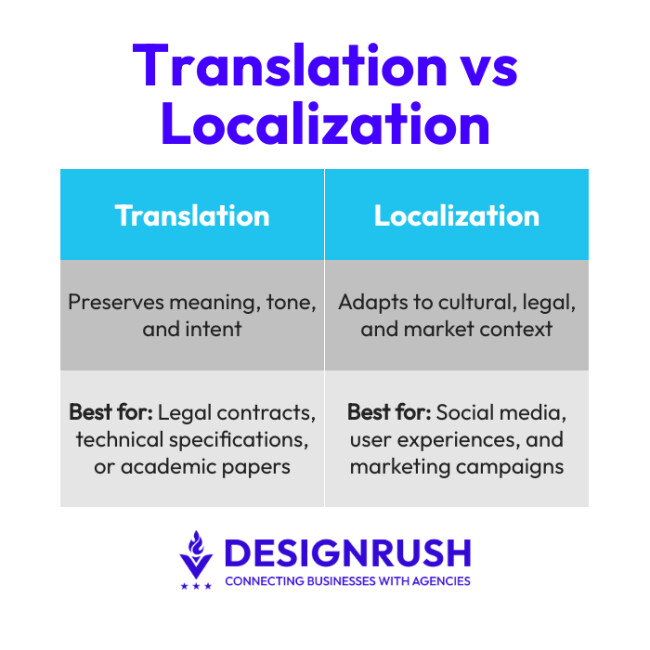
What is the difference between translation and localization services? Translation focuses on converting text accurately from one language to another.
A good translator preserves meaning, tone, and intent while producing grammatically correct output in the target language.
Such a process works well for documents where precision matters most: legal contracts, technical specifications, or academic papers.
Businesses that invested in translation were 1.5 times more likely to observe an increase in revenue.
Localization goes further because it adapts content to fit the cultural, legal, and market expectations of a specific region.
The process includes adjusting date formats, currencies, measurement units, colors, images, and even humor.
Localized social media content has shown organic performance improvements of up to 2,500%, according to industry research.
Meanwhile, 84% of marketers report that content localization helped grow their revenue.
For software and apps, localization includes adapting UI elements, ensuring text fits buttons and menus, and testing functionality across regions.
Furthermore, 86% of localized mobile advertisements performed better than their English counterparts, showing a 22% and 42% increase in conversion and click-through rates respectively.
The best professional translation agencies offer both services, helping you decide what level of adaptation your project needs.
What should I prepare before contacting a professional translation agency? Coming prepared helps you get accurate quotes and a faster turnaround. Here are some things to prepare:
Start by gathering your source files in their original format (Word documents, InDesign files, or whatever you have). Editable formats work better than PDFs, which may require additional formatting charges. List your target languages and any specific regional variants (Latin American Spanish vs. European Spanish, for example). Define your deadlines realistically; remember that quality translation takes time.Provide context about how the content will be used. Will it appear on a website, in print materials, or in legal proceedings? This affects the level of review and certification needed.Share any existing style guides, glossaries, or brand guidelines. If you've had previous translations done, provide those files, as they can be loaded into translation memory systems.Finally, clarify whether you need certified translation, notarization, or apostille services, as these add time and cost to the project. How do I ensure translation quality and consistency over time? To ensure translation quality and consistency over time, consider the following:
Quality starts with proper documentation. Work with your provider to develop glossaries that define key terms, product names, and industry-specific vocabulary. Create style guides that outline your brand voice, preferred terminology, and formatting conventions. Translation memory (TM) technology stores previously translated segments for reuse in future projects. It helps maintain consistency across documents and over time, especially important if you work with multiple translators, and it boosts productivity by at least 30%.Over 50% of professional translators report that agency clients require them to use specific computer-assisted translation (CAT) tools for this reason. Build in quality checkpoints. The industry-standard TEP process ensures every translation is reviewed by a second native linguist. For critical content, add a third review layer with subject-matter experts. Request sample translations before committing to large projects. Establish feedback loops with your provider — regular communication about what's working (and what isn't) improves quality over time. How do I measure whether a translation agency is delivering value? Research shows businesses investing in translation are 1.5 times more likely to see revenue increases.
A professional company should demonstrate clear ROI through improved performance in your international markets.
Here’s how you can measure whether an agency is delivering results:
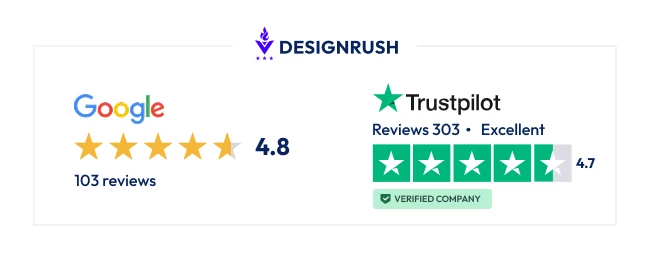
Start with accuracy metrics Monitor revision requests 2 and a maximum of 3 revisions .Consistency matters for brand integrity 95–99% terminology consistency, while inconsistency above 5% often correlates with brand dilution and rework costs of 10%–20% per project.Run spot checks with native speakers in your target markets to catch cultural missteps that automated QA might miss.Look at turnaround performance 95–99% on-time delivery rates. Missing deadlines and late delivery often increase downstream costs by 10%–25% due to rescheduling, expedited reviews, or lost market windows.Consider cost efficiency over time. Translation memory should reduce your per-word costs on similar content as the database grows. Measure business outcomes. up to 70%. Why People Trust DesignRush Rated 4.8 on Google and 4.7 on Trustpilot , DesignRush Agency Directory is a reliable resource for finding translation companies in the United States. We owe this to our executive selection team, which follows a strict screening process when featuring agencies on the platform, assessing key performance indicators, like portfolio, client reviews, and industry reputation.
Learn more about DesignRush Agency Ranking Methodology .
Sources DesignRush sustains a directory of over 40,000 agencies categorized by service category, location, expertise, and reviews. We build our database in two ways:
Our dedicated team of agency experts actively searches the web for top-performing companies. We then pull information from their websites, online presence, and client testimonials to verify their status and qualifications prior to listing. The agencies listed get notified of their profiles on the website and they can choose to claim it or not, which suggests their availability for more collaborations. Agencies can also reach out to DesignRush and must go through the verification process prior to being listed.

 Proposals