Our directory features top ERP companies across 17 US states and has been thoroughly evaluated by our 12 executive experts using our five-step ranking criteria. As such, you can efficiently find a credible ERP partner for your needs.
Discover Top ERP Vendors in the USA
383 Companies-Rankings updated: September 29, 2026
Organic rankings are determined by five factors: top services, reviews, portfolio, awards/press, and team expertise. Sponsored listings pay for a placement that appears above organic positions. Sponsorship does not affect star ratings or review content - read more on our methodology page.
Supporting organizations in redesigning their operational processes, handling vast amounts of data, overcoming challenges, and accelerating business growth with our proven IT strategies and solutions...
Eastern Software Solutions accelerates digital transformation by blending AI-driven automation with deep industry expertise. Through our flagship ebizframe ERP, intelligent RPA bots, BI and custom mobile and web apps, and Oracle legacy system modernization we eliminate workflow bottlenecks and turn scattered...
AptaCloud is your strategic partner for innovative cloud solutions and digital transformation services tailored for the business-to-business market. Since its inception, AptaCloud has dedicated itself to helping enterprises navigate the complexities of modern technology landscapes, optimizing processes...
Experts in full-cycle US medical claims management from charge capture, eligibility checks, and prior approvals to denial handling, payment posting, and AR recovery. Compliant with HIPAA, ICD-10, CPT, HCPCS. Support all payers: commercial, Medicare, Medicaid, TriCare, VA, Workers Comp...
Digital Stratify is a certified Salesforce and RevOps consulting agency for B2B mid-market companies. We are the rare partner that owns both sides of your revenue engine: the RevOps operating model (funnel design, data architecture, forecast methodology) and the Salesforce build (Sales Cloud, Data Cloud...
Hajana Technologies is an AI & workflow automation partner helping U.S. businesses eliminate manual admin tasks. Engineered by enterprise systems architects, we build custom autonomous AI agents, multi-agent workflows, and RAG systems to scale your operations without expanding headcount...
ConsultEvo helps service businesses and fast moving teams streamline operations with ClickUp systems, CRM automation, AI implementation, and custom workflows...
We Help Your Business Grow With Powerful Solutions
We Help Your Business Grow With Powerful Solutions
Texono builds custom mobile, web, and desktop applications for manufacturing companies and machine shops. With a team of 49+ professionals and expertise in .NET, C#, React Native, Angular, Blazor, Azure, and AWS, Texono delivers working prototypes within one week. Every project includes a free 60-day trial...
Transforming Enterprise Operations with Agentic AI
Transforming Enterprise Operations with Agentic AI
CogniAI helps commercial organizations and Government modernize operations through Agentic AI, intelligent automation, data engineering, geospatial intelligence, and enterprise AI platforms. Our expertise spans AI workflow orchestration, digital twins, data modernization, and secure AI solutions that improve...
Allianze InfoSoft is a software development company offering Artificial Intelligence (AI), IoT, and Digital Marketing services. We equip globally-settled customers with progressive packages within user-friendly budgets...
Empowering Organizations With Cutting-Edge IT Solutions
Empowering Organizations With Cutting-Edge IT Solutions
Infodata Professional Services, founded by IT consultants and subject matter experts, offers IT infrastructure, security, software solutions, managed/professional services, and cloud solutions. We deliver cutting-edge technology innovation and deployment in collaboration with top-tier solution providers. Our...
JanBask helps organizations unlock business potential through next-gen IT consulting, salesforce solutions, system integration, and cloud transformation...
Novaris provides advanced software solutions for businesses, industries, and government organizations integrating AI-driven innovation, expert engineering, and enterprise-level reliability. Advanced website, mobile app, and software development at 30% lower cost and 40% faster delivery!...
We provide unmatched full-stack mobile app development services globally to a wide range of business verticals & help them enhance their market reach, growth and ROI. With Confianz Global you can hire an IOS app developer or an android app developer to work directly with your own IT team or have us build your...
Nettyfy Global Digital Solutions, Tailored for Your Growth.
Nettyfy Global Digital Solutions, Tailored for Your Growth.
Website, Mobile App and Custom Ecommerce Website Development Company in USAShowcase your Business in Digital Market with leading Website, Mobile App, Custom Ecommerce Development and Internet Marketing Company for more traffic, leads & sales...
Hexaware is a global technology and business process services company. Every day, Hexawarians wake up with a singular purpose: to create smiles through great people and technology. With offices across the world, we empower enterprises worldwide to realize digital transformation at scale and speed...
Strateger AI is a full-service technology and AI solutions company dedicated to helping businesses innovate, automate operations, and scale through advanced digital solutions...
The Single Source For Your Business Technology Needs
The Single Source For Your Business Technology Needs
Congruent Software, headquartered in Bellevue, WA, delivers software development and IT consulting to global enterprises. With 30+ years and 3,000+ projects, the Microsoft and Salesforce partner specializes in AI, cloud, custom apps, data analytics, Dynamics 365, Salesforce and SharePoint...
CloudFountain Inc is a leading web development agency for startups and businesses in USA. We offer custom software & web development, salesforce Integration, data analytics, cloud development, AI and Machine learning development solutions globally at an affordable cost...
#1 Reliable Digital Agency.The world's most efficient digital marketing agency, providing a wide range of exclusive services.Tafol Technologies is ranked as one of the best digital marketing agencies in Asia...
At Levisoft, we combine advanced AI tools with expert oversight to deliver complex software solutions at twice the speed. Our MIT-certified tech leads and developers ensure accuracy, efficiency, and security, while dedicated project managers and industry-specific consultants facilitate seamless integration...
At Pixel Genesys, we provide innovative technology solutions that empower businesses to thrive. From game development to digital marketing and custom software, our services are designed to meet diverse business needs with cutting-edge technology...
Enstep Technology Solutions is a trusted IT service provider serving small and medium businesses in the Houston and Austin areas. We offer managed IT services, cybersecurity, cloud solutions, and IT consulting. Our proactive approach helps organizations stay secure, efficient, and productive while supporting...
Elevating businesses with cutting-edge tech solutions.
Elevating businesses with cutting-edge tech solutions.
At ISpectra Technologies, we embark on a journey of innovation, where your ideas meet our expertise to create transformative digital solutions. As a leading technology partner, we specialize in software engineering, cloud transformation, and cyber security services, propelling businesses into a new era of...
Solutions Wave, a leading software development firm, is committed to offering innovative, customized solutions that improve business operations. Our specialty is customizing and executing leading CRM systems, such as SugarCRM, Salesforce, Microsoft Dynamics, and Odoo, to your businesss specific needs...
Design Freaks is a creative digital agency that excels at pushing the boundaries of design and innovation, catering to businesses of all sizes. By combining unconventional creativity with thorough research and industry insights, they deliver customized website designs, social media strategies, and online...
At Wildnet Edge, we combine AI-first thinking with deep product engineering expertise to build future-ready software for startups, mid-size firms, and global enterprises. Backed by Wildnet Technologies 19+ year legacy, our developers specialize in AI-native, scalable, and performance-driven systems...
E-Commerce, Marketing and ERP/CRM Consulting for the US Market
E-Commerce, Marketing and ERP/CRM Consulting for the US Market
Freeman NYC is a New Jersey based e-commerce and business consulting agency serving the US market. We work on Shopify and marketplace sales channels, Amazon and Google advertising, SEO, ERP and CRM implementation, and logistics and fulfilment operations...
Zylo Solutions is an AI-focused software development and digital product agency specializing in AI automation, custom software engineering, UI/UX design, branding, and scalable digital systems. Founded in 2021, the company helps businesses improve operational efficiency, accelerate product deployment, and...
The Peña Company is an Orlando Based Business Transformation and marketing agency helping small businesses caled with enterprise grade infrastructure. True to our ethos as builders, not just consultants, we don't hand off advice we actively design, implement, and automate customized Sales, Marketing, and...
Stellixsoft is a 50-person enterprise software development company specializing in IoT platform development, legacy application modernization, and complex multi-tenant systems...
Marketing Blink isn't just fast, it's faster than your competitors' blink reflex. We're the digital rocket fuel that launches your brand from obscurity to the top of the search engine food chain. Tired of marketing that's slow, clunky, and leaves you in the dark? We ditch the jargon and deliver crystal-clear...
InfoSwift Corp is a technology consulting and software development company with over 15 years of experience serving clients across the United States. The company specializes in next-generation technologies, data solutions, artificial intelligence, and enterprise software development...
Bytexus is a Trusted software development company delivering reliable software development services to businesses worldwide. Backed by 12+ years of hands-on engineering experience, we build secure, scalable solutions across AI & ML, web and mobile applications, cloud platforms, UI/UX design, system...
Ksolves India Limited is an AI-first Software Development company delivering end-to-end digital transformation services across cutting-edge technologies such as AI, Big Data, Salesforce®, Odoo, and more...
Our expertise makes a positive impact to your business
Our expertise makes a positive impact to your business
AlgoRepublic offers comprehensive business automation, product development, and software/web development services to clients globally. Our expertise ensures innovative and efficient solutions tailored to meet the diverse needs of businesses worldwide...
Dynamic Netsoft is a leading Microsoft Dynamics 365 implementation and ERP Consulting services company. Over the past decade, we have been helping customers transform their business processes and automate their operations with our expertise and unique products...
NextRow Digital headquartered in Schaumburg (Chicago suburbs). Incorporated in 2008, NextRow Digital is a proven leader MarTech space with many MarTech implementations under our belt. While assisting customers with Digital Transformation needs, NextRow Digital specializes in Adobe Experience Cloud, Salesforce...
We bring clarity to complex business processes and projects.
We bring clarity to complex business processes and projects.
606 Digital is a Chicago-based consulting agency that focuses on client satisfaction through simple, elegant solutions. We pride ourselves in our ability to turn the most complex business requirements into intuitive software solutions, empowering our clients with the tools they need to seamlessly support and...
brij is one of the largest Oracle ERP reseller and professional services practices in the United States. For over 35 years, Brij has provided in-depth technical and application sales, consulting, upgrades, systems support services, and project management all over the United States...
Since 2014, MSOFT has created high-load, complex, and distributed systems for enterprise clients. We engage industry leaders in digital transformation, designing online platforms and products, automating processes, and developing smart strategies in a digital environment...
Prime is founded by group of highly talented IT professional. Prime develop business applications and offers outsourcing solutions. Prime Consulting goal is to to bridge the gap between right talent with right requirement...
Founded in 2002, Team Wasserman offers sport marketing, entertainment marketing, and branding services for athletes, artists, brands, and properties all over the world...
Bounteous embraces the power of co-innovation, rooted in a crucial understanding that serves as the catalyst for progress. This co-innovation mindset paves the way for Digital Flow, an ongoing and dynamic cycle that consistently produces fresh insights, fueling innovation in brand experiences...
Providing Wichita businesses with expert technology solutions
Providing Wichita businesses with expert technology solutions
Enegren Technology is a long-standing, family-owned enterprise boasting more than three decades of experience in delivering expert and pragmatic technological solutions to the vibrant Wichita business community. Our core values revolve around nurturing client relationships, upholding the principles of...
Digital strategy (34%): Developing a long-term transformation plan, defining system architecture, and guiding organizations through data strategy and change enablement.
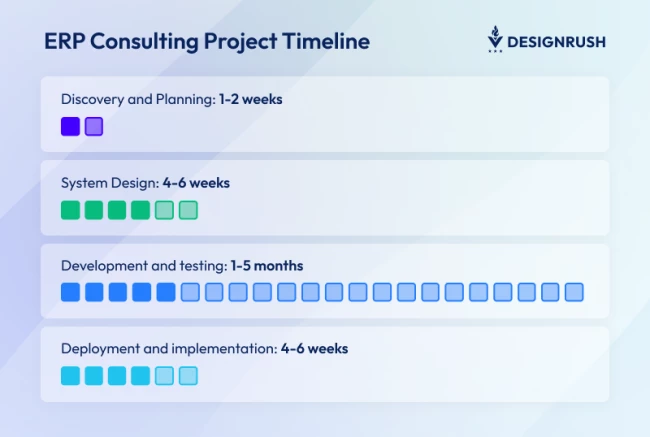
What are the typical timelines for these projects across complexity levels?
Typically, ERP consulting projects can take anywhere between a few months and years to complete, depending on your business's IT environment and the consultant’s expertise.
Estimated timelines include:
Small and medium-sized businesses take 3-9 months on average, as they may have fewer processes to standardize and lighter integration needs.
Large companies with multiple modules and requiring significant customizations will need around 9-18 months to complete.
Global enterprises require 12-36 months due to phased rollouts, localization, complex data harmonization, compliance requirements, and substantial change management.
When can clients expect ROI from project implementation?
Industry research shows that 83% of businesses experience a return on investment (ROI) after 1 year of ERP implementation. However, the timeline will depend on user adoption, process redesign, and ERP system complexity.
Below is an average ROI timeline:
Small businesses with out-of-the-box ERP systems and minimal integrations may see an ROI within 6-12 months.
Medium-sized companies with several system integrations and more complex processes may record an ROI within 1-5 years.
Enterprises and multi-location organizations may take 5-10 years, as they often implement ERP in phases.
How do leading US ERP consulting firms ensure implementation success?
About 70% of ERP implementation initiatives fail due to business process and goal misalignment.
To circumvent this, these agencies conduct the following:
Extensive discovery and analysis process to specify objectives, processes, data quality, and technical infrastructure.
Strong stakeholder involvement and alignment to confirm buy-in, clarify priorities, and align the ERP solution with business objectives.
Robust project management, including using proven methodologies, establishing clear key performance indicators (KPIs), and proactive risk mitigation to maintain project budget and schedule.
Rigorous testing, including usability, functionality, and stress testing, to ensure the system works within the business’s real-life environment
Change management and user training to ensure that the entire organization understands the value of the new system and has the skills to use it
Data strategy and migration planning to enhance data accuracy and integrity, implement data governance practices, and improve reporting quality.
Post-go-live support to maintain the ERP system’s scalability, security, and reliability.
What industries do the best ERP companies in the US typically work with?
US ERP consulting firms work with a variety of industries, since they adapt the system to a business’s unique needs. However, research shows that some sectors implement ERP software more than others.











































 4.8
4.8 4.8
4.8
 Proposals