
Your ERP system goes live, but teams are still exporting data into spreadsheets. Reports take hours. Integrations lag. Scope quietly keeps expanding.
That’s usually a strategy problem. Here’s how to structure an ERP strategy that facilitates growth and integration from the get-go.
Key Findings: ERP Strategies
- 75% of ERP strategies lack alignment to business goals, which makes a clearly defined ERP strategy critical to long-term success.
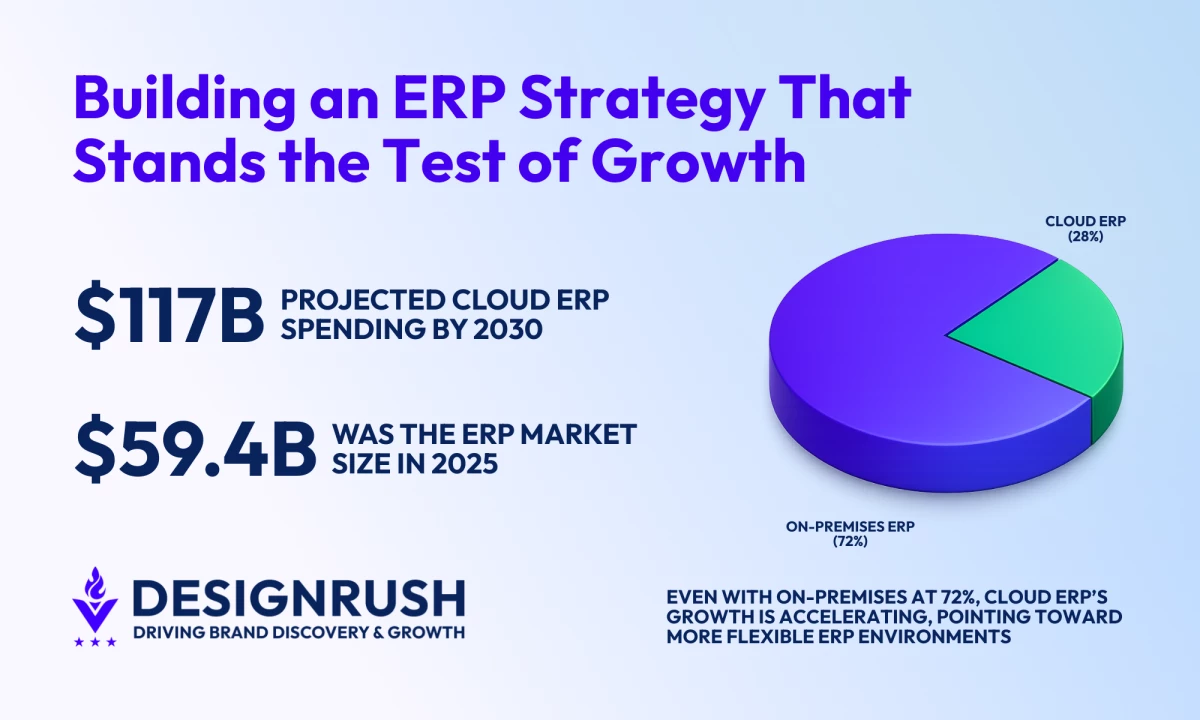
- The global ERP market reached $59.4 billion in 2025, with cloud ERP spending expected to exceed $117 billion by 2030.
- AI-enabled tools will account for 62% of cloud ERP spending by 2027.
Why an ERP Strategy Matters
According to Gartner, 75% of ERP strategies are not strongly aligned with overall business strategy, leading to confusion.
By 2027, more than 70% of recently implemented ERP initiatives are expected to fall short of their original business case goals, and up to 25% may fail catastrophically.
These failures often reflect gaps between stakeholder expectations and the delivered reality:
- Failed ERP programs have cost organizations revenue and credibility
- Many implementations optimized for IT success but didn’t improve the end-user experience
- Repeated disappointments have made large ERP transformations harder to implement internally
As ERP platforms move toward SaaS models, embedded AI, and composable architectures, organizations need a clear strategy that defines business outcomes, architectural principles, and integration priorities before execution begins.
What Is an ERP Strategy?
An ERP strategy is the decision framework that determines how an organization designs, governs, and evolves its enterprise systems.
It defines what belongs inside the ERP platform, what should remain external, and how processes, data, and responsibilities are structured across the organization.
Rather than focusing on features or modules, an ERP strategy sets boundaries. It clarifies scope, establishes governance, and outlines how changes will be evaluated over time.
Without this foundation, ERP initiatives often expand unpredictably and become harder to maintain.



Key Components of an ERP Strategy
If ERP projects fail because the strategy is vague, the fix is simple: define what matters before touching configuration.
A well-developed ERP strategy answers these questions:
- What are we solving, and what does success look like?
- How should work flow across the business?
- How will we manage and trust our data?
- How will ERP connect to the rest of our systems?
- Who governs decisions and manages change?
- How will we measure value over time?
Now, let’s unpack each one.
What Are We Solving, and What Does Success Look Like?
ERP initiatives require a clearly defined operational purpose.
Leadership should specify the measurable improvements the system is expected to support, such as:
- Shorter order-to-cash cycles
- Improved inventory accuracy
- Stronger financial visibility
- Faster month-end close
- Multi-entity reporting readiness
How Should Work Flow Across the Business?
ERP makes process gaps visible quickly. Order approvals stall. Inventory handoffs slow down. Teams build workarounds outside the system.
This is where the strategy earns its value.
It should define how work is expected to flow across finance, operations, sales, and supply chain before configuration begins. That includes decisions about standardization across business units, approval layers, exception handling, and cross-functional ownership.
The goal is consistency, which improves effectiveness and clarity while allowing variation where necessary.
Without this definition, configuration becomes reactive and complexity grows over time.
How Will We Manage and Trust Our Data?
ERP consolidates operational and financial data across functions. Its reliability depends on disciplined data practices.
A detailed strategy defines:
- Master data ownership
- Migration preparation and cleansing standards
- Reporting definitions and metric alignment
- Ongoing validation controls
How Will ERP Connect to the Rest of Our Systems?
ERP exists within a wider ecosystem. Most organizations rely on multiple surrounding platforms that support customer engagement, fulfillment, payroll, analytics, and reporting.
A strategy should clearly document:
- Which systems remain alongside ERP
- Where ERP serves as the system of record
- How data flows between applications
- What integration approach will be used
- Which legacy platforms will be retired
Integration design influences scalability, reporting accuracy, and upgrade flexibility. These decisions determine whether ERP becomes a stable backbone or a coordination bottleneck.
Who Governs Decisions and Manages Change?
ERP initiatives cut across finance, operations, procurement, HR, and compliance. Without clearly defined ownership, decisions stall or drift. The scope expands gradually. Accountability gets blurred.
A strategy should spell out who approves configuration changes, how cross-functional disagreements are resolved, and where escalation sits when trade-offs affect multiple departments.
It should also define how compliance, audit requirements, and risk monitoring are handled throughout the system's lifecycle.
Clear governance creates speed. Teams move faster when decision rights are visible and consistent.
It also protects long-term system integrity by preventing uncontrolled customization and fragmented ownership.
How Will We Measure Value Over Time?
Your strategy should establish:
- Operational KPIs tied to the main objectives
- Review cadence post-implementation
- Ownership of ongoing improvement
- Prioritization criteria for enhancements
Defined performance tracking will support steady and aligned evolution with your business needs.
Building Your ERP Strategy: The Decisions That Matter Early On
Once the structural components are defined, what really shapes your ERP program are the early system design and sequencing decisions.
Those decisions show up later in upgrade effort, integration stability, operating costs, and how confidently the system promotes growth.
Establishing Organizational Readiness and Ownership
Before diving into architecture diagrams or vendor shortlists, the organization needs clarity around ownership and internal capacity.
That means:
- Executive sponsorship with visible accountability
- Clear process ownership among departments
- An honest assessment of internal resource capacity
- Alignment on risk tolerance and change readiness
Without defined ownership, configuration discussions drift. Without realistic capacity planning, timelines slip before implementation even begins.
Planning for Expansion and Functional Complexity
ERP design should reflect where the business is headed, not just where it stands today.
Growth adds reporting layers, new entities, regulatory obligations, and higher transaction volumes.
Future pressure points often include:
- Geographic expansion
- Increased transaction density
- Multi-entity consolidation
- Regulatory changes tied to new markets
- Expanded analytics or AI-supported planning
Shortcuts in system design tend to resurface later as rework, integration strain, or reporting limitations.
Preserving an Upgradeable Core While Still Building What Makes You Different
Few ERP decisions carry a greater long-term impact than deciding where unique business logic should live.
Bending the ERP core around every exception can feel efficient at first. Over time, heavy modifications increase upgrade effort, complicate vendor support, and expand testing requirements with every release cycle.
For example, Instinctools takes a different position. They advise keeping the ERP core stable while differentiating through adjacent layers rather than altering the foundational architecture.
Their approach is based on a three-layer structure:
- ERP Core
Finance, inventory, procurement, and HR remain aligned with the platform’s native logic to support predictable upgrades and vendor support.
- Companion Applications
Business-specific capabilities are developed as ERP-adjacent portals or workflow tools that integrate with core data without modifying it.
- Integration and Automation Layer
CRM, ecommerce, warehouse, and analytics systems connect through APIs and workflow automation to eliminate manual transfers and reconciliation work.
To determine where a requirement belongs, Instinctools suggests a simple evaluation:
- If the platform already supports it, configure it.
- If a structural requirement makes modification unavoidable, customize selectively.
- If it creates competitive differentiation, build a companion application.
- If the issue is manual data movement, automate the integration.
This keeps maintenance predictable while preserving room to evolve.
If you are evaluating how to protect your ERP core while still building differentiated capabilities, Instinctools works with teams to design and implement this layered approach end-to-end.
Explore what Instinctools can do for your business.
Sequencing Value Instead of Transforming Everything at Once
ERP programs slow down when the scope grows faster than the delivery capacity.
Instead of attempting full transformation at once, Instinctools recommends starting with a small set of high-impact workflows and building measurable progress in stages.
A practical 30, 60, 90-day structure might look like this:
- First 30 Days
Identify three workflows that create measurable friction. Map their data flows and system dependencies. Establish baseline metrics such as cycle time, error frequency, manual touchpoints, and adoption levels.
- By 60 Days
Release the first integration or workflow automation. Introduce one focused companion module if needed. Compare results against baseline performance.
- By 90 Days
Expand automation coverage. Review adoption patterns. Select the next workflow according to operational impact.
Breaking the program into controlled steps reduces risk and keeps attention on measurable outcomes.
As Keith Shields, CEO of Designli, explains, trying to do everything at the same time is when teams usually lose control:
“Businesses sometimes try to do too much at once. We recommend focusing on a core MVP first, then iterating based on feedback. And to prevent technical debt, we design scalable architectures to support future growth.”
Choosing Technology Without Creating Future Friction
Cloud deployment, embedded AI, mobile access, regulatory reporting tools, and API-driven integrations all carry architectural consequences.
Before adopting any capability, ask:
- Does this solve a real operational constraint?
- Can we support it long-term without creating new complexity?
- What changes in governance or data ownership will it require?
Technology choices determine your cost structures, integration density, and oversight models.
Keeping System Integrity Oversight After Go-Live
Go-live is not the end of strategy work.
Without continued oversight, enhancements accumulate, integrations multiply, and ownership boundaries blur.
Here’s what you need:
- Ongoing platform review checkpoints
- Upgrade planning cycles
- Clear criteria for approving enhancements
- Visible accountability for system evolution
Which ERP Strategy Model Fits Your Organization?
The ERP market reached approximately $59.42 billion in 2025, with steady growth projected over the next decade.
That scale reflects how much operational control, financial visibility, and automation now sit inside ERP platforms.
Different organizations adopt different structural models depending on scale, regulatory exposure, and internal IT maturity.
According to Precedence Research, in 2024, large enterprises accounted for just over 41% of ERP market share, reflecting the system’s role in managing operational complexity.
Medium-sized enterprises are expanding adoption at the fastest rate, often favoring modular and cloud-based models that balance flexibility with cost control.
What’s the right choice for you?
- Modular ERP Strategy: Best for Phased Rollouts
- Cloud-Centric ERP Strategy: Best for Global Operations
- Composable ERP Strategy: Best for Complex System Environments
- AI-Enabled ERP Strategy: Best for Data-Intensive Enterprises
- Industry-Specific ERP Strategy: Best for Regulated Sectors
- IoT-Connected ERP Environments: Best for Asset-Heavy Operations
Modular ERP Strategy: Best for Phased Rollouts
A modular approach introduces ERP capabilities in waves rather than deploying a full enterprise suite at once.
One organization may begin with financial management or inventory control, then expand into procurement or production once early phases stabilize. This structure works well when implementation capacity varies or when leadership prefers incremental delivery.
Cloud adoption reinforces this model. With cloud ERP spending projected to exceed $117 billion by 2030, subscription pricing and infrastructure flexibility make phased deployment easier to budget and sequence.
Even so, phased rollout demands coordination. Without structured oversight, modules can drift into disconnected implementations.
Firms such as Instinctools support modular ERP programs by helping teams define sequencing logic, integration priorities, and upgrade boundaries before each phase begins.
Cloud-Centric ERP Strategy: Best for Global Operations
Choosing cloud deployment reshapes how your system is operated and governed.
According to Precedence Research, on-premises deployments accounts for roughly 72% of ERP market share, while cloud represents about 28%.
That split reflects continued demand for control and compliance in certain sectors, even as the interest in cloud adoption accelerates.
Infrastructure management decreases, upgrade cycles simplify, and distributed teams gain access. At the same time, leadership must address data residency, security systems, and long-term operating cost models.
Two-tier and multi-cloud structures are increasingly common. A central ERP instance supports enterprise reporting and consolidation, while lighter deployments typically serve subsidiaries or regional entities with localized requirements.
You must establish clear data ownership and synchronization rules from the beginning to prevent reporting fragmentation.
Composable ERP Strategy: Best for Complex System Environments
A composable architecture treats ERP as the transactional foundation, with specialized systems surrounding it and connected through APIs.
Financial processing may remain within the ERP, while advanced planning, analytics platforms, ESG reporting tools, and customer experience systems operate independently.
This setup allows targeted upgrades and experimentation without reconfiguring the entire core. As integration density increases, strong data ownership and integration standards become essential.
Agencies such as Itransition and ScienceSoft often support composable ERP initiatives by designing API architectures and integration governance frameworks for distributed environments.
AI-Enabled ERP Strategy: Best for Data-Intensive Enterprises
Artificial intelligence is increasingly embedded directly within ERP platforms.
Gartner predicts that finance teams using cloud ERP applications with embedded AI assistants will complete their financial close up to 30% faster by 2028. AI-enabled solutions are projected to account for 62% of cloud ERP spending by 2027, up from 14% in 2024.
Gartner also identifies five themes shaping AI in cloud ERP finance:
- Composable ecosystems
- Intelligent process automation
- AI trust and risk management
- Adaptive analytics
- AI-driven planning
Together, these developments push ERP finance from transactional processing toward predictive insight and automated decision support.
Gartner projects that by 2028, roughly 80 percent of ERP systems will include generative AI and predictive analytics.
Introducing AI into business processes calls for clear oversight. Organizations exploring AI-enabled ERP often work with implementation partners, such as Instinctools, to align automation use cases with governance, data-readiness, and oversight models.
Industry-Specific ERP Strategy: Best for Regulated Sectors
Industry-specific ERP platforms continue expanding, with projections estimating growth from roughly $169 billion in 2025 to nearly $549 billion by 2035.
These systems include predefined workflows, compliance logic, and reporting structures tailored to sectors such as manufacturing, healthcare, logistics, or construction.
As per Precedence Research, the services sector held the largest ERP revenue share in 2024 at approximately 27%, while manufacturing is projected to grow at close to 9.6% annually.
Finance capabilities within these vertical platforms are also advancing as AI becomes embedded in sector-specific solutions.
For example, firms such as Innowise specialize in vertical ERP implementations customized for regulated and process-driven industries.
IoT-Connected ERP Environments: Best for Asset-Heavy Operations
Operational technologies increasingly feed live data directly into ERP systems.
In manufacturing and logistics environments, for example, this is waht happens with connected equipment and warehouse systems.
Higher data frequency increases the demands on the system structure and processing capacity. Validation logic, synchronization controls, and infrastructure capacity must be designed to handle continuous input without performance strain.
Final Thoughts on ERP Strategies
A well-planned ERP strategy is what keeps your system from becoming a costly mess down the line. When you set goals early, manage your scope intentionally, and keep governance tight, you give your ERP a real shot at delivering long-term value.
The payoff is smoother operations, informed decision-making, and a system that evolves with your business.
If you want to ensure success without draining internal resources, collaborating with seasoned ERP experts is crucial.

Our team ranks agencies worldwide to help you find a qualified partner. Visit our Agency Directory for the top ERP consulting companies, as well as:
- Top CRM Consultants
- Top Staff Augmentation Services
- Top Cloud Consulting Companies
- Top IT Services Companies
- Top ECM Consultants
FAQs: Developing Your ERP Strategy
1. Why do so many ERP initiatives fail to meet expectations?
If your ERP strategy doesn’t truly match your business goals, things get messy fast. You’ll find yourself endlessly tweaking configurations, and no one’s sure who’s responsible for what.
In short, it leads to confusion, delays, and frustration, which is exactly why a solid strategy from the start is essential.
2. How do you know your ERP is really working post go-live?
Keep an eye on practical metrics, like how fast you close the books, speed of order-to-cash, mistake reduction, inventory accuracy, and how well people actually use it. Those show if it’s paying off.
3. How do you avoid getting stuck with ERP customization headaches?
Stick to the platform’s native strengths for core processes. If you need something unique, build it in external companion apps or automation tools. That way, future updates won’t become a nightmare.
4. When should you go modular with ERP?
If your team’s bandwidth is limited or leadership wants to see results in steps, modular is the way to go. You roll out one piece at a time, get it working, then expand from there.
5. What’s the best way to approach AI in your ERP strategy?
Look at AI through a practical lens. Will it improve forecasting, spot anomalies, or streamline planning? Just make sure you’ve put in place strong oversight before you let AI steer key financial decisions.