Explore leading Android app developers specializing in custom mobile apps, scalable architectures, API integrations, and user-focused UI/UX design. Our team curated a list of vetted agencies that build high-performance Android apps designed for reliability, usability, and long-term growth.
Organic rankings are determined by five factors: top services, reviews, portfolio, awards/press, and team expertise. Sponsored listings pay for a placement that appears above organic positions. Sponsorship does not affect star ratings or review content - read more on our methodology page.
Sorry, no agency was found by that name.
Please retry your search.
Explore Mobile App Development Specializations
- Accessibility Mobile App
- App Development Consultants
- Application Modernization
- Consumer
- Cross-Platform
- eCommerce
- Educational
- Enterprise
- Entertainment App Development
- Field Operations
- Financial
- Fitness App Development
- Food Delivery App Development
- Freelance
- Gambling
- Games
- Government
- Healthcare
- HTML5
- Hybrid
- Insurance
- iPad
- iPhone
- Media App
- Mobile App design
- Nonprofit
- Publishing
- React Native
- Restaurant App Development
- Small Businesses App Development
- Social Network Apps
- Sports App Development
- Startup
- Telemedicine App Development
- Thunkable
- Travel App Development
- Wearables
- Windows
Everything You Need to Know Before Hiring Android App Developers
Which programming languages do Android app developers use?
Android developers mainly use Kotlin and Java to build native Android applications. Other languages such as Dart, JavaScript, and C++ may be used when developing cross-platform apps or performance-heavy features.
- Kotlin
Kotlin is the official Android development language recommended by Google. It is modern, concise, and reduces common coding errors. Most new Android apps today are built with Kotlin because it improves developer productivity and works fully with Android Studio. - Java
Java was the original Android programming language and remains widely used in many existing apps. Large enterprise systems and legacy Android applications often rely on Java because of its stability and long ecosystem support. - Dart
Dart is used with the Flutter framework, which allows developers to build Android and iOS apps from a single codebase. It is popular for startups and companies that want faster development and lower maintenance costs. - JavaScript
JavaScript is used with React Native to build cross-platform mobile apps. Developers can create Android and iOS apps using web technologies, which helps teams reuse code and speed up development. - C++
C++ is used in Android development for performance-critical components, such as game engines, graphics processing, or heavy computing tasks. It is usually combined with Kotlin or Java rather than used alone.
In practice, most Android app development companies use Kotlin or Java for native development, while Flutter or React Native are common when businesses want one app codebase for multiple platforms.
What can an Android app development company do for my business?
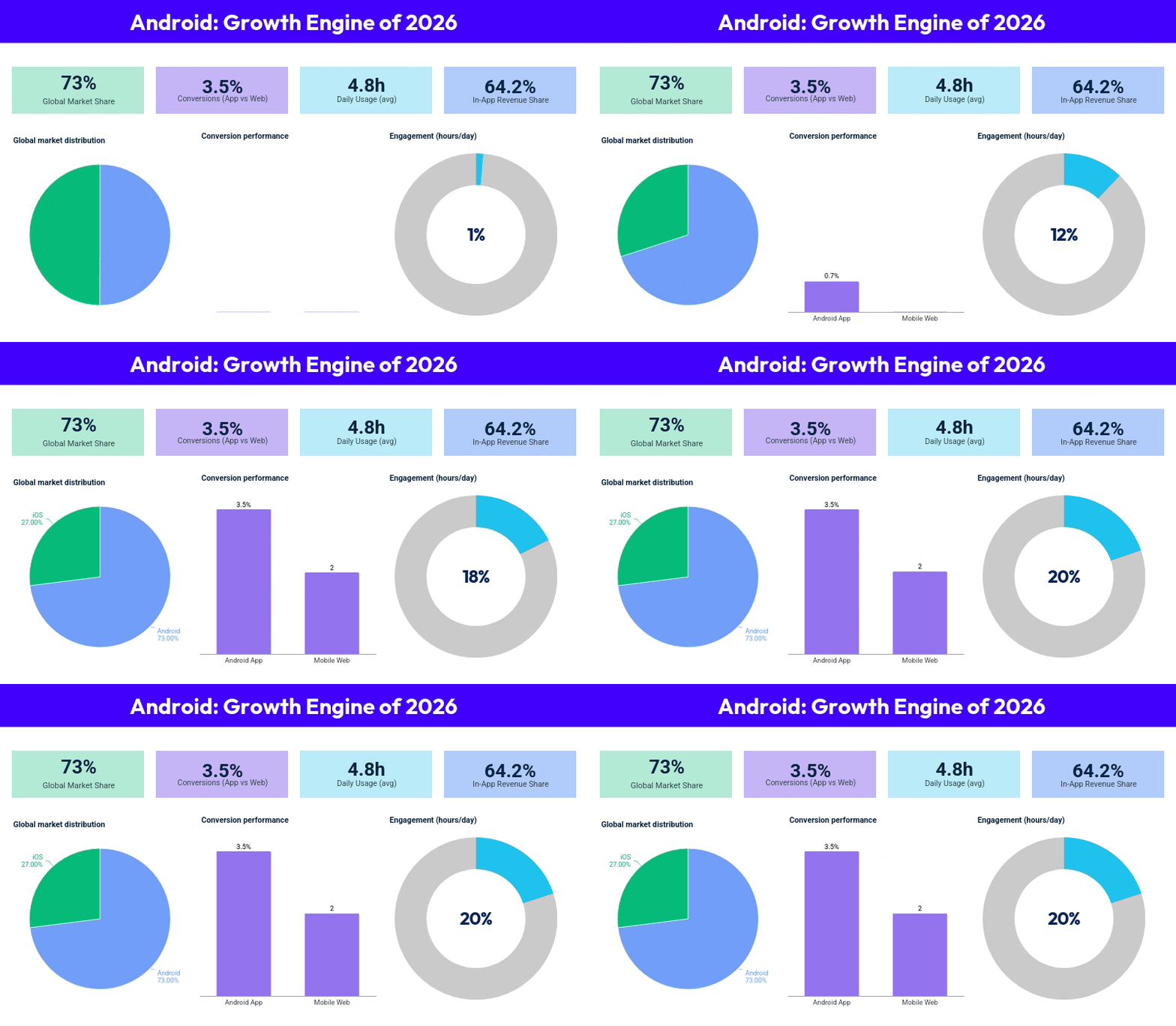
Partnering with an Android app development company allows you to tap into an ecosystem that currently commands roughly 72% of the global mobile OS market share.
Here are five key benefits an Android development partner can deliver for your business:
1. Massive global reach and market penetration
An Android app is the most effective way to scale your business internationally. Because Android runs on a massive variety of hardware, from budget smartphones to premium foldable devices, it offers a footprint that other platforms simply cannot match.
- As of early 2026, Android continues to dominate with approximately 73% of the global mobile market share, compared to roughly 27% for iOS.
- There is now an estimated 3.74 billion active Android users worldwide, providing an unparalleled audience for customer acquisition.
- In high-growth regions like India, Android’s market share is even bigger, reaching as high as 96-97%.
2. Higher conversion rates than mobile web
While many businesses rely on responsive websites, dedicated Android apps significantly outperform mobile browsers in converting visitors into paying customers. This is due to smoother checkout flows, saved payment info, and native performance.
- Mobile apps in 2026 convert at a rate of 3.5%, compared to just 2% for mobile websites.
- Apps can reduce cart abandonment to as low as 20%, while the mobile web still struggles with abandonment rates near 97%.
- With 5.6 billion digital wallet users globally, a professional developer can integrate seamless one-tap payments that drive higher transaction volumes.
3. Increased operational efficiency and ROI
Beyond customer-facing apps, developers can build internal tools that automate manual processes. Custom software tailored to your specific workflow often yields a much higher return than generic SaaS solutions.
- Businesses that use custom mobile applications report 30 to 40% higher operational efficiency compared to those using generic platforms.
- Case studies show that custom coordination apps can drop administrative workloads by up to 30% by automating scheduling and data entry.
- Projects utilizing agile development (the standard for top firms) have a 28% higher success rate than traditional development models.
4. Improved customer retention and engagement
Developers use features like push notifications and AI personalization to keep your brand top-of-mind.
- Global users are projected to spend over 5.5 trillion hours inside mobile apps in 2026, emphasizing the shift away from desktop browsing.
- The average Android user now spends 4.8 hours per day on their device, giving your business multiple touchpoints to engage them.
- Around 90% of mobile apps are used once and then deleted within the first 30 days, which makes retention-focused design, onboarding, and performance critical.
- While average 30-day retention is low, top-performing apps built by professional firms can achieve 35% retention rates after a full year.
5. Faster time-to-market
A professional agency uses cross-platform and modular development tools to get your product to market faster without sacrificing the native feel Android users expect.
- Using cross-platform frameworks (like Flutter or React Native) can reduce development time by up to 40% while maintaining a consistent experience across devices.
- In 2026, in-app purchases and subscriptions command 64.2% of the market share, making it easier to monetize a launched product quickly.
- Standard industry practice is to allot 15 to 20% of the initial cost for annual maintenance, ensuring your app stays compatible with the latest Android OS updates.
Can an Android app development company convert my iOS app to an Android app?
Yes. Android app development companies can build an Android version of your iOS app, but the process usually involves rebuilding the app for the Android platform rather than directly converting the original code.
iOS apps are typically written in Swift or Objective-C, while Android apps use Kotlin or Java. Because the platforms use different programming languages, operating systems, and design standards, most of the interface and functionality must be recreated for Android devices.
Developers usually reuse the product logic, features, and backend systems, then rebuild the mobile layer so it works properly across different Android screen sizes, devices, and OS versions.
In some cases, an Android app development company may also use cross-platform frameworks such as Flutter or React Native. These frameworks allow teams to share part of the code between iOS and Android, which can reduce development time for future updates.
How to choose the right Android app development agency?
Choosing the right Android development company affects your app’s quality, scalability, and long-term success. Evaluating several practical factors helps confirm whether the agency has the skills, experience, and process required to deliver a reliable product.
- Check Android development experience
Review the portfolio to see how many apps a custom Android app development company has built and launched. Prior experience with similar apps often reduces development risk. - Evaluate technical expertise
Confirm the team works with modern Android technologies such as Kotlin and Android SDK. Strong technical skills help ensure the app performs well across devices. - Review UI/UX design quality
Examine the agency’s design work to see if their apps are clear and easy to use. Good UI/UX improves user engagement and retention. - Check the development process
Ask how the team manages discovery, design, development, and testing. A structured process helps prevent delays and miscommunication. - Evaluate testing and quality assurance
Ensure the agency tests apps across different Android devices and OS versions. Proper QA helps reduce bugs and performance issues after launch. - Check communication and project management
Review how the team shares updates, tracks milestones, and reports progress. Clear communication helps keep the project aligned with your goals. - Evaluate post-launch support
Confirm whether the Android app development agency offers maintenance, updates, and bug fixes after release. Ongoing support keeps the app secure and compatible with new Android versions. - Check pricing transparency
Ask for a detailed estimate that explains development costs and timelines. Clear pricing helps avoid unexpected expenses during the project.
What questions should you ask Android developers before signing a contract?
Before hiring an Android development company, ask clear questions about their experience, processes, and approach to your specific project. These questions help verify technical capability, development workflow, and whether the team can deliver your app successfully.
Relevant Background
- How many Android apps has your team developed and launched on Google Play?
- Which industries or app categories do you have the most experience with?
- Can you share case studies or examples of Android apps similar to my project?
- What technologies, frameworks, and programming languages does your team use for Android development?
Services and Processes
- What does your typical Android app development process look like from discovery to launch?
- How do you handle testing, quality assurance, and bug fixing during development?
- Do you provide UI/UX design, backend development, and API integration services
- Do you offer post-launch maintenance, updates, and technical support?
Related to Your Project
- What development timeline do you estimate for my Android app?
- Which features should be prioritized for the first version or MVP?
- How will you ensure the app performs well across different Android devices and OS versions?
- How will you manage communication, progress updates, and project milestones during development?
Sources
DesignRush sustains a directory of over 40,000 agencies categorized by service category, location, expertise, and reviews. We build our database in two ways:
- Our dedicated team of agency experts actively searches the web for top-performing companies. We then pull information from their websites, online presence, and client testimonials to verify their status and qualifications prior to listing.
- The agencies listed get notified of their profiles on the website and they can choose to claim it or not, which suggests their availability for more collaborations.
Agencies can also reach out to DesignRush and must go through the verification process prior to being listed.
Latest Trends Related to Android App Development