
ChatGPT has quickly become one of the most transformative digital tools in recent years, supercharging productivity for businesses.
To see how it’s reshaping work, learning, and digital adoption, we’ve gathered the most revealing ChatGPT user statistics in 2026.
ChatGPT Usage Statistics: Key Findings
- 64% of U.S. teens ages 13-17 have used AI chatbots such as ChatGPT or Copilot, while 58% of adults under 30 have used ChatGPT.
- Nearly 80% of ChatGPT interactions center on practical guidance, seeking information, and writing.
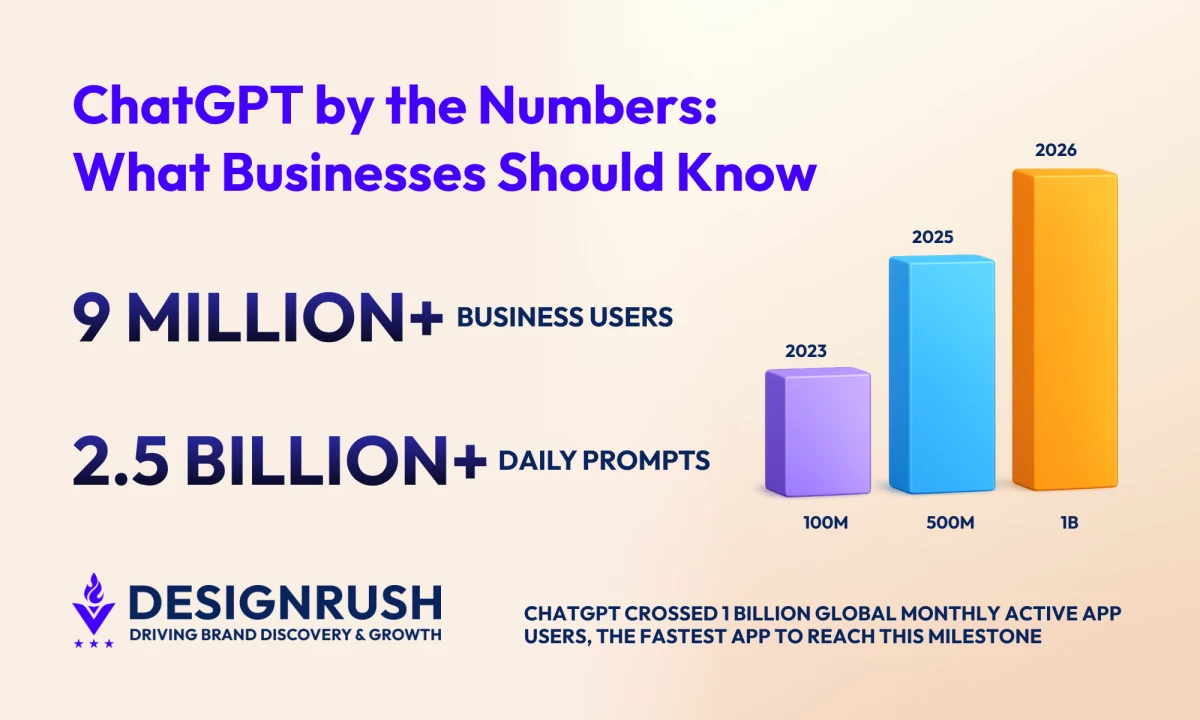
- Over 9 million business users rely on ChatGPT, as organizations expand AI adoption in workflow automation, customer service, and content creation.
ChatGPT Joins the Billion-User Club
ChatGPT surpassed 1 billion monthly active users in May 2026, becoming the fastest app in history to reach the milestone.
This achievement proves how quickly generative AI has become a mainstream tool used for work, learning, creativity, and everyday problem-solving.
The Rapid Rise of ChatGPT and Why Businesses Can’t Ignore It
OpenAI's chatbot gained traction at a pace few digital products have matched.
It reached 1 million users within five days of launch and crossed 100 million users just two months later, cementing its place as one of the most successful consumer technology launches on record.
Usage has only accelerated since then: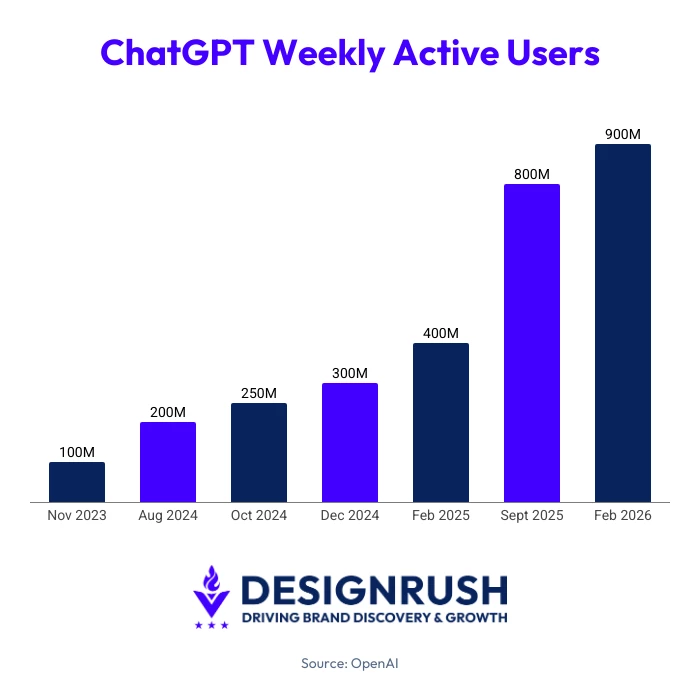
- ChatGPT is now the fifth most visited website globally, reflecting its mainstream adoption.
- The platform serves nearly 800 million weekly active users, processing more than 2.5 billion prompts every day.
- The ChatGPT mobile apps (iOS and Google Play) now outperform the website in monthly reach, drawing a combined 557 million monthly active users.
- By comparison, ChatGPT.com attracts approximately 489 million unique monthly visitors, showing that usage is increasingly shifting to mobile. (Datareportal)
- 58% of adults under 30 have used ChatGPT, signaling deep penetration among digitally native consumers.
Why This Matters for Businesses
- Leverage existing user familiarity: Most teams and customers already know how to use tools like ChatGPT, making it easier to roll out AI-driven features like support bots or internal assistants.
- Prioritize capability over novelty: Engagement grows when AI delivers real value. Align your investments with functional improvements to drive lasting impact.
- Younger buyers expect AI fluency: With millions of under-30 adults using ChatGPT, brands that don’t adapt may appear outdated to future core spenders.
- Customer expectations are shifting: As consumers experience instant, personalized answers through AI, they expect the same speed and clarity from brands.



Who’s Using ChatGPT and What That Means for Your Market
A closer look at ChatGPT’s user demographics reveals where generative AI is gaining traction, where it underperforms, and which audiences are driving its real-world utility:
As reported by Similarweb:
- 53.44% of ChatGPT visitors are male, while 46.56% are female.
- The most active users (28.69%) are aged 25 to 34, digitally native, tool-curious professionals who readily adopt new tech.
Language usage reveals another layer of insight. While OpenAI officially supports 61 languages, user testing and independent assessments suggest ChatGPT operates — at varying levels of fluency — in over 95 languages.
However, linguistic breadth does not equal uniform performance. The model is strongest in English and other globally dominant languages such as Spanish, French, and Chinese, i.e., languages with a high volume of online content.
Education is closely linked to ChatGPT adoption, according to Pew Research:
- Adults with a postgraduate degree (52%) or Bachelor’s degree (51%) are nearly three times as likely to have used ChatGPT as those with a high school education or less (18%).
- Higher-educated adults are also the most likely to use ChatGPT for learning, with 39% of postgraduates and 34% of bachelor’s degree holders reporting educational use.
Age and workplace usage show similar patterns:
- Younger employees drive workplace adoption: 38% of employed adults ages 18 to 29 reporting workplace use, compared to 30% of those ages 30 to 49 and 18% of workers 50 and older.
- Adults under 30 are also the most likely to use ChatGPT for learning (46%) and entertainment (42%).
- AI adoption is becoming more common among younger generations.
- In 2026, 64% of U.S. teens ages 13 to 17 reported using AI chatbots such as ChatGPT or Copilot, while 57% use AI to search for information and 54% use it for schoolwork.
Why This Matters for Businesses
- Your early adopters are educated, young professionals: With the highest usage among bachelor’s and postgraduate degree holders, ChatGPT’s core audience overlaps with decision-makers, knowledge workers, and high-spending consumers.
- Workplace adoption is shaping B2B buying behavior: AI is now part of procurement research, vendor comparisons, and strategic evaluation. If your brand isn’t discoverable in AI-driven workflows, you risk being excluded early in the buying process.
- Education-driven usage signals high-intent engagement: The strongest adoption among highly educated users suggests ChatGPT is frequently used for research, skill-building, and informed decision-making. These are high-value moments for brand influence.
- AI-native customers expect smarter brands: Younger employees already use ChatGPT at work. That means they expect faster responses, clearer information, and AI-enhanced experiences from the companies they buy from.
The Countries Powering ChatGPT’s Growth and What It Signals for Brands
Available in 195 countries, ChatGPT now ranks as the most widely used generative AI platform globally, outpacing Google's Gemini and Microsoft Copilot by a wide margin.
However, adoption patterns show notable geographic concentration and behavioral nuance. Here are some ChatGPT statistics by country, via Firstpagesage:
- United States: Still the single largest source of ChatGPT traffic, accounting for 17.1% of global visits, making it the leading market by traffic share.
- India: A fast-growing second place contributor with 16.5% of global usage, reflecting rapid adoption in one of the world’s largest internet populations.
- Brazil: Consistently ranks among the top markets with 5.8% of global traffic, showing strong regional engagement in Latin America.
- Canada, France, Mexico, Japan, United Kingdom, Spain, the Philippines, and South Korea also appear in the top ranks, collectively contributing significant shares of usage across Europe, Asia and the Americas.
Regional share patterns:
- Asia-Pacific leads with the largest overall traffic share (28.6%), driven by India, Japan, Indonesia and the Philippines.
- North America follows (19.8%), with the U.S. and Canada dominating.
- Europe accounts for about 14%, while Latin America, the Middle East & Africa, and other regions make up the balance.
As regional usage deepens, generative AI is steadily becoming embedded in both professional and personal routines, particularly in tech-forward economies like the US.Why These Regional Patterns Matter for Businesses
Understanding where ChatGPT usage is strongest — and where it’s still emerging — helps companies tailor strategies in ways that can shape growth and engagement:
- Geography shapes use case and risk: If you're operating in sensitive sectors (e.g., finance, health, or security) don’t treat generative AI as a one-size-fits-all tool. Build in oversight and transparency, especially in regions with lower tolerance for errors.
- Competitive positioning across markets: Markets with high AI adoption often have more digitally savvy consumers who expect rapid, personalized interactions.
- Targeted content strategies: High adoption in large markets like the U.S. and India means localized AI-optimized content can yield competitive advantages in discovery and customer engagement.
How Businesses Can Understand ChatGPT Engagement and User Behavior
ChatGPT users are highly engaged, turning it into a creativity and productivity hub rather than a casual tool.
Key usage patterns reveal how and why people rely on it:
- Users spend over 12 days per month interacting with ChatGPT, showing habitual adoption.
- The average user types 348 words per conversation, nearly 70 times longer than a typical Google search query. Opening messages average 103 words, signaling thoughtful, intentional prompts. (WebFX)
- While 32.9% of conversations are question-based, about 19.3% are commands, where users delegate tasks or request specific actions.
- Nearly 80% of conversations fall into Practical Guidance, Seeking Information, and Writing, with writing leading work-related tasks, highlighting ChatGPT’s ability to produce digital outputs that traditional search engines cannot.
- Computer programming and self-expression account for smaller shares of usage, showing that ChatGPT’s primary value remains productivity and information generation. (NBER)
Why This Matters for Businesses
- Writing and work-focused tasks highlight AI’s unique value: ChatGPT is shaping digital output, content creation, and professional workflows, signaling a shift in how people work online.
- High engagement equals opportunity: Users are spending meaningful time with ChatGPT, creating repeated touchpoints where brands can influence research, learning, and task execution.
- Long-form interaction means richer intent signals: Unlike brief search queries, ChatGPT conversations reveal context, goals, and priorities — actionable data for content and marketing strategy.
Irina Shvaya, Partner and Marketing Consultant at eSEOspace, emphasizes the change in how brands should optimize content in the age of generative AI:
“AI is changing how buyers research and make decisions. Businesses that integrate SEO, AEO, and GEO are not just optimizing for search.
“They’re positioning themselves as trusted sources in the conversations happening across AI platforms. Staying visible today means thinking beyond links and ensuring your expertise is included wherever your customers are looking.”
ChatGPT User Statistics: Final Thoughts
ChatGPT’s growth is a signal of how AI is reshaping work, marketing, and customer expectations.
Businesses that harness these insights now can improve productivity, capture high-intent audiences, and future-proof operations for the AI-driven economy.

Our team ranks agencies worldwide to help you find a qualified partner. Visit our Agency Directory for the Top AI Companies, as well as:
- Top Generative AI Companies
- Top AI Consulting Companies
- Top AI Automation Companies
- Top AI Customer Service Companies
- Top Chatbot Solution Companies
- Top AI Companies in Seattle
ChatGPT User Statistics FAQs
1. Why should marketers track ChatGPT usage trends?
ChatGPT conversations reveal long-form intent, research priorities, and workflow patterns that traditional search doesn’t capture. Marketers can use this data to optimize content, target high-value users, and anticipate AI-driven buying behavior.
2. How many people use ChatGPT today?
ChatGPT surpassed 1 billion monthly active users in May 2026, which makes it the fastest app in history to reach the milestone.
The platform also serves more than 900 million weekly active users, demonstrating how quickly generative AI has become mainstream.
3. What do people use ChatGPT for most?
Research analyzing millions of ChatGPT conversations found that most interactions fall into three categories: practical guidance, information seeking, and writing assistance.
Writing-related tasks are one of the platform's most common professional use cases.
4. Which industries are seeing the fastest business adoption of ChatGPT?
Technology, marketing, finance, and professional services lead in adoption, using ChatGPT for content creation, data analysis, and workflow automation, while smaller adoption is seen in sectors like manufacturing and logistics.
5. Are small businesses adopting ChatGPT differently from enterprises?
Smaller companies often focus on content generation, social media drafts, and automating customer replies. Enterprises integrate ChatGPT more broadly across workflows, decision support, and internal knowledge management.
6. How do brands ensure responsible AI use internally?
By setting usage guidelines, reviewing outputs for accuracy, disclosing AI involvement in communications, and incorporating human oversight, companies can maintain ethical and compliant AI practices.
7. How many languages does ChatGPT support?
ChatGPT officially supports 61 interface languages, helping OpenAI expand its reach across global markets. It can understand and generate content in many additional languages and dialects.