
Artificial intelligence isn’t causing mass unemployment so much as silently reshaping every role.
We’ll answer: which jobs and industries are most exposed, how fast AI is rolling out, and what net effect on jobs we can expect by 2030.
AI Job Displacement Statistics: Key Findings
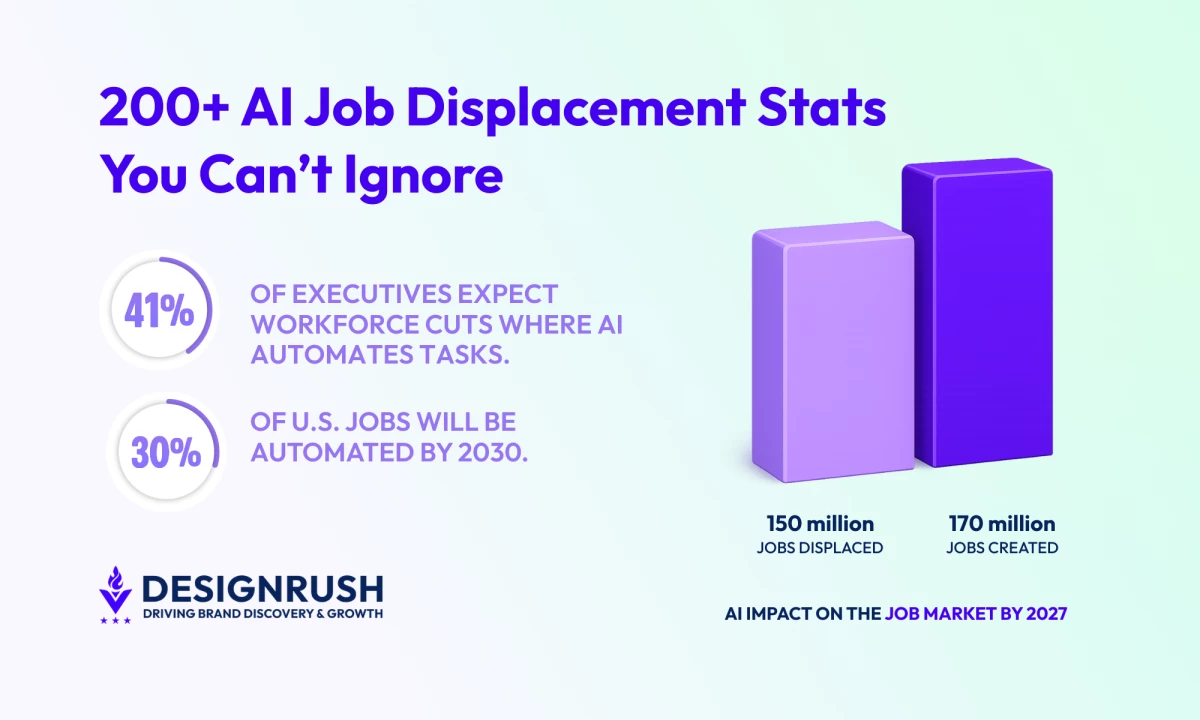
- 30% of what you do today will be automated by 2030. So, redesign your role around the 70% AI can’t easily replace: judgment, context, relationships, and decision-making.
- Follow where new value is formed. 150 million jobs may be displaced by 2027, but 170 million new ones are expected to emerge. The net effect is growth in AI-adjacent roles.
- For leaders, redeploy before you reduce. 41% of executives expect workforce cuts where AI automates tasks. The smarter move is internal mobility by moving people from shrinking tasks into growing functions.
How We Reached the Tipping Point
Today, over 90% of Fortune 500 companies use AI, and 92% plan to increase investment over the next three years.
Enterprises don’t commit to that scale unless the economics make sense.
So, what changed?
The real shift was Gen AI’s capability:
- In 2022, GPT-3.5 struggled with broader reasoning, but today’s GPT-4-model can rank in the top 10% on the bar exam and answer about 90% of U.S. medical licensing questions correctly, reaching near-professional reasoning.
- On SWE-Bench, AI systems jumped from solving 4.4% of coding problems in 2023 to 71.7% in 2024.
- A recent paper by Goldman Sachs found that current AI systems can match or outperform up to 47% of industry professionals on a predefined benchmark of economically valuable tasks.
And that’s exactly how we got here. When AI can handle a large chunk of the tasks that define a role, companies don’t need as many people to do the same work anymore.
Does that mean the labor market is collapsing? Not yet. But it does mean we’re entering a decade-long shift in the workplace, and many jobs as we know them will look very different — or disappear entirely.
The statistics that follow show just how deep this goes.



How Much Work Is Exposed to AI and What That Means
AI’s reach is broad, touching millions of jobs across industries. Some roles are highly vulnerable, while others are shifting more gradually.
Understanding this exposure helps us grasp both the risks and opportunities ahead of this shift.
Global and U.S. Exposure Snapshot
Here’s where AI stands today in terms of job exposure:
- By 2030, AI could automate up to 30% of U.S. jobs (National University).
- Worldwide, 40% of jobs face potential AI exposure (International Monetary Fund).
- 60% of current roles will see significant task changes due to AI (National University).
- AI could eliminate 300 million jobs globally, roughly 9% of all employment (National University).
- The next 10–30 years could bring the sharpest disruptions, with automation possibly touching 50% of jobs by 2045 (National University).
- 94% of employees and 99% of C-suite executives report some level of use (McKinsey & Company), which means familiarity with gen AI is nearly universal.
- 46% of U.S. adults over 18 had adopted large language models at work by 2025 (Goldman Sachs).
These numbers tell us two things:
First, AI exposure spans nearly every sector and isn’t limited to tech jobs. Even jobs that aren’t fully automated are seeing major shifts in the tasks workers perform.
Second, adoption is already widespread. Employees and executives are already using AI in their daily work, meaning the shift is far from theoretical. It is happening now.
While full automation of jobs is still a long-term prospect, the widespread exposure signals that the tasks inside those jobs are changing, and fast.
A Reality Check in the Workplace
On the ground, the picture is nuanced. Workers are understandably concerned, but the data shows that most have the ability to adapt.
- By 2029, 30% of U.S. workers worry that AI or similar technologies could replace their jobs (National University).
- Among 37.1 million highly AI-exposed workers, roughly 70% (26.5 million) have the adaptability and skills to transition if their roles shift (Brookings).
- 39% of essential U.S. job skills are projected to evolve by 2030, down from 44% in 2023 (National University).
- 59% of workers will need to upskill or reskill by 2030 to stay relevant (National University).
- 86% of employers expect AI and data-driven technologies to reshape their businesses by 2030 (World Economic Forum).
- 41% of employers foresee workforce reductions where AI can handle tasks (World Economic Forum).
Most exposed roles are held by individuals with the education, mobility, or resources to transition if tasks change.
Skills themselves are changing quickly, and employers are preparing to invest in training or new hires rather than simply cutting jobs.
But there is a clear signal: employees and companies who don’t update their skills and strategy risk falling behind.
Job Loss Is Already Happening, But Not Quite As We Expected
What We Can Measure Right Now
AI is starting to leave its mark on employment stats:
- In 2025, 10,375 job cuts were directly tied to AI (ChallengerGray).
- Early AI adoption has contributed to 76,440 positions eliminated in 2025 (SSRN).
- 41% of employers globally plan to cut up to 40% of their workforce due to AI within five years (World Economic Forum).
- 20% of organizations plan to use AI to flatten hierarchies, potentially removing over half of current middle-management roles (Gartner).
- Roles with higher AI exposure see 10–15% slower employment growth over five years (National Bureau of Economic Research).
The headline figures underestimate AI’s reach. It’s true that many roles aren’t disappearing entirely, but if even a quarter of a job’s tasks are automated, it can already reduce hours, limit raises, and slow promotions.
Importantly, many early layoffs have hit routine and mid-level positions. Senior staff often keep their roles but may take on more work as AI handles junior tasks.
In other words, companies are hiring more slowly where AI can do some of the work.
We’re already seeing examples:
- One survey reported that nearly a quarter of firms (23.5%) have replaced some workers with AI tools like ChatGPT (National University).
- Among companies using ChatGPT, about 49% say it has already replaced human jobs (National University).
- 40% of employers expect to reduce their workforce where AI can automate tasks (National University).
- 37% of business leaders anticipate replacing human workers with AI by the end of 2026 as pilot programs scale (HRDive).
- 13.7% of U.S. workers say they’ve lost a job to robots or AI-driven automation (National University).
- Currently, humans handle 47% of tasks, technology 22%, and hybrids 30%; by 2030, all three are expected to roughly equal one-third each (WEF).
Robots and autonomous systems are expected to be the largest net displacer globally, with around 5 million jobs lost (World Economic Forum).
A major consulting report estimates that ongoing robotics and AI could cost 6–7% of the U.S. workforce (Goldman Sachs).
Financial services data suggests the impact may unfold more gradually in some sectors.
Recent Cambridge Centre for Alternative Finance research found that 74% of financial institutions reported no significant AI-driven workforce changes over the past three years despite widespread AI adoption.
Longer-term expectations are more mixed, with 24% of firms expecting net role reductions by 2030 and 25% anticipating significant reskilling and workforce transformation.
How AI Changes Roles
But this is not yet a free-fall. Rather than eradication, AI is changing what people do on the job, which urges many employers to reassign or retrain workers.
In fact, 77% of employers aim to upskill staff for working with AI (WEF), while roughly 47% of employers plan to move affected employees into other positions internally.
For example, a firm might redeploy a data-entry clerk into a new analytics role, or a translator into a content-review role alongside AI.
These transitions are already measurable:
- Jobs affected by AI are seeing skills evolve 66% faster, up from 25% in 2024 (PWC).
- 50% of data and AI career switchers come from other fields, rising to 75% in sales, 72% in content, and 67% in engineering (WEF).
- By 2030, about 14% of workers worldwide may have been forced to switch careers because of AI (National University).
- Roughly 20 million U.S. workers will need to retrain for new kinds of jobs or to use AI tools within the next few years (National University).
- More than 70% of all employees believe that within 2 years, gen AI will change 30% or more of their work (McKinsey & Company).
And a silver lining: 70% are estimated to be able to transition successfully due to high adaptive capacity.
Entry-Level Work Is Disappearing First
Junior, routine jobs are the most exposed. AI excels at basic, repeatable tasks, so it tends to replace or shrink entry-level roles before senior ones.
Meaning, a customer service chatbot can handle first-level inquiries or a code-completion tool can write boilerplate code, but higher-level judgment and management still need humans.
In fact, Dario Amodei (Anthropic CEO) predicted in 2025 that AI could eliminate roughly 50% of white-collar entry-level positions in five years.
More data points prove this:
- Workers aged 22–25 in AI-exposed roles, such as software developers and customer service reps, have seen a 16% drop in employment, even while experienced workers remain stable (Goldman Sachs).
- U.S. companies adopting AI reduced hiring of junior employees by about 13% (Cornell University).
- New AI roles create a skills bottleneck, with 77% requiring a master’s degree and 18% a doctorate (SSRN).
- AI could eliminate 10–20% of entry-level white-collar jobs in the next 1–5 years (Axios), impacting nearly 50 million U.S. positions (National University).
What this means is that new graduates and young workers face a tougher market.
Many entry-level roles, like clerks, cashiers, and basic analysts, are shrinking, and more job posts are calling for AI-capable writers, analysts, and developers.
The Other Side of the Coin: AI Adoption Leads to Job Creations
As we’ve touched on above, AI is also creating jobs, often higher-skilled, higher-paid jobs that did not exist before.
And this is not a new cycle: in fact, about 60% of US workers today are in occupations that didn’t exist in 1940.
This means over 85% of employment growth since then has come from technology-driven job creation (Goldman Sachs).
Data backs this up:
- Emerging positions include prompt engineers, human-AI collaboration specialists, and AI ethics officers, totaling roughly 350,000 jobs (SSRN).
- By 2025, 85 million jobs may be displaced while 97 million new roles emerge, for a net gain of 12 million globally (SSRN).
- By 2030, job displacement could reach 300 million and job creation 350 million, for a net increase of 50 million roles (SSRN).
As Sray Agarwal, Head of Responsible AI at Fractal Analytics, puts it:
"Similarly, advancements in AI are poised to create new job opportunities. By enabling faster decision-making processes, AI technologies can improve productivity and allow businesses to serve more customers."
Jobs At Risk: Where AI Causes the Most Damage First
Certain occupations and sectors are hotspots of AI disruption.
Data and surveys highlight which fields have low adaptive capacity (workers with fewer resources to pivot) and high AI exposure.
The table below examines 356 occupations, representing 95.9% of the U.S. workforce.
Occupation | Total Employment | AI Exposure | Adaptive Capacity |
Court, municipal, and license clerks | 170K | 58% | 11% |
Door-to-door sales workers, news and street vendors, and related workers | 5K | 50% | 3% |
Eligibility interviewers, government programs | 156K | 59% | 18% |
Insurance sales agents | 469K | 53% | 24% |
Interpreters and translators | 53K | 82% | 29% |
Legal secretaries and administrative assistants | 155K | 75% | 37% |
Medical secretaries and administrative assistants | 831K | 63% | 23% |
Office clerks, general | 2.5M | 50% | 22% |
Payroll and timekeeping clerks | 157K | 50% | 15% |
Property appraisers and assessors | 59K | 50% | 15% |
Receptionists and information clerks | 965K | 58% | 30% |
Secretaries and administrative assistants, except legal, medical, and executive | 1.7M | 59% | 14% |
Tax examiners and collectors, and revenue agents | 54K | 62% | 18% |
Tax preparers | 74K | 63% | 30% |
Clerical and Administrative
Office clerks, secretaries, and data-entry clerks top the list.
- About 6.1 million U.S. clerical and administrative workers are at high risk of disruption, and these workers have the lowest adaptive capacity (Brookings).
- Manual data-entry roles face an automation risk of 95%, as AI systems can now scan and process thousands of documents per hour with far fewer errors than humans (SSRN).
- 7.5 million data-entry and admin jobs could be lost by 2027 due to AI (SSRN).
Retail Cashiers
Automated checkout and computer-vision systems are now more widespread.
In fact, 60% of retailers will have a self-checkout system between 2020 and 2025.
The following data from SSRN shows this:
- Retail cashiers face a 65% risk of automation by 2025 due to self-checkout and computer-vision systems.
- AI-powered checkout is expected to reach 25% adoption by 2026–2028.
- Walmart’s self-checkout expansion may replace 8,000 positions.
- Sam’s Club’s AI verification rollout could eliminate 12,000 cashier jobs
Manufacturing and Warehousing
Even before the AI boom, industrial automation had already been eroding jobs:
- The U.S. lost about 1.7 million manufacturing jobs to machines since 2000 (National University).
- Oxford Economics predicts that global manufacturing could lose up to 20 million jobs by 2030 if automation accelerates.
- By 2030, assembly line roles may drop from 2.1M to 1.0M, machine operators from 1.8M to 0.9M, and packaging workers from 890K to 320K (SSRN).
- 57% of manufacturing employees worry about job losses due to AI in the next decade (OECD Employment Outlook).
Transportation and Logistics
Transportation disruption intensifies in 2027–2030 as autonomous vehicle trials and AI dispatchers threaten jobs like truck driving and courier delivery.
For instance:
- SSRN projects 1.5 million U.S. trucking jobs at risk by 2030, with professional drivers declining from 3.8M (2024) to 2.3M (2030).
- Autonomous trucking tech could cut costs per mile by ~38% and reduce incidents by 50% from 116,000/year to 58,000/year, incentivizing fleets to automate (SSRN).
Creatives and Marketing
Creative and marketing roles have also seen a downturn since the launch of ChatGPT.
In particular, job forecasts have been dim for content writers, copywriters, translators, and 2D/3D artists.
Research from Cornell University supports this trend:
- On online labor platforms, demand drops 20–50% for skills that AI can substitute, like writing and translation.
- Since 2022, writing jobs fell 30%, software and web development 21%, and engineering 10%.
- Freelancers in AI-exposed writing roles saw a 2% monthly job decline and 5% drop in monthly earnings post-ChatGPT.
- Image-generation AI also triggered double-digit demand declines in graphic design and 3D modeling
And according to SSRN projections:
- Content writing roles could fall from 380,000 to 190,000 by 2030 (−50%).
- Reporters and writers are projected to decline by 30%.
- Editors and proofreaders by 30%.
- Copywriters by 30%.
Financial Services
Banking is moving aggressively into AI, particularly across compliance, KYC, and IT.
While many institutions say they’ll retrain employees for AI-powered roles, job cuts are already underway:
- Bloomberg Intelligence predicts that as AI takes over back- and middle-office work, Wall Street could see up to 200,000 roles cut over the next three to five years. That is about 3% of the sector’s workforce.
- DBS, Singapore’s largest bank, plans to cut around 4,000 roles over the next three years as AI handles tasks once done by humans (FinTech Magazine).
Repetitive, process-heavy roles are the first to go, even as firms position AI adoption as a transition rather than pure downsizing.
Customer Service
Perhaps no area is more disrupted right now than customer service, as chatbots and virtual assistants handle far more inquiries than human teams ever could.
According to SSRN, customer service reps face the most immediate risk:
- Customer service reps face an 80% automation risk by 2025, up from 60% today.
- In the U.S., 2.8 million jobs are at risk, with 2.24 million likely displaced by 2025.
Real-world examples show how this plays out:
- Dukaan, an Indian e-commerce platform, replaced 27 customer service agents with a ChatGPT-powered bot, cutting costs by 99% while maintaining 85% customer satisfaction.
- IBM’s AskHR handles 11.5 million interactions annually with less than 5% human oversight, resolving 78% of inquiries without escalation (SSRN).
In Conclusion
In each of these areas, the workers most at risk tend to be in lower-paying, less specialized roles.
At the same time, industries are also shifting tasks upwards: senior staff end up having to supervise AI, analyzing outputs, and handling complex work that humans still do better.
This creates a clear need for targeted reskilling in the hardest-hit sectors. Without it, workers risk long-term job loss, while companies miss out on fully benefiting from AI.
Displacement Demographics: Who Is Hit Hardest?
AI’s impact is not felt evenly across society. Two demographic patterns stand out:
By Age and Generation
Younger workers tend to feel more threatened by AI and, in some cases, are more directly affected.
Surveys show that 18–24-year-olds are 129% more likely than older workers to fear AI could make their jobs obsolete.
Nearly half of Gen Z job seekers (49%) also feel that AI has diminished the value of their college education (National University).
Goldman Sachs data show exactly why these concerns are justified:
- Overall employment continues to rise, but growth for younger workers has remained flat since late 2022.
- Among 20- to 30-year-olds in tech-exposed roles, unemployment has increased by nearly 3 percentage points since early 2025.
- Workers aged 22–25 in the most AI-exposed roles have seen a 6% drop in employment from late 2022 to September 2025.
- In 2025, software developers aged 22–25 experienced an almost 20% decline in employment compared to their late-2022 peak.
By contrast, middle-aged millennials (roughly 35–44 today) are more comfortable with AI, according to McKinsey’s survey:
- They are 1.4 times more likely than other age groups to report strong familiarity with generative AI tools.
- Millennials are 1.2 times more likely to anticipate workflow changes within the next year, positioning them as early advocates for change.
- 90% report confidence in their ability to use generative AI effectively.
By Gender
Women are disproportionately in the jobs most exposed to AI.
In the U.S., 79% of employed women hold positions at high risk of automation, compared to 58% of men. For example, the clerical and administrative occupations at highest risk are 86% female.
Moreso, women are also underrepresented in AI and STEM fields, limiting their access to new, high-paying tech jobs created by AI (National University).
Many of the occupations with both high AI exposure and low adaptive capacity are female-dominated. NBER research highlights this:
Occupation | Share of Females | AI Exposure | Adaptive Capacity |
Court, municipal, and license clerks | 85% | 58% | 11% |
Eligibility interviewers, government programs | 81% | 59% | 18% |
Insurance claims and policy processing clerks | 84% | 54% | 30% |
Interpreters and translators | 77% | 82% | 29% |
Legal secretaries and administrative assistants | 96% | 75% | 37% |
Medical secretaries and administrative assistants | 94% | 63% | 23% |
Office clerks, general | 84% | 50% | 22% |
Payroll and timekeeping clerks | 89% | 50% | 15% |
Receptionists and information clerks | 92% | 58% | 30% |
Secretaries and administrative assistants, except legal, medical, and executive | 96% | 59% | 14% |
Other data reinforce this gender gap:
- Nearly 59 million women hold jobs that are highly exposed to AI, compared with about 49 million men in the U.S. (SSRN).
- Globally, 4.7% of women’s jobs face high AI disruption, compared with 2.4% for men (National University).
- In high-income countries, 9.6% of women’s jobs are at top AI risk, versus 3.2% of men’s (National University).
Which Jobs Are Growing in the AI era?
On the flip side, some of the occupations with high AI exposure but excellent adaptability are in technology and creative fields.
For example, roles like web designers, marketing managers, data scientists, and cybersecurity analysts often scored very high on adaptive capacity in one survey.
These jobs have both high exposure and workers with the skills or mobility to shift. NBER’s survey highlights this in this table:
Occupation | Total Employment | AI Exposure | Adaptive Capacity |
Web and digital interface designers | 111K | 68% | 100% |
Marketing managers | 385K | 60% | 100% |
Producers and directors | 145K | 52% | 100% |
Financial and investment analysts | 341K | 50% | 99% |
Computer and information systems managers | 646K | 56% | 99% |
Computer network architects | 177K | 56% | 99% |
Other mathematical science occupations | 270K | 66% | 99% |
Web developers | 79K | 64% | 97% |
Other life scientists | 175K | 55% | 97% |
Other financial specialists | 184K | 58% | 97% |
Information security analysts | 179K | 54% | 97% |
Software quality assurance analysts and testers | 200K | 60% | 97% |
Computer and information research scientists | 38K | 50% | 97% |
Chemists and materials scientists | 92K | 46% | 96% |
Public relations and fundraising managers | 113K | 54% | 96% |
Tech and Data Roles
Unsurprisingly, computer and IT jobs are better positioned to ride the AI wave.
Apart from software and web developers, positions like network architects, security analysts, and QA testers all rank very high in adaptive capacity.
Key data from the National University backs this up:
- Software developers are projected to see a 17.9% increase in employment from 2023 to 2033.
- Job postings for entry-level software engineers grew 47% between October 2023 and November 2024.
- Cybersecurity and technological literacy are among the fastest-growing skill demands in the U.S. job market.
- Information security analyst roles expected to grow 32% from 2022 to 2032.
- Project management and UX design are top recommended upskilling paths for U.S. workers in 2025.
Trade and Service Jobs (Resilient Sectors)
Many skilled trades and personal services are relatively safe.
In fact, 52% of professionals believe trade jobs are less susceptible to AI disruption than white-collar roles (Skywork).
According to the National University:
- Construction and skilled trades rank among the least vulnerable occupations to AI automation.
- Personal service roles, such as food service workers, medical assistants, and cleaners, are also less likely to be replaced by AI.
- Food preparation and personal care jobs are projected to add hundreds of thousands of positions by 2033, reflecting continued demand for human interaction in dining and care.
- Technicians who install, repair, or maintain equipment are in chronic shortage and unlikely to be fully automated.
- Teaching, caregiving, coaching, or hands-on physical work are among the least exposed to AI and represent 23% of the workforce (PEW).
Healthcare
Far from automating nurses and therapists out of jobs, AI is being used to support and augment their work:
- Healthcare AI spending is rising from $15.1B in 2024 to $19.8B in 2025 (SSRN).
- Nurses, therapists, and aides are projected to grow as AI supports their work (National University).
- Nurse practitioners alone are expected to grow 52% from 2023 to 2033, far above the average for all occupations (National University).
Data and AI Roles
AI adoption is creating new specialized careers. In fact, an estimated 350,000 new AI-related roles are projected to emerge (SSRN).
Companies now hire AI trainers, chatbot supervisors, data labelers, prompt engineers, and AI ethics officers. These roles are often hybrid, combining tech and human skills (National University).
Hence, demand for work that complements AI is rising:
- In Q1 2025, 35,445 AI job openings were recorded, up 25.2% year-over-year (Veritone).
- Machine learning roles are up 24%, and AI chatbot development has nearly tripled (Cornell University).
- AI/ML engineer roles are growing 13.1% quarterly and 41.8% annually (Veritone).
- AI engineer roles, the fastest-growing in the AI field, have surged 143.2% year-over-year in demand (Autodesk).
- Median pay for AI roles reached $156,998 in Q1 2025 (Veritone).
The Top 10 Fastest-Growing AI Job Titles
Autodesk’s 2025 AI job trends report ranks these as the fastest-growing AI roles:
Demand across these roles reflects a shift from pure model development to applied, creative, governance, and product-focused AI work.
Geography: Where AI Is Reshaping Work the Most
AI disruption is uneven by region. It concentrates on where economies are more digitized and where firms can scale new workflows.
Estimates suggest AI could affect nearly 60% of jobs in advanced economies, compared with 26% in low-income countries (National University).
Regional adoption rates show this uneven pace:
- North America leads AI adoption at 70% by 2025, followed by Asia-Pacific at 60%, Europe at 55%, and Latin America at 40% (SSRN).
- In Design & Make industries, Asia tops AI hiring, with job listings up 94.2% YoY in 2025 (Autodesk).
- Across 927 metro and micro areas, 2.4%–6.9% of workers are in high-exposure/low-adaptability roles (national average 3.9%; 90% of areas fall between 3.1%–5.2%) (NBER).
- Tech hubs like San Jose (2.9%), Seattle (3.1%), and San Francisco (3.4%) have below-average shares of high-exposure/low-adaptability workers, while some college towns and state capitals are higher (NBER).
- In high-income countries, 5.5% of jobs are highly exposed to AI vs. 0.4% in low-income countries (Cornell University).
Listing Growth by Region and Industry
Regional AI job growth by industry, as tracked by Autodesk’s 2025 report:
When it comes to hiring, Asia pulls ahead of North America, despite the latter leading in adoption, suggesting that much of the global AI talent comes from the region.
In fact, 84% of international employees say they receive strong support to learn AI skills, versus just over half of U.S. workers (McKinsey & Company).
In these “softer” sectors, North America takes the lead.
Lower adoption regions often aren’t short on talent. They’re short on the conditions that scale AI, such as cloud maturity, data governance, and procurement capacity.
Is AI the Only Cause to Blame for Job Loss?
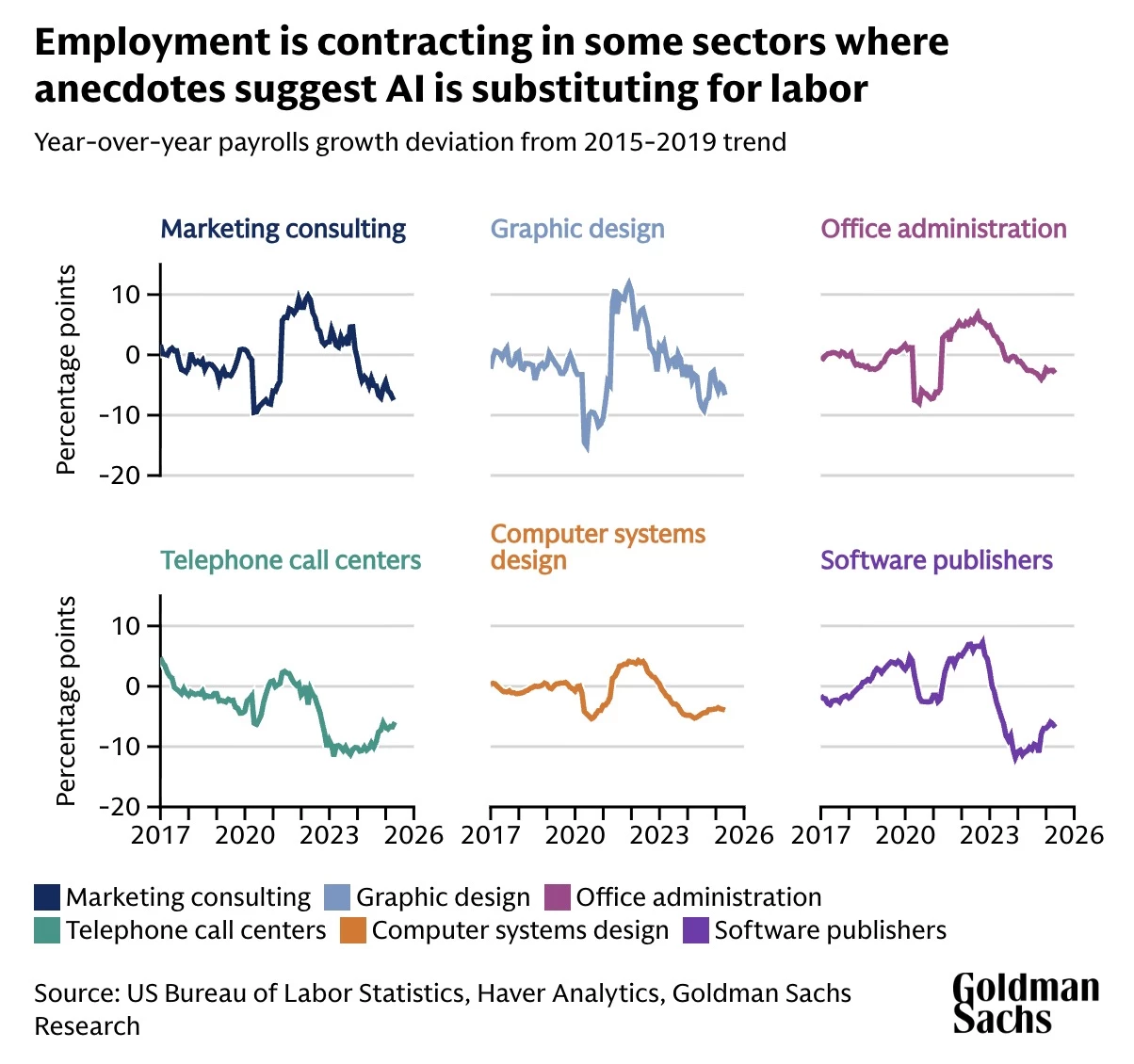
It’s important to note, however, that across many sectors, payroll growth has lagged pre-pandemic trends since around 2022.
However, this largely reflects broader economics rather than a sudden shock from ChatGPT.
Post-pandemic, tech and service firms initially over-hired, then pulled back as interest rates rose to combat inflation, which slowed demand and prompted hiring freezes, cost-cutting, layoffs, and slower payroll growth.
High inflation and economic uncertainty have been cited repeatedly by economists and employers as key drivers of 2025–2026 job cuts, rather than solely automation.
At the same time, AI adoption is real, but its labor market impact so far appears modest and nuanced rather than dramatic.
Where AI might actually be contributing:
- Employment declines show some correlation with roles more exposed to gen AI, particularly among younger workers.
- A few firms are starting to replace certain contract tasks with AI, though many still retrain or redeploy staff instead of cutting them.
- AI can cut down on the need to hire for routine or automatable tasks, but it’s not the main reason overall employment is falling.
- Its labor substitution effects are creeping in slowly and unevenly across occupations.
What AI Job Displacement Statistics Mean for the Future of Work (2025–2030)
Looking ahead, the data sketch out two broad scenarios for labor markets, and history suggests the second is more likely:
1. Long-Term Mass Unemployment
In this unlikely scenario, AI makes human labor largely unnecessary. Productivity soars, but jobs permanently vanish.
However, most experts find this extreme outcome improbable. In fact, just fully automating half of the current tasks worldwide could take another 20 years (National University).
In the near future, it's more likely that new AI-powered industries will emerge to absorb displaced workers.
Historical data supports this:
- 60% of U.S. workers today are in jobs that didn’t exist in 1940 (Goldman Sachs).
- Over 85% of employment growth since 1940 came from tech-driven job creation.
New technologies create demand as well as save labor. Over time, rising incomes from AI productivity often spur new sectors like healthcare, education, entertainment, etc., that hire lots of people.
2. Short-Term Dislocation and Reallocation
This is the expected scenario: a temporary rise in unemployment as workers leave old roles and transition to new ones.
For example, each 1-point productivity gain from technology tends to raise unemployment by ~0.3 points in the short run. This effect is usually temporary, with most job losses fading within two years (Goldman Sachs).
The main impact of AI in 2025-2030 will likely be this “transition inflation” in unemployment rather than a permanent structural collapse.
The AI Transition: What Should You Do Next?
This transition will not be painless, but it is manageable. It requires honesty from leaders and proactive action to sustain employment, including reskilling, safety nets, and adaptability.
For Workers: Future-Proof Skills
For employees, the message is clear: emphasize retraining and mobility. History shows workers eventually find new jobs, but the adjustment can be painful without support.
Those who can work with AI are in demand, so you must acquire AI literacy and durable human skills:
- Workers with AI skills earn, on average, 25% more than those without (PWC).
- 69% of employers plan to hire talent to design AI tools (WeForum).
- 62% plan to recruit employees with skills to work alongside AI (WeForum).
- By 2030, 66% of tasks will still need human or human-tech collaboration.
At the same time, uniquely human skills will remain irreplaceable.
Employers consistently rank communication, leadership, critical thinking, collaboration, and character skills as top future skills, appearing in 15M U.S. job postings annually.
According to the National University:
- 8 of the top 10 U.S. job skills are durable (human) skills.
- Tech skills are growing fastest, outpacing other categories over the next five years.
- Creative thinking, resilience, flexibility, and agility rise sharply in importance for employers.
- Analytical thinking, curiosity, and lifelong learning rank among the top 10 growing skills.
- 75% of U.S. employers now prioritize continuous upskilling and lifelong learning.
For Businesses: Leadership Drives AI Impact on Jobs
While AI can cut some costs now, the smart play is to invest in people and new business areas. Automation can boost efficiency, but companies that ignore talent or fail to redeploy workers risk long-term stagnation.
All companies need a strategic plan for people, because leadership (or lack thereof) will multiply the effects of AI on jobs.
Some key insights from McKinsey’s leadership survey:
1. Invest Strategically
Nearly all firms are pouring money into AI, yet only about 1% of companies feel AI is fully integrated into their workflow.
Executives know AI matters but struggle with execution.
2. Mind Perception Gaps
Similarly, only 20% of leaders expect heavy AI use in a year, while 47% of employees anticipate it. Adoption is often grassroots, led by eager staff.
Many leaders underestimate employee readiness:
- 47% of leaders say their company moves “too slowly” on generative AI, even though 69% invested over a year ago.
- Leaders believe only 4% of employees use AI for 30%+ of tasks, but surveys show 13% already do, almost 3x more than their estimate.
- Only 20% of leaders expect heavy AI use in a year, while employees are twice as likely (47%) to believe they will.
This shows that tech adoption is often grassroots, led by eager staff rather than top-down mandates.
3. Invest in Talent and Training
92% of organizations plan to increase AI spending in the next three years, and 7% of executives cite employee skill gaps as a main adoption barrier.
And yet, only 48% of employers say they involve non-technical staff early when developing AI tools.
Meanwhile, 48% of employees rank training as the most important factor to adopt AI successfully, but half feel they get only “moderate or low” support.
Without enough training and inclusive planning, adoption risks alienating workers.
4. Don’t Neglect Culture and Inclusion
Leaders should recognize that millennials and GenZ employees already expect AI adoption.
McKinsey finds millennials are 1.4× more likely than older peers to embrace AI in workflows, with 90% confident in using it. Including these employees as champions or trainers can speed up success.
Conversely, ignoring the workforce’s anxieties, especially among younger workers worried about job security, can create resistance, slowing down implementation.
5. Roll Out AI Responsibly and Ethically
Ethical and transparent deployment matters. 71% of U.S. workers trust employers to implement AI safely and ethically.
Leaders should build on that trust by setting clear guidelines for AI use, involving employees in governance, and offering support.
AI Job Displacement Stats: Final Words
AI reshuffles the deck. Instead of a free fall, we are entering an evolution of jobs. It hurts many routine roles while benefiting or creating jobs that require technical or uniquely human skills, which is where adaptation is easier.
But ultimately, leadership is the biggest multiplier of its impact. The same technology that displaces jobs in one company can create opportunities in another, depending on strategy.
Workers who proactively update their skills and mindsets will find opportunities, and businesses that invest in people will fully benefit from AI’s productivity gains.

Our team ranks agencies worldwide to help you find a qualified partner. Visit our Agency Directory for the Top AI Companies as well as:
- Top AI Marketing Companies
- Top AI Automation Agencies
- Top AI App Development Companies
- Top AI Web Design Companies
- Top Generative AI Companies
Our design experts also recognize the most innovative design projects across the globe. Visit our Awards section for the best & latest.
AI Job Displacement Stats FAQs
1. Will AI actually eliminate more jobs than it creates?
Not necessarily. According to the World Economic Forum, AI and automation could displace 92 million jobs globally by 2030, but they’re also expected to create around 170 million new roles.
That’s a projected net gain of roughly 78 million jobs, even though the transition may be uneven and disruptive.
2. How many jobs are at risk of being automated?
Research from the McKinsey Global Institute suggests that up to 30% of hours worked in the U.S. economy could be automated by 2030.
3. Which workers are most exposed to AI?
Goldman Sachs estimates that around 300 million full-time jobs globally could be affected by generative AI, particularly roles involving administrative support, legal work, and office-based tasks.
Entry-level and routine cognitive roles tend to face the highest exposure.