
AI-native means building the way a company works around AI, rather than adding AI tools to existing processes.
In an AI-native organization, AI influences workflows, decisions, roles, governance, and the operating model itself. Reaching that point means moving through several stages that gradually change how work gets done.
Let's break down where leaders get stuck, what has to change first, and how to turn everyday AI use into a real operating advantage.
AI-Native Companies: Key Findings
- AI-native companies redesign how work gets done around AI, embedding it into workflows, roles, governance, and decision processes rather than limiting it to individual tasks or isolated tools.
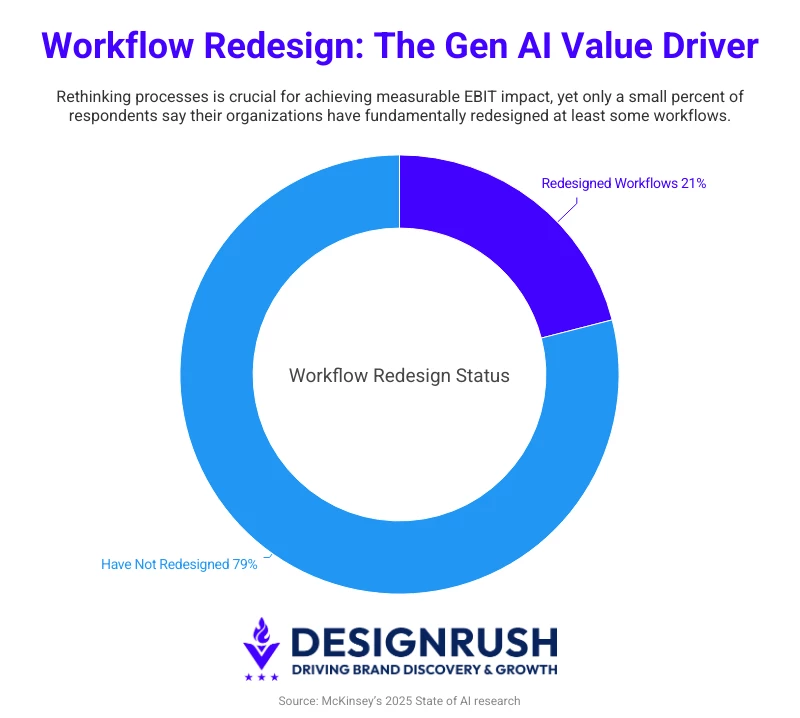
- Workflow redesign is one of the clearest dividing lines between AI adoption and AI-native operations. McKinsey found it had the greatest effect on gen AI EBIT, yet only 21% of organizations had fundamentally redesigned at least some workflows.
- Leadership use of AI is already outpacing the systems needed to manage it well. Deloitte found that 60% of executives regularly use AI to support decisions, but only 5% say they manage that use well.
88% of Companies Are Using AI, but Only 6% Are Getting Real Results
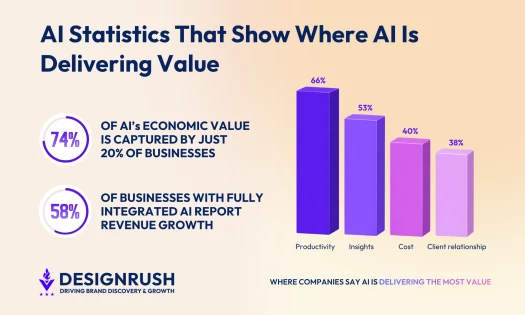
McKinsey’s State of AI found that 88% of organizations now use AI in at least one business function, but only about 6% qualify as AI high performers.
Meanwhile, the upside is already concentrating.
BCG found the small group they call “future-built” makes up only 5% of firms, yet those companies achieve five times the revenue increases and three times the cost reductions that others get from AI.
Here’s how to win the race from AI adoption to growth, margin gains, and competitive speed that come with being AI-native.
Why AI Adoption Still Falls Short of AI Transformation
There's a meaningful difference between a company that uses AI and one that is built around it.
- AI adoption means AI is used as a tool within existing workflow, which is helpful, but bolted on.
- AI-native means AI actively reshapes workflows, decisions, and the operating model itself.
You use AI to draft emails, summarize meetings, speed up research, or clean up presentations. That improves personal productivity, but it does not change how the business operates.
Adoption means people are using the tool.
Transformation means the company has changed how work gets done because of it.
So, even when usage is high, AI ROI stays low because the surrounding workflow never changed.
Companies become AI-native only when AI stops being a helpful layer on top of work and starts reshaping how work moves across the business.
The difference is easier to see as a progression. The AI-native vs. AI-enabled distinction comes down to how deeply AI changes the way work gets done. Use the table below to identify where your company currently sits and what needs to change next.
| Stage | How AI Is Used | How Work Gets Done | Human Role | Likely Impact |
| AI Adoption | AI is used for drafting, research, summaries, or basic analysis | Existing workflows remain largely unchanged | People complete the work, with AI supporting individual tasks | Task-level time savings and productivity gains |
| AI Integration | AI is embedded in selected tools, processes, or business functions | Parts of existing workflows are automated or accelerated | People direct the process and review AI outputs | Efficiency gains in specific teams, functions, or workflows |
| Workflow Redesign | AI supports connected steps within an end-to-end workflow | Workflows are rebuilt around AI, reliable data, and human review | People focus more on judgment, exceptions, and accountability | Faster decisions, less rework, and measurable impact |
| AI-Native | AI is embedded in workflows, roles, governance, and strategy | Human-AI interaction is built into the operating model | People and AI work through defined roles and escalation paths | Greater potential for sustained financial and operational value |
How To Become AI Native by Redesigning Your Workflows
McKinsey’s 2025 State of AI research found that redesigning workflows had the biggest effect on whether organizations saw EBIT impact from gen AI.
Yet only 21% of respondents said their organizations had fundamentally redesigned at least some workflows.
That is a significant market gap you can fill: Most companies are introducing AI into work, but far fewer are redesigning how work really moves. Here’s how to do it the right way in five phases.
- Phase 1: Start the AI transformation roadmap with one workflow that matters
- Phase 2: Build a decision-ready input system before you redesign the decisions
- Phase 3: Build AI decision memos for better leadership decisions
- Phase 4: Replace the traditional leadership meeting with an AI-native workflow
- Phase 5: Turn one working AI workflow into a repeatable operating model
Phase 1: Start the AI Transformation Roadmap With One Workflow That Matters
A good first workflow usually has four signs: it happens often, it involves manual effort, the steps are easy to trace, and the business value of fixing it is obvious.
That is what makes it a better starting point than a broad function like marketing, sales, or operations.
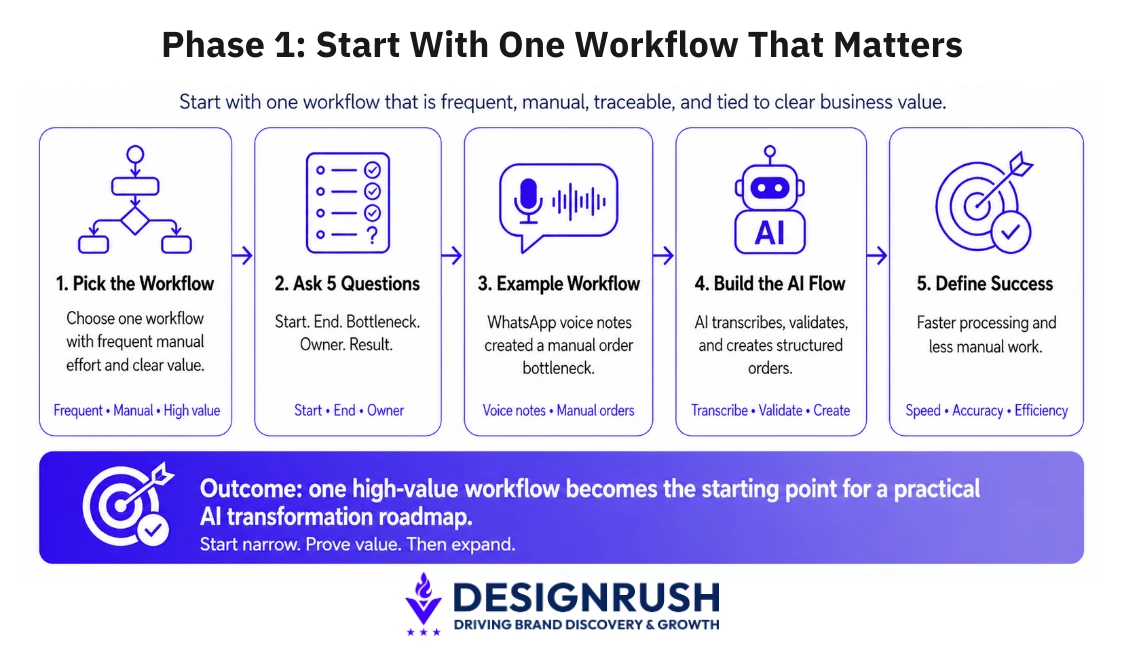 A good example is what Unico Connect did for their client, Ashokraj Transport & Logistics.
The company had a bottleneck in one specific workflow:
Customers and field staff were placing orders through WhatsApp voice notes in Hindi and English, and the operations team then had to manually transcribe those messages, interpret the details, check them against the product catalog, and enter the orders into the system.
That is the kind of workflow you want to find first.
- It has a clear start point: A voice note comes in.
- It has a clear end point: A structured order is created in the operations system.
- It has obvious friction points: Transcription, interpretation, validation, and data entry.
- And it has a clear business payoff: Faster processing and less manual handling.
That is how you should approach phase one in your own business. Look for one workflow where you can answer five questions clearly:
- Where does the workflow begin?
- Where does it end?
- Where is the manual bottleneck?
- Who owns the outcome?
- What business results should improve if this works?
In this case, Unico Connect used those answers to build a multilingual AI voice agent inside WhatsApp Business.
It transcribed and interpreted voice notes in Hindi and English, extracted the order details, validated them against the catalog, and created structured orders automatically.
The result was faster order processing, less manual handling, and an AI interface that worked inside a channel customers were already using.
Phase 2: Build a Decision-Ready Input System Before You Redesign the Decisions
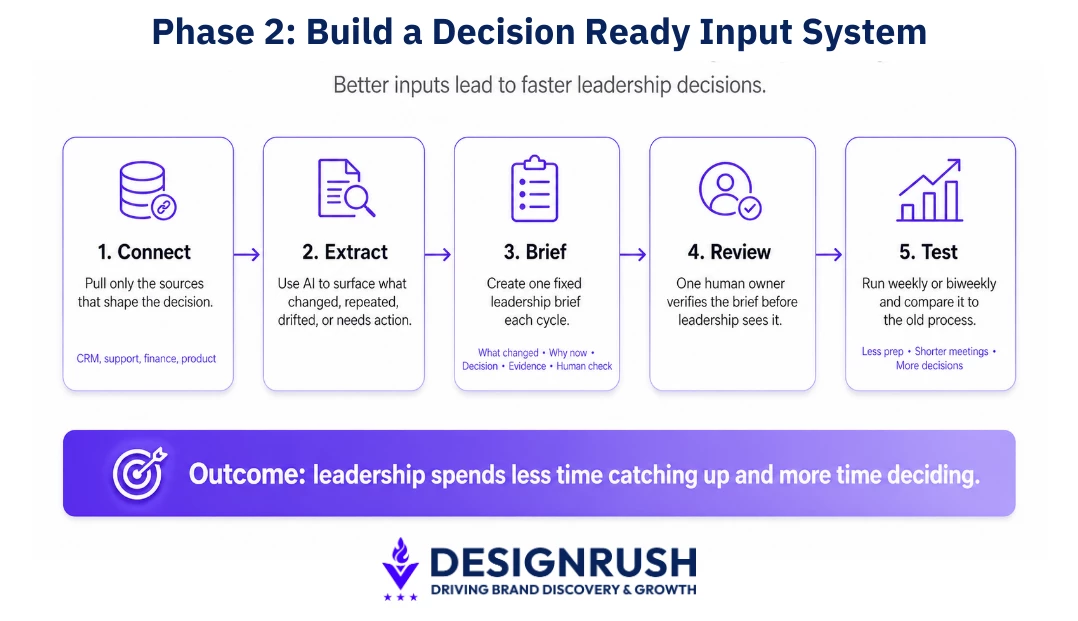 Before you can make better decisions with AI, you need better inputs.
In most companies, those inputs are still fragmented. Sales has one view, support has another, finance has another, and by the time everything is stitched into a deck, the meeting is spent catching up instead of deciding.
Build the data input system like this:
What to connect:
Pull in only the sources that shape the decision you are redesigning, such as CRM notes, support trends, finance shifts, call transcripts, product usage changes, competitor moves, or delivery blockers.
What AI should extract:
Use AI to pull out what changed, what keeps repeating, what is moving off trend, what risk is building, what opportunity is emerging, and what now needs a decision.
What the output should look like:
Turn that into one fixed brief leadership sees every cycle:
- What changed
- Why it matters now
- What decision it affects
- What evidence supports it
- What still needs human confirmation
Who checks it before leadership sees it:
Assign one human owner to review the brief before it reaches leaders. AI should prepare the first layer of synthesis, but a person should verify the signal, remove weak points, and make sure the brief is trustworthy.
How to test whether it works:
Run it weekly or biweekly for a few cycles and compare it with the old reporting process. The signs it is working are simple: less time spent assembling updates, fewer duplicate reports, shorter meetings, and more time spent on actual decisions.
If you do this right, your leadership team stops spending Monday morning getting informed and starts Monday morning already at the point of interpretation.



Phase 3: Build AI Decision Memos for Better Leadership Decisions
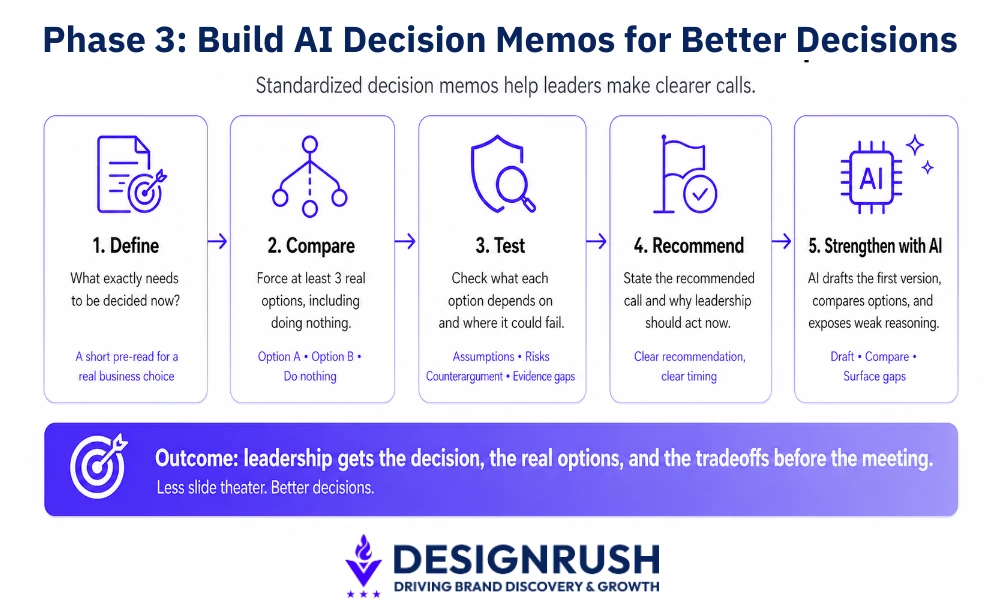 A decision memo is a short pre-read leadership gets before a meeting when a real business choice needs to be made, such as whether to enter a market, change pricing, approve a hire plan, delay a launch, or shift budget.
Most companies already have some version of this, but it usually comes disguised as a proposal, a deck, or an update document built to support one preferred answer.
That is the problem. By the time leadership reads it, the thinking has already been narrowed.
The better redesign is to standardize one decision memo format that every team uses when it needs leadership to make a call.
Use this structure:
- Decision to make: What exactly needs to be decided now?
- Options: Force at least three real options, including doing nothing.
- Assumptions: What has to be true for each option to work?
- Risks: What could fail operationally, financially, or politically?
- Counterargument: What is the strongest case against the recommended path?
- Evidence gaps: What do we still not know?
- Recommended call: What should leadership do, and why now?
AI can help draft the first version, compare the options, surface weak assumptions, identify missing evidence, and generate counterarguments.
That makes the memo more useful because it becomes harder to hide weak reasoning behind polished slides.
- Before, leadership gets a document that says: Here is what we want to do.
- After, leadership gets a short pre-read that says: Here is the decision, here are the real options, and here is what each one costs.
Phase 4: Replace the Traditional Leadership Meeting With an AI-Native Workflow
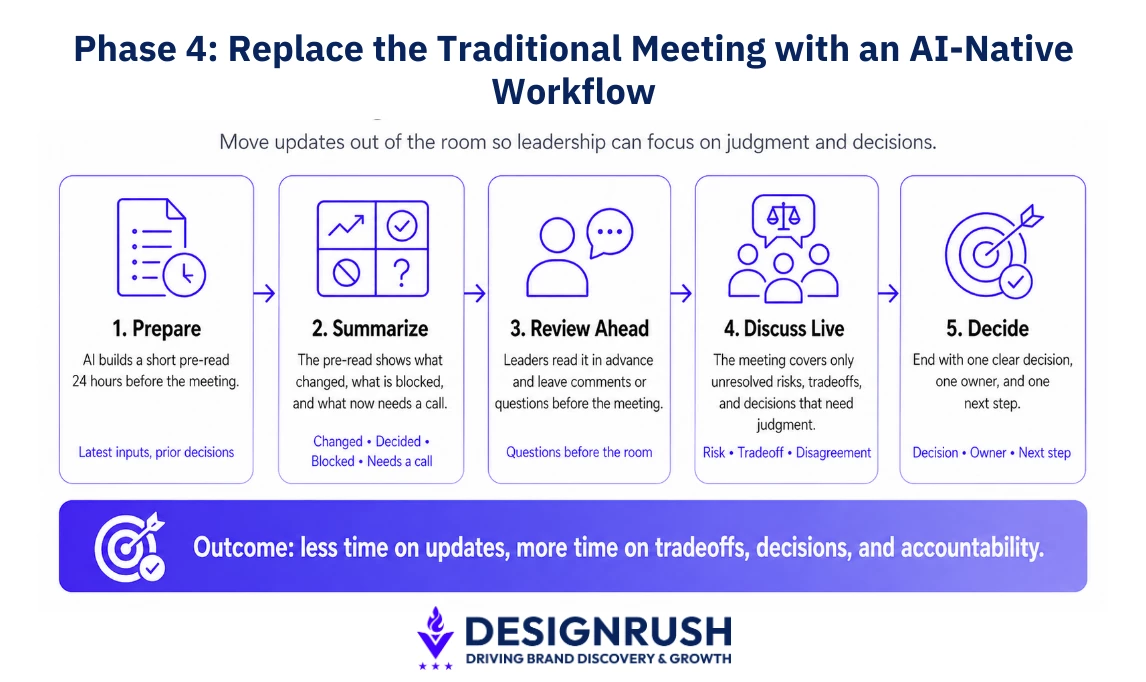 Most leadership meetings are still built around updates. Teams walk in with slides, repeat what already happened, explain background that should have been read earlier, and leave with loose follow-ups instead of clear decisions.
The better redesign is to split the meeting into two parts:
- What people should absorb before the room.
- What only leadership can resolve live.
AI handles the first part by preparing a short pre-read that pulls together the latest inputs, summarizes prior decisions, and highlights what is still unresolved. The meeting then focuses only on the issues that require judgment.
What should happen before the meeting:
- AI prepares a short pre-read 24 hours in advance.
- The pre-read includes what changed, what was already decided, what is blocked, and what now needs a call.
- Leaders review it before the meeting and leave comments or questions in advance.
What should happen in the meeting:
- What still looks risky or unclear: Not a full replay of the background, just the points that still need discussion.
- Where the real tradeoff is: What the company is choosing between, what each path costs, and where disagreement still exists.
- What gets decided now: The final call, the owner, and the next step.
Before, the weekly leadership meeting spends 40 minutes on updates and 15 on rushed discussion. People leave with different interpretations of what was decided.
After, the meeting opens with unresolved issues, spends most of the time on tradeoffs, and ends with one clear decision, one owner, and one next step.
Phase 5: Turn One Working AI Workflow Into a Repeatable Operating Model
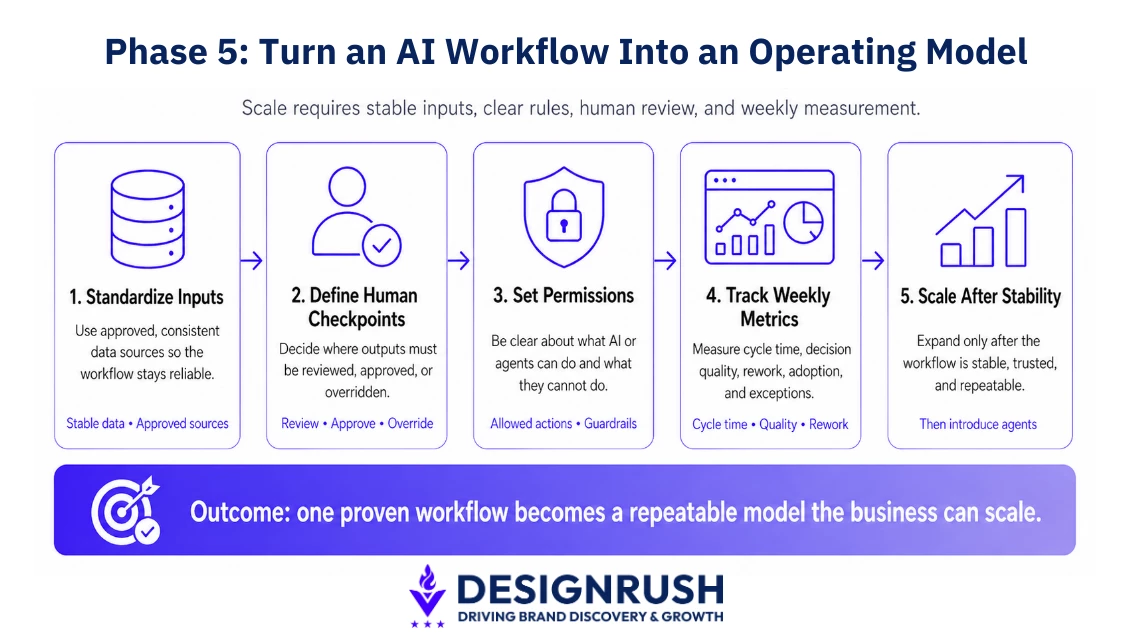 Many AI initiatives look promising early because a few people are manually holding the process together, checking outputs, fixing edge cases, and filling in gaps as they go.
That may be enough to prove the idea, but it is not enough to scale it. The people manually correcting outputs, filling data gaps, and handling exceptions are part of the pilot’s operating model, even if the company hasn’t formally defined their role.
McKinsey’s recent work on agentic AI found that nearly two-thirds of enterprises have experimented with agents, but fewer than 10% have scaled them to deliver tangible value.
Eight in ten cite data limitations as a roadblock.
That is why scaling requires approved data sources, clear model-validation rules, defined human review points, and an operating model that assigns responsibility for value creation within a domain.
As Jordan Brown, Founder of Omnie, puts it, “Equally important is adopting scalable AI solutions that can grow with the business while remaining flexible to technological advancements.”
Build scale like this:
- Standardize the workflow inputs: If source data is inconsistent, the AI layer will stay unreliable.
- Define human checkpoints: Decide where outputs must be reviewed, approved, or overridden.
- Set permissions: If AI or agents can trigger actions, be explicit about what they can do and what they cannot do.
- Track workflow metrics weekly:
- Cycle time
- Decision quality
- Rework
- Adoption
- Exceptions or overrides
- Only introduce agents after the workflow is already stable.
The AI Mindset Shift Leaders Can No Longer Avoid
The roadmap explains how to redesign the mechanics of work. The next challenge is building the leadership discipline that prevents those workflows from slipping back into bolted-on AI use.
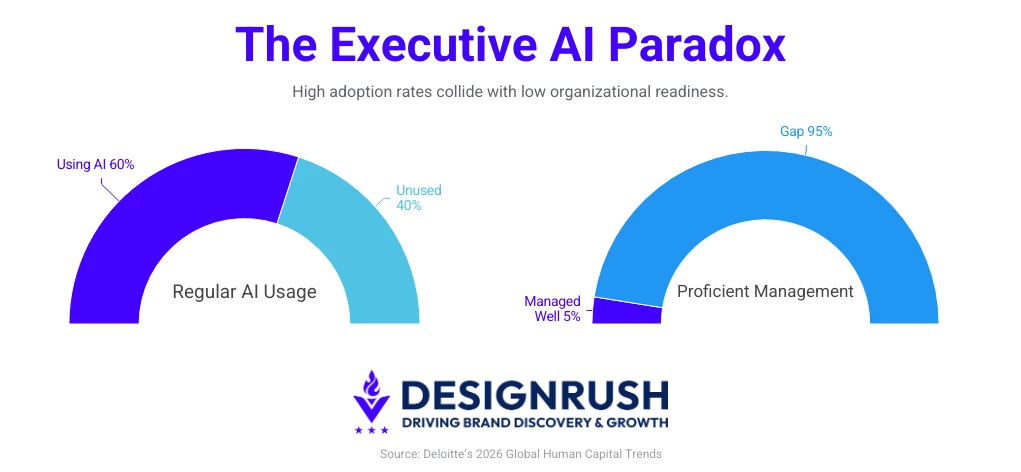
Deloitte’s 2026 Global Human Capital Trends research found that 60% of executives regularly use AI to support decisions, yet only 5% say they manage that use well.
In other words, AI is already influencing leadership judgment faster than most leaders are building the discipline to use it well.
- Stop spending executive attention on work that no longer deserves it
- Treat AI as a way to widen the decision space before narrowing it
- Stop moving faster in the wrong direction
Stop Spending Executive Attention on Work That No Longer Deserves It
AI-native leaders understand that one of the biggest leadership failures now is misallocating attention.
You spend high-value cognitive time on synthesis, formatting, recap, and first-pass analysis simply because that work used to require senior involvement. It does not anymore.
The important thing now is deciding which thinking still deserves human time and which thinking has become too expensive to do manually.
In plain words, protect your attention for what remains scarce:
- Making tradeoffs
- Setting direction
- Judging risk
If you are still spending your time cleaning up summaries, recaps, or first-pass analysis, you are using executive attention on work AI can already absorb.
Your time is better spent deciding what the business should do with that information.
Treat AI as a Way To Widen the Decision Space Before Narrowing It
Most leadership teams use AI after the direction is already emerging. At that point, AI just speeds up articulation.
AI-native leaders use it earlier, when the decision space is still wide. They use it to generate more options, more framings, more downside scenarios, and more stakeholder perspectives than a room of busy executives would usually have time to surface on their own.
If you only bring AI in once you already have a preferred direction, you are using it to reinforce your thinking, not improve it. Use it earlier, while the decision is still open, so it can show you paths you might otherwise miss.
Stop Moving Faster in the Wrong Direction
Aside from execution, AI accelerates bad framing, weak assumptions, shallow consensus, and polished nonsense. A company can now move faster in the wrong direction with more confidence than ever.
AI-native leaders understand that speed without cognitive expansion is dangerous. They do not use AI to rush to closure, but to prevent premature closure.
If you use AI only to speed up execution, it can make a weak decision look well thought out.
You may move faster, but straight into the wrong answer.
Proven Blueprints: Companies That Embody the AI‑Native Model
Understanding what it means to be AI-native becomes clearer when you look at the organizations that have built it into their operating core.
Here are my go-to examples that show just how broad and powerful AI-native design can be:
- Copy.ai: AI as core operating system
- TikTok: AI as the engine of culture and discovery
- Midjourney: Visual creativity reimagined through AI
Copy.ai: AI As Core Operating System
Copy.ai is a leading example of what it means to be enterprise AI-native.
What started as a writing tool is now an AI OS for go-to-market teams. Internally, Copy.ai uses its own platform to run customer support, marketing, and sales, often with no human touchpoint unless the AI escalates.
In my evaluation, its workflows show how AI can replace entire operational layers, from sales outreach to CRM updates.
TikTok: AI As the Engine of Culture and Discovery
TikTok’s meteoric rise can’t be attributed solely to clever marketing. It’s popularity is fueled by an AI-native infrastructure that powers hyper-personalized content discovery.
The company's recommendation system is the heartbeat of the user experience, which determines what shows up on the “For You” page in real time, based on countless signals like watch time, engagement, and user behavior patterns.
Without AI, TikTok wouldn’t scale, wouldn’t engage, and frankly, wouldn’t exist in its current form.
The platform learns from every interaction, continuously optimizing to show users what they didn’t know they needed.
Midjourney: Visual Creativity Reimagined Through AI
Built entirely around generative intelligence, Midjourney allows users to produce high-quality images by typing simple text prompts.
The entire experience, from prompt to output, is mediated through proprietary diffusion models trained to interpret language as visual intent.
While it’s often used by designers, filmmakers, and marketers for prototyping or ideation, Midjourney also reflects a deeper shift: the creative process itself is being rerouted through intelligence, making the act of visual production more accessible, iterative, and fast-moving than ever before.
As Min Lew, Creative Director at Base Design, put it,
“By embracing AI, we challenge the notion that it threatens creativity, turning it into an advantage to produce something avant-garde. This approach turns client projects into experiments, attracting audiences by staying current and experimenting in real-time.”
How To Restructure Teams for AI and Build an AI-Native Organization
As companies become AI-native, the real change is redesigning roles, so work moves faster with clearer ownership.
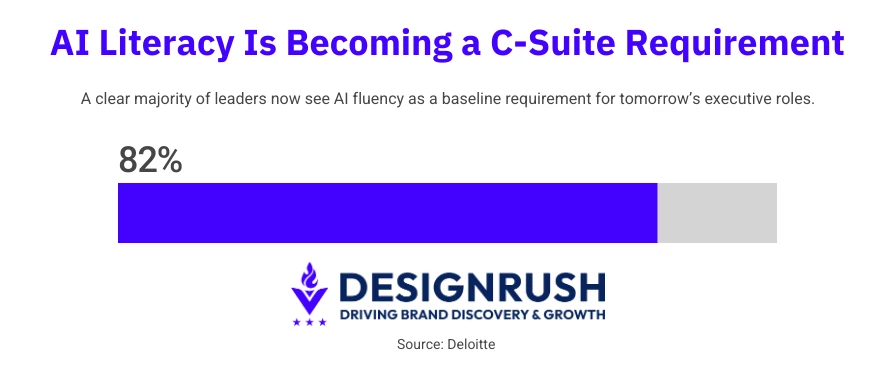
7 in 10 business leaders say speed and agility are their main strategy, while 82% of leaders say AI understanding will be mandatory for future C-suite roles, yet only 41% feel confident they can lead it well.
 On the other hand, Deloitte’s 2026 report says companies that intentionally redesign human-AI roles and interactions are twice as likely to exceed AI ROI expectations.
Cambridge Centre for Alternative Finance (CCAF) research found that organizations reaching advanced AI maturity consistently shared the same foundations: higher AI investment, better workforce preparedness, better data infrastructure, and clearer organizational readiness.
Financial institutions spending more than $100,000 annually on AI were significantly more likely to reach advanced adoption maturity than lower-spend peers.
The pattern strengthens a broader point: becoming AI-native requires operational redesign, long-term investment, and teams prepared to work alongside AI systems.
As Brown puts it, “Businesses should train their teams to work alongside AI, fostering collaboration between automation and human expertise to deliver exceptional customer experiences.”
Here’s how to do it right:
- Leadership: Keep strategy, tradeoffs, risk, and accountability with humans. Leaders should stop acting as information relays and start acting as decision owners: setting direction, defining guardrails, and deciding where human review is non-negotiable.
- Managers: Redesign the manager role around coaching, exception handling, and decision quality. As AI absorbs recap work, first-pass synthesis, and routine coordination, managers should spend less time collecting updates and more time helping teams interpret outputs, escalate edge cases, and improve execution.
- Teams and individual contributors: Shift everyday work away from drafting, summarizing, and basic analysis, and toward interpretation, customer context, problem framing, and action.
This is why role redesign matters more than AI training alone: McKinsey says 75% of roles need fundamental reshaping right now, and BCG estimates 50% to 55% of US jobs will be reshaped by AI over the next two to three years.
Potential Results You Should Be Seeing from Becoming AI-Native
 Becoming AI-native should start showing up in operating results, and the clearest signs are faster decisions, redesigned workflows, stronger human-AI coordination, and early business impact.
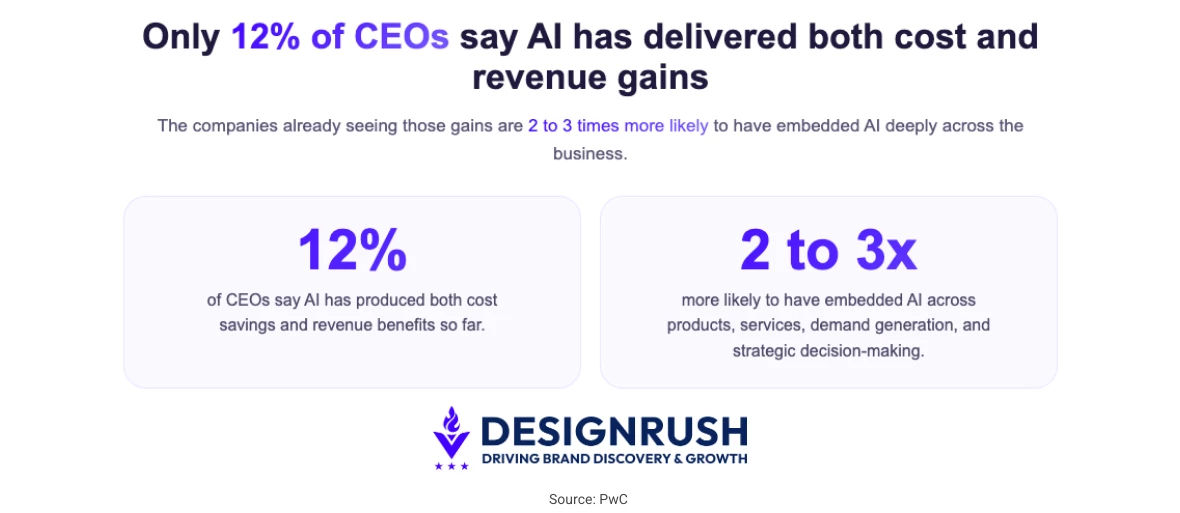
- Better chances of getting both revenue and cost gains: PwC found that only 12% of CEOs say AI has delivered both cost and revenue benefits so far, but the companies getting those gains are 2 to 3 times more likely to have embedded AI extensively across products, services, demand generation, and strategic decision-making.
- Stronger margins when AI is integrated deeply: PwC also found that companies applying AI widely across products, services, and customer experience achieved nearly four percentage points higher profit margins than those that did not.
- Deeper day-to-day AI use inside real work: McKinsey found employees report using gen AI for at least 30% of their daily work at 3 times the rate C-suite leaders estimate, and 47% of employees believe they will use gen AI for more than 30% of their daily tasks within a year.
- Stronger leadership ownership: McKinsey found AI high performers are 3 times more likely to say senior leaders demonstrate ownership of AI initiatives.
- A clearer human-AI operating model: Deloitte’s 2026 report says only 6% of organizations lead in intentional human-AI interaction design, which means one practical result of becoming AI-native is moving out of that broad majority that still has AI access without a well-designed way of working.
How To Become an AI-First Company: Final Thoughts
An AI-native company changes how work gets done. That means redesigning workflows, clarifying human review and ownership, and using AI where it improves decisions, speed, or business outcomes.
If your organization is ready to move beyond isolated AI use, the right implementation partner can help turn those changes into a workable operating model.
Our team ranks agencies worldwide to help you find a qualified partner. Visit our Agency Directory to find top-rated AI companies, as well as:
- Top AI Consultants
- Top Generative AI Firms
- Top Chatbot Solution Companies
- Top AI Automation Agencies
- Top AI Companies in San Francisco
Our design experts also recognize the most innovative design projects across the globe. Given the recent uptick in AI tools usage, you'll want to visit our Awards section for the best & latest in AI website designs.