
I’ve worked with teams that tried to build broad “AI for everyone” offerings, and I can tell you — that path usually ends in burnout and weak client trust.
The agencies that thrive narrow their focus, articulate ROI in plain numbers, and build models that scale without compromising quality. That’s the framework I’ll walk you through.
How to Start an AI Automation Agency: Key Points
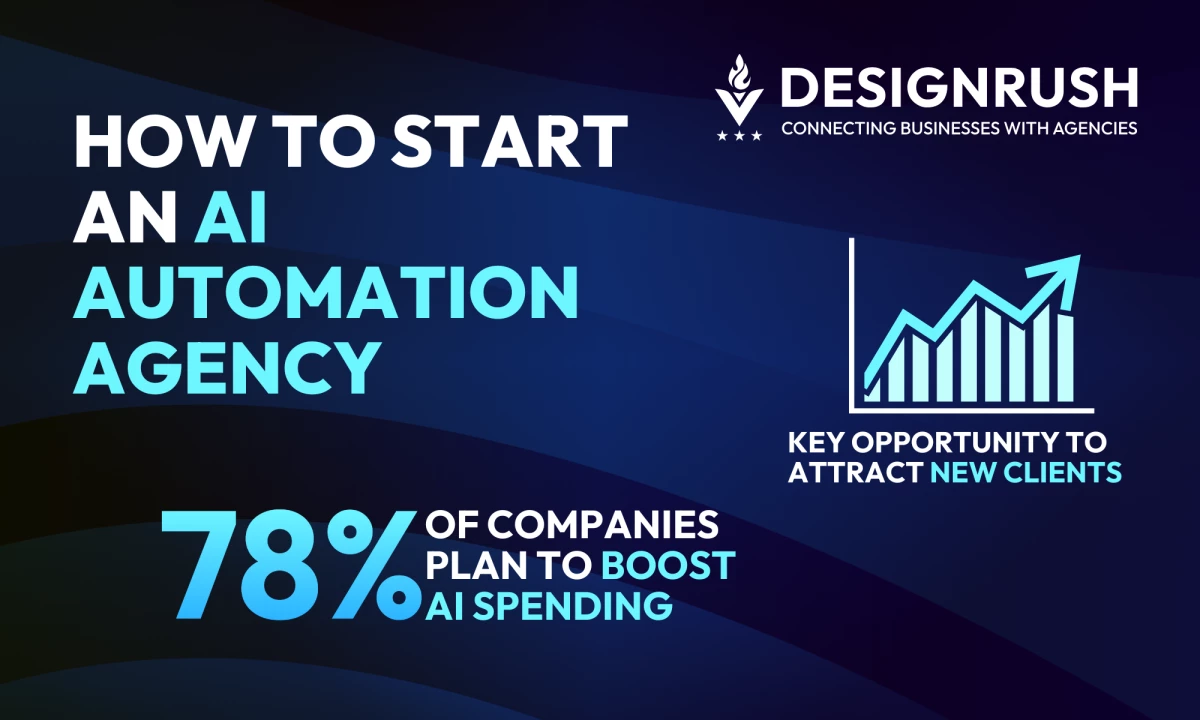
- Nearly 80% of companies worldwide already use AI, signaling a strong and growing demand for specialized automation services.
- Research shows 75% of B2B decision-makers trust companies that work with experts, while 88% prefer those offering educational content, proving that expertise and thought leadership drive client acquisition.
- Agencies that showcase hard metrics, like a 50% reduction in processing time, consistently outperform those relying on buzzwords to win deals.
How To Start an AI Automation Agency: Overview
As nearly 80% of companies worldwide are already using AI, the demand for specialized AI automation services has never been higher.
I see this rapid growth as a unique opportunity for agencies willing to step in with clarity and focus. But momentum alone won’t carry you. To truly capitalize, you need a business model that’s both scalable and flexible; one that adapts as client needs evolve.
Here’s how I recommend laying the foundation for long-term success.
Step 1: Define Your Niche and Value Proposition
In my experience, the most common mistake new agencies make is spreading themselves too thin. The truth is, clients don’t want generalists — they want experts who can solve their exact problems.
When I’ve consulted on automation projects in finance, for example, executives respond instantly when you address loan processing delays or fraud monitoring.
In healthcare, I’ve seen agencies win by automating patient triage or billing. Generic “AI solutions” won’t cut through — clients want specificity and proof.
Here’s how I approach defining a niche:
- Identify a high-impact vertical: Pick industries where automation has measurable ROI. Finance, healthcare, supply chain, and manufacturing are rich targets.
- Articulate client pain points clearly: The more concrete your framing (“cut claim errors by 30%”), the more credibility you build.
- Make ROI your headline: I’ve learned executives sign contracts when they see numbers — cost reduction, efficiency gains, or revenue lift. Every pitch should quantify value.
Kristin Marquet, Founder and Creative Director of Marquet Media, emphasizes the importance of streamlining agency offerings: “The most successful agencies aren’t generalists — they own their niche.”



Step 2: Choose a Business Model That Scales
From leading development roadmaps, I’ve learned a simple truth: your business model isn’t just pricing — it’s how you communicate stability to clients.
- Subscription models create predictable revenue, but only work if you can deliver consistent value month after month.
- Project-based pricing is effective for early traction but dangerous if it locks you into a “deal-hunting” cycle.
- Retainers transform you into a long-term partner, which in my experience is where client loyalty (and agency growth) compound.
I typically advise agencies to start with project-based work — prove value quickly — then evolve into retainer packages once trust and measurable results are established.
Step 3: Build Compliance Into Your DNA
One challenge I’ve seen agencies underestimate is compliance.
In finance and healthcare especially, no amount of innovation offsets sloppy handling of sensitive data.
- Legal structure matters: I’ve worked with agencies that paid dearly for ignoring this upfront. Whether you choose an LLC or S-Corp, it directly impacts liability and client confidence.
- Security is non-negotiable: I’ve seen deals stall because teams couldn’t demonstrate GDPR logging or HIPAA protocols. Encryption, access control, and audit trails aren’t “nice to have” — they’re table stakes.
- Documentation builds trust: Clients often ask for evidence of your compliance processes. Having a clear playbook shows you operate at enterprise-grade standards.
Step 4: Streamline Operations and Keep Innovating
Ironically, I’ve seen automation agencies slow themselves down with manual internal processes. The best-run teams practice what they preach:
- Automate internally first: At DesignRush, I’ve overseen projects where AI-powered scheduling and reporting freed entire teams to focus on strategy. That’s how you scale without ballooning overhead.
- Invest in R&D: AI moves faster than most roadmaps. If you aren’t reinvesting in emerging tech, you’ll fall behind in less than a year.
- Close the loop with feedback: Every high-performing team I’ve worked with treats client feedback as a development sprint. Continuous improvement is the difference between a one-off vendor and a long-term partner.
Tools I Recommend for AI Automation Agencies
I evaluate tools not just for their features but for how they hold up in real-world pipelines. Here’s how I break it down:
Tool/Platform | Best For | Why I Recommend It | Top Use Cases |
TensorFlow | Custom machine learning model development | Offers deep flexibility for agencies building bespoke AI solutions at scale | Training deep learning models, predictive analytics, image recognition |
Hugging Face | NLP and pre-trained AI models | Speeds up time-to-market with reusable, community-backed models | Chatbots, sentiment analysis, document summarization |
Cloud AI Services (AWS, Azure, Google) | Scalable infrastructure and ML tools | I’ve used these to scale deployments without reinventing infrastructure | Model training, data storage, deployment at enterprise scale |
UiPath | Enterprise robotic process automation (RPA) | Reliable for large, repeatable workflows in regulated industries | Automating ERP/CRM tasks, invoice processing, HR onboarding |
Blue Prism | Large-scale RPA for enterprises | Strong governance features, critical for compliance-heavy sectors | Banking automation, compliance workflows, call center processes |
Zapier | Lightweight, no-code automations | Perfect for lean agencies needing fast wins without dev overhead | Connecting SaaS apps, automating marketing and sales flows |
Make (Integromat) | Advanced no-code workflow automation | Offers more customization than Zapier for growing teams | API integrations, data sync across platforms |
OneTrust | Privacy and compliance automation | I’ve seen clients trust faster when agencies show OneTrust in their stack | GDPR compliance, data consent management, privacy reporting |
AWS Key Management Service (KMS) | Cloud-based data encryption | Scales securely without burdening your dev team | Encrypting sensitive data, managing access keys |
Tanium | Endpoint security and compliance | Provides real-time monitoring — invaluable in enterprise environments | Vulnerability management, auditing, threat detection |
My advice: don’t over-engineer your stack early.
I’ve seen lean agencies succeed by starting with lightweight platforms like Zapier and Hugging Face APIs, then scaling up once client demand justifies the overhead.
Step 5: Master Client Acquisition
One challenge I see agencies consistently struggle with is translating technical brilliance into client trust. AI feels abstract to many executives, and your job is to bridge that gap.
And with nearly 80% of companies planning to increase their AI investments in the upcoming fiscal year, the timing couldn’t be better. If you can demystify AI and show measurable ROI, you’ll be in a prime position to capture new clients.
- Educate through content: In my experience, whitepapers and case studies consistently outperform glossy sales decks. Executives trust data-backed insights, and research confirms it — 75% of B2B decision-makers trust companies that work with experts, and 88% prefer those offering educational content.
- Showcase real metrics: A single chart showing “50% reduction in processing time” has won more deals than I can count. Data beats buzzwords.
- Network deliberately: I’ve built more long-term partnerships through focused industry events and LinkedIn engagement than through cold outreach.
How To Differentiate Your AI Automation Agency: Actionable Insights for Agency Leaders
With AI growing at breakneck speed, I’ve seen clients flooded with options — and most offers sound the same. If you want your agency to stand out, you need more than technical chops; you need a clear identity that clients remember.
Here’s how I approach differentiation in practice:
- Offer customized solutions: In my experience, generic automation doesn’t close deals. The agencies that win tailor services to client pain points and show how their solution solves a specific business challenge.
- Leverage emerging technologies: I’ve learned that clients notice when you bring cutting-edge tools to the table. By continuously experimenting with new AI innovations, you position your agency as a leader rather than a follower.
- Adapt to evolving needs: One constant I’ve seen in my career is change. The strongest agencies design solutions that grow with clients, not ones that become obsolete within a year.
- Position as a long-term partner: The most successful agencies I’ve worked with aren’t “vendors” — they’re strategic partners. They offer continuous improvements and support, proving they’re invested in the client’s future, not just the next invoice.
My Closing Advice To New Founders
In my work overseeing development lifecycles, one lesson has stayed constant: discipline beats hype.
If I were starting an AI automation agency today, I’d:
- Focus on one vertical where automation creates undeniable ROI.
- Start with project-based engagements, then move to retainers once trust is earned.
- Bake compliance and documentation into the business from day one.
- Automate my own agency operations before selling automation externally.
That combination builds authority faster than any marketing campaign.

Our team ranks agencies worldwide to help you find a qualified partner. Visit our Agency Directory for the top AI companies, as well as:
- Top AI Companies in Boston
- Top AI Consulting Companies
- Top AI Automation Agencies
- Top Generative AI Companies
- Top AI Marketing Companies
Our design experts also recognize the most innovative design projects across the globe. Visit our Awards section for the best & latest in design.
How To Start an AI Automation Agency FAQs
1. What are the startup costs for an AI automation agency?
Startup costs range from a few thousand to tens of thousands of dollars. Key expenses include hardware, software, talent (developers, data scientists), and marketing. Don’t forget ongoing costs like office space, cloud services, and personnel.
Plan for initial and ongoing expenses like office space (even if remote), cloud services, and personnel to estimate your budget.
2. Which industries benefit most from AI automation?
Industries like finance, healthcare, manufacturing, and retail benefit significantly from AI. Finance uses AI for fraud detection, healthcare for diagnostics, and manufacturing for efficiency.
Other targets include logistics, energy, and telecommunications. Focus on the industries where you can demonstrate clear ROI from automation. Focus on sectors where AI can provide clear, measurable ROI through automation.
3. What challenges should I expect when starting an AI automation agency?
Expect technical challenges with data management and compute power, and business challenges around client acquisition and market competition. You’ll also need to navigate regulatory issues like GDPR and emerging AI regulations, but with strategic planning, these challenges are manageable.