
I reviewed the top AI SEO tools on the market and compared how well they help teams find better opportunities, optimize faster, and make smarter search decisions.
AI-Powered SEO Tools: Key Findings
- Platforms like Semrush, HubSpot, Moz Pro, Conductor, and Brandi AI help teams track brand mentions, citations, share of voice, and competitor visibility across AI-generated answers.
- AI-based SEO tools such as Jasper and Frase streamline keyword research, outlining, and draft creation at scale.
- For a fully managed alternative, done-for-you (DFY) SEO agencies like Searchbloom and Victorious handle strategy, content, link building, and technical SEO end-to-end.
What Is an AI SEO Tool and What Can It Actually Do in 2026
AI SEO tools use artificial intelligence to automate and improve tasks like keyword research, content optimization, competitor analysis, and performance tracking.
In 2026, a second layer emerged: tracking visibility not just on Google, but inside AI-generated answers from ChatGPT, Perplexity, Gemini, and Google AI Overviews. This is where the category has meaningfully evolved.
Here are the key features to aid your SEO strategy in 2026:
- Keyword and topic research: Groups queries by intent and surfaces long-tail opportunities and content gaps before competitors fill them.
- On-page optimization: Analyzes pages with NLP to suggest stronger tags, headings, and content structure.
- Competitive analysis: Compares your content and backlinks against competitors to flag where rankings and authority are falling behind.
- Backlink audits: Flags broken or low-value links and identifies which backlinks are most likely to strengthen performance.
- Performance tracking: Monitors ranking changes in real time and alerts teams to traffic drops or algorithm shifts.
- Insights and predictions: Forecasts trending keywords, search demand, and high-performing content formats.
As Marco Noceda, Founder of Ecom Health, explains:
"AI excels at the foundational work: SEO audits, keyword research, topic clustering, and meta tag generation. These tasks involve structured data and patterns, making them ideal for automation."
AI SEO Tools Compared by Features, Pricing, and Best-Fit Use Cases
To compare the best AI SEO tools in 2026, I looked at how each platform performs across the areas SEO teams rely on most, including AI capabilities, core use cases, workflow support, pricing, and overall value.
This breakdown shows which tools are best suited for content optimization, keyword research, technical SEO, competitor tracking, and broader search performance management.
|
AI SEO Tool |
Best for |
AI Audits |
AI Keyword Research |
AI Content Creation |
Pricing Starts At (billed annually) |
|
All-in-one SEO and AI visibility |
✅ |
✅ |
✅ |
$99/month |
|
| HubSpot |
AEO with built-in execution |
✅ |
✅ |
✅ |
$45/month |
|
Turning AI-visibility gaps into action |
✅ |
❌ |
✅ |
Custom |
|
|
Trusted authority metrics and accessible AI visibility |
❌ |
✅ |
✅ |
$79/month |
|
|
Data-driven SEO and AEO |
✅ |
✅ |
❌ |
$208/month |
|
|
AI-driven content workflows |
❌ |
✅ |
✅ |
$39/month |
|
|
AI search visibility |
✅ |
✅ |
✅ |
$99/month |
|
|
Enterprise AEO and unified reporting |
✅ |
✅ |
✅ |
Custom |
|
|
Tying AI visibility to measurable traffic |
✅ |
✅ |
✅ |
$599/month |
|
|
AI SEO content automation |
✅ |
✅ |
✅ |
$59/month/seat |
|
|
Google AI overviews tracking |
✅ |
✅ |
✅ |
$103/month |
|
|
Topic authority and content strategy |
✅ |
✅ |
❌ |
Free / Custom |
|
| Indexly |
AI crawler accessibility and instant indexing |
✅ |
✅ |
✅ |
$83/month |
1. Semrush: Best for AI Search Visibility and Brand Presence Tracking
Try Semrush if you are a marketing, SEO, or brand team trying to understand how your company shows up across AI-generated search experiences.
Semrush brings traditional SEO data and AI visibility tracking into one platform, helping teams monitor how their brand appears across Google, AI Overviews, Google AI Mode, ChatGPT, Gemini, and Perplexity.
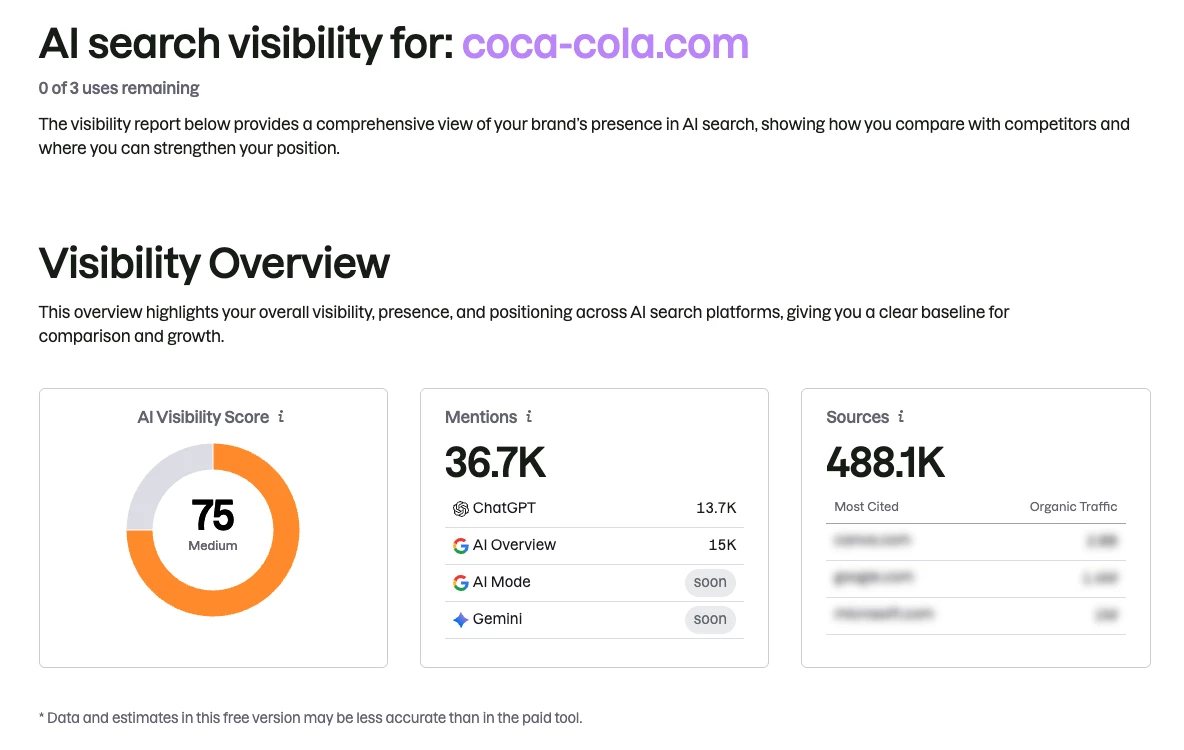
Its AI Visibility Toolkit shows where your brand appears across generative search platforms, how often competitors appear instead, which prompts matter most, and which sources AI tools cite when forming answers.
Its Visibility Score gives you a quick read on brand presence across AI search experiences, while Prompt Research helps you build a monitoring list around the questions your audience is likely asking.
DesignRush readers can use the exclusive 14-day Semrush ONE Starter trial to evaluate its AI visibility tracking, prompt monitoring, and SEO workflows before choosing a plan.
Pros:
- Strong AI visibility tracking across major generative search platforms
- Visibility Score helps measure brand presence in AI-generated answers
- Prompt Research helps identify high-value prompts for monitoring
- Daily Prompt Tracking supports ongoing visibility monitoring
Cons:
- Pricing can rise for extra domains, prompts, or users
- Broader platform may feel complex for smaller teams
The most useful part for me was how Semrush connects brand visibility with the sources and narratives influencing AI-generated answers.
You can see whether your brand appears, how often competitors are mentioned, which prompts trigger those mentions, and which sources AI platforms rely on when forming responses.
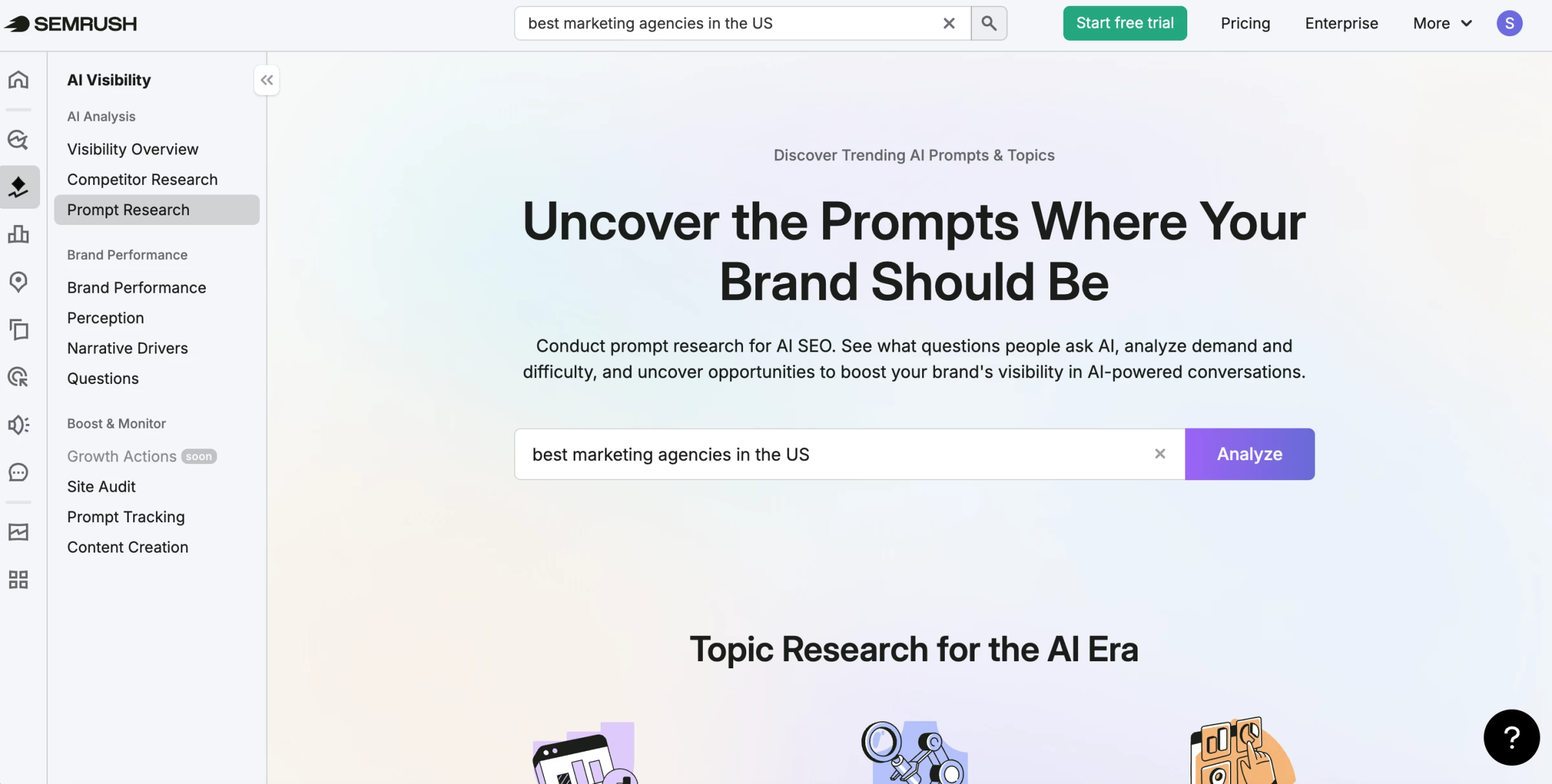
The Prompt Research feature is especially useful because it turns AI visibility tracking into a structured workflow.
You can discover high-value prompts, build a monitoring list, and then use Prompt Tracking to follow visibility changes over time.
The broader Semrush ONE offering adds more depth by connecting AI visibility with Semrush’s traditional SEO toolkit.
That means teams can compare LLM discoverability with keyword rankings, technical SEO performance, backlink data, competitor research, and content optimization in the same platform.
Overall, Semrush ONE is best for brands, agencies, and marketing teams that want to track AI search visibility, LLM discoverability, competitor presence, cited sources, and brand narratives without separating that work from their existing SEO strategy.
Pricing (billed annually)
- Starting at $99/month
Claim the exclusive 14-day Semrush ONE Starter trial.
What Users Say
Users on Capterra often describe Semrush as a comprehensive and data-rich platform for SEO, competitor research, keyword tracking, and campaign reporting.
Many reviewers highlight how useful it is for managing multiple search tasks in one place, especially for agencies and teams that need detailed visibility into rankings, backlinks, and competitors.
The main drawbacks users mention are the learning curve and pricing.
Several reviewers note that Semrush can feel overwhelming at first because of the number of tools inside the platform, while smaller teams may find the cost harder to justify if they only need a few core features.
Other Notable Features
- Prompt Research for building high-value prompt lists
- Prompt Tracking for ongoing AI visibility monitoring runs
- Daily Prompt Tracking for visibility changes over time
- Visibility Score for measuring brand presence across AI search experiences
- AI-readiness checks for technical issues that may block AI crawlers
- Traditional SEO tools for keyword research, backlinks, rank tracking, technical audits, and content optimization
For teams still comparing AI SEO tools, the exclusive 14-day Semrush ONE Starter trial offers a practical way to assess how Semrush tracks brand visibility across AI search experiences.
2. HubSpot: Best for AEO With Built-In Execution
Try HubSpot AEO if you want visibility and execution in one place: spot a gap in AI answers, then publish the content that closes it.
HubSpot AEO (answer engine optimization) tracks how often your brand shows up when buyers ask ChatGPT, Gemini, and Perplexity for recommendations, flags where competitors are surfacing instead and turns each gap into a prioritized action.
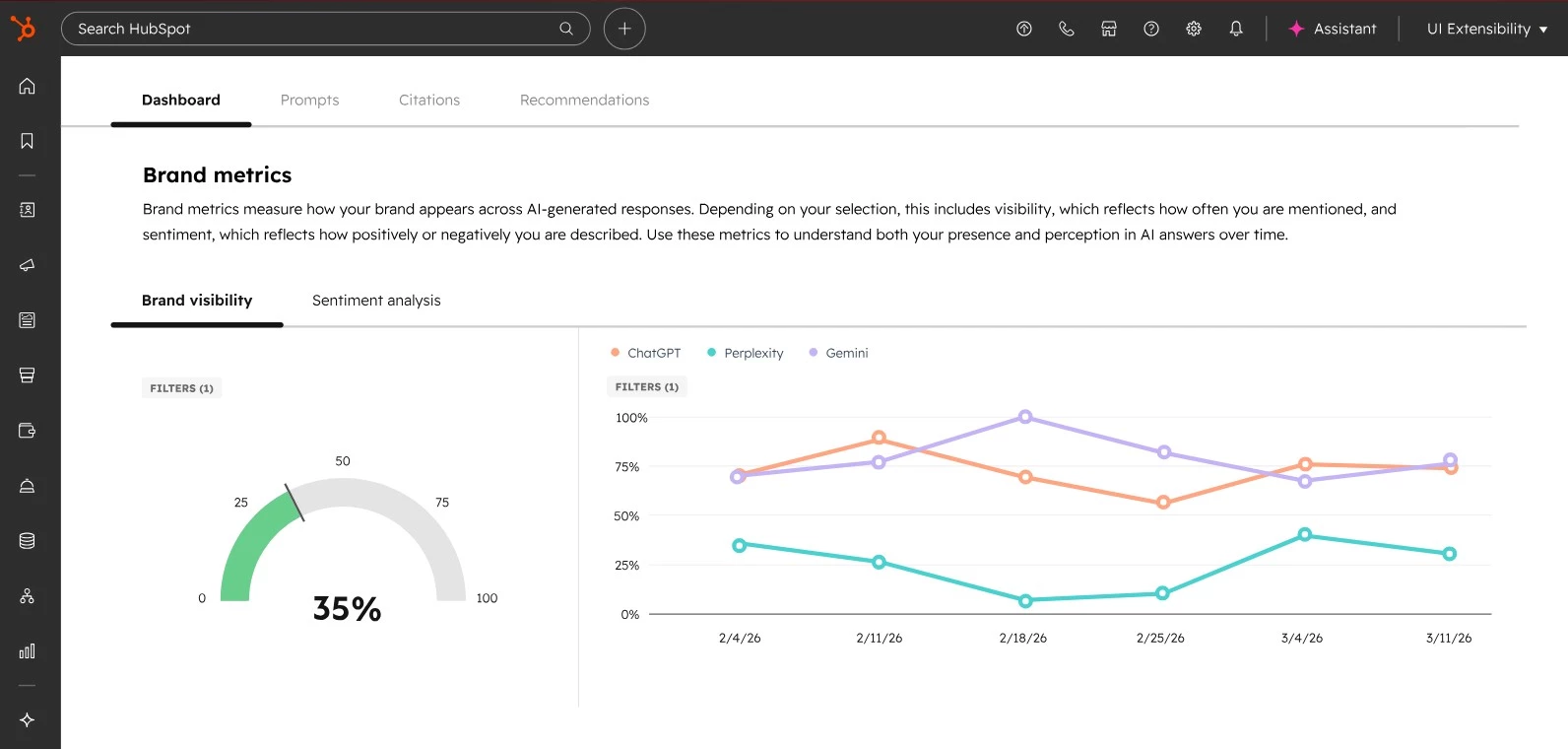
HubSpot AEO is available as a standalone product or bundled into MHP+ (Marketing Hub Professional and Marketing Hub Enterprise).
Pros:
- Multi-engine visibility tracking across ChatGPT, Gemini, and Perplexity
- Prioritized recommendations that tell you what to create or fix, and why
- Visibility and execution in one platform: publish blog posts, social, and email without leaving HubSpot
- Self-serve entry point with a 28-day free trial, no credit card required
Cons:
- The dedicated product is newer and currently in beta
- CRM-informed recommendations and built-in content creation require Marketing Hub Professional or Enterprise.
HubSpot pairs visibility with execution. Most trackers stop at the gap, but HubSpot lets you create and publish the content to close it, all in one system.
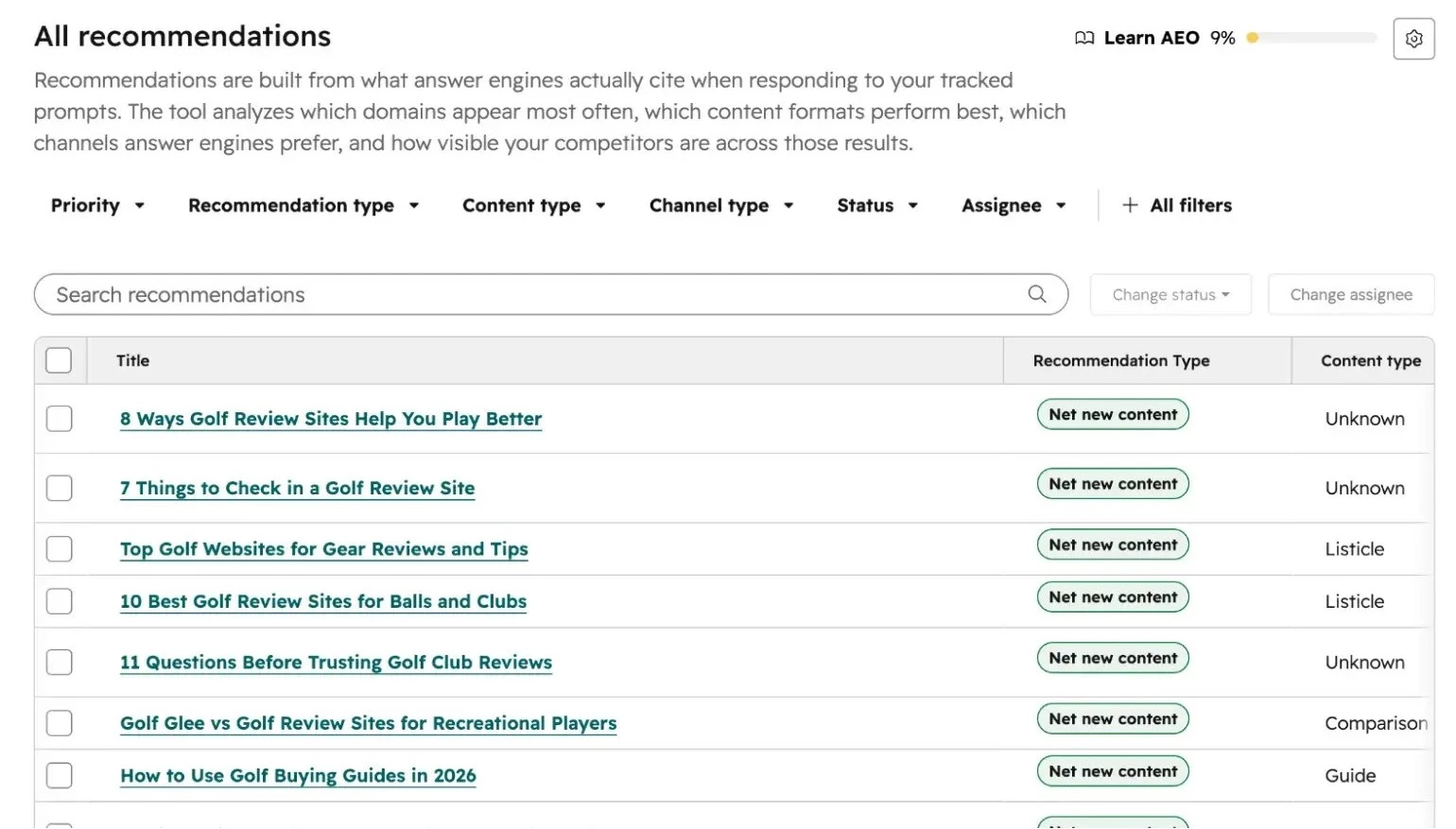
Two free tools feed into the paid product: the AEO Grader (one-time brand snapshot across ChatGPT, Perplexity, and Gemini) and the AI Search Sensor (industry-wide AI trend dashboard).
HubSpot AEO is ideal for marketing teams, content strategists, and revenue leaders who want to measure AI visibility and immediately act on it inside one end-to-end system.
Pricing
- HubSpot AEO: $50/month, or $45/month billed annually
- Included at no extra cost with Marketing Hub Professional (25 prompts, 2,500 answers per month) and Enterprise (50 prompts, 5,000 answers per month).
What Users Say
Early user feedback is generally positive, particularly among existing HubSpot customers.
Users like having AI visibility tracked inside HubSpot itself, especially teams already running everything there, the $50 entry price, and the CRM-informed prompt suggestions – some report new citations after acting on them.
The main gripes users have are that auto-generated prompts can feel generic, and that it's a lighter, entry-level option next to purpose-built AEO platforms.
Other Notable Features
- Brand visibility score and sentiment analysis across ChatGPT, Gemini, and Perplexity
- Competitor share-of-voice benchmarking on the prompts you track
- Citation analysis by domain, page, source type, and content type
- Prioritized recommendations spanning new pages, technical fixes, video, and third-party outreach
- Free AEO certifications through HubSpot Academy
3. Brandi AI: Best for Enterprise AI Visibility and GEO
Brandi AI works best for CMOs and SEO leaders who need a clearer view of how their brand appears in AI-generated answers and where visibility can be improved.
Brandi AI is purpose-built for a new reality where discovery happens inside AI-generated answers, not just traditional search results.
Rather than focusing on rankings alone, it gives marketing teams direct visibility into how brands appear on ChatGPT, Google AI Overviews, Gemini, and Perplexity. It tracks the exact buyer questions that drive AI-generated recommendations.
Pros:
- Deep AI visibility tracking across major answer engines
- Competitive benchmarking across AI-generated results
- Intent-driven GEO recommendations tied to real buyer prompts
Cons:
- Enterprise-focused, may be complex for smaller teams
- Limited traditional SEO tooling compared to all-in-one platforms
At the core of Brandi AI is its AI Discovery Intelligence layer, which reveals whether your brand is mentioned, cited, or excluded in high-intent AI responses and why.
Its Competitive Market Universe™ benchmarks your visibility against competitors, showing which prompts drive share of voice and where you’re losing ground in AI-generated answers.
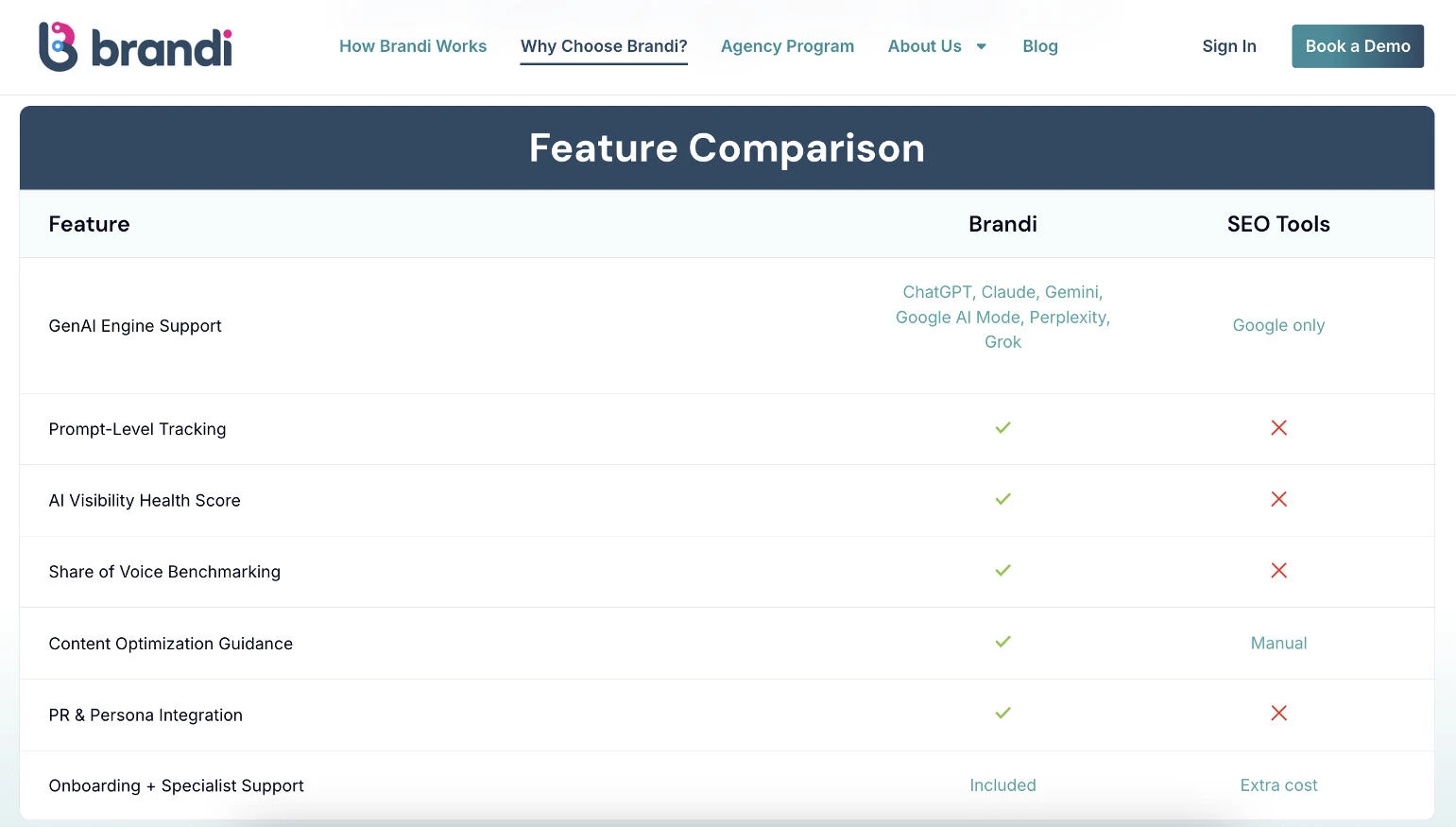
Brandi AI also stands out for its intent-driven generative engine optimization (GEO) framework.
It analyzes real buyer prompts, identifies messaging and content gaps, and guides teams in optimizing existing pages or creating new assets designed specifically to earn AI citations.
For global teams, its multi-language and regional intelligence uncovers how AI answers vary across markets, helping brands adapt content to different cultural and linguistic contexts.
Brandi AI is ideal for CMOs, SEO leaders, and content strategists at enterprise and mid-market organizations that need to understand, measure, and improve how their brand is discovered in AI-driven search environments.
Pricing
- Custom pricing
What Users Say
Public reviews and launch coverage highlight its ability to show where a brand appears in AI-generated answers, which competitors are being surfaced instead, and which buyer prompts are shaping discovery.
The tradeoff is that Brandi AI is not positioned as a lightweight SEO tool. Smaller teams looking for basic keyword tracking, site audits, or content scoring may find it more specialized than they need.
Other Notable Features
- Tracks brand mentions and citations across AI platforms and prompts
- Surfaces competitive visibility gaps and share-of-voice insights
- Provides actionable recommendations to improve AI citation rates
- Supports AI visibility analysis across 15+ languages and regions
- Aligns content strategy with real buyer questions and AI discovery patterns
Book a demo with Brandi AI to see how your brand performs in AI search.
4. Moz Pro: Best for Trusted Authority Metrics and Accessible AI Visibility
Try Moz Pro if you are an SMB marketer, in-house team, or agency wanting trusted authority metrics and AI visibility tracking without the enterprise price tag.
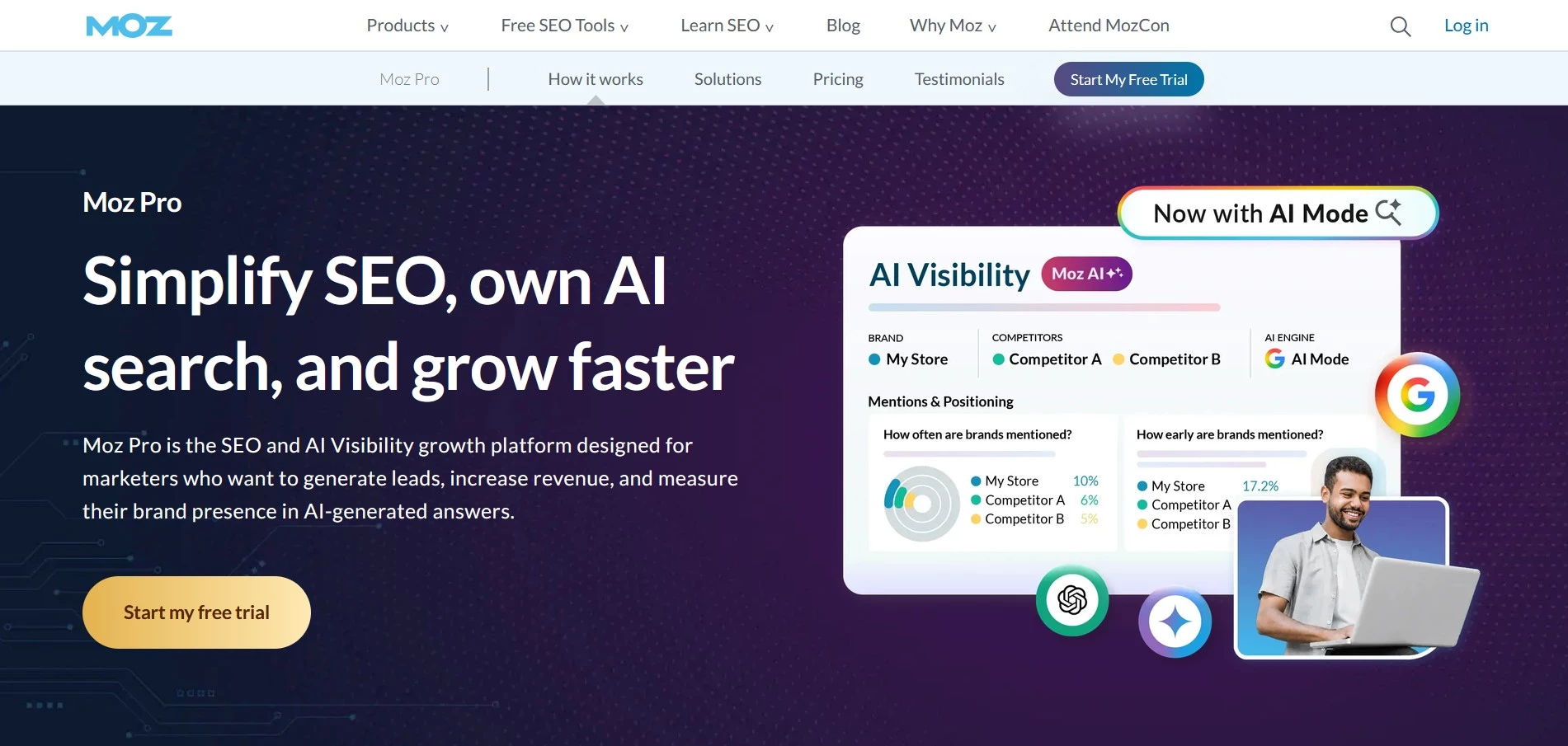
Moz has been building SEO software since 2004 and produced Domain Authority, the 1-100 score the marketing industry already speaks fluently.
Moz Pro extends that foundation into AI search, layering prompt-level visibility tracking and AI Overviews monitoring onto the keyword research, rank tracking, site audits, and link analysis teams rely on.
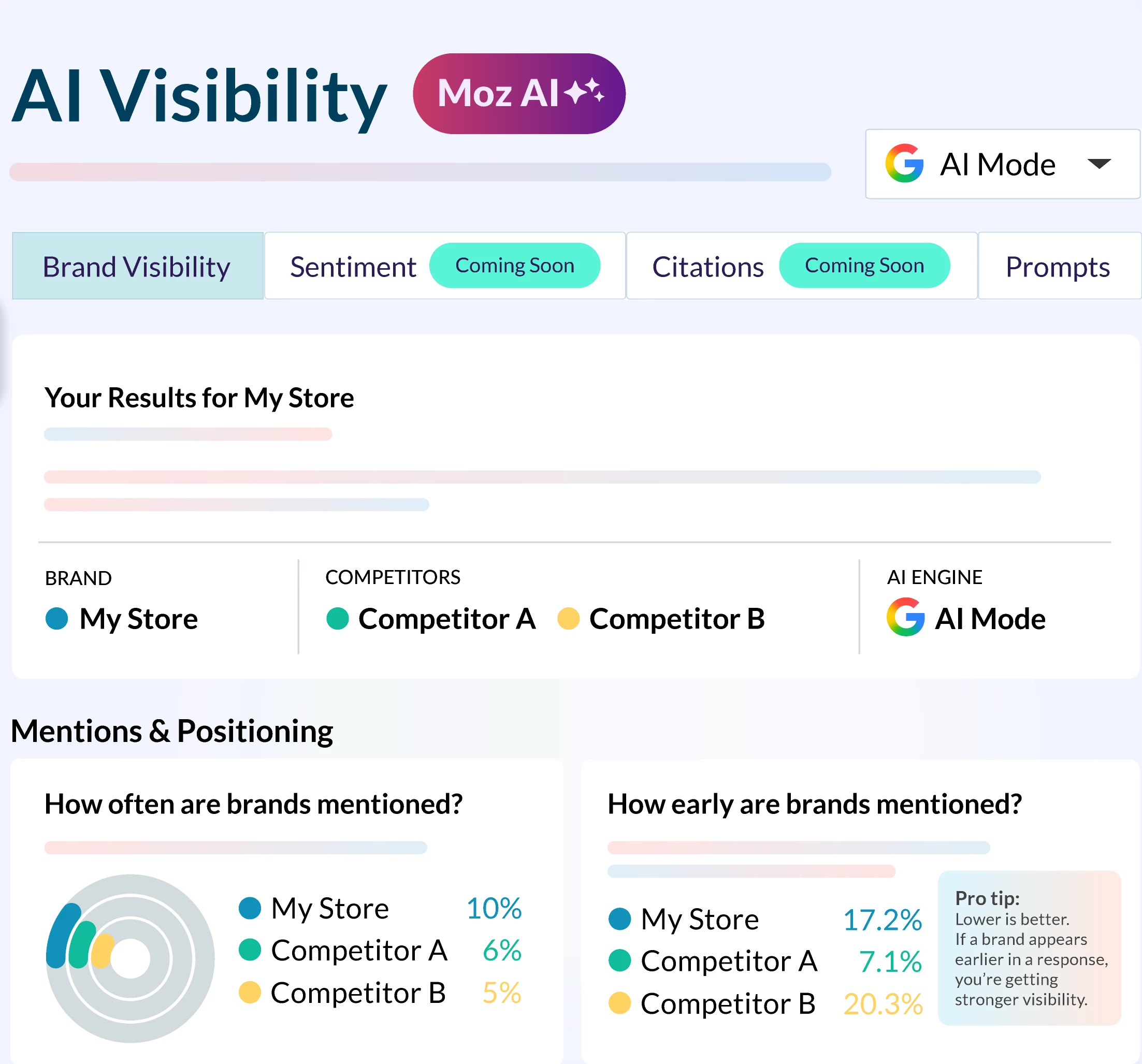
Its AI Visibility Dashboards and tracked prompts show how your brand surfaces across ChatGPT, Gemini, and Google AI Mode, while AI Overviews by Keyword reveals which queries trigger AI snippets and where you appear within them.
View this post on Instagram
Pros:
- Industry-standard Domain Authority, Page Authority, and Brand Authority metrics
- AI Visibility Dashboards and prompt tracking across major answer engines
- Lowest entry price among the major all-in-one SEO platforms
Cons:
- Standard tier AI Visibility is limited to Gemini and ChatGPT, 50 prompts, and one dashboard
- Backlink index and data breadth trail the largest competitors
To me, Moz Pro feels like a familiar SEO workspace updated for the AI search era rather than a separate AI add-on.
AI visibility sits alongside Domain Authority, rank tracking, site audits, and link data, which makes it easier to compare traditional SEO performance with how a brand appears in ChatGPT, Gemini, Google AI Mode, and AI Overviews.
The platform also proves its value on practical, high-stakes work.
Domain migrations are among the riskiest SEO projects since a single misstep can wipe out years of rankings. That's exactly where Moz's crawl, rank, and link data earn their place.
In the case of TopSpot’s migration, the team braced for a 7-10% traffic loss but instead saw organic traffic climb 29% within 90 days.
Moz Pro doesn’t remove project risk, but it does give teams enough crawl, ranking, link, and visibility data to make high-stakes SEO decisions with more confidence.
Overall, Moz Pro is best for SMB marketers, in-house teams, and agencies that want an accessible all-rounder with trusted authority metrics at the center, not the deepest enterprise data platform, but one that brings traditional SEO and AI search tracking together.
Pricing (billed annually)
- Starts at $79/month
What Users Say
Users repeatedly single out Moz Pro's ease of use and client-facing reporting.
One agency reviewer noted that tracked keywords can be segmented by client to keep everything in one place, while others credit automated reports and crawl alerts with making it easy to show clients progress over time.
The most common drawbacks are cost, and one long-term user notes they switch to another tool for reporting tasks like geo-segmented rank changes.
Other Notable Features
- AI-powered Keyword Suggestions by Topic, included on every plan
- Brand Authority Score for measuring brand strength in search
- Link Explorer and Keyword Explorer backed by 20+ years of data
- Site crawls and on-page optimization with prioritized, actionable fixes
- Customizable, scheduled reporting for agencies and client work
Try it free for 7 days, or use a free Moz Community account for limited ongoing access.
5. Ahrefs: Best for Data-Driven SEO Insights and Analysis
Try Ahrefs if you are an SEO team or analyst looking to turn large-scale search data into actionable insights.
Ahrefs embeds AI across its entire ecosystem, from keyword research to content creation, rather than treating it as a standalone add-on.
It uses AI to turn massive datasets into clear, actionable insights, ensuring AI recommendations are grounded in real search behavior
Pros:
- AI built into every core SEO workflow (keywords, content, brand, tech SEO)
- AI visibility tracking across major LLMs
- Strong data accuracy and scale
Cons:
- Higher starting price than lightweight AI SEO tools
- Content generation is optimization-focused rather than fully autonomous
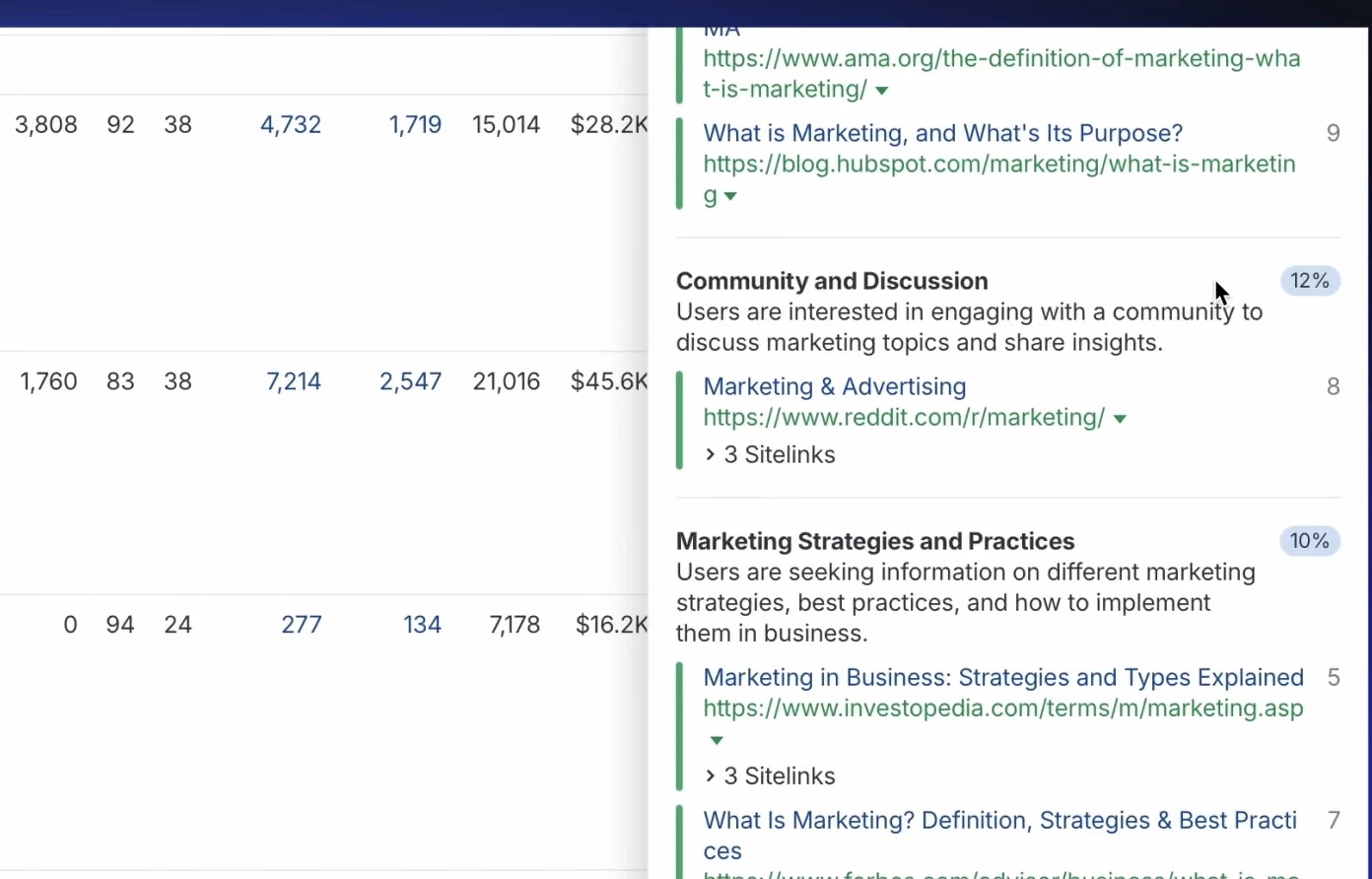
Features like AI Search Intents break down why users search and how traffic is distributed across intents, while the AI Content Helper grades your drafts against top-ranking pages to surface gaps and improvements.
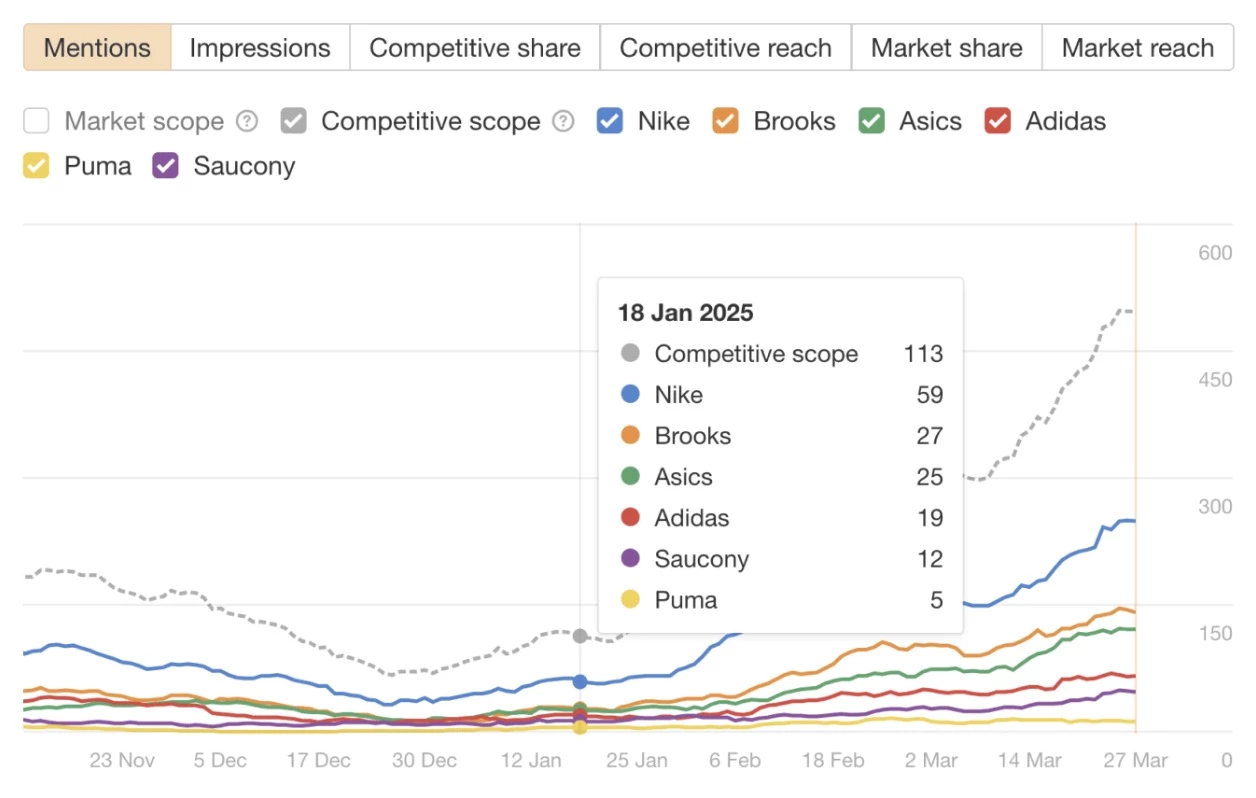
Brand Radar tracks how your company appears in AI-generated answers across tools like ChatGPT, Perplexity, and Google AI Overviews.
Overall, Ahrefs is best for SEO professionals, content teams, and enterprises that need reliable AI insights backed by one of the largest proprietary SEO datasets available.
Pricing (billed annually
- Starts at $208/month
What Users Say
Users consistently praise Ahrefs for its depth of SEO data, especially for backlink analysis, keyword research, competitor research, and content planning.
The main drawback users mention is cost. Several reviewers say Ahrefs can feel expensive for smaller teams, especially when usage limits, credits, or lower-plan restrictions come into play.
Other Notable Features
- AI Keyword Suggestions & Clustering with localization support for 173+ languages
- AI Citations to identify keywords triggering AI-generated summaries
- Patches for AI-assisted technical SEO fixes without developer input
- AI Detector to analyze AI-generated content across your site
- AI Translations for scalable, search-ready international SEO
6. Frase: Best for AI-Driven Content Workflows
Try Frase if you are a content marketer or writer looking to streamline research, outlining, and SEO writing in one platform.
Frase’s AI engine streamlines the process from keyword research to final draft, combining data, structure, and writing assistance in one workspace.
Pros:
- Top-performing articles scanning
- Streamlined content creation in one workspace
- Multiple AI writers for different content types
Cons:
- Accuracy can vary by topic
- SEO analytics and SERP data locked behind a paywall
Frase’s AI-powered content editor evaluates writing in real time, suggesting improvements to structure, keyword density, readability, and tone.
Its integration of SERP-based research ensures that each draft aligns with what’s performing best in search.
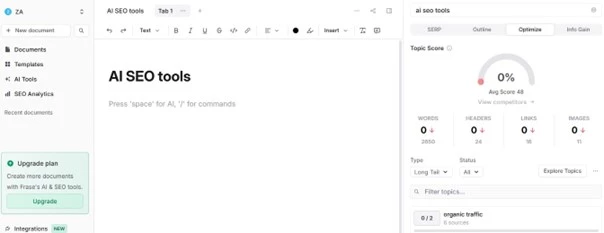
Users can prompt Frase to outline, write, or rewrite sections. It recommends the next steps and generates pre-built outlines from top-ranking pages.
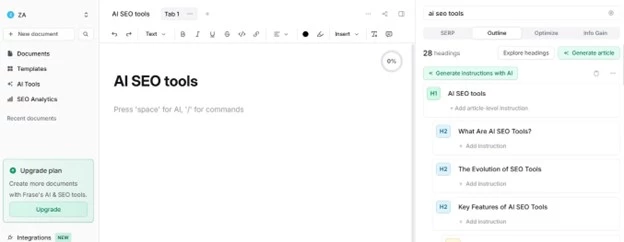
Frase is particularly beneficial for bloggers, content marketers, and in-house writers who aim to efficiently produce long-form, SEO-friendly content.
Its AI-driven features assist in overcoming writer’s block and ensuring that the content aligns with current SEO best practices.
Pricing (billed annually)
- Starts at $39/month
What Users Say
Users praise Frase for making SEO content production faster, especially when building briefs, researching competitors, outlining articles, and optimizing drafts in one place.
The main complaints are around consistency and polish. Some users say the AI writing output still needs editing, while others point to occasional bugs, interface friction, or limited depth compared with larger SEO platforms.
Other Notable Features
- Builds SEO briefs from top-performing SERP data
- Analyzes competitors to uncover questions, topics, and gaps
- Supports multiple formats like intros, FAQs, product descriptions, and more
- Provides instant SEO scoring to keep content aligned with ranking factors
- Question research that surfaces real questions from Reddit, Quora, and People Also Ask
7. Surfer SEO: Best for AI Search Visibility
Surfer SEO is a strong fit for content and SEO teams that want to fine-tune pages for traditional Google rankings while also preparing them for AI-driven search visibility.
As users turn to AI assistants like ChatGPT, Perplexity, and Gemini for answers, SurferSEO helps your content stay visible everywhere.
Its algorithm identifies content gaps, enriches text with semantic keywords, and fine-tunes structure around the entities AI systems actually use.
Pros:
- Powerful on-page optimization with real-time Content Score
- AI internal linking and contextual optimization
- Humanizer and AI Detector ensure authenticity and compliance
Cons:
- Requires a learning curve for full customization
- Limited keyword research features
The Content Editor offers live metrics for keyword use, structure, readability, and tone. Its Content Score updates in real time, guiding you toward perfectly optimized articles.
Surfer also introduces advanced tools like the AI Content Detector and AI Humanizer.
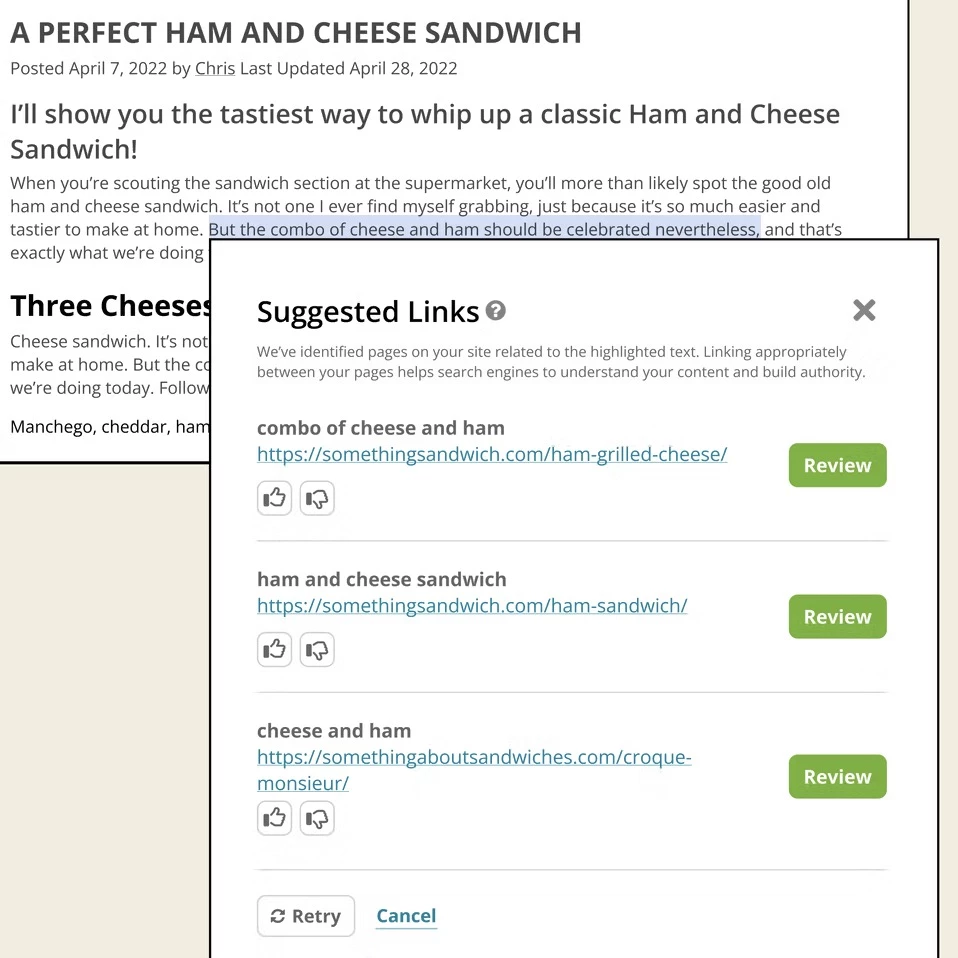
Meanwhile, the Auto Internal Links feature scans your site and inserts relevant links automatically, helping Google and AI crawlers understand your site’s topical depth.
SurferSEO is ideal for content teams, agencies, and businesses that want to future-proof their SEO strategy for both Google and AI search visibility.
Pricing (billed annually)
- Starts at $99/month
What Users Say
Capterra reviewers often describe Surfer as fast, intuitive, and useful for improving content structure, keyword coverage, and on-page SEO without turning the process into guesswork.
Some users say Surfer delivers strong value once it becomes part of the content workflow, but smaller teams may find the cost harder to justify.
Other Notable Features
- Outline Builder for keyword-rich content briefs and headlines in seconds
- Multi-language support for global SEO campaigns
- Plagiarism Checker to ensure originality and compliance
- Sites Hub for centralized performance monitoring and SEO audits
8. Conductor: Best for Enterprise AEO and Brand Visibility in AI Search
Conductor is built for enterprise marketing teams that need to manage brand visibility across traditional search results and AI answer engines from one platform.
Powered by the industry's most complete data engine, Conductor is one of the most advanced AEO platforms for enterprises navigating AI search and answer engines like ChatGPT, Perplexity, and Gemini.
Pros:
- Purpose-built for AEO and AI search visibility
- Tracks brand presence across major LLMs
- Enterprise-grade data engine
Cons:
- Enterprise-focused pricing may be overkill for small teams
- Less emphasis on lightweight AI copy generation
It's an end-to-end platform that unifies your entire process, from insight to action to impact, eliminating data silos.
Conductor’s AI capabilities come together through three tightly connected parts: Conductor Creator, Conductor Intelligence, and Conductor Monitoring.
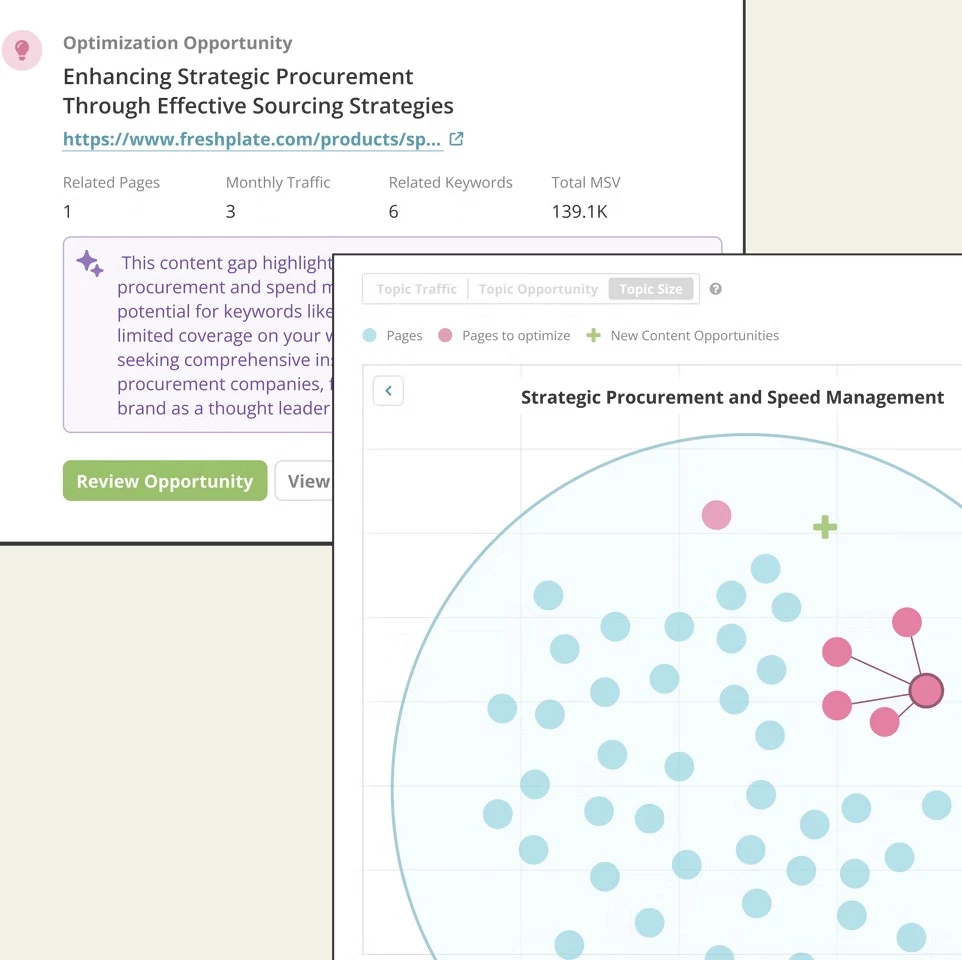
Instead of producing generic AI copy, Conductor Creator uses first-party data and market and audience signals to guide content creation toward topical authority and visibility where AI models source their answers.
- AI Topic Mapping: Conductor’s proprietary AI maps your presence and authority and reveals content gaps and new topic opportunities.
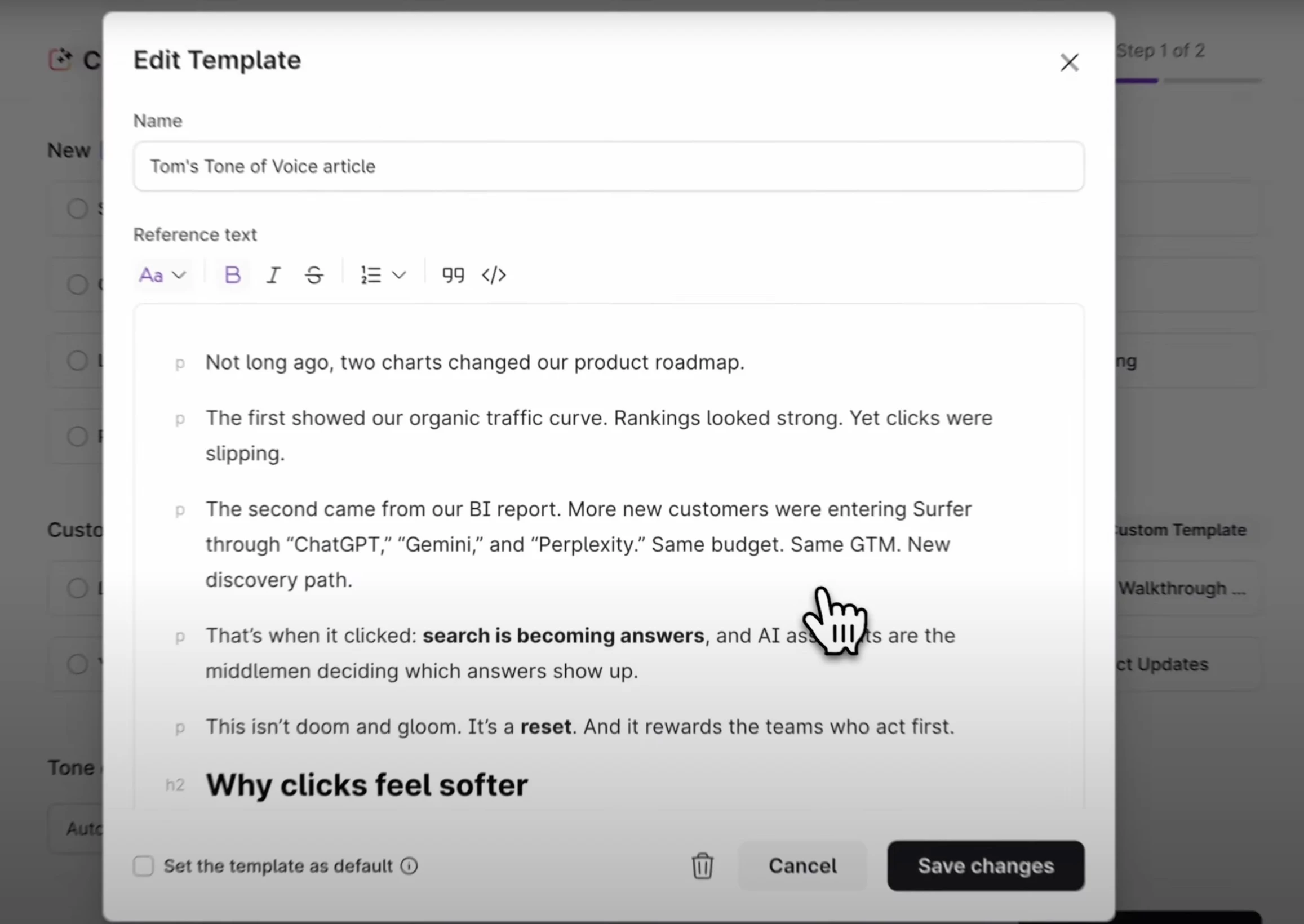
- AI Writing Assistant: Generates high-quality content aligned with your brand voice using Custom Content Profiles and surfaces intelligent internal linking suggestions. It also autogenerates optimized headers, tags, and metadata.
- Content Score: Scores topical coverage, intent alignment, and AI-readiness.
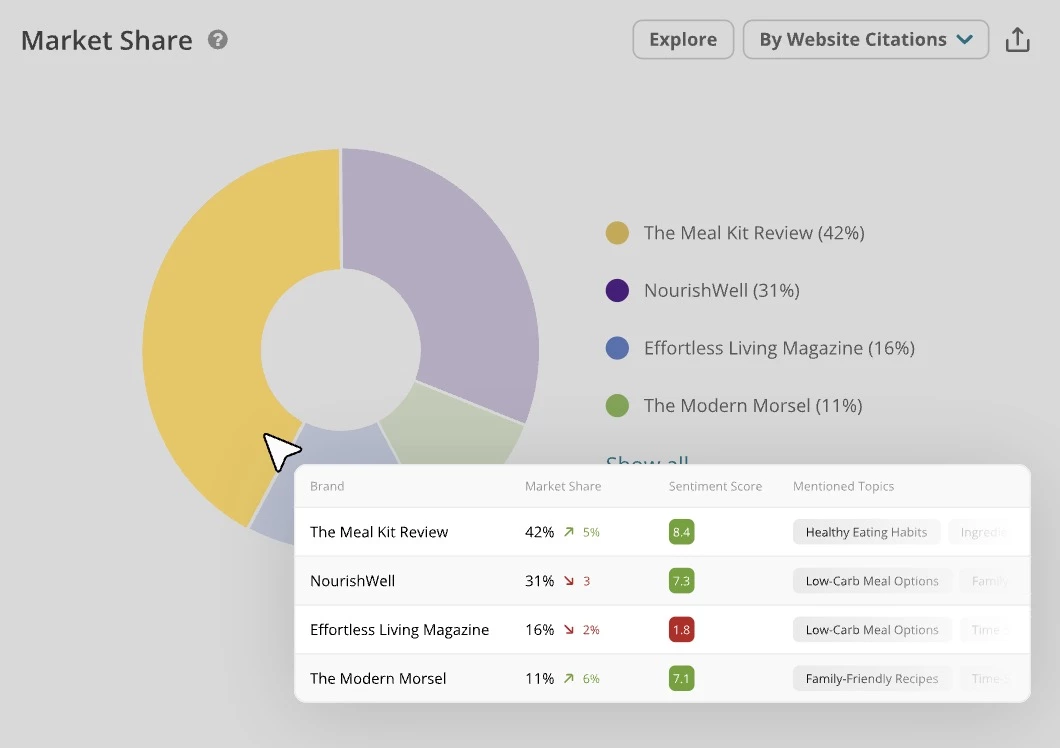
Conductor Intelligence unifies your data and processes within a single source of truth for all things AEO and SEO:
- AI search performance: Analyzes full AI responses to track brand mentions, citations, and sentiment across leading answer engines, revealing exactly where competitors outperform you.
- Topic & keyword research: Uncovers emerging customer needs and shows exactly who’s searching with age, occupation, and location insights.
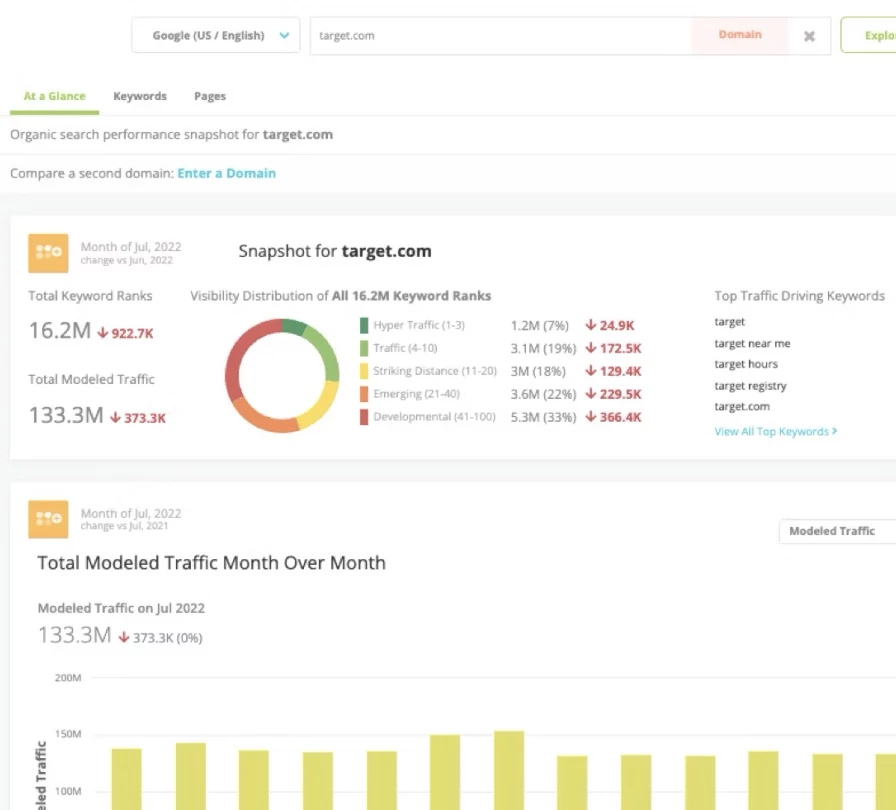
- Competitive intelligence: Tracks competitor market share, content strategies, and search performance, so you can compare head-to-head and uncover insights on how to outperform them.
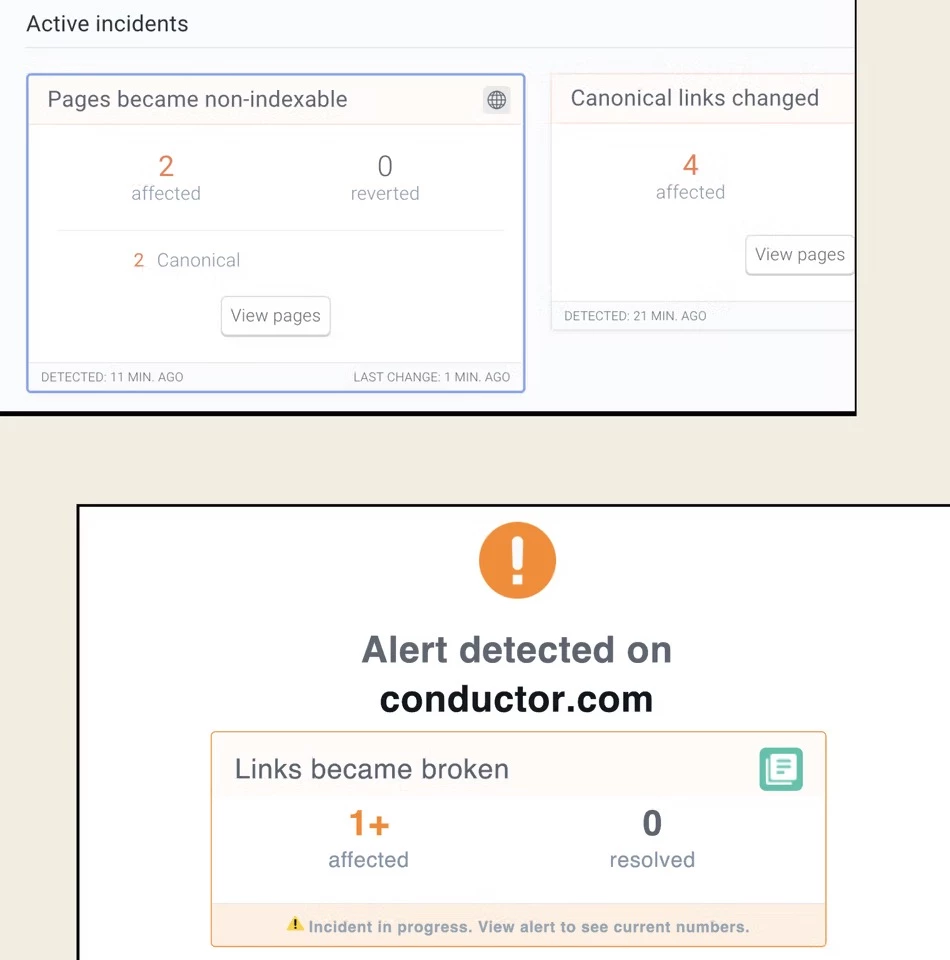
Conductor Monitoring keeps your website protected 24/7 with features designed for maximum performance and quick issue resolution.
You can receive real-time alerts about status code errors, stale content, or site issues.
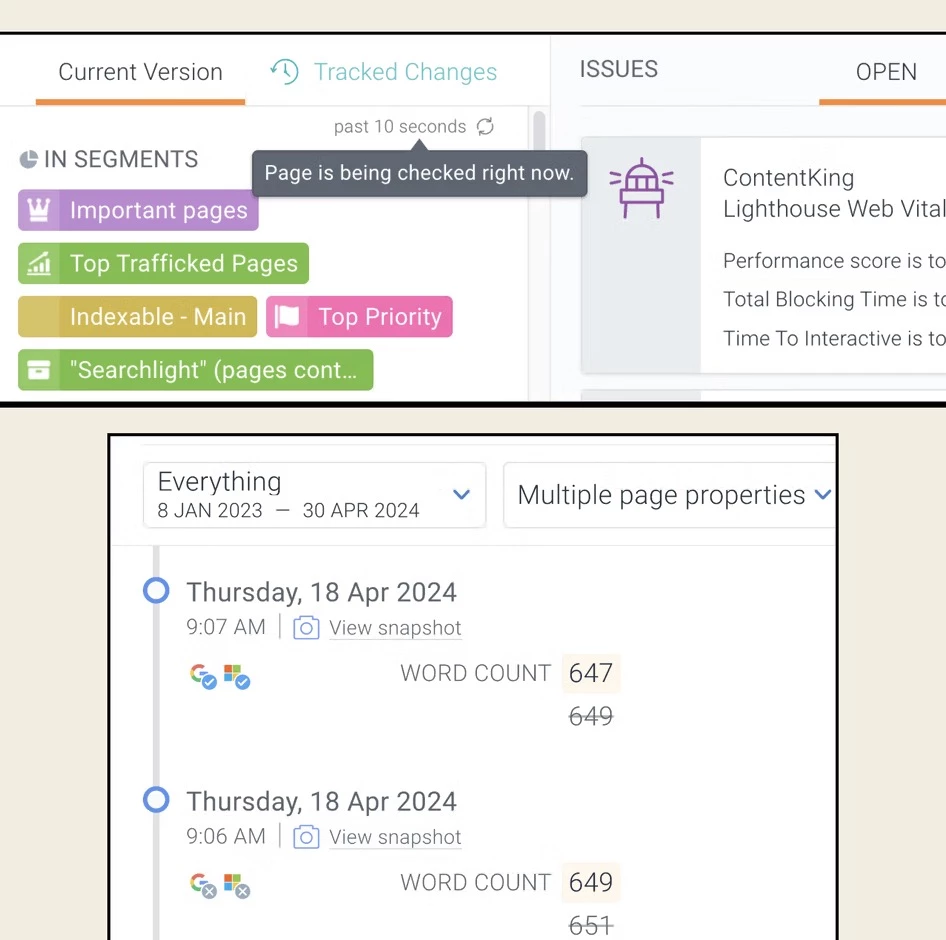
Its Intelligent Prioritization also allows your team to focus on the pages and opportunities that matter most, whether your site has 100 pages or 1 million.
Conductor is best for large brands and enterprise teams competing on high-value topics where visibility in AI answers directly impacts traffic and conversions.
Pricing
- Custom enterprise pricing
What Users Say
Users praise Conductor for helping large teams manage SEO workflows, reporting, site monitoring, and content optimization from one platform.
Some users mention a learning curve because of the platform’s depth, and smaller teams may find it more advanced than they need.
Other Notable Features
- Unified enterprise data that consolidates AI visibility, search performance, content intelligence, and technical signals
- AI & LLM Integration that powers ChatGPT, Claude, Copilot, BI tools, and custom AI workflows
- Built for scale, privacy, and compliance (ISO 42001, ISO 27001, SOC 2 Type 2)
- Enterprise-ready dashboards to track the impact of SEO and AI efforts.
Start your free Conductor trial now – no credit card needed.
9. Gauge: Best for AI Search Visibility
Gauge is a good match for marketing and growth teams that want to monitor how their brand appears across AI-powered search experiences and spot visibility gaps faster.
While most SEO tools stop at rankings and traffic, Gauge tracks something newer and harder to measure: how often your brand appears in ChatGPT, Perplexity, Gemini, and other AI responses and why.
Instead of guessing whether AI visibility is improving, you see prompt-level data, citation rates, competitor share, and content impact over time.
Pros:
- Tracks brand visibility across major AI models
- Integrates GA4 and GSC
- AI-powered competitor-based content briefs
Cons:
- Some deeper reports take time to process
- Results depend on implementing recommendations actively
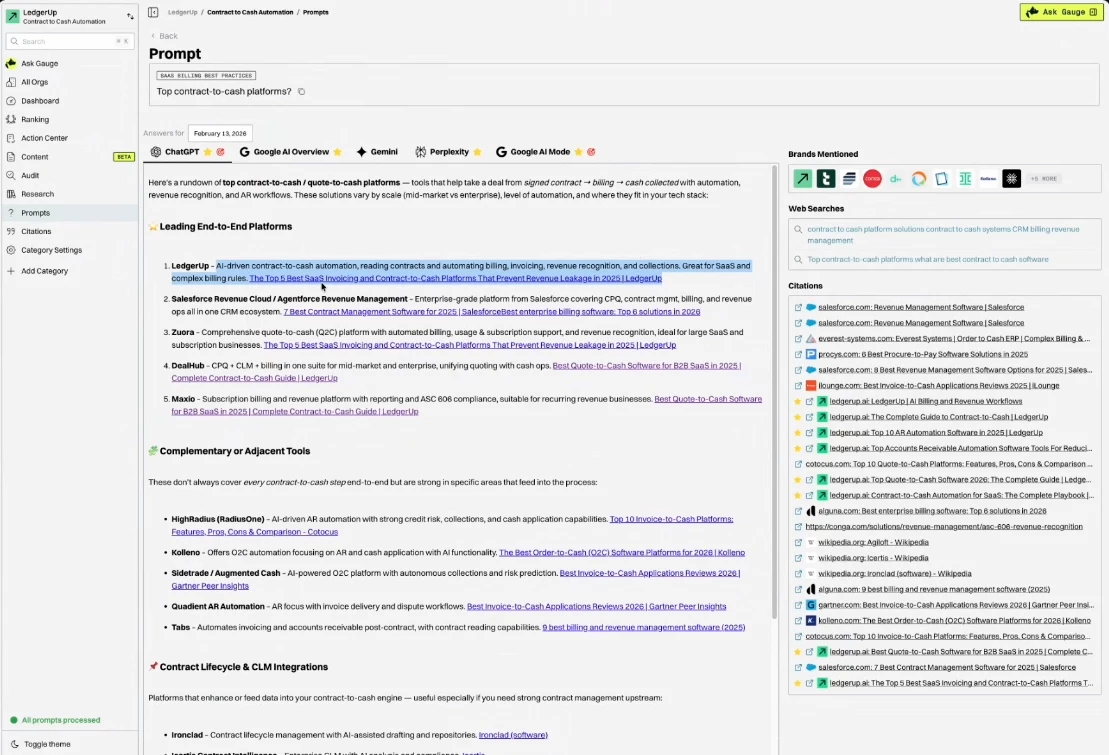
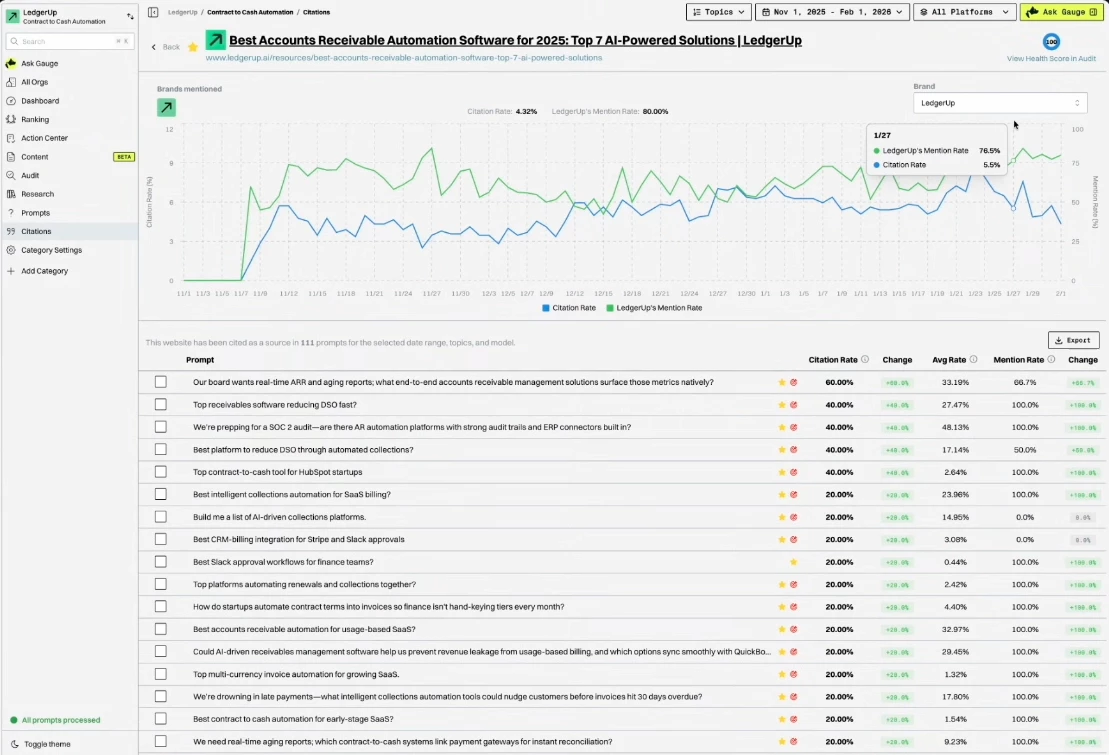
Gauge monitors specific prompts and shows exactly which sources AI models cite. You can move from prompt to citation, from citation to URL, and see how visibility shifts over time.
It also connects AI visibility to real SEO performance. By integrating Google Analytics and Google Search Console, Gauge correlates citation growth with traffic, CTR, brand queries, and landing page performance.
The content generation workflow is structured and practical. It analyzes top-performing competitor pages, pulls keyword and intent data through SEMrush, extracts semantic themes, and generates editable briefs.
From brief to outline to full article, everything is reviewable before publishing.
One of its strongest features is the built-in AI data assistant.
You can ask it to compare GA4 periods, surface content gaps from Search Console, recommend new prompts based on keyword trends, or generate executive summaries combining SEO and AI visibility data.
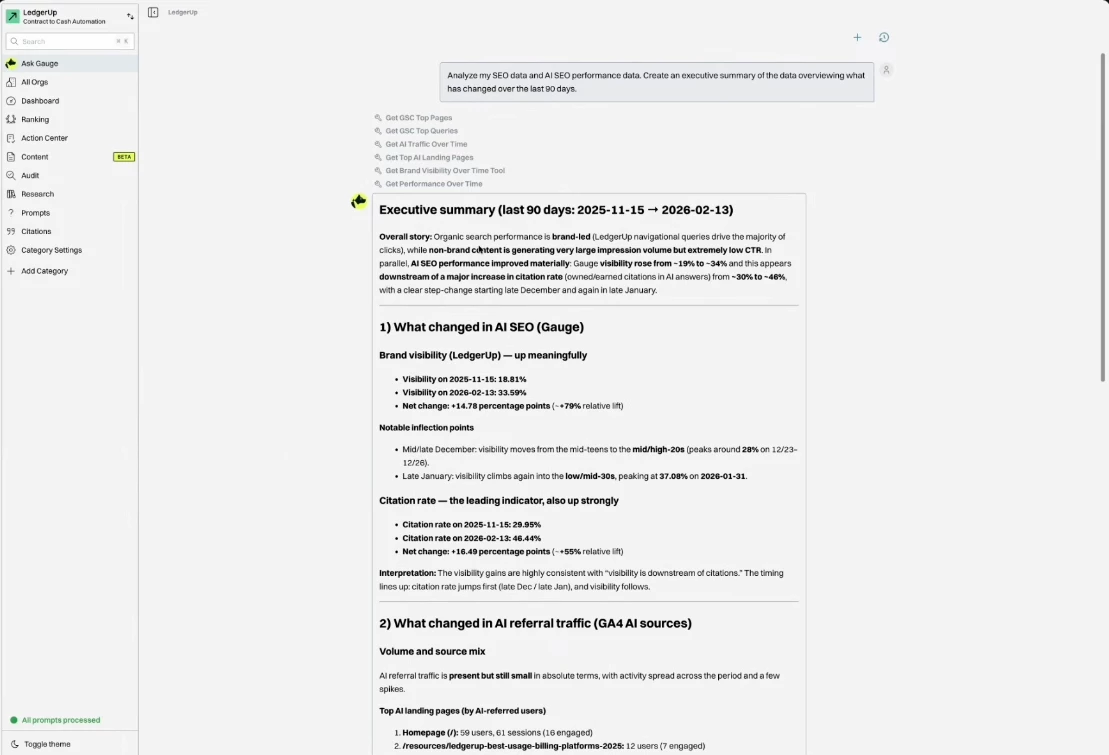
It runs multiple processes in the background without interrupting workflow, which makes it feel more like an operations tool than a simple monitor.
Gauge works best for SaaS and B2B brands competing in crowded categories, especially those investing heavily in comparison and “Top X” content. It’s also valuable for teams that want proof that AI search visibility is driving measurable business impact.
Pricing
- Starts at $99/month
Start your free Gauge trial today.
What Users Say
Users like Gauge for connecting AI search visibility with real marketing data, including prompts, citations, competitors, GA4, and GSC insights.
Its main drawback is that it is still newer and more specialized than established SEO suites, so teams looking for a broad, long-tested platform may find it limited.
Other Notable Features
- Daily automated prompt execution
- Multi-model tracking (ChatGPT, Perplexity, Gemini, etc.)
- Uses real SEO data via SEMrush API
- Source trend visualization over time
- URL-level citation tracking
10. Jasper: Best for AI SEO Content Automation
Jasper is ideal for marketing teams that want to scale content production without losing control over brand voice, messaging consistency, or SEO performance.
Jasper is an end-to-end AI content automation platform built for marketers who want to scale SEO performance without losing brand consistency.
Its Content Pipelines system lets teams connect real-time SEO insights, target keywords, and brand strategy into automated workflows that generate optimized, on-brand content.
Pros:
- AI SEO, AEO, and GEO workflows
- Full-scale automation through Jasper’s Content Pipelines
- Centralized brand voice and SEO context via Jasper IQ
Cons:
- Steeper learning curve for smaller teams
- Primarily built for marketing teams, not solo creators
Using Jasper IQ, marketers can integrate first-party data, keyword clusters, and tone preferences.
Tools like Jasper Grid and Jasper Studio allow marketers to automate repetitive production workflows, while Brand IQ and Marketing IQ maintain consistent tone, terminology, and keyword use across every asset.
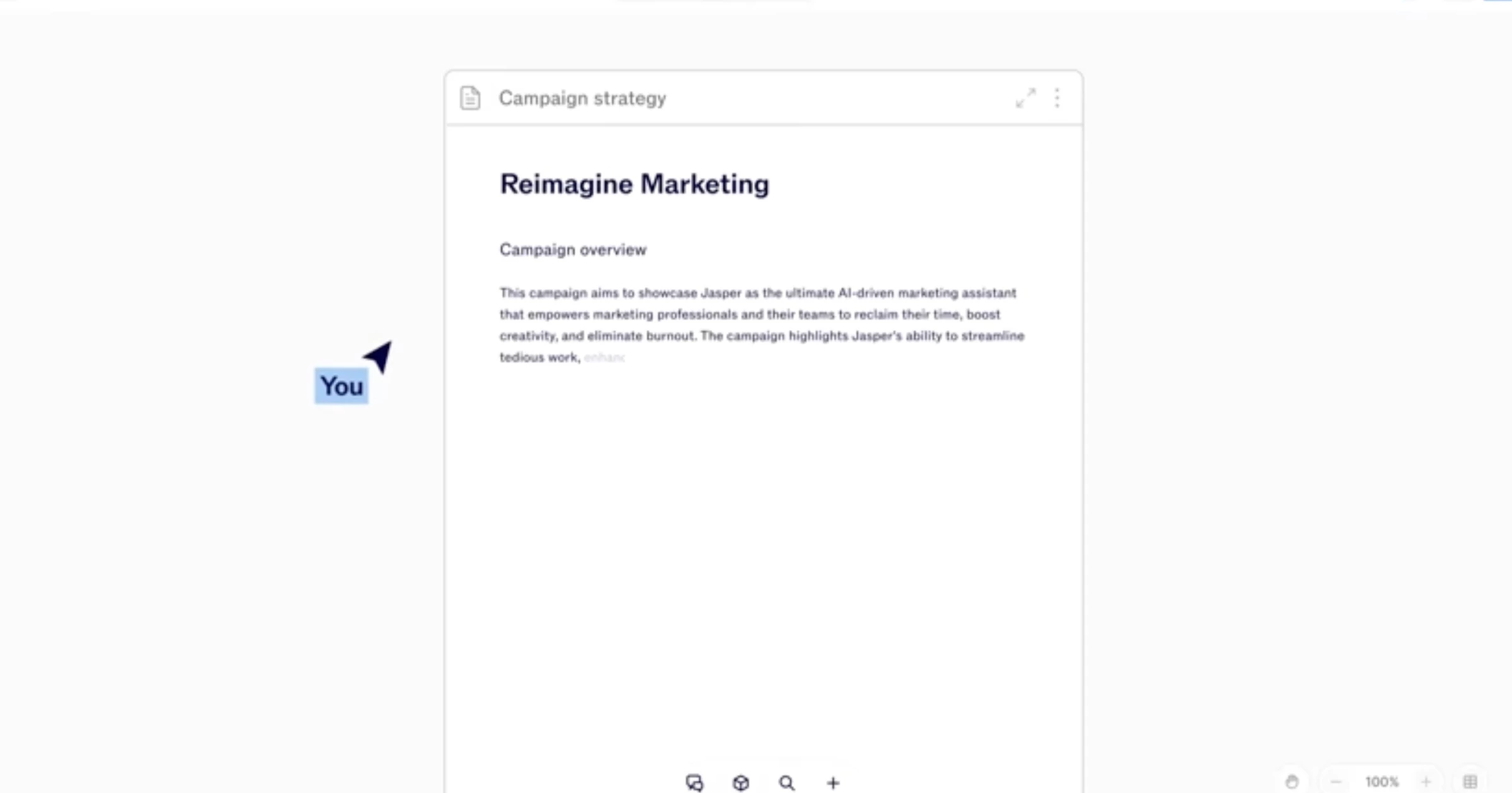
Jasper is ideal for marketing teams, SEO specialists, and content operations leaders seeking to automate SEO optimization and content creation under one unified, intelligent platform.
Pricing (billed annually)
- Starts at $59/month/seat
What Users Say
Users like Jasper for speeding up content production, reducing writer’s block, and keeping marketing content consistent across blogs, emails, ads, and social posts.
Its main drawbacks are pricing and the need for human editing, especially for fact-heavy, nuanced, or highly creative content.
Other Notable Features
- Automates SEO-driven workflows from strategy to execution
- Context hub that unifies SEO goals, brand data, and tone
- SEO/AEO/GEO tools optimize for Google and AI-driven search engines
- Builds reusable SEO templates and AI workflows
- Enterprise-grade security and compliance
11. SE Ranking: Best for Google AI Overviews Analysis
SE Ranking is a practical choice for SEO professionals who want to track visibility in Google’s AI-generated summaries and optimize content around those opportunities.
SE Ranking measures, compares, and optimizes how your brand appears inside AI-generated answers, especially Google’s AI Overviews.
Pros:
- Industry-leading Google AI Overviews tracking
- AI vs. organic ranking comparisons
- Historical AIO data
Cons:
- AI content generation is an add-on
- Advanced AI tracking requires the AI Search add-on
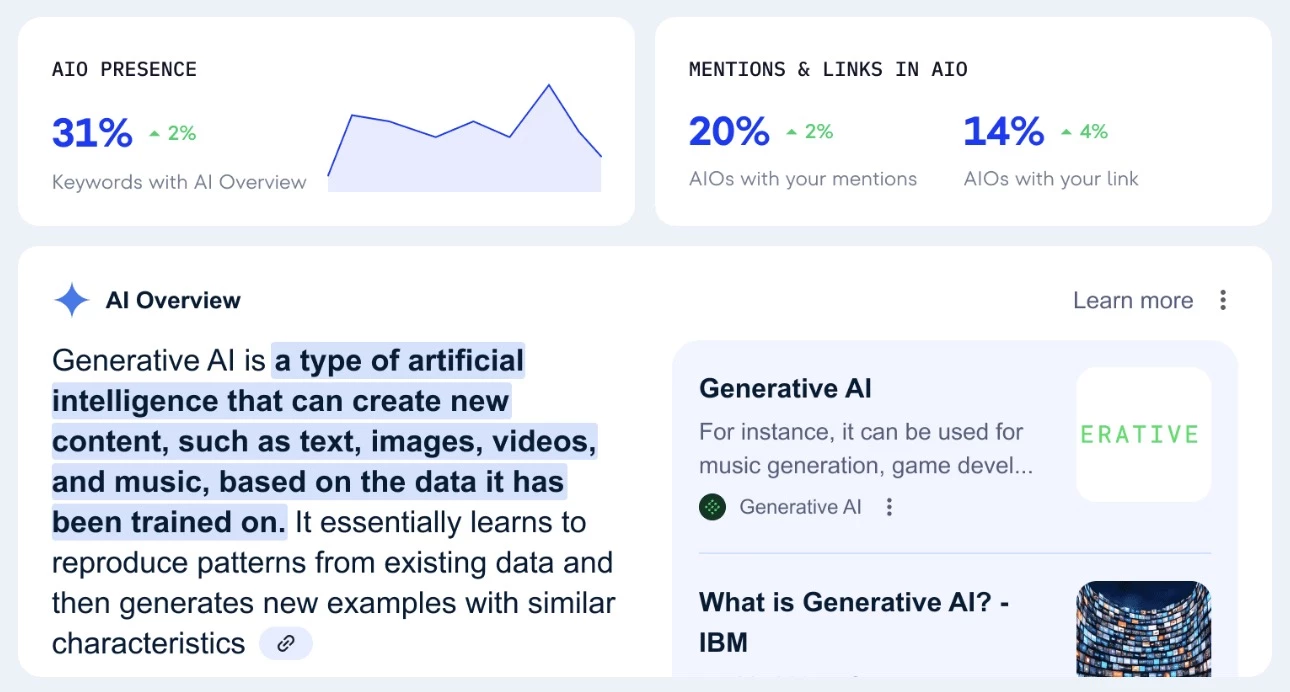
Its AI Overviews Rank Tracker fills a major gap left by Google by showing which keywords trigger AI snippets, where your site appears within them, which competitors are cited, and how those positions change over time.
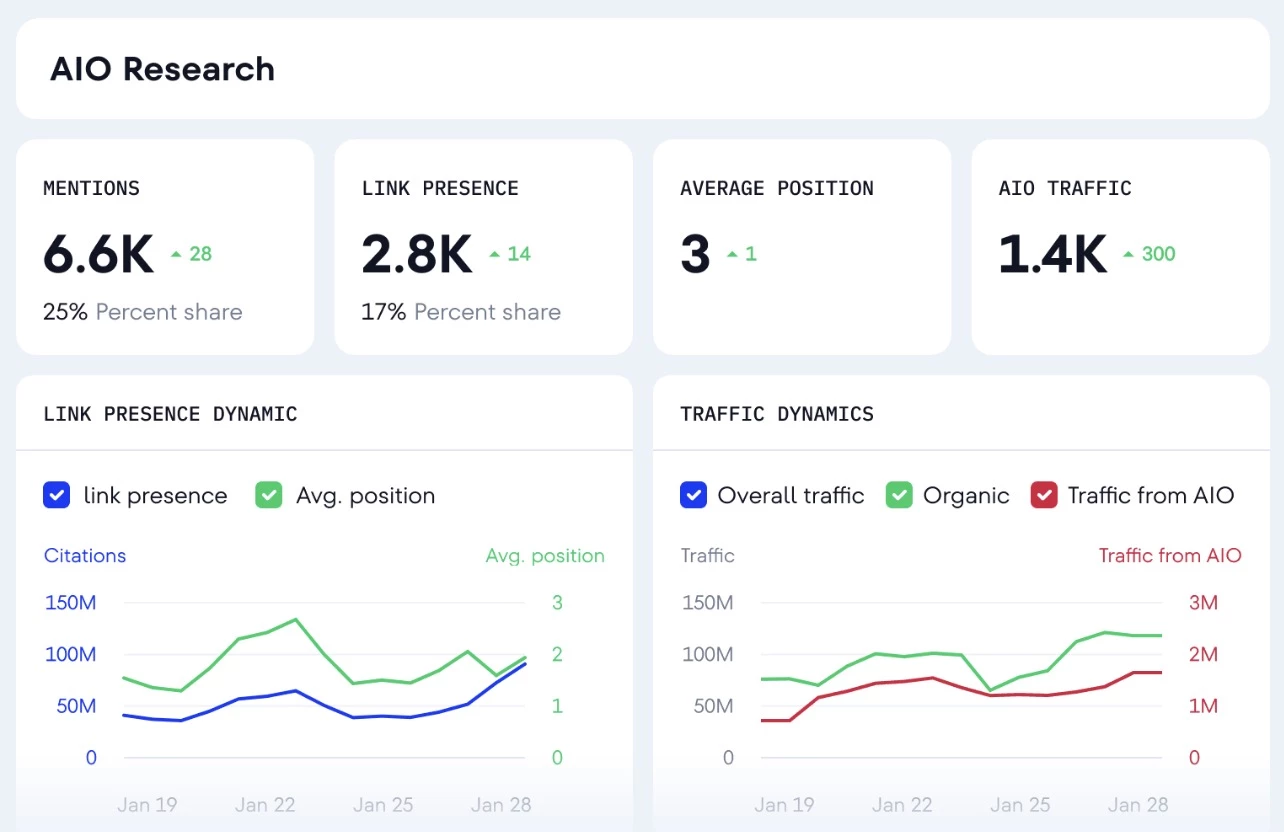
Its Generative AI Search Toolkit tracks brand mentions and links across ChatGPT, Gemini, Perplexity, and Google AI Mode.
You can analyze AI citations, compare traditional rankings vs. AI snippet positions, estimate potential traffic from AI Overviews, and review cached AI SERPs to understand how sources shift.
SE Ranking is valuable for teams that already manage SEO campaigns and need to connect classic rankings with AEO (Answer Engine Optimization).
Pricing (billed annually)
- Starts at $103/month
What Users Say
Users like SE Ranking for combining rank tracking, audits, competitor research, reporting, and newer AI visibility insights in a platform that is easier to use and more affordable than many enterprise SEO suites.
Some users mention reporting limitations, occasional ranking-data concerns, and the need to pay for advanced AI search features, so it may not be the best fit for teams that want fully bundled AI tracking from the start.
Other Notable Features
- AI Search Intent Analysis for queries triggering AI-generated results
- Historical AI Visibility Trends to spot shifts and opportunities early
- AI Content Writer with SERP-driven optimization and real-time content scoring
- Competitive AI Visibility Benchmarking to uncover gaps vs. rivals
12. MarketMuse: Best for Topic Authority and Content Strategy
MarketMuse is a strong fit for content strategists who want to build topical authority, uncover content gaps, and prioritize the opportunities most likely to move rankings.
MarketMuse is one of the most strategy-first AI SEO platforms on the market.
Instead of relying on surface-level keyword metrics, it uses patented AI models to analyze your entire content inventory, assess true topical authority, and identify where you can realistically outperform competitors.
Pros:
- Patented AI for topic authority analysis
- Best-in-class content planning
- Strong editorial and quality guidance
Cons:
- No full AI article generation
- Higher learning curve than basic SEO tools
MarketMuse focuses on personalized difficulty scoring. It evaluates competitiveness based on your site's existing authority, making its recommendations far more actionable.
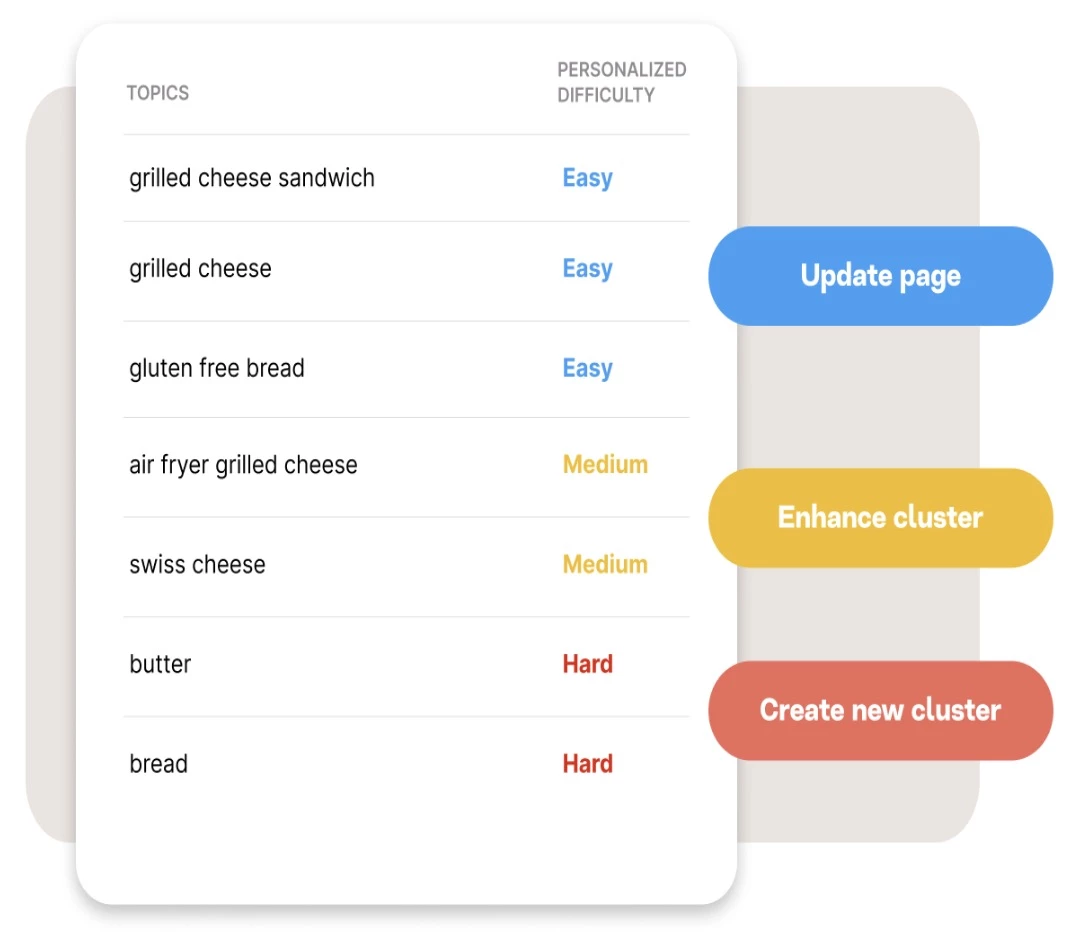
It also excels at content planning at scale, automatically generating prioritized roadmaps, detailed AI-powered content briefs, and internal linking strategies that align with how search engines evaluate expertise and topical depth.
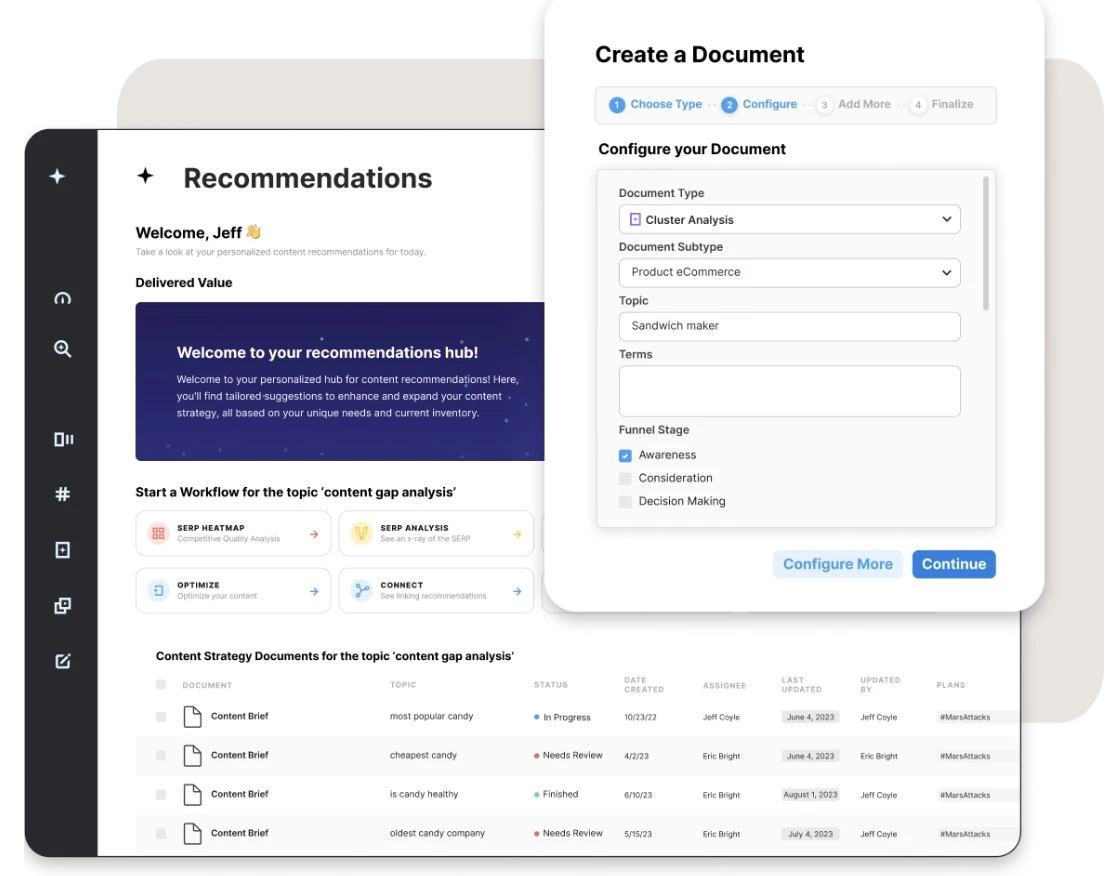
MarketMuse is for teams that manage large content libraries who need to decide what to create, what to update, and what to ignore, backed by data.
Pricing
- Free plan available
- Custom pricing for paid plans
What Users Say
Users like MarketMuse for turning content strategy into a clearer roadmap, especially through topic modeling, content briefs, optimization guidance, and gap analysis.
Some users find it expensive and less beginner-friendly, with a learning curve that makes it better suited for serious content teams than smaller teams that need a simple AI writing tool.
Other Notable Features
- Competitive Content Gap Analysis to uncover missed opportunities
- Content Planning Roadmaps showing what to create or update first
- Quality & Depth Scoring aligned with E-E-A-T principles
- Internal Linking Recommendations to strengthen topical clusters
13. Indexly: Best for AI Crawler Accessibility and Instant Indexing
Try Indexly if you want to make sure Google and AI answer engines can find, crawl, and index your pages, quickly, rather than waiting weeks to be discovered.
Every other tool in this guide assumes your content is already being read by search engines and AI models. Indexly works one step earlier, on the prerequisite: getting your pages indexed fast and confirming that AI crawlers can access them at all.
It automatically submits eligible new and updated pages through Google's Indexing API and Bing IndexNow, then monitors index status and alerts you when pages are indexed, deindexed, or hit crawl issues.
On top of that, it tracks how your brand appears across ChatGPT, Gemini, Perplexity, Claude, and AI Overviews.
Pros:
- Instant, automated indexing to Google, Bing, and Yandex, with daily sitemap scans for new or non-indexed pages
- LLM-accessibility tools (llms.txt, schema, and crawlability checks) that help AI crawlers discover and interpret your content.
- Simple setup – connect Google Search Console, no coding or API work required
- Free indexing and AI-visibility tools to start
Cons:
- Interface and analytics are still maturing)
- AI-visibility depth trails purpose-built AEO platforms
Indexly's most distinctive capability is helping prepare content for AI crawlers. Its llms.txt guidance, structured data, and crawlability checks help AI systems discover and interpret your pages more effectively while giving you additional guidance over how supporting documentation is exposed.
Indexly is best for SEO and content teams, agencies, and technically lean businesses that want fast indexing and AI-crawler readiness as a foundation before layering on visibility tracking and optimization.
Pricing:
- Starts at $83/month (billed annually), with free indexing and AI-visibility tools available to test first
What Users Say
On Capterra, reviewers describe Indexly as an affordable, low-maintenance way to keep a site technically healthy. It automatically indexes pages and helps identify indexing and crawl issues — and single out responsive customer support.
The most common request is a clearer interface plus deeper SEO-and-AI-visibility analytics.
Other Notable Features
- Instant, bulk, and auto-indexing across Google, Bing, and Yandex
- Index-status alerts via email, Slack, or webhook
- Page-level keyword and ranking monitoring
- llms.txt and schema tools to improve AI crawler guidance and content discoverability
- WordPress and Shopify integrations; multi-site and multi-GSC-account support for agencies
Start with Indexly's free indexing tools, or try the full platform.
Other SEO Tools With Growing AI Capabilities
Below, we explore noteworthy alternatives that are pushing the boundaries of what's possible with AI in SEO.
- Yahini: AI-powered SEO content strategist in a box
- SEOTesting: Content-decay monitoring built on Search Console data
- DataForSEO: Raw SEO data API for teams building their own tools
1. Yahini: AI-Powered SEO Content Strategist in a Box
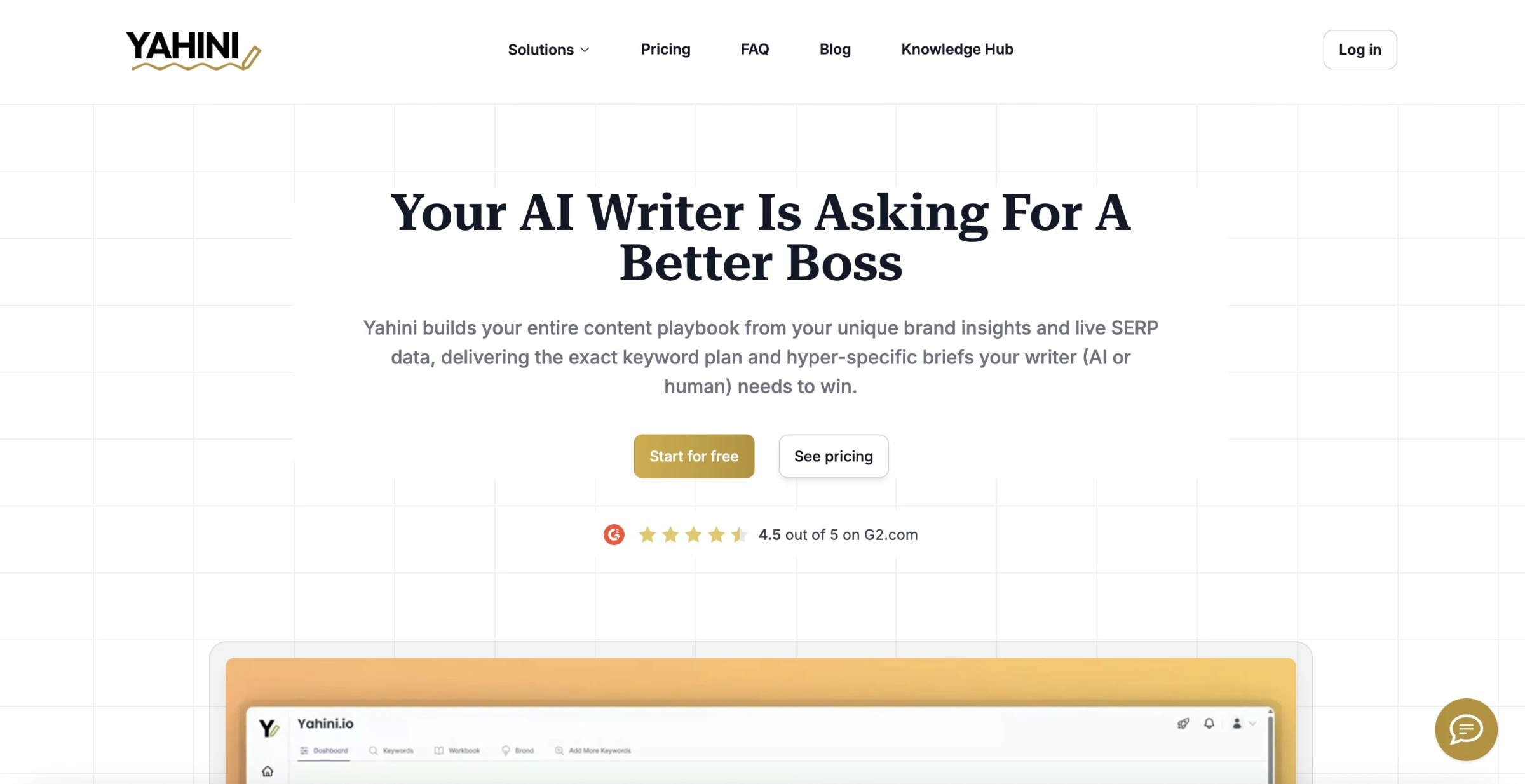
Yahini is an AI-powered content strategy platform designed to streamline and level up SEO and marketing workflows. Diving into Yahini, the onboarding felt strategic, not just a prompt interface.
| Pros | Cons | Pricing |
|
|
|
Yahini generates a prioritized keyword roadmap and funnel mapping across TOFU, MOFU, and BOFU stages.
Its "Generate Workbook" feature outputs keyword clusters, SERP insights, and brief templates, while "Enhance Brief" folds in new details without breaking the strategy's logic. This is ideal for SaaS founders and SEO teams who want automation without losing rigor.
2. SEOTesting: Content-Decay Monitoring Built on Search Console Data
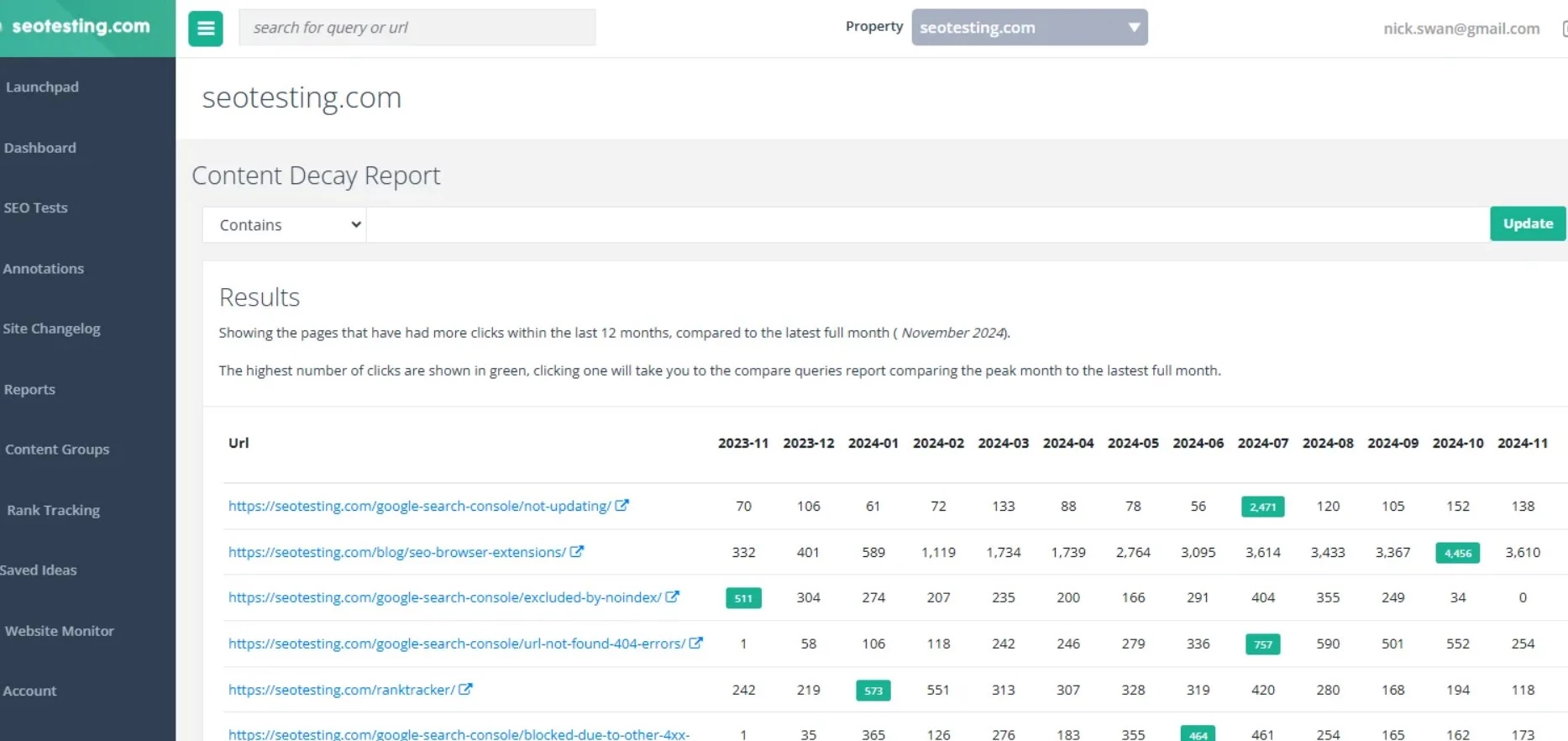
SEOTesting connects to Google Search Console to measure the real impact of SEO changes and catch content that's quietly losing ground. It's the piece the lineup above is missing: ongoing decay monitoring rather than one-time optimization.
| Pros | Cons | Pricing |
|
|
|
Its Content Decay Report tracks each page's clicks and impressions against its own history, flagging pages trending down before the decline shows up in rankings.
Beyond decay, it adds SEO split-testing, keyword cannibalization detection, CTR opportunity reports, and AI-powered summaries that turn a month of data into client-ready insights.
3. DataForSEO: Raw SEO Data API for Teams Building Their Own Tools
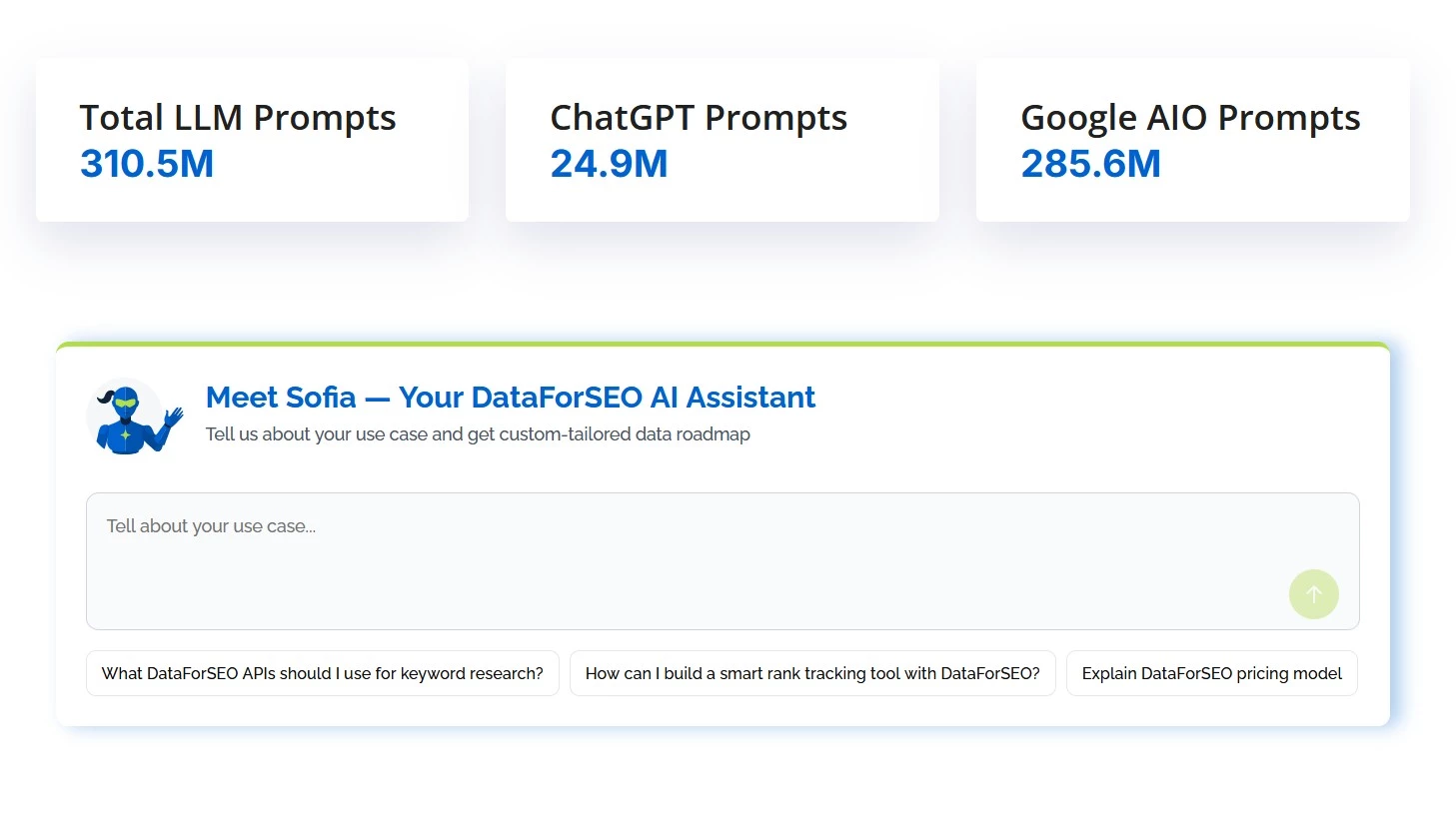
DataForSEO is the raw data layer many SEO tools are built on, delivered by API.
It's a different kind of buy: infrastructure for teams with engineering resources rather than a point-and-click app, and a lower-cost alternative for anyone who'd rather build than pay for a packaged interface.
| Pros | Cons | Pricing |
|
|
|
With DataForSeo, you can build custom dashboards, automated client reports, or internal workflows without paying for traditional per-seat SEO software.
Its MCP server is the forward-looking piece: pipe DataForSEO into an AI assistant and ask, in plain language, for SERP, keyword, or backlink data on demand.
AI SEO Tool Alternatives: Top 3 DFY Agencies
AI SEO tools tell you where you're losing visibility in ChatGPT, Perplexity, and Google AI Overviews, but they don't do the work that earns it back.
The three done-for-you agencies below were selected from the DesignRush SEO directory for their expertise in AI-search execution:
- Searchbloom: Best for AI search citations (AEO/GEO)
- Victorious: Best for answer engine optimization
- HigherVisibility: Best for enterprise SEO & GEO
1. Searchbloom: Best for AI Search Citations (AEO/GEO)
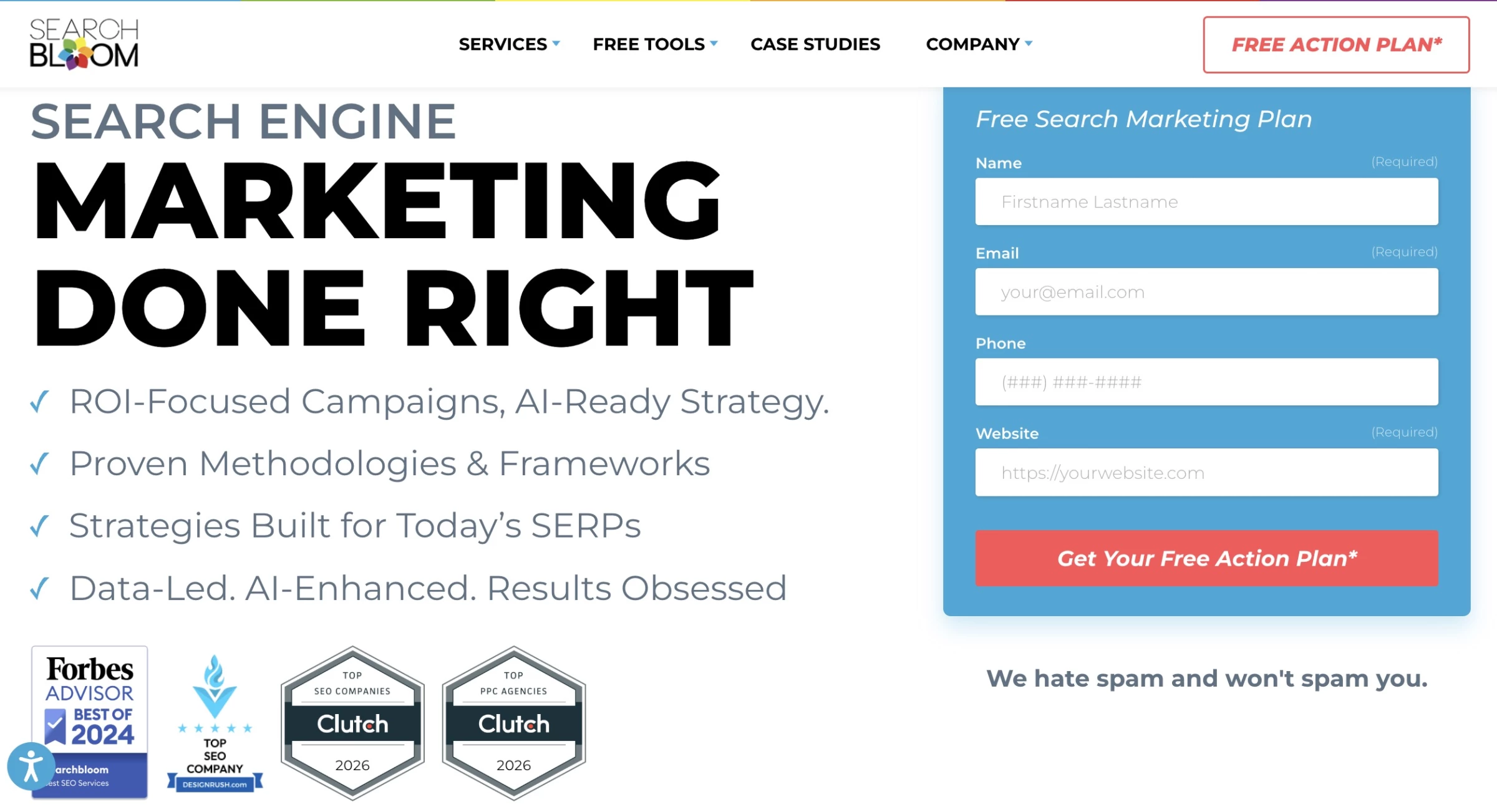
Searchbloom is a performance-driven search and digital marketing firm founded in 2014 and headquartered in South Jordan, Utah. They have been recognized by Forbes, USA Today, Backlinko, and Search Engine Land.
Where AI SEO tools surface citation gaps and track AI Overview mentions, Searchbloom builds the assets and signals behind those citations. The agency handles both strategy and execution under one roof, making it a strong done-for-you alternative for businesses that want more than software insights.
Its proprietary A.R.T. (Authority, Relevancy, Technology) framework guides traditional SEO efforts, while the MERIT framework is designed specifically for AI search. Together, these connect deliverables to a defined objective, so clients can evaluate what's being built and the evidence supporting it.
- Agency services:
- AI SEO (AEO/GEO)
- Technical SEO
- Content Strategy & Information Gain
- Minimum budget: $1,000-$10,000
- Notable clients: Nordstrom, USBank, Medusa, Bill.com, Divvy
What Clients Say
Clients consistently point to Searchbloom's distinctive, long-game approach. They report gaining more actionable SEO, PPC, and Google Business Profile insight in a single consultation than they received from months of work with other agencies.
Across the review base, the recurring themes are transparency, reliability, and proactive communication. Partners describe the team as a genuine extension of their own, delivering on what was promised and responding within 24 to 48 hours.
What Sets the Agency Apart
Searchbloom built and published its own AI SEO framework "MERIT" (Mentions, Evidence, Relevance, Inclusion, Transformation), for earning citations in ChatGPT, Perplexity, and Google AI Overviews.
It’s a DFY alternative that codifies a method instead of relabeling traditional SEO as AI SEO. Their proprietary framework positions them as the team that does what the listed tools above only measure or assist.
2. Victorious: Best for Answer Engine Optimization
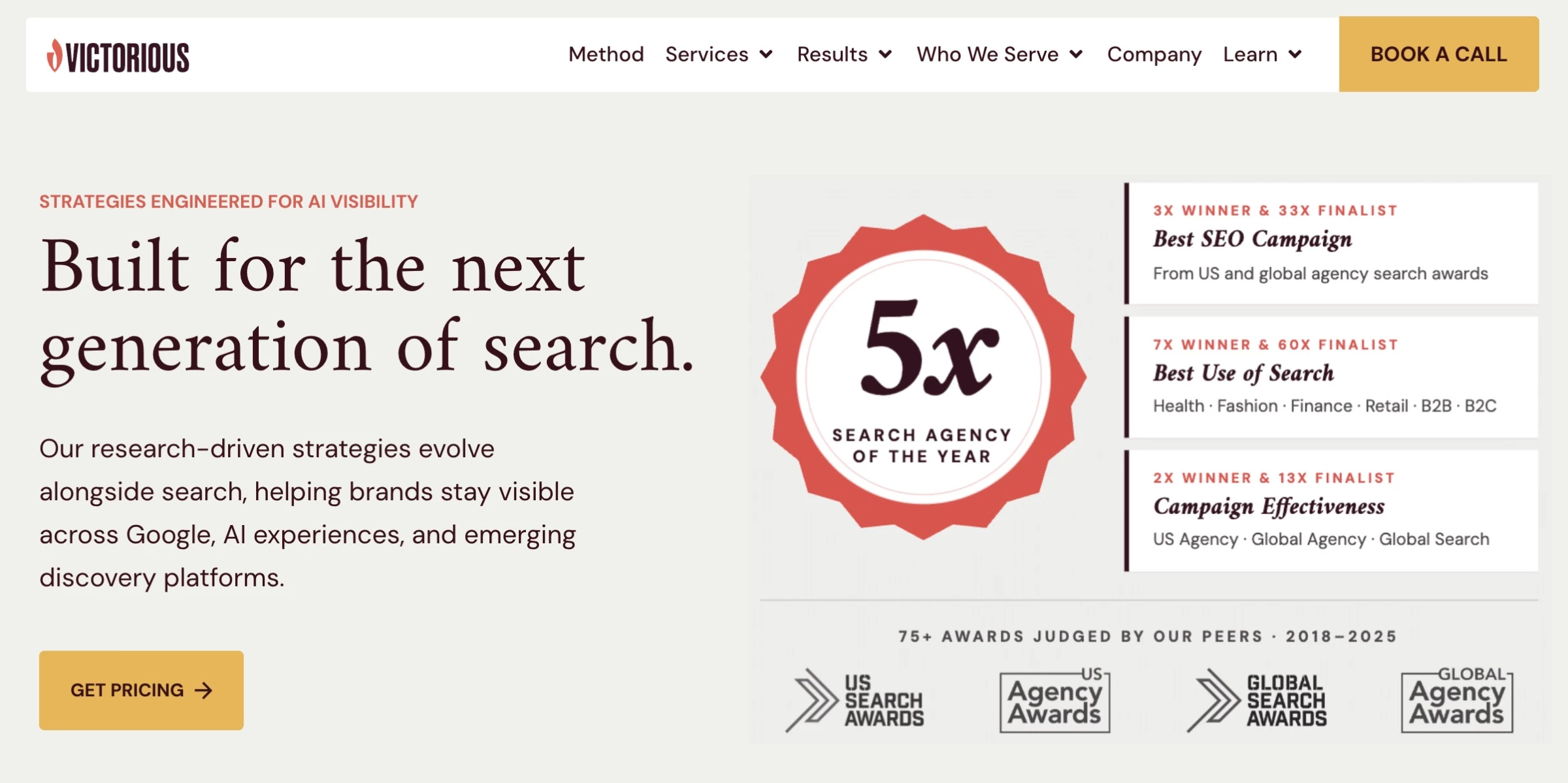
Victorious is a San Francisco-based SEO agency founded in 2013 and named 5x SEO Agency of the Year, having served 600+ brands across finance, SaaS, healthcare, law, and ecommerce.
Their service model is organized around four integrated pillars: SEO, AEO, Content, and Technical SEO, treating AEO as a core delivery alongside traditional search.
As a done-for-you alternative to AI SEO tools, Victorious fields a dedicated team of SEO strategists, content specialists, and technical experts who execute the work instead of flagging it.
The agency also publishes original AI-search research: its Q1 2026 Search Report examined how 177 brands appear in AI versus traditional search, which directly informs their client strategy.
- Agency services:
- Search Engine Optimization (SEO)
- Generative Engine Optimization (AEO)
- Content Marketing
- Minimum budget: Inquire
- Notable clients: Salesforce, SoFi, GoFundMe
What Clients Say
Clients highlight Victorious's depth of expertise as the primary reason they chose the agency over generalist alternatives.
The agency actively builds strategies for where search is going, including specifically transitioning campaigns into GEO to ensure their brands are cited by AI search engines.
The combination of strategic transparency, structured execution, and AI-era adaptability is what clients in high-stakes industries credit most.
What Sets the Agency Apart
Victorious has AEO built into its core service model as a dedicated pillar and has published its own ongoing research into how AI platforms surface and cite content.
A dedicated SEO-only team runs the entity development, content architecture, and authority-building work across both traditional and AI search simultaneously.
3. HigherVisibility: Best for Enterprise SEO & GEO
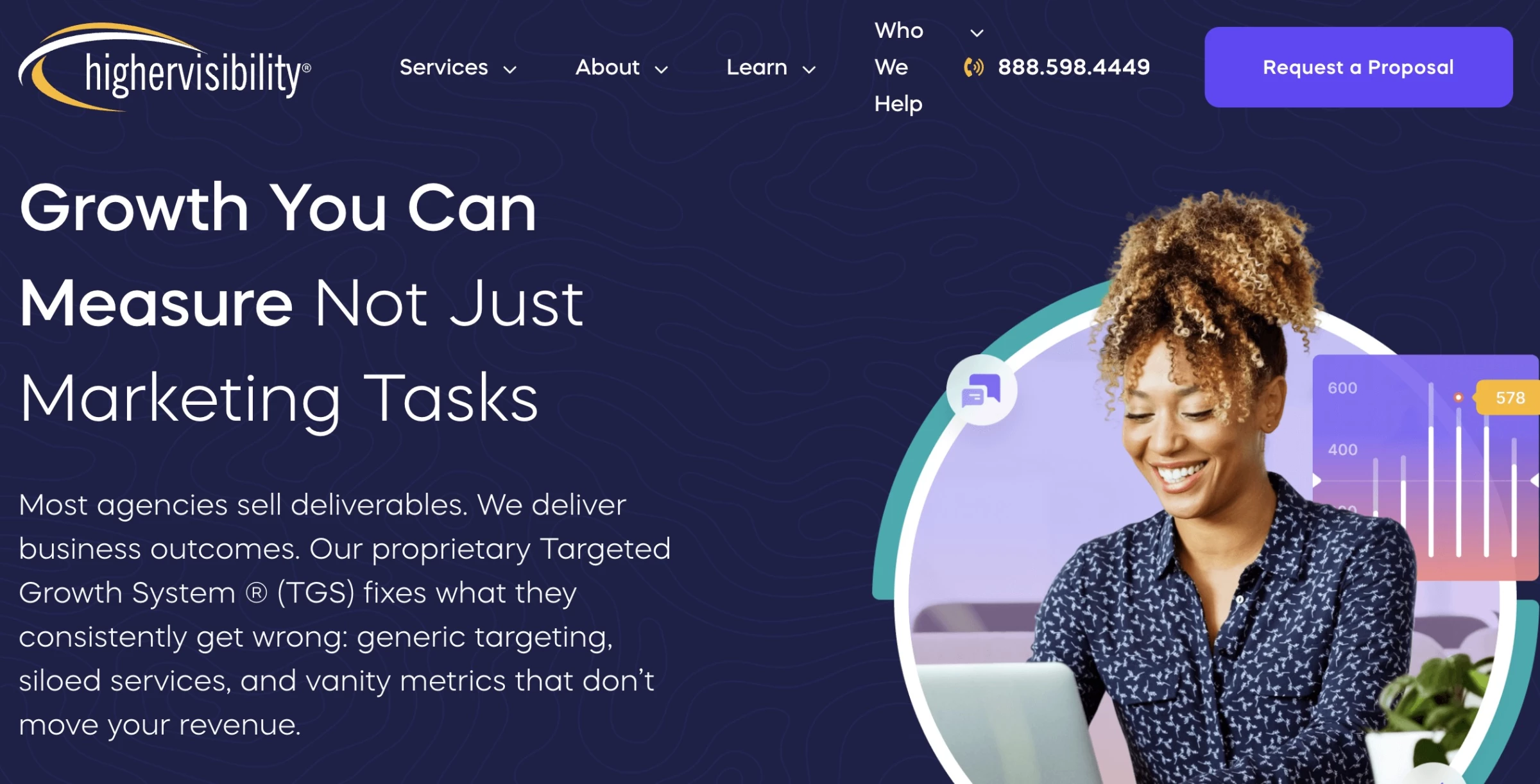
HigherVisibility is a Memphis-based digital marketing agency founded in 2008.
The agency serves franchise and multi-location brands, healthcare, ecommerce, and enterprise clients, and is a Google Premier Partner managing campaigns from SMBs to Fortune-level accounts.
On the AI front, HigherVisibility offers a dedicated GEO service, optimizing for citations in ChatGPT, Google AI Overviews, Google AI Mode, Gemini, and Perplexity, which it integrates into SEO campaigns rather than selling separately.
Its proprietary Targeted Growth System® governs both, meaning AI visibility and traditional organic growth are built from the same buyer research, ICP development, and authority infrastructure.
- Agency services:
- SEO
- GEO (AI SEO)
- PPC Management
- Minimum budget: $1,000-$10,000
- Notable clients: Caliber Collision, eBay, Warner Bros
What Clients Say
Long-term client relationships are a recurring pattern in HigherVisibility's reviews, with many engagements running three to five or more years.
Clients describe going from minimal online presence to consistent first-page rankings for their most competitive keywords, crediting the team's command of both SEO and paid search as a competitive asset that compounds over time.
Reviewers describe a team that is proactive rather than reactive, responsive when needed, and transparent about what it's doing and why.
What Sets the Agency Apart
HigherVisibility is one of the few agencies that has built GEO directly into its core methodology.
The Targeted Growth System® powers both traditional SEO and AI citation work from the same strategic foundation, so investment in one channel compounds the other.
Five SEO Agency of the Year recognitions from independent industry bodies (Search Engine Land, US Agency Awards) provide third-party validation of their expertise.
Business Benefits of Adopting SEO AI Tools
The real value of AI SEO tools is in helping teams prioritize better opportunities, reduce repetitive work, improve content quality, and adapt faster as search shifts from classic rankings to AI-generated answers.
- 45% of B2B marketers plan to increase investment in AI-powered marketing tools
- 51% of B2B marketers using generative AI report fewer tedious tasks
- 42% of B2B marketers using generative AI see improved content optimization
- 72% of SEO professionals using AI content say it performs as well as or better than human-written content
- 53% of technology marketers say AI-assisted content creation improved content quality
45% of B2B Marketers Plan To Increase Investment in AI-Powered Marketing Tools
SEO AI tools are becoming a budget priority because they help teams move faster across research, optimization, reporting, and content planning.
With 45% of B2B marketers planning to increase investment in AI-powered marketing tools, the business case is moving from experimentation to operational priority.
The benefit is a stronger output without adding the same level of manual workload across every SEO task.
51% of B2B Marketers Using Generative AI Report Fewer Tedious Tasks
AI SEO tools reduce the repetitive work behind keyword grouping, SERP analysis, content briefs, metadata, internal linking, and page updates.
Since 51% of B2B marketers using generative AI report fewer tedious tasks, according to Content Marketing Institute, these tools can give SEO and content teams more room to focus on strategy, editorial judgment, and performance improvements instead of spending hours on manual prep work.
42% of B2B Marketers Using Generative AI See Improved Content Optimization
AI SEO tools help teams create stronger search content by identifying missing topics, weak headings, content gaps, keyword opportunities, and optimization issues before a page is published.
With 42% of B2B marketers using generative AI reporting improved content optimization, as reported by the same Content Marketing Institute report, these tools make content updates more targeted and give writers clearer direction when improving ranking potential.
Adam Romasko, Managing Partner at GordoWebDesign, sees this as one of the clearest business advantages of AI SEO tools.
“I think the most obvious [benefits] are AI tools spotting trends that are not obvious in the data,” he says. “One of my favorite things is finding an underserved niche or cohort and is maybe low competition but I can rank quickly for.”
72% of SEO Professionals Using AI Content Say It Performs as Well as or Better Than Human-Written Content
AI-assisted SEO workflows can speed up content production while keeping human review in the process.
Since 72% of SEO professionals using AI content say it performs as well as or better than human-written content, the business value comes from faster briefs, faster first drafts, stronger optimization, and shorter production cycles without removing editorial oversight.
53% of Technology Marketers Say AI-Assisted Content Creation Improved Content Quality
For content-heavy teams, AI SEO tools can improve consistency across briefs, outlines, metadata, FAQs, and optimization guidelines.
With 53% of technology marketers saying AI-assisted content creation improved content quality, these tools can help brands maintain quality across larger content libraries, especially when multiple writers, editors, and SEO specialists are involved.
How To Choose the Right AI SEO Software
The right tool should amplify your team’s judgment, not replace it. Consider how each platform fits into your real workflow:
- Feature fit: Match the tool’s capabilities to your goals. Make a checklist of must-haves (e.g., content briefs, index automation, backlink analysis) and compare tools side-by-side.
- Cost & scalability: Examine pricing tiers and user limits as many have paywalls for advanced AI features. Also factor in editorial bandwidth and if the tool can grow with your business.
- Integrations: Check if the tool connects to your existing stack. At the least, it should sync with Google Search Console, analytics platforms (GA4/Looker), and CMS systems (WordPress, Shopify).
- Industry fit: Look for case studies or features tailored to your niche. eCommerce sites benefit from AI that handles product pages, while B2B/SaaS need competitor content mapping.
- Demo performance: Most importantly, try the tool against a small project or pilot cluster, and verify that its recommendations align with your editorial judgment and business goals.
Cameron Prockiw, founder and CEO at Nerder, points out:
“The best check for the validity of AI-generated recommendations is the human eye.
An experienced SEO professional should be able to quickly identify any potentially wonky recommendations, then cross-check them against trusted industry blogs, guides, or books.“
Common Challenges of AI-Powered SEO Tools
-
Over-reliance on automation: AI suggestions can be generic or formulaic. Use AI to gather data and propose outlines, but have editors and experts refine and add original value.
- Blind trust in recommendations: AI suggestions can miss context, especially in niche industries. Validate all changes against the current SERPs.
Noceda adds:
"Treat AI suggestions as hypotheses, not final decisions. Cross-check with analytics data: what is current traffic, what queries are already converting, what pages are ranking.
Validate with your historical performance before pushing changes live."
-
Generic tone & brand voice: AI writing often lacks personality. Without careful editing, AI drafts can feel flat or too uniform across pages. Lock your brand voice into AI prompts and perform a human edit pass to ensure consistency.
- Factual accuracy & E-E-A-T: AI may hallucinate data or cite outdated facts. In sensitive industries (health, finance, legal), add strict editorial review or SME input.
Emerging Trends in AI SEO To Watch
@webhivedigital Think AI search has made SEO irrelevant? Not even close. AI search engines like ChatGPT, Perplexity & Claude are changing how people search, but they still rely on traditional search engines like Bing to find answers. If you're not doing SEO, you're not showing up in any of these search engines. #aisearch #aiseo #searchengineoptimisation #digitalmarketing #marketingtips ♬ original sound - Kate Smoothy | SEO Specialist
The next phase of SEO will move beyond automation. It will rewire how data, content, and algorithms interact.
-
Full AI-integrated content ops: The future may hold unified systems where idea generation, writing, editing, optimization, and monitoring happen in one loop.
- Automated SERP & AI-agent Intelligence: Tools will track not just Google’s SERPs but also AI assistant results like ChatGPT.
-
Voice and visual search optimization: AI SEO tools will extend to multimodal search. Expect features that analyze image alt-text and structure content for voice assistants.
- Hyper-personalization: AI enables different content variants based on user signals. Content blocks, calls-to-action, or page formats could adjust automatically to user segments.
Prockiw expands on how AI tools like SemRush are reshaping SEO work:
“AI is about to take most of the repetitive SEO chores off our plates. That means SEO professionals can focus on higher-impact work and scale their efforts like never before.
On top of that, AI is a game-changer for personalization, letting us tailor content and search results for even the tiniest niche audiences...”
How To Get Started With AI SEO Tools
AI SEO tools can help teams move faster across research, content planning, optimization, and reporting.
The right next step depends on whether you want to test platforms yourself, get expert support, or keep researching before choosing.
- If you want to test tools first, look at platforms with free plans or trials, including Frase, Surfer SEO, SE Ranking, Indexly, MarketMuse, and Semrush.
- If you're on a tight budget, Frase and Yahini (both from $39/month) cover briefs and content strategy, while Indexly's free tools handle indexing and AI visibility. Pair one with an AI assistant and Search Console, and you can cover a lot before upgrading.
- If you want expert help choosing and implementing AI SEO tools, use DesignRush’s SEO agency directory to compare agencies by expertise, reviews, pricing, location, and service focus.
- If you want to learn more before committing, read related guides on AI search visibility, SEO strategy, content optimization, and agency selection.
Our team ranks agencies worldwide to help you find a qualified partner to implement the latest AI solutions. Visit our Agency Directory for the Top SEO Companies, as well as:
- Top SEO Consultants
- Top On-Page SEO Companies
- Top Startups SEO Companies
- Top Enterprise SEO Companies
- Top Austin SEO Companies
AI SEO Optimization Tools FAQs
1. Are AI SEO tools replacing traditional SEO experts?
Not at all. AI speeds up analysis and content execution, but human strategy still drives performance.
The best results come from pairing AI insights with experienced judgment, especially for interpreting data, managing brand tone, and setting KPIs.
2. What’s the best AI SEO tool for small businesses or startups?
For lean teams, Frase and Surfer SEO offer the best balance of affordability, usability, and AI content recommendations.
They help teams scale faster without needing an in-house SEO analyst.
3. Which AI SEO tools are best for tracking Google AI Overviews?
Tools like SE Ranking and Ahrefs stand out for tracking Google AI Overviews, offering insights into AI-triggered keywords, citation sources, and how your brand appears in AI-generated results.
4. Do AI SEO tools help with GEO and AI search visibility?
Yes, platforms like Brandi AI help optimize for GEO by tracking AI prompts, improving content for citations, and increasing visibility across AI-driven search engines.
5. How can I measure ROI from AI SEO tools?
Track changes in organic traffic, CTR, keyword rankings, and content velocity before and after adopting AI tools.
Many experts recommend tying outcomes to cost per optimized page or hours saved to quantify productivity ROI.
6. How accurate is AI SEO tool data compared to Google Search Console?
Expect some variance. GSC stays the source of truth for your own clicks, impressions, and positions; third-party tools are best for competitive data, scale, and forecasting.
For AI-visibility tools, also check whether the platform queries answer engines through their APIs or their real user interfaces, since the two can differ from what a user actually sees.
7. Can ChatGPT or Perplexity replace dedicated AI SEO tools?
For some tasks, yes. General-purpose assistants are great for drafting meta descriptions, generating schema, clustering keywords, and with Perplexity or search-enabled ChatGPT and Gemini, pulling cited sources for research.
They can't replace reliable rank tracking, backlink indexes, or continuous AI-visibility monitoring, which depend on live data and dedicated infrastructure. Most teams use both: an assistant for fast content tasks, purpose-built tools for measurement.
8. Can I query my SEO reporting data directly from an AI assistant like ChatGPT or Claude?
Increasingly, yes. Some platforms, such as Gauge, include a built-in AI data assistant that answers plain-language questions from your connected GA4 and Search Console data.
Data providers also now ship MCP servers that let assistants such as Claude and ChatGPT query SEO data directly.
The advantage over a raw export is that answers come from governed, labeled reporting data rather than an unlabeled spreadsheet.