
AI assistants are changing how people discover information, often providing answers directly within search results instead of sending users to multiple websites.
If you're looking for the AEO meaning, this guide covers the AEO definition, how AEO works, how it differs from SEO and GEO, and the practical steps you can take to improve your chances of appearing in AI-generated answers.
What Is AEO: Key Findings
- Research analyzing 1,702 AI answer citations found that pages with clear structure, structured data, and updated metadata are significantly more likely to be cited.
- Only 374 out of every 1,000 Google searches in the US result in clicks to external websites, meaning most queries are resolved directly within search interfaces.
- Nearly 90% of B2B buyers now use generative AI during vendor research, yet 73% of vendors receive zero citations when AI recommends providers.
What Is AEO?
AEO is the process of optimizing content, so AI-powered systems, such as ChatGPT, Google AI Overviews, Perplexity, and Microsoft Copilot, can easily understand it and include it in generated answers.
In practical terms, AEO involves:
- Structuring content so machines can extract answers easily.
- Providing authoritative information AI systems can trust.
- Publishing content aligned with real user questions.
Instead of visiting multiple websites to research a topic, users ask a question and receive a synthesized response drawn from several sources.
AEO aims to ensure that your content becomes one of those sources.


Why Does AEO Matter?
The importance of AEO is tied to measurable changes in how people search.
First, AI answers are becoming more common in search interfaces. For example, Google’s AI Overviews generate summaries directly in search results pages, giving users information without requiring them to click through to a website.
Second, AI-driven discovery is growing rapidly. Gartner predicts that traditional search volume may decline by 25% by the end of 2026 as users shift toward AI-generated answers.
Third, the presence of AI answers affects traffic patterns. A large empirical study examining Google’s AI Overviews found that pages exposed to AI summaries experienced about a 15% drop in daily traffic, because users could obtain the information directly in search results.
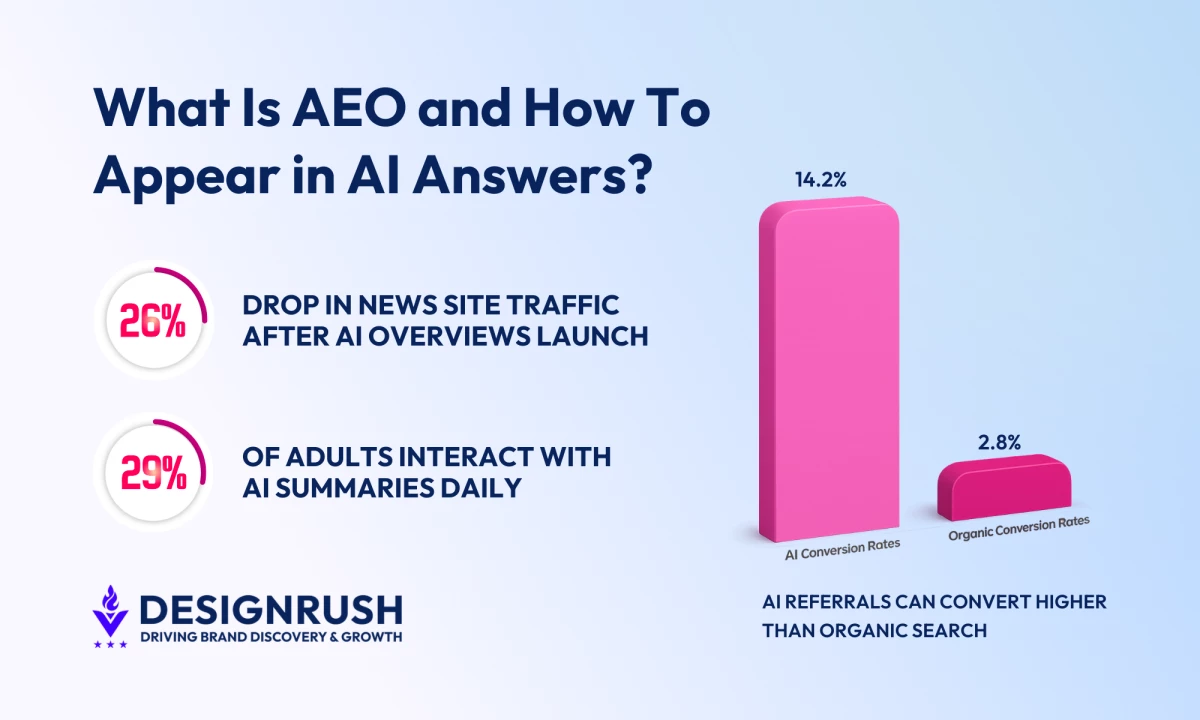
On top of that, Similarweb reports that organic traffic to publisher websites declined 26% after Google launched AI Overviews, reflecting how AI-generated summaries increasingly satisfy queries directly in search results.
But visibility in AI answers can still be valuable. According to marketing research cited by Semrush, visitors coming through AI search experiences convert about 4.4× more often than traditional organic traffic, suggesting that users arriving after interacting with AI responses tend to have stronger intent.
Put simply:
- Search traffic is changing
- AI answers increasingly mediate discovery
- Being cited matters more than being clicked
Roy Caccamo, Founder and CEO of Why Digital, notes that this shift is already visible in user behavior.
“People are already going to AI to get answers to many questions rather than Google, and once they believe they can get solutions to their problems using AI, trusting the output, brands will need to rethink their content strategies, third-party endorsements, and monitor and measure like never before.”
AEO vs. SEO: Ranking Pages vs. Delivering Answers
Businesses typically operate across three layers of search visibility:
- AEO: Structuring content so it can be extracted as direct answers.
- Search engine optimization (SEO): Improving rankings in traditional blue-link search results.
- Generative engine optimization (GEO): Influencing how AI systems describe brands and topics in generated responses, which is the umbrella term for optimizing brand presence in AI Search results.
This shift reflects broader changes in how people discover information online.
| Key Difference | SEO | AEO |
| Primary goal | Rank highly in traditional blue-link search results | Be extracted, cited, or presented as a direct answer |
| Optimizes for | Search engine results pages (SERPs) | Answer engines, AI Overviews, AI Mode, and chat-based search |
| Content focus | Keywords, search intent, site structure, and backlinks | Clear answers, FAQs, definitions, step-by-step guidance, and schema markup |
| Success metrics | Rankings, organic traffic, and CTR | Citations, answer inclusion, AI referrals, and visibility in AI results |
| Typical outcome | Users click through to a webpage | Users receive an answer extracted from your content |
| Key question | Can users find my content? | Can AI use my content as an answer? |
SEO focuses on improving a webpage’s visibility within search engine results pages (SERPs). Traditional SEO strategies emphasize:
- Keyword targeting
- Backlinks and domain authority
- Site speed and technical performance
- Internal linking and crawlability
These signals help search engines determine which pages should appear in the results list.
AEO, by contrast, focuses on ensuring that content can be extracted and presented directly as an answer.
Importantly, AEO does not replace SEO. Instead, SEO ensures content can be discovered, while AEO ensures it can be extracted and used as an answer.
Here’s what the experts at Brandi AI have to say on the comparison:
“Honestly, if a brand wants to maximize its presence in AI search results, the brand needs to lead with GEO, first. SEO is for getting indexed and found, and your owned content cannot be picked up by an AI model unless your information is indexed.
But GEO strategy and tactics will help that indexed content be read, summarized and returned in AI answers – SEO will not.
So, for owned content: GEO, first with SEO technical underpinning. For everything off-domain, just be concerned with GEO."
AEO vs. GEO: Optimizing Answers vs. Influencing AI Narratives
While AEO focuses on structuring individual pieces of content, GEO focuses on shaping how AI systems understand and describe brands across multiple sources.
Large language models generate responses by combining information from many datasets, including:
- Websites
- News articles
- Reviews and ratings
- Structured knowledge graphs
- Publicly available datasets
Because of this, AI responses often synthesize information about a company from multiple independent sources rather than a single webpage.
For example, if a user asks an AI assistant:
What are the best B2B marketing directories?
The AI system may compile a response using signals from:
- Industry articles
- Directory listings
- Brand mentions across the web
If a company is frequently mentioned across reputable sources, it becomes more likely to appear in AI-generated recommendations.
GEO strategies therefore focus on strengthening cross-platform authority signals, such as:
- Mentions in authoritative publications
- High-quality backlinks
- Consistent brand information across directories
- Positive reviews and ratings
This broader digital presence helps AI systems associate the brand with specific topics or industries.
| Key Difference | AEO | GEO |
| Primary goal | Be extracted, cited, or presented as a direct answer | Influence how AI systems describe brands, products, your competitors, and topics |
| Optimizes for | Answer engines, AI Overviews, AI Mode, and chat-based search | Large language models and AI-generated responses |
| Content focus | Clear answers, FAQs, definitions, step-by-step guidance, and schema markup | Entity authority, brand mentions, expertise signals, and third-party references |
| Success metrics | Citations, answer inclusion, AI referrals, and visibility in AI results | Brand mentions, share of voice, sentiment, and recommendation frequency |
| Typical outcome | Users receive an answer extracted from your content | AI systems recognize and reference your brand or expertise |
| Key question | Can AI use my content as an answer? | Does AI know and trust my brand? |
Where AEO Appears in AI and Search Results
Answer engine optimization affects multiple discovery surfaces:
AI-Generated Search Summaries
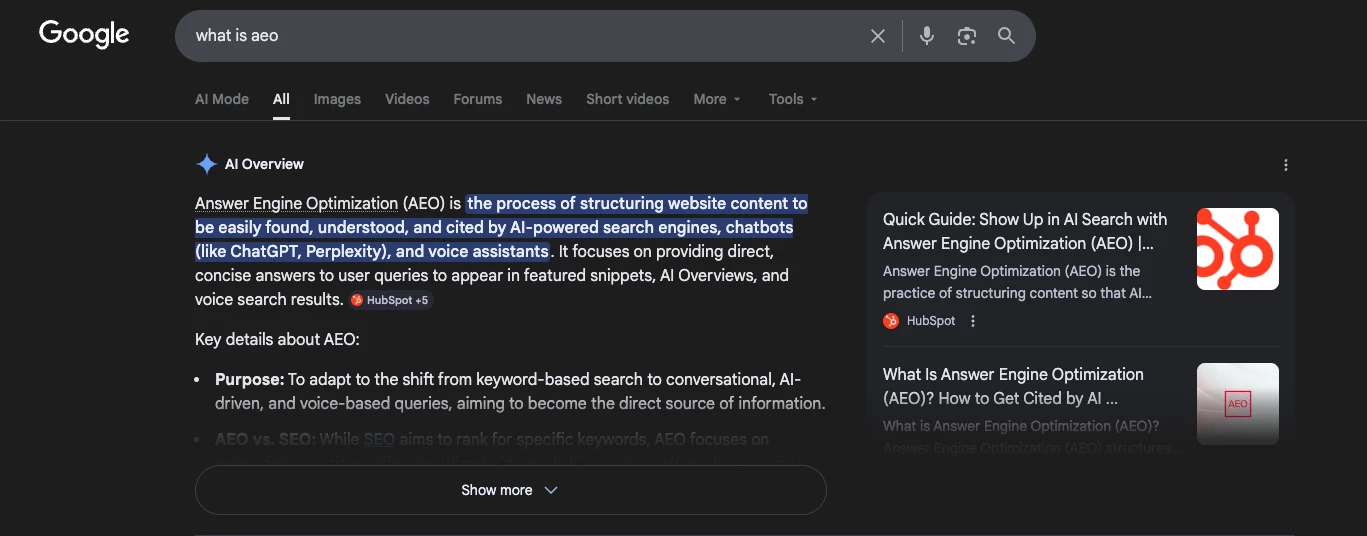
Google’s AI Overviews generate summaries that appear above traditional search results. These summaries synthesize information from multiple sources and sometimes include citations to underlying webpages.
For example, a search like:
What is brand activation?
may produce an AI summary explaining the concept and linking to the sources used to construct the answer.
AI Chat Search
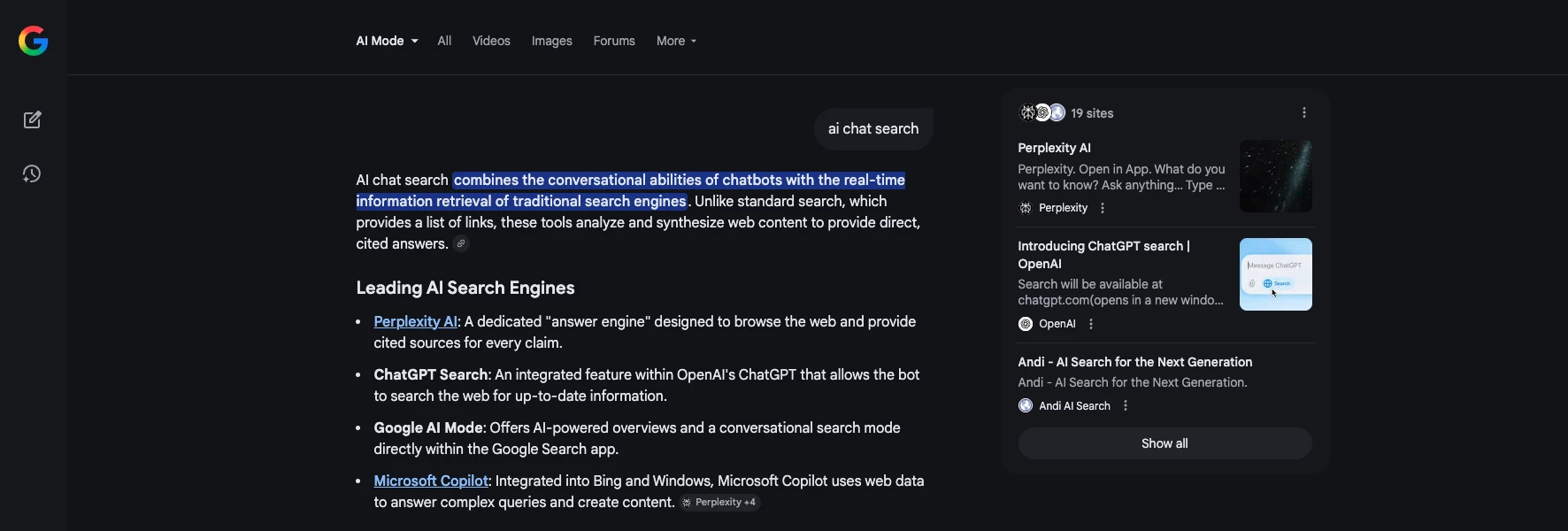
Tools like ChatGPT, Perplexity, and Microsoft Copilot allow users to ask questions in natural language and receive conversational responses.
These systems typically:
- Retrieve relevant web pages
- Extract useful information
- Generate a summarized answer
- Provide citations
This model shifts the importance from ranking position to source inclusion.
Featured Snippets and Direct Answers
Even before generative AI, Google displayed position zero answers that summarize content above organic results. These formats are still part of AEO strategies because they deliver direct answers extracted from webpages.
Voice Search
Voice assistants like Siri and Google Assistant frequently read a single answer aloud. Structured content increases the chances that your page becomes that answer.
How Answer Engines Select and Cite Sources
Although each AI system uses its own algorithms, most answer engines follow a similar pipeline:
- Retrieve relevant sources: The system identifies pages related to the user’s question.
- Extract potential answers: Algorithms scan those pages for passages that clearly address the question.
- Evaluate authority and reliability: Signals such as topical authority, consistency, citations, and page quality help determine which sources are trustworthy.
- Generate a response: The system synthesizes an answer and may cite or reference the sources used.
In other words, the pages most likely to be cited tend to share three traits:
- Clear structure
- Reliable information
- Strong topical authority
How To Implement AEO in 6 Steps
Implementing AEO mostly revolves about structuring content so machines can interpret it easily.
- Provide direct answers early in the content
- Structure content for machine readability
- Build topic clusters
- Treat freshness and metadata as AEO infrastructure
- Use structured data where relevant
- Maintain credibility signals
1. Provide Direct Answers Early in the Content
Answer engines generate responses by retrieving sources and then extracting answer candidates. The easier your page is to extract from, the more likely it becomes usable.
Google itself frames AI features as experiences where your content may be included, and the practical implication is: make content easy to interpret and include.
Example:
Less effective
Marketing automation platforms have many features designed to help businesses manage campaigns more efficiently…
AEO-friendly
What is marketing automation?
Marketing automation is software that automates marketing tasks such as email campaigns, lead scoring, and audience segmentation.
The second format provides a concise definition that an AI system can extract.
2. Structure Content for Machine Readability
A research study analyzing 1,702 citations across multiple AI answer engines found that factors such as structured data and semantic HTML strongly correlate with being cited in AI answers.
Common formats include:
- Numbered steps
- Bullet lists
- Tables
- Definitions
These formats help systems isolate specific pieces of information when constructing answers.
What to do:
- Use a consistent hierarchy:
- H2s: User questions
- H3s: The sub-answers (why it matters, how it works, example)
- Keep critical info in HTML text, not hidden in:
- Image-only charts
- PDFs for key facts
- Collapsed tabs that hide the only definition
Microsoft’s official guidance warns against burying key content, like PDF, image-only, and hidden, because assistants need to parse clean blocks.
3. Build Topic Clusters
AI systems evaluate topical authority across multiple pages.
Instead of publishing isolated articles, successful AEO strategies often create clusters such as:
- What is AI marketing automation
- AI marketing automation examples
- AI marketing automation tools
- AI marketing automation benefits
A group of related pages signals deeper expertise in the topic.
4. Treat Freshness and Metadata as AEO Infrastructure
The same citation study found Metadata and Freshness among the strongest predictors of being cited across engines.
Google also notes site owners can control snippets and preview behavior, and that more restrictive settings can limit inclusion in AI experiences, which reinforces that how content is presented and managed affects visibility.
What to do:
- Add:
- datePublished and dateModified
- Clear authorship and editorial review
- Update volatile sections, like stats, definitons, and platform features, on a schedule
- Keep one canonical source of truth paragraph for definitions across your site to avoid contradictions
5. Use Structured Data Where Relevant
Schema markup helps machines interpret content.
Common structured data types include:
- FAQ schema
- How-to schema
- Product schema
- Article schema
These formats provide explicit signals about how information should be interpreted.
6. Maintain Credibility Signals
Answer engines prefer sources that demonstrate expertise and reliability.
Important signals include:
- Identifiable authors
- Citations to reliable sources
- Updated statistics
- Consistent information across pages
These factors align with the broader concept of Experience, Expertise, Authoritativeness, Trustworthiness (E-E-A-T).
Common AEO Mistakes To Avoid
As AEO gains popularity, so does the number of tactics promising quick visibility in AI-generated answers. Recent guidance from Google and research from Ahrefs suggest the opposite.
Most sustainable gains still come from publishing trustworthy, well-structured content and building topical authority over time. Before investing in new tools or technical workarounds, make sure you’re not making these common mistakes:
- Treating llms.txt as a shortcut to AI visibility
Emerging technologies often attract attention before their impact is proven. According to Ahrefs, there is currently little evidence that implementing an llms.txt file improves AI visibility or increases citations on its own.
- Publishing conflicting information across multiple pages
Contradictory definitions, outdated statistics, or inconsistent messaging can make it harder for answer engines to determine which version of your content is the most reliable.
- Relying on a single page to demonstrate expertise
Topical authority is built through comprehensive coverage. Supporting content such as FAQs, comparisons, case studies, and related resources helps reinforce expertise across a subject area.
- Using generic author bylines with no expertise signals
Author credentials, first-hand experience, and subject-matter expertise help readers and search systems understand why your content should be trusted.
- Letting high-value content become outdated
Information that changes frequently should be reviewed and updated regularly. Outdated examples, statistics, and recommendations can reduce the likelihood of being cited in AI-generated answers.
Trends Shaping Answer Engine Optimization in 2026
The following trends highlight the key shifts shaping how content is discovered, selected, and cited in AI-generated answers in 2026.
- AI Discovery Is Becoming Part of B2B Purchasing Behavior
- Entity Authority Is Influencing Answer Selection
- Conversational Queries Changed Search Behavior
- AI Search Is Evolving Into an Agent-Driven Experience
- Audience Loyalty Is Now an AI Visibility Signal
1. AI Discovery Is Becoming Part of B2B Purchasing Behavior
According to Gracker’s State of AI Search Visibility 2026, nearly 90% of B2B buyers now use generative AI during purchase research. Yet most brands are still absent from the answers buyers see.
When ChatGPT was asked for vendor recommendations across multiple categories, 73% of companies received no citations at all.
HubSpot’s The State of AEO in 2026 suggests that visibility in AI answers is already affecting buying decisions. Nearly half of marketers surveyed have made a business purchase based primarily on information first discovered in AI-generated answers, and 29% have done so more than once.
Trust appears to be moving in the same direction. HubSpot reports that 42% of marketers consider AI-generated brand recommendations trustworthy, suggesting that answer engines are beginning to shape perceptions before a prospect ever visits a website.
“Structured credibility and authority first, always.” according to Brandi AI. They also added:
“A brand must have a consistent and authoritative voice and structured content that can be read. They must also have signals off domain that underscore its credibility and authority.”
As answer engines become part of the buying journey, visibility in AI-generated recommendations is increasingly influencing which companies make the shortlist and which never enter the conversation.
2. Entity Authority Is Influencing Answer Selection
Search engines and answer engines are drawing citations from a wider range of sources than they were a year ago. Ahrefs found that only 38% of pages cited in AI Overviews also rank in Google’s top 10 results for the same query, down from 76% last year.
Rankings aren’t the only signal influencing which sources appear in AI-generated answers.
Mentions in industry publications, news sites, directories, research reports, and other trusted sources help reinforce a brand’s association with specific topics, making it more likely to be recognized as a relevant source.
According to Digital Applied, brands cited in AI Overviews receive 35% more organic clicks than those that aren’t cited, which gives companies another reason to invest in visibility beyond their own websites.
When it comes to the most impactful steps a brand can take to strengthen its entity authority, especially if it doesn't have the budget for a PR firm to secure top-tier press coverage, it’s “publishing owned content that speaks to the questions people most likely ask.”
Brandi AI further adds:
“Answer the questions people will most likely ask in the most credible, authoritative way.”
3. Conversational Queries Changed Search Behavior
Traditional search queries average 3.37 words, and the average ChatGPT prompt is 23 words, according to research from The Growth Memo.
Users are searching differently as they provide context, describe goals, set constraints, and ask for recommendations in a single prompt.
A search for “CRM software” and a prompt requesting the best CRM for a 20-person SaaS company with a limited budget may touch on the same topic, but they require very different answers.
That is changing the type of content answer engines produce. Definitions, comparisons, buying guides, FAQs, and step-by-step explanations are often better suited to detailed prompts than pages optimized around a single keyword.
Audience behavior varies, too. HubSpot’s The State of AEO in 2026 found that 74% consumers primarily use answer engines for quick answers, whereas decision-makers use them for product research just as often as for general research. Brands now need content that supports both journeys.
4. AI Search Is Evolving Into an Agent-Driven Experience
At Google I/O 2026, Google expanded AI-powered search with AI Mode, introduced Gemini 3.5 Flash as its default model, and reported that AI Mode now reaches more than 1 billion monthly users.
Query volume has also been growing rapidly, more than doubling each quarter.
Google also introduced information agents that can monitor topics, search for new developments, and deliver synthesized updates over time. Instead of repeatedly searching, users can rely on AI systems to track subjects for them.
Content that earns citations today may be reassessed as agents revisit a topic and incorporate new information.
Freshness, consistency, and regular content maintenance are becoming more important as AI-powered search experiences continue to evolve and visibility turns into an ongoing process.
5. Audience Loyalty Is Now an AI Visibility Signal
Search visibility has traditionally been shaped by algorithmic signals such as relevance, authority, backlinks, and content quality. Google’s Preferred Sources feature introduces a new variable - user preference.
Users can now select websites they want to see more of in Search, and those preferences are carried into AI Overviews and AI Mode.
Preferred Sources can appear as labeled links within AI-generated responses, giving selected websites additional visibility inside AI-powered search experiences.
This creates a direct connection between audience loyalty and AI visibility. A brand with loyal readers, subscribers, or repeat visitors can influence discoverability in a way previously possible only through search personalization.
Google reports that users are twice as likely to click a Preferred Source once it has been selected, and more than 345,000 unique sources have already been added through the feature.
For AEO, building an audience that actively seeks out and trusts your content has become another factor in maintaining visibility inside AI-generated answers.
How To Measure AEO Performance
Measuring AEO requires a broader view than traditional SEO analytics.
In classic search optimization, success is primarily measured through rankings, impressions, and clicks. AEO introduces additional layers because users often receive answers without visiting the source website.
This means visibility can still influence brand awareness, trust, and conversions even when the interaction does not produce an immediate click.
As a result, AEO measurement focuses on five categories of signals:
- AI answer citations
- SERP answer features
- Brand mentions in AI responses
- Downstream engagement and conversion quality
- Zero-click search impact
Together, these metrics reveal whether your content is being selected, trusted, and acted upon by AI systems and users.
Brandi AI agrees and adds:
“Mentions, owned citations, and impact of actions like PR initiatives that lead to secured media coverage. You can also mention Share of Voice within your unique market universe.”
When asked about the most common blind spots you see in how companies try to track their AI visibility today, they highlighted the following:
“The blind spots are around brand intelligence, sentiment, and the narrative consistency. It is crucial to monitor and optimize the way a brand is positioned in the answers.
It's not enough to be mentioned if the positioning is inaccurate, negative, and does not support long-term brand mission.”
1. Track AI Answer Citations
Because most AI systems do not yet provide analytics dashboards, monitoring citations currently requires a mix of manual and automated methods.
Method 1: Prompt Testing
Create a list of key queries you want to own.
Example prompts:
- What is answer engine optimization?
- Best AEO strategies for businesses
- Difference between AEO and SEO
Run these prompts in:
- ChatGPT
- Perplexity
- Copilot
- Google AI search results
Record:
- Whether your domain appears
- Where it appears in the answer
- Whether it is cited directly
Repeat this test monthly to identify visibility trends.
Method 2: AI Monitoring Platforms
Several emerging platforms track AI citations across answer engines.
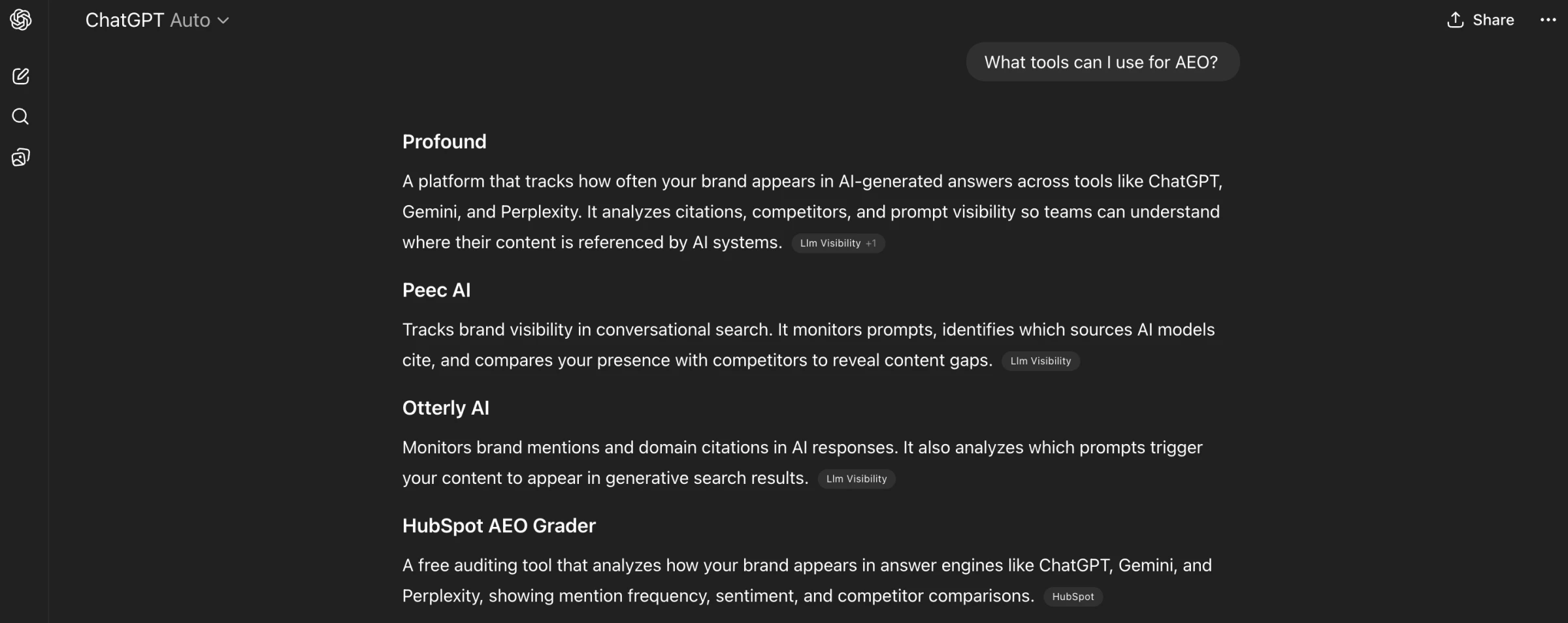
Examples include:
These tools scan thousands of prompts to detect whether brands appear in AI-generated answers and track changes over time.
This approach is similar to traditional keyword ranking tools but adapted for generative search.
Method 3: Referral Traffic Analysis
Some AI platforms send referral traffic when users click cited sources.
Check analytics for traffic sources such as:
- perplexity.ai
- chat.openai.com
- copilot.microsoft.com
Even small volumes can indicate that your content is being used as an AI source.
2. Monitor SERP Answer Features
To measure featured snippet visibility, use SEO tools such as:
These tools track when your pages appear in:
- Featured snippets
- Question-based SERP features
If your site frequently wins featured snippets for informational queries, it indicates that your content is structured in a way that answer engines can extract easily.
3. Measure Brand Mentions in AI Responses
Answer engines sometimes reference brands without linking to them.
For example, an AI response may say:
Companies such as DesignRush, HubSpot, and Ahrefs provide resources on digital marketing strategies.
Even without links, these mentions influence:
- Brand awareness
- Perceived authority
- Future searches
Use the same prompt monitoring process described earlier but focus on brand inclusion rather than links.
Track:
- Whether your brand is mentioned
- How it is described
- Which competitors appear alongside it
Over time, this reveals whether your organization is becoming part of the AI knowledge graph for a topic.
4. Evaluate Conversion Quality
Even when AI answers reduce clicks, the traffic that does arrive may be higher intent.
Users who visit after interacting with AI answers often already understand the topic and are closer to making a decision.
- RankScience analyzed 12 million website visits and found that traffic referred by AI platforms converted 14.2% on average compared with 2.8% for Google organic traffic, although results varied by platform and industry.
- Ahrefs reported that 12.1% of signups came from AI search referrals even though those referrals represented only 0.5% of traffic, suggesting unusually high conversion efficiency.
And now here’s how to measure conversion quality:
Focus on engagement metrics rather than raw traffic.
Track:
- Conversion rate
- Time on page
- Pages per session
- Lead quality indicators
Compare users coming from:
- Organic search
- AI referral traffic
- Branded search queries
Higher engagement and conversion rates suggest that AI-driven discovery is sending more qualified visitors.
5. Monitor Zero-Click Search Impact
AEO measurement should also consider how search behavior is evolving.
A large share of searches end without users clicking a website link, and these are known as zero-click searches.
Research from Pew supports this shift. When Google displayed an AI-generated summary, users clicked a traditional search result 8% of the time, compared with 15% when no summary appeared.
Users clicked links cited inside the AI summary itself about 1% of the time, showing how often AI answers satisfy queries without further navigation.
SparkToro’s research found that in the United States, only about 374 out of every 1,000 Google searches result in clicks to open web pages, meaning the majority of searches are resolved within the search interface itself.
Because search engines do not directly report zero-click queries in analytics tools, measurement relies on combining multiple signals:
Compare Impressions to Clicks in Google Search Console
The first signal appears in the relationship between impressions and clicks.
If impressions increase while clicks remain flat or decline, it can indicate that users are seeing your content but getting answers directly on the results page.
For example:
- Rising impressions
- Declining CTR
- Stable rankings
This situation often suggests that search features like AI summaries or snippets are satisfying queries without requiring clicks.
Track Click-Through Rate Trends
Monitoring CTR trends across informational queries provides another signal.
If pages that historically received clicks begin showing declining CTR while maintaining ranking positions, the likely cause is the appearance of answer features above the traditional results.

Our team ranks agencies worldwide to help you find a qualified partner. Visit our Agency Directory to find top-rated SEO agencies, as well as: