
Choosing the wrong SEO agency can cost you months of wasted budget and stalled growth before you even realize something’s off.
That’s why you need to understand what to look for in an SEO agency, and apply clear SEO agency selection criteria, before you commit.
Good SEO Agency Qualities: Key Findings
- Most SEO underperformance comes from misaligned strategy, not lack of effort.
- Top-performing SEO agencies prioritize user experience (not just content) as pages ranking #1 are ~10% more likely to meet Core Web Vitals standards.
- High-performing SEO agencies focus on outcomes tied to revenue and growth, not deliverables or vanity metrics like traffic alone.
What Makes a Good SEO Agency?
You won’t know if you’ve chosen the right SEO agency until you’re months down the line because results are slow, complex, and easy to misrepresent.
That means a misaligned strategy can hold back your growth for years.
Unlike paid media, where performance is immediate, SEO progress can be ambiguous. That makes it much easier for weak agencies to hide behind reports, jargon, and long timelines.
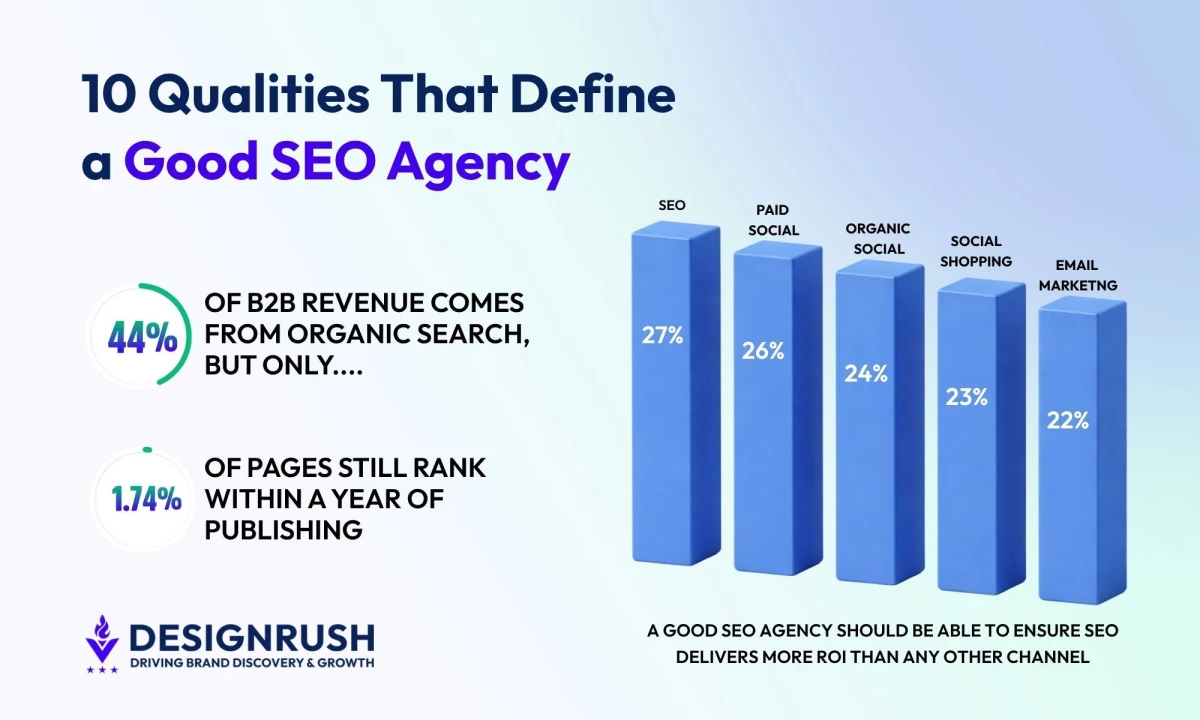
But done right, SEO remains one of the highest ROI marketing channels. Websites and blogs deliver an average ROI of 27%, higher than paid social and other digital channels.
One of the clearest ways to understand how to evaluate an SEO agency is to look at whether they prioritize conversions or just traffic:
| Traffic-Focused Agency | Conversion-Focused Agency |
|
|
The qualities outlined here show exactly how to evaluate an SEO agency and separate high-performing partners from ineffective ones.



1. Prioritize Impact Over SEO “Busywork”
A good SEO agency focuses on work that actually achieves something. Weaker agencies present output over outcomes, publishing low-value blog posts, tweaking metadata endlessly, or chasing minor technical fixes that don’t meaningfully improve rankings.
Strong agencies, on the other hand, constantly ask: “Will this drive measurable growth?” If the answer is no, it doesn’t make the roadmap.
This means prioritizing initiatives like:
- Targeting high-intent keywords instead of vanity traffic
- Improving pages that already rank on page two
- Strengthening internal linking to boost authority where it matters
The result is a strategy built around leverage where every effort is tied to tangible gains in visibility, traffic quality, or conversions.
As Dan Wiggins, founder and RedCore Digital, explains: "SEO is fundamentally a long-term investment, and rushing the process can lead to prioritizing short-term tactics over sustainable strategies.”
Ultimately, he adds, this results in missed opportunities.
2. Build Strategies Around How Google Actually Works
Search is constantly evolving, and agencies that rely on outdated tactics quickly fall behind. A good SEO partner stays grounded in how Google actually evaluates content today, not how it worked five years ago.
That means understanding the growing importance of:
- Search intent over exact-match keywords
- Topical authority rather than isolated pages
- Content quality, expertise, and trust signals
- User experience and engagement metrics
Instead of chasing loopholes or short-term wins, a good agency will build SEO strategies aligned with long-term ranking factors. It’s about working with the algorithm rather than trying to “game” it.
3. Diagnose Why SEO Isn’t Working (Before Doing More Work)
One of the clearest signs of a weak agency is jumping straight into execution without understanding the problem. More content, more links, more audits, but no real diagnosis.
A good SEO agency takes the time to uncover why performance is underwhelming in the first place. Often the issue isn’t a lack of effort, but misdirected effort. Only once the root causes are clear do they recommend action.
This diagnostic phase is about identifying the specific constraints holding growth back, whether that’s technical, strategic, or competitive.
This often involves:
- Identifying technical barriers like indexing issues, crawl inefficiencies, site speed bottlenecks, or poor internal linking structures that prevent pages from being discovered or properly evaluated.
- Analyzing gaps in content relevance, depth, or intent alignment, especially where pages exist but fail to satisfy what users (and Google) expect.
- Reviewing competitive positioning in the SERPs to understand what top-ranking pages are doing differently in terms of structure, authority, and coverage.
- Assessing whether the site has enough authority to realistically compete for target queries, or if expectations need to be recalibrated.
A good agency also looks for false positives: situations where activity appears correct on paper but isn’t producing results.
For example, publishing content that targets keywords with no real business value, or building links that don’t meaningfully improve authority.
4. Tie SEO to Revenue, Not Just Traffic
It's revenue that grows a business, not traffic. You want a partner that understands this, with clear SEO agency ROI measurement.
They view SEO as a revenue engine that influences the entire customer journey, from discovery to conversion. This means looking beyond surface-level metrics and focusing on how organic search contributes to actual business outcomes.
Rather than celebrating increases in sessions or impressions, they focus on:
- Conversions and lead quality: Are the right users taking meaningful action?
- Revenue attribution from organic search: What portion of pipeline and sales can be traced back to SEO?
- Pipeline impact for B2B businesses: How organic traffic supports longer, multi-touch buying cycles
- Customer acquisition costs over time: How SEO compares to paid channels in efficiency and scalability
This shift in perspective fundamentally changes the approach to SEO strategy. Keyword targeting becomes more commercially intentional, prioritizing queries with clear buying signals.
It ensures content is designed to guide users toward action, not just rank. Reporting also becomes far more valuable, connecting SEO efforts directly to business performance rather than isolated metrics.
Organic search consistently ranks as the top revenue-driving channel, with 44.6% of B2B revenue attributed to SEO and 70% of marketers reporting it generates more sales than PPC.
That’s because organic traffic is often intent-driven, meaning users arrive already closer to making a decision.
How a Good SEO Agency Measures ROI
To understand SEO agency ROI measurement, it’s neceesary to look beyond traffic and focus on how organic search contributes to real business outcomes.
| Metric | Why It Matters |
| Organic leads | Shows how SEO contributes to pipeline growth |
| SQLs from SEO | Indicates the quality and sales-readiness of leads |
| Revenue attribution | Connects SEO efforts directly to generated revenue |
| CAC from organic | Measures how cost-efficient SEO is vs other channels |
| Conversion rate | Reflects how well traffic turns into meaningful actions |
5. Customize Strategy (No Templates or Packages)
SEO is not a one-size-fits-all discipline, yet many agencies rely on standardized packages or templated deliverables. This often leads to generic strategies that fail to account for real-world nuances.
A good SEO agency builds everything from the ground up, including:
- Market dynamics: How search demand, customer behavior, and industry trends shape what people are actually looking for, and where the biggest opportunities lie.
- Competitive intensity: Who you’re up against in the SERPs, how established they are, and what it will realistically take to outrank them.
- Domain authority and history: Your site’s existing credibility, backlink profile, and past performance, which all influence how aggressively you can compete.
- Internal resources and constraints: Your team’s capacity, content production ability, technical support, and broader business priorities.
Instead of forcing clients into predefined “tiers,” they design strategies that reflect the specific challenges and opportunities at hand.
6. Show Exactly What Work Is Being Done
Transparency is a major differentiator in SEO. Because results take time and processes can feel opaque, it’s easy for agencies to hide behind vague updates or surface-level reports.
A good SEO agency will do the opposite. They make their work visible and understandable.
This includes:
- Clear breakdowns of tasks completed
- Access to content, optimizations, and technical changes
- Roadmaps that explain what’s coming next and why
- Reporting that connects actions to outcomes
Clients should never feel like they’re guessing what’s happening behind the scenes. The best agencies build trust by showing (not just telling you) how progress is being made.
Strong reporting should clearly show how SEO contributes to business outcomes, including:
- Revenue from organic
- Leads by landing page
- Keyword → conversion mapping
- Pipeline attribution
- Optimization impact
7. Challenge Unrealistic Expectations Early
It’s a big red flag during the onboarding process when an SEO agency promises quick wins without context. SEO is powerful, but it’s not instant.
If you have a decent SEO agency, they’ll set expectations early and honestly, and keep the conversation grounded in data, experience, and the realities of the competitive landscape.
Instead of overpromising to win business or chasing every new SEO trend, they focus on what will actually drive results.
They explain:
- How long results normally take, and why SEO is inherently a long-term investment.
- What’s realistically achievable given your industry, competitors, and current starting point.
- The level of investment required to compete effectively, both in content and authority-building.
- The risks of shortcuts or overly aggressive tactics that may deliver short-term gains but long-term penalties.
They also define what success looks like (and how it will be measured) so that expectations are aligned from the outset.
This can sometimes mean pushing back on client assumptions or timelines. But that pushback prevents misalignment, avoids wasted effort, and sets the foundation for a productive, trust-based partnership built on realistic goals.
8. Own Outcomes, Not Just Deliverables
Deliverables are easy to produce, but outcomes are much harder to guarantee.
A low-quality agency will try to focus on what they do (number of blog posts published, backlinks acquired, or audits completed) instead of what those actions actually achieve in the context of your business goals.
When the reality is that only 1.74% of newly published pages rank in the top 10 within a year, showing how hard it is to achieve meaningful rankings.
A good SEO agency, however, will take ownership of:
Ranking improvements, especially for commercially meaningful keywords
Traffic growth, with a clear understanding of quality and intent
Conversion impact, not just visits
Overall performance against defined business objectives
And they don’t treat these as vanity metrics. They connect the dots between effort and impact to show how specific initiatives contribute to measurable progress over time.
In practice, strong SEO performance should translate into clear, measurable business outcomes such as:
- Traffic growth that is matched by increases in conversions
- Consistent revenue growth driven by organic search
- Expansion of rankings for bottom-of-funnel, high-intent keywords
- Steady growth in qualified lead volume over time
- Ongoing reduction in customer acquisition cost (CAC)
If something isn’t working, they don’t hide behind completed tasks or shift blame to “algorithm changes.” They reassess assumptions, reallocate effort, and refine the strategy based on real performance data.
9. Integrate SEO With Product, UX, and Conversion
SEO doesn’t operate in a vacuum. Rankings alone don’t drive growth if the on-site experience doesn’t convert users.
The best agencies recognize that SEO sits at the intersection of multiple disciplines, and they actively work across them to improve overall performance:
- Collaborating with product and development teams to improve site structure, navigation, and crawlability
- Enhancing UX to reduce friction, improve engagement, and keep users moving through the site
- Aligning content with clear conversion pathways, ensuring each page has a defined purpose
- Optimizing landing pages not just for rankings, but for clarity, trust, and action
This broader view is vital because Google increasingly rewards sites that deliver strong user experiences. In fact, pages that rank in the top position are about 10% more likely to meet Core Web Vitals standards than lower-ranking pages.
By integrating SEO with product and conversion strategy, agencies can ensure that traffic progresses: visitors find what they need, trust what they see, and take meaningful action.
Without this alignment, even strong rankings can underperform. With it, SEO becomes a compounding driver of both traffic and revenue.
10. Limit Client Load to Maintain Quality
SEO requires strategic thinking, consistent execution, and ongoing optimization. Agencies that take on too many clients often struggle to deliver this level of attention.
A good SEO agency is deliberate about its client load. They ensure their team has the capacity to:
- Think deeply about each account, rather than applying surface-level solutions
- Execute consistently without cutting corners or rushing deliverables
- Respond quickly to changes in performance, competition, or search trends
- Maintain a high standard of work across both strategy and execution
This often means being selective about who they work with, even if it means growing more slowly than competitors that prioritize volume.
Sure, this may limit short-term revenue for the agency, but it leads to stronger long-term results for clients. Each account gets the focus it needs to perform, adapt, and improve over time.
In the long run, this focus on depth over volume builds lasting client relationships based on results, not promises.
Qualities of a Good SEO Agency: Final Thoughts
Choosing the right SEO agency is about finding out who can drive meaningful, sustained growth.
The best partners think beyond tasks to prioritize impact, adapt to real performance, and align SEO with broader business goals to create lasting momentum. Get it right, and SEO becomes a compounding driver of growth that’s hard to displace.
More Agency Hiring Resources
If you're evaluating SEO agencies, these related guides can help you make more informed decisions:
- Important Questions When Hiring an SEO Company
- SEO In-House vs. Outsourcing: Choosing the Right Path
- How to Define SEO Goals Before Hiring an Agency

Our team ranks agencies worldwide to help you find a qualified partner to implement the latest AI solutions. Visit our Agency Directory for the Top SEO Companies, as well as:
- Top SEO Consultants
- Top On-Page SEO Companies
- Top Startups SEO Companies
- Top Enterprise SEO Companies
- Top Austin SEO Company
Qualities of a Good SEO Agency FAQs
1. How long does it take to see results from SEO?
Most SEO strategies take 3–6 months to show measurable progress. Month 1 is usually focused on audit and strategy, months 2–3 on implementation, months 3–6 on early ranking movement, and months 6–12 on meaningful revenue impact.
2. How much should a business expect to spend on SEO services?
SEO costs vary widely, but most businesses invest anywhere from $1,000 to $10,000+ per month depending on scope, competition, and goals.
3. What are the biggest red flags when hiring an SEO agency?
Common red flags include guaranteed rankings, lack of transparency, vague reporting, and a heavy focus on deliverables instead of outcomes.
4. Is it better to hire an SEO agency or build an in-house team?
It depends on your resources and goals, but agencies often provide broader expertise and faster execution, while in-house teams offer more control and alignment.
5. What metrics actually matter in SEO performance?
The most important metrics are conversions, revenue impact, keyword rankings for high-intent terms, and qualified organic traffic.
6. Can SEO work without content creation?
Content is essential for SEO growth, but it needs to be strategically aligned with search intent and business goals to be effective.
7. How do you measure ROI from SEO?
SEO ROI is measured by tracking how organic traffic contributes to leads, sales, and revenue relative to the cost of investment.