
AI-driven tools now enable businesses to improve their SEO efforts by automating the keyword research process, optimizing content for search intent, and uncovering hidden opportunities to stay ahead of competitors.
AI for SEO Keyword Research: Key Points
- AI adoption is widespread: Over 90% of content marketers now integrate AI into their daily workflows.
- AI boosts SEO performance: 65% of companies report improved SEO results from using AI.
- Search intent is key: AI tools excel at categorizing keywords by user intent, allowing businesses to create content tailored to the specific customer needs.
Step-by-Step Guide to Implementing AI for Keyword Research
One of the key advancements in AI-powered tools is Natural Language Processing (NLP), which enables these systems to understand nuances in language. This capability allows AI to better grasp user intent and refine keyword suggestions to ensure alignment with search engine requirements.
Follow this step-by-step guide to implement AI for optimal keyword research and set your business up for SEO success.
- Phase 1: Define SEO goals
- Phase 2: Generate keywords and analyze search intent
- Phase 3: Assess your competition
- Phase 4: Predict future trends and keyword success
- Phase 5: Refine and optimize your content strategy
Phase 1: Define SEO Goals
Establishing your SEO objectives provides direction and ensures that your keyword efforts align with broader business goals, ultimately guiding the effectiveness of your entire digital strategy.
To help you establish a strong foundation for your AI-powered keyword research, here are actionable insights for this phase:
- Identify business priorities: Determine your organization's primary business goals, whether it’s increasing revenue, driving traffic, boosting brand visibility, or expanding into new markets. These goals will directly influence the type of keywords you target.
- Define specific, measurable SEO outcomes: Establish clear KPIs for your SEO efforts, such as improving organic traffic by 20% over the next quarter, ranking in the top 5 for specific keywords, or increasing the conversion rate for a key product or service.
- Determine target audience and user intent: Understand who your audience is, what they are searching for, and the intent behind their searches.
- Set short-term and long-term goals: Short-term goals might focus on ranking for high-traffic keywords, while long-term goals could involve building authority around niche topics or improving domain authority.
- Focus on business outcomes over metrics: Consider how the keywords you choose can lead to tangible business results, such as increased sales or better customer engagement.
Phase 2: Generate Keywords and Analyze Search Intent
AI takes the guesswork out of keyword research by analyzing user behavior and categorizing search intent, enabling you to focus on high-value keywords that are most likely to drive conversions.
This shift from general keywords to intent-driven content is key to building an SEO strategy that truly resonates with your audience.
AI’s ability to identify intent helps you create content that matches what users are actually looking for, ensuring it’s both relevant and actionable.
- Start with seed keywords: Input core keywords into AI tools and let them generate a broader list of relevant keywords, saving time and uncovering new opportunities.
- Categorize by user intent: Use AI to sort keywords into informational, navigational, or transactional categories to align your content with what users want at each stage.
- Prioritize conversion-focused keywords: Focus on transactional keywords if your goal is to drive sales, as these terms signal high intent to purchase.
- Create content based on intent: Tailor your content to the user’s intent, whether it’s answering questions, directing to a site, or encouraging a conversion.
- Leverage long-tail keywords: AI can help you identify specific long-tail keywords with high conversion potential, offering less competition and greater chances for success.
Leveraging ChatGPT for Keyword Research
ChatGPT can assist in generating keyword ideas, understanding user intent, and brainstorming content that aligns with what users are searching for. Here's how you can leverage it for various search intents:
1. Informational intent: fitness company
| Sample ChatGPT prompt for informational intent |
Provide a comprehensive list of long-tail keywords related to marathon training for beginners, with a specific focus on training schedules, nutritional tips, injury prevention, and motivation strategies. Break down the list into the following categories:
Include keywords related to both general and niche topics, such as different types of training plans (e.g., 12-week plans, training for a marathon in 3 months), diet and supplements (e.g., vegan marathon training diet, pre-race fueling tips), common injuries (e.g., shin splints prevention, knee injury recovery for runners), and mental strategies (e.g., overcoming marathon fatigue, motivation for long runs). |
This expanded ChatGPT for SEO keyword prompt ensures that the fitness company can create targeted content that addresses the specific needs of beginners while aligning with common search queries.
2. Navigational intent: footwear brand
| Sample ChatGPT prompt for navigational intent |
What are some common search queries users might use to find my brand, 'BestFit Shoes,' online? Focus on navigational keywords, including variations such as branded searches, website-specific searches, product page queries, and other brand-specific intent. For each keyword, explain the user's intent and suggest additional search terms they might use to navigate directly to our homepage, specific product pages, or promotional offers. Also, suggest content or SEO strategies to optimize our website’s visibility for these queries. |
This expanded prompt will provide actionable insights that help the footwear brand improve its website's SEO visibility for branded searches and optimize for higher conversion rates.
3. Transactional intent: sustainable fashion brand
| Sample ChatGPT prompt for transactional intent |
Generate a detailed list of transactional keywords related to eco-friendly sneakers for a sustainable fashion brand.
Further, suggest how these keywords align with the customer journey, distinguishing between initial research versus purchase-stage intent. Then, recommend targeted content strategies for each phase of the journey. |
Phase 3: Assess Your Competition
Understanding your competitors' keyword strategies is essential for gaining a competitive edge. By identifying the phrases they rank for and finding gaps in their strategy, you can refine your own SEO to outperform them.
For example, AI tools may uncover valuable keywords your competitors are overlooking or reveal high-volume terms you haven’t targeted yet.
- Analyze competitor websites: Use AI to scan your competitors’ websites and identify the top-performing keywords they rank for, giving you a benchmark for your own SEO strategy.
- Spot keyword gaps: Look for keywords that competitors are missing or not optimizing well and capitalize on these to capture untapped traffic.
- Focus on long-tail keywords: Long-tail keywords typically face less competition and show higher intent, so prioritize them for niche targeting that can drive quality traffic.
Phase 4: Predict Future Trends
Adam Romasko, Managing Partner at GordoWebDesign, has successfully leveraged AI for keyword trend tracking:
“I think the most obvious [benefits] are AI tools spotting trends that are not obvious in the data. One of my favorite things is finding an underserved niche or cohort and is maybe low competition but I can rank quickly for.”
By using AI to predict and act on future trends, you ensure your SEO strategy remains dynamic, forward-thinking, and ahead of the curve.
- Leverage AI for trend analysis: Use AI tools to spot rising keywords and forecast their growth in search volume, helping you stay ahead of market shifts.
- Create content around emerging keywords: Build and optimize content for keywords predicted to grow, positioning your brand as a leader on these terms before they become mainstream.
- Monitor keyword trends regularly: Set up automated alerts to track keyword performance, so you can quickly pivot your strategy based on real-time data.
Phase 5: Refine and Optimize Your Keyword Strategy
Keywords alone won’t drive results if your content isn’t fully optimized to support them. AI helps you fine-tune structure, relevance, and authority, ensuring your content aligns with both user intent and search engine requirements.
AI makes it easy to constantly refine your approach, ensuring your keyword strategy evolves with the market and remains impactful over time.
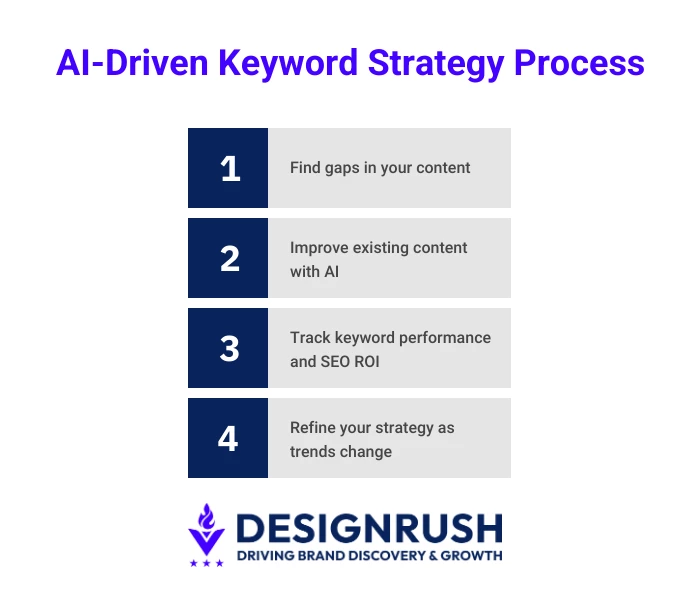
- Analyze content gaps: AI tools pinpoint areas where your content falls short, helping you address these gaps and create more valuable, comprehensive content.
- Optimize existing content: Leverage AI to improve existing content by adding relevant keywords, answering common user questions, and enhancing readability.
- Track SEO ROI and performance over time: Continuously monitor keyword performance to identify opportunities for further refinement and improvements based on AI-driven insights.
- Iterate and improve: Use AI to regularly refine your keyword strategy and content, ensuring your SEO efforts stay effective and evolve with changing trends.



AI Tools for Streamlined Keyword Research
Several AI-powered tools can transform your SEO strategy by automating keyword research and enhancing the accuracy of your selections. Some of the leading platforms include:
- Ahrefs: Best for keyword discovery and competitor research
- Clearscope: Best for content relevance
- Surfer SEO: Best for on-page optimization
1. Ahrefs: Best for Keyword Discovery and Competitor Research
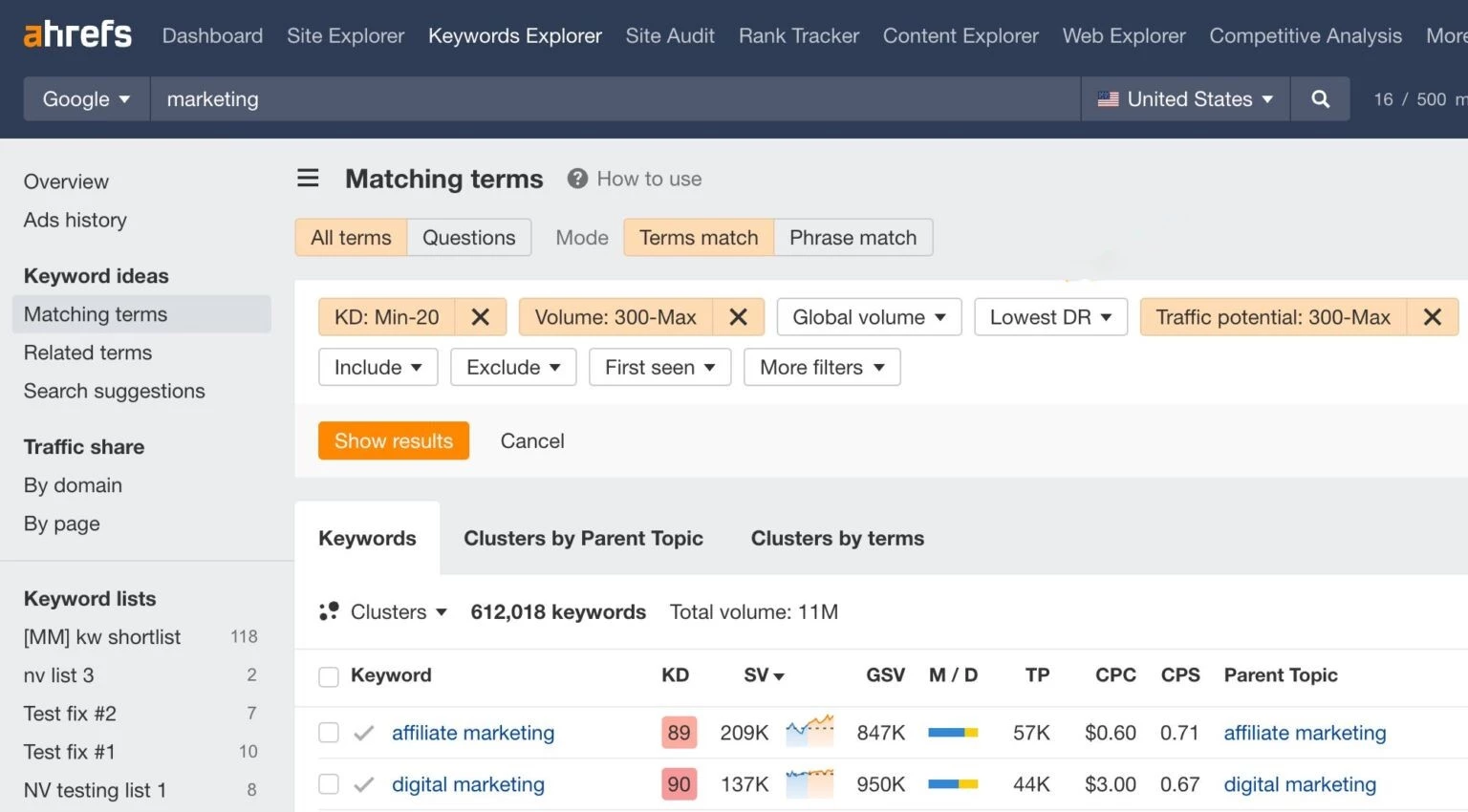
Ahrefs combines AI-assisted keyword research with SEO data to help marketers choose which topics to target. Its Keywords Explorer tool helps users expand keyword ideas and assess search intent, while competitor research reveals opportunities their websites may be missing.
Key Features:
- AI keyword suggestions: Generates keyword ideas from a seed topic, helping users explore relevant terms before evaluating their search potential.
- AI search intent analysis: Identifies and groups top-ranking results by intent, helping users understand what searchers expect from a page.
- Keyword clustering: Groups keywords by parent topic or shared terms to help organize content plans and identify related searches.
- Keyword metrics: Provides search volume, keyword difficulty, and traffic potential estimates to help users weigh demand against ranking competition.
- Content gap analysis: Finds keywords competitors rank for but your website doesn’t, highlighting opportunities for new or updated content.
Ahrefs Standard costs $208/month (billed annually) and includes the AI keyword suggestions and search intent features.
2. Clearscope: Best for Content Relevance
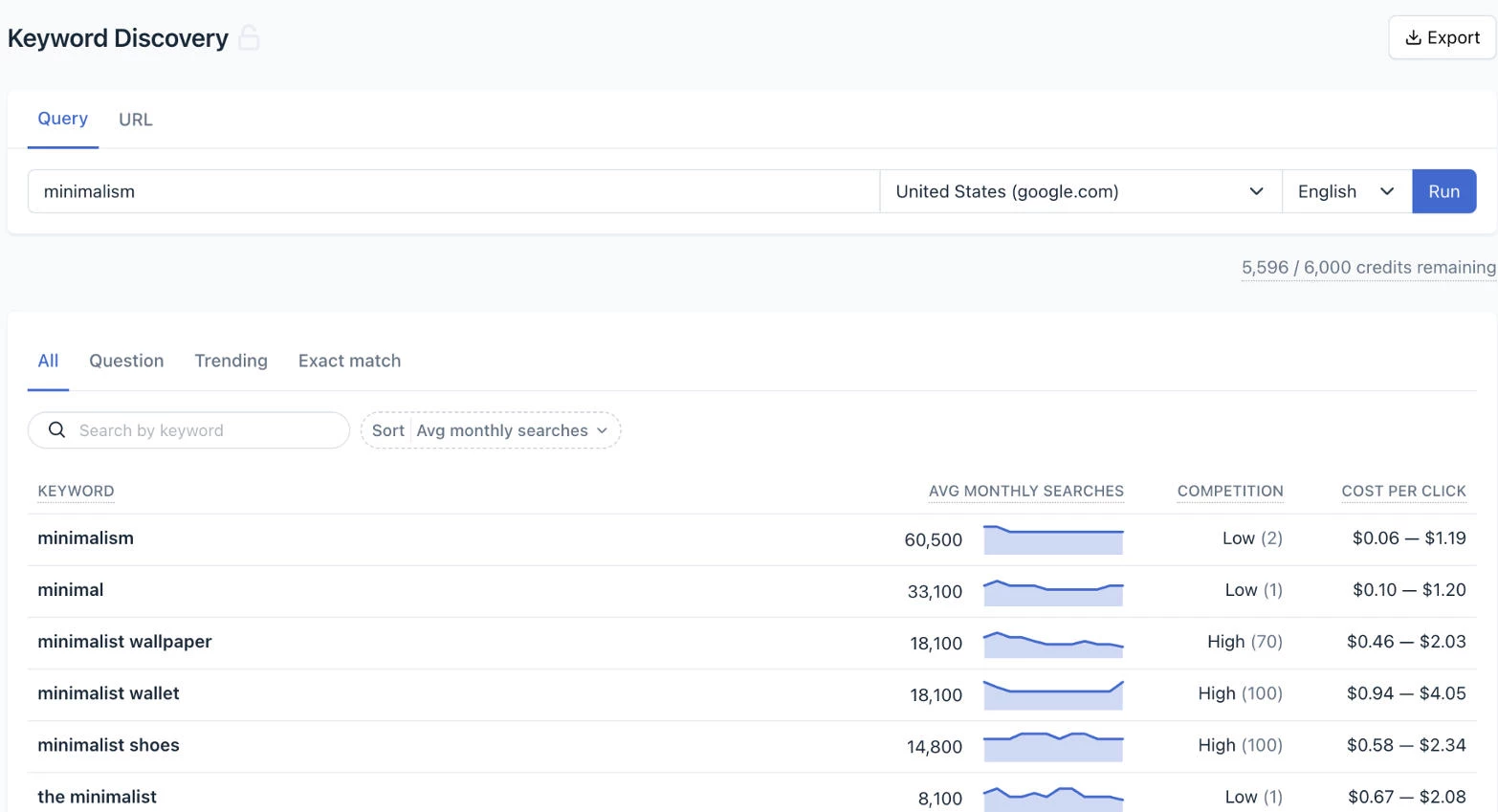
Clearscope is an AI-driven content optimization platform designed to enhance SEO strategies through advanced keyword research and content analysis.
Key AI-Powered Features:
- Keyword discovery tool: Users can input a broad search query or URL to uncover relevant, frequently-searched keywords based on intelligent language algorithms and trusted search volume data.
- Search volume and competition analysis: The platform provides data on average monthly searches, competition level, and cost-per-click (CPC) for each keyword.
- Question-based keyword suggestions: The tool pulls phrases directly from Google Autocomplete, giving in-depth insights into what users are actively searching for.
- Competitor analysis: You can uncover which topics are gaining traction and identify gaps in your strategies.
- Content grading and optimization: Its content grading system evaluates content against top-ranking pages and provides actionable recommendations to enhance SEO performance.
Clearscope Essentials plan starts at $189/month.
3. Surfer SEO: Best for On-Page Optimization
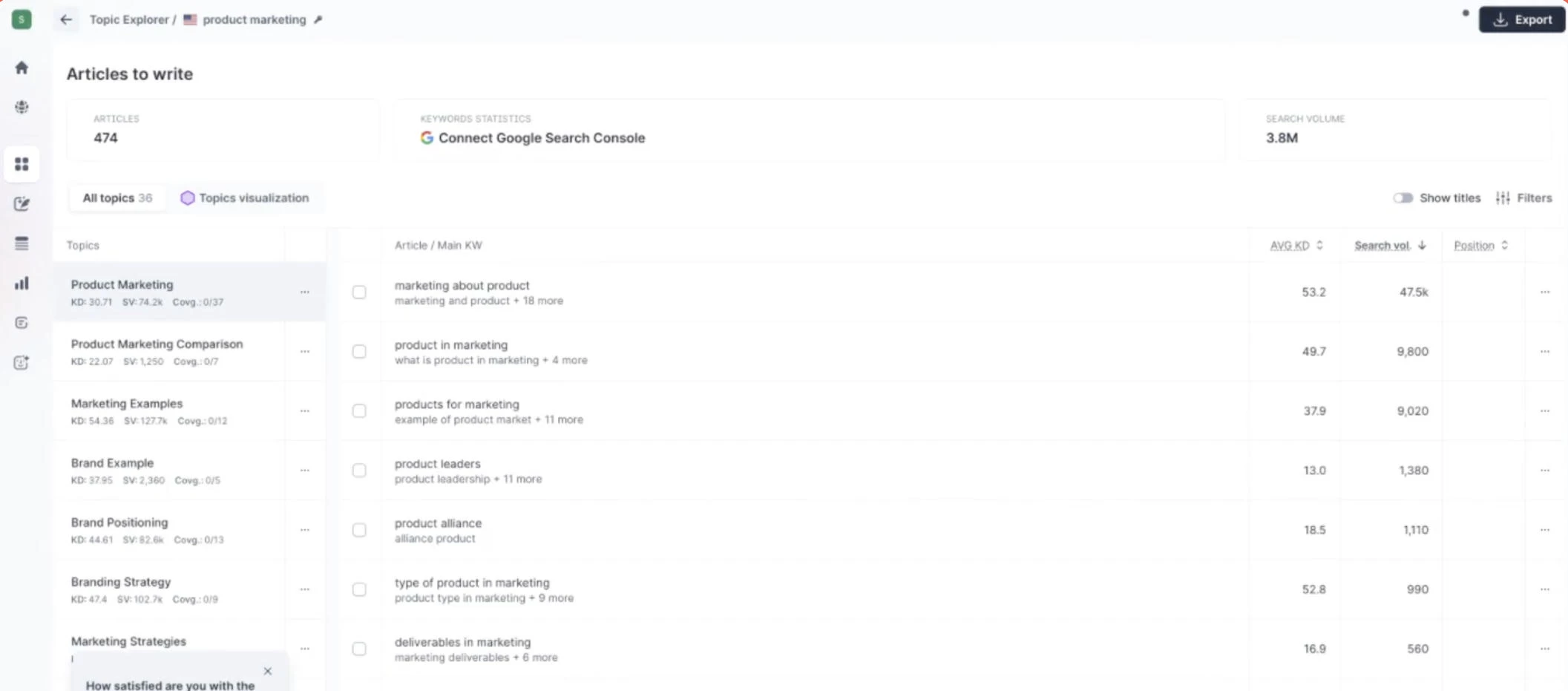
Surfer SEO is a robust AI-driven platform designed to enhance content optimization and keyword research. By analyzing over 500 on-page signals, it provides data-driven recommendations to improve content relevance and search engine rankings.
Key AI-Powered Features:
- NLP-driven keyword suggestions: Utilizes NLP to generate semantically relevant keyword ideas, enhancing content depth and relevance.
- SERP analyzer: Analyzes top-ranking pages for a given keyword, providing insights into content structure, keyword usage, and other ranking factors.
- Content editor: Offers real-time optimization suggestions, including keyword density, headings, and content length.
- Keyword clustering: Groups related keywords into clusters, aiding in the creation of comprehensive content strategies and topic silos.
- Content audit: Evaluates existing content for SEO performance, providing actionable recommendations to improve rankings and user engagement.
Surfer SEO Essential plan starts at $79/month (billed annually).
Why Use AI for Keyword Research in SEO?
Manual keyword research can be slow, cumbersome, and prone to errors. Traditional methods often miss out on emerging trends or fail to capture the nuances of search behavior.
AI-driven tools automate data collection and analyze search behaviors at scale. These tools can process vast amounts of data in real-time, allowing you to identify the most relevant keywords with speed and accuracy.
These statistics underscore the importance of leveraging AI for SEO strategies:
- Over 90% of content marketers have incorporated AI into their daily workflows.
- More than a third of companies use AI to enhance on-page SEO strategies and content planning, particularly for scalable implementation.
- 65% of companies have experienced improved SEO results by using AI.
Mistakes to Avoid When Using AI for Keyword Research
While AI can significantly enhance keyword research, it's important to be mindful of common mistakes that can undermine its effectiveness and lead to suboptimal results.
- Treating AI-generated keyword lists as final: Relying on AI-generated keyword lists without further validation can lead to missed opportunities or irrelevant keywords — always fine-tune your AI outputs with a human touch.
- Overlooking AI's limitations in understanding context: AI may identify keywords based solely on frequency or relevance but might miss the deeper context of how those phrases are used in your industry.
- Trusting AI to understand niche markets: AI tools often can’t capture the nuance of niche markets or industry-specific language. Manual research and feedback from subject matter experts will boost your strategy.
- Assuming AI will handle all keyword clustering perfectly: AI tools may not always group keywords effectively, so reviewing and adjusting clusters manually can make a big difference.
- Failing to understand AI's reliance on historical data: AI may not always reflect emerging trends or newly popular keywords. It's crucial to combine it with ongoing market research.
AI for SEO Keyword Research: Final Thoughts
AI-powered tools have revolutionized keyword research, offering efficiency, precision, and actionable insights. By leveraging AI to automate keyword discovery, optimize for search intent, and track competitor strategies, businesses can gain a significant competitive advantage in SEO.

Our team ranks agencies worldwide to help you find a qualified partner. Visit our Agency Directory for the top SEO agencies as well as: