Not every eCommerce agency in the USA can handle your channel mix, scale, or customer expectations. Our directory helps you compare leading agencies based on their strategy, UX, and growth expertise.
Organic rankings are determined by five factors: top services, reviews, portfolio, awards/press, and team expertise. Sponsored listings pay for a placement that appears above organic positions. Sponsorship does not affect star ratings or review content - read more on our methodology page.
ATRIUM Digital is a full-service digital marketing agency serving clients worldwide. Our proprietary Marketing Systems Engineering framework helps businesses build more consistent marketing performance and measure how it contributes to leads, sales, and revenue...
Top Services:
- Digital Marketing
- Social Media Marketing
- SEO
- AEO
- PPC
- Show more
- Location
- San Francisco, California
- Number of Employees
- Under 49
- Average Hourly Rate
- $125/hr
- Minimal Budget
- $1,000 - $10,000

eCommerce Development Companies by City
eCommerce Development Companies by State
eCommerce Development Specializations in the US
Hiring Guide: How to Choose the Top eCommerce Agency in the US
What can the top eCommerce development companies in the US do for businesses?
Top eCommerce companies in the US help businesses build scalable, high-performing online stores that are designed to grow revenue while reducing operational complexity.
They improve user experience and site performance, which directly supports higher conversion rates, faster load times, and better checkout completion.
These agencies also structure product catalogs and backend systems, so businesses can manage larger inventories without friction.
Another advantage of US eCommerce companies is building security into the site, ensuring that payment gateways, customer and company data, and systems can withstand cyberattacks. This matters more than ever as buyers pay closer attention to how their information is handled, and data transparency in eCommerce has become a real factor in whether they trust a store enough to buy.
The result is a measurable impact across key KPIs such as higher average order value, lower customer acquisition cost, improved retention, and reduced return rates, allowing teams to scale efficiently without increasing overhead.
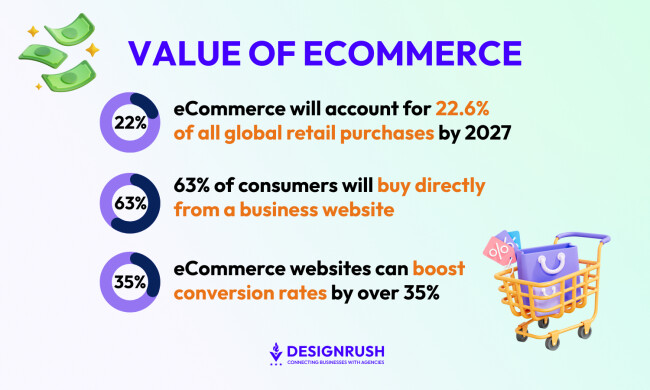
According to industry research, eCommerce will account for 22.6% of all global retail purchases by 2027.
Moreover, 63% of consumers will buy directly from a business website, showing that an effectively developed eCommerce platform is a potential growth driver for many brands.
In fact, eCommerce websites can boost conversion rates by over 35%.
What's the cost of hiring eCommerce development agencies in the United States?
The costs of hiring an eCommerce agency range from $100-$200 per hour or $25,000-$250,000+ per project for comprehensive end-to-end development.
The final price will depend on platform type, store complexity, customization level, number of pages, core features and functions, integration and security requirements, and service scope.
Here is a more detailed pricing breakdown:
| Project Type | Estimated Cost | What is Included |
| Simple store development | $5,000-$20,000 |
|
| Mid-sized build | $25,000-$80,000 |
|
| Headless eCommerce | $30,000-$50,000 |
|
| Enterprise build | $100,000-$250,000+ |
|
What is the typical process when working with an eCommerce agency?
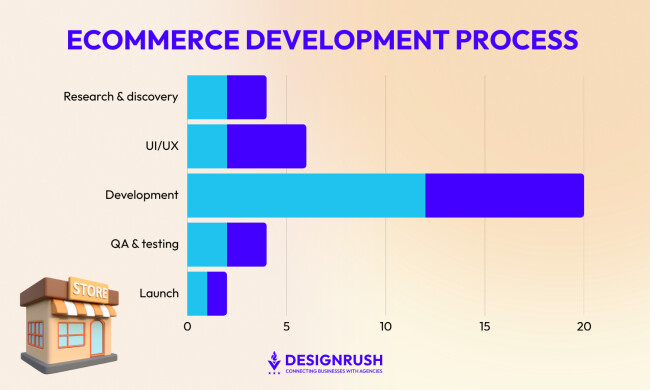
Most eCommerce agencies follow a structured workflow designed to reduce risk and deliver predictable outcomes from planning through optimization. Here are the typical process and approximate timeframes of an agency:
- Research and discovery (2-4 weeks): The agency learns about business goals, customers, competitors, KPIs, technical requirements, and project scope. Deliverables typically include a discovery summary, high-level recommendations, a detailed scope, timeline, and cost estimate.
- UX and UI design (4-6 weeks): User journeys, wireframes, and visual designs are created to optimize conversion and usability. Deliverables include wireframes, design mockups, and design system components.
- Development (8-20+ weeks): The store is built on the chosen platform with custom features, configurations, and system integrations. Clients usually get access to a staging site, system documentation, validated data imports, and regular progress updates.
- QA and testing (2-4 weeks): The site is tested for functionality, performance, security, and cross-device compatibility. Clients receive a test plan, bug reports, and fixes prior to launch.
- Launch (1-2 weeks): The site goes live following final checks and deployment. Deliverables include launch checklists and go-live confirmation.
- Post-launch support and optimization (ongoing): Agencies monitor performance, fix issues, and improve conversions. Ongoing deliverables may include reports, optimization recommendations, and maintenance documentation.
What common mistakes should I avoid when hiring an eCommerce development company?
Common mistakes to avoid when hiring an eCommerce agency include:
- Choosing based on visuals only: A polished design does not guarantee strong performance, scalability, or code quality. Instead, look for companies that have driven measurable business outcomes for clients and have strong development experience as well as design skills.
- Not defining scope, goals, and KPIs: Unclear requirements often lead to missed deadlines, budget overruns, and misaligned expectations. As such, it is best to specify your target customers, tech stack, core features and functions, key success metrics, business goals, budget constraints, and project timeline.
- Ignoring platform expertise and migration risk: Lack of experience with your platform and industry can result in data loss, noncompliance, or prolonged operational downtime.
- Overlooking QA testing and post-launch support: Insufficient testing increases the risk of checkout failures, bugs, security vulnerabilities, and customer frustration.
- Not clarifying ownership of code, themes, and accounts: Unclear ownership can limit flexibility and create long-term dependence on the agency. It can also inflate costs as the project becomes increasingly unscalable.
What questions should I ask eCommerce development agencies in the United States before hiring one?
Use the checklist below to evaluate technical fit, delivery capability, and long-term partnership readiness when hiring an eCommerce agency in the United States.
Relevant Background
- Which eCommerce platforms do you specialize in, and how many projects have you delivered on each?
- What post-launch support, optimization, and maintenance options do you offer?
- Can you provide references or case studies from similar US-based eCommerce projects?
Services and Processes
- What does your end-to-end development process look like from discovery to launch?
- What experience do you have with store migrations and SEO preservation?
- What QA and testing steps do you complete before launch?
- How do you handle custom features, integrations, and scalability requirements?
Related to Your Project
- How do you define scope, timelines, and success metrics at the start of a project?
- How do you assess whether a platform is the right fit for our business size and growth plans?
- How do you manage communication, progress reporting, and change requests?
- Who owns the code, themes, data, and platform accounts after project completion?
Sources
DesignRush sustains a directory of over 40,000 agencies categorized by service category, location, expertise, and reviews. We build our database in two ways:
- Our dedicated team of agency experts actively searches the web for top-performing companies. We then pull information from their websites, online presence, and client testimonials to verify their status and qualifications prior to listing.
- The agencies listed get notified of their profiles on the website and they can choose to claim it or not, which suggests their availability for more collaborations.
Agencies can also reach out to DesignRush and must go through the verification process prior to being listed.

Why companies trust DesignRush
Every agency is independently vetted before it can be listed or ranked
 4.8
 4.8
Some agencies pay for sponsored placement, clearly labeled and held to the same vetting standards.
Frequently Asked Questions About eCommerce Companies
What services do eCommerce development companies in the United States offer?
US eCommerce development companies typically offer:
- Custom eCommerce website development: Builds storefronts, themes, and commerce functionality (catalog, pricing, promotions, checkout, customer accounts) plus required backend services.
- Platform migration and re-platforming: Moves products, customers, orders, content, and SEO signals with testing and cutover planning to minimize downtime and revenue risk.
- Custom eCommerce design: Creates brand-aligned UI/UX, information architecture, and conversion-focused user flows for product discovery, cart, and checkout.
- Catalog setup and merchandising foundations: Includes product data modeling, category structure, search configuration, and tooling for merchandising and promotions.
- Systems integration: Connect payments, tax/shipping, ERP/OMS/WMS, CRM, analytics, marketing automation, and other third-party tools.
- Security and compliance: Implements security best practices like SSL/PCI compliance.
- Maintenance and ongoing optimization: Provides ongoing updates, testing, and improvements, such as the page load speed and checkout flow, to improve success metrics and ensure the eCommerce store performs optimally.
What’s the difference between an eCommerce development company and an eCommerce marketing agency?
eCommerce development companies focus on building, optimizing, and maintaining the online store itself, while eCommerce marketing agencies typically concentrate on marketing, growth, and customer acquisition across channels.
| Agency type | Primary focus | Typical deliverables |
| eCommerce development | Store architecture, performance, UX, and integrations | Website builds, platform setup, custom features, checkout optimization, integrations, migrations, maintenance |
| eCommerce marketing | Marketing strategy and demand generation | SEO, paid ads, social media, content, email marketing, branding |
What kind of ROI can I expect from an eCommerce agency?
A well-developed and designed eCommerce store delivers an average ROI of 10%-30%.
However, the return on investment depends on your goals, platform type, target markets, business benchmarks, success metrics, and ongoing marketing strategies.
For instance, a Shopify fashion brand has an average conversion rate (CVR) of 1.6%-1.9%. But home electronics see higher returns at a CVR of 3%-3.6%, while the beauty and personal care sector experiences an average CVR of 6.5%-6.8%.
Here are the general global benchmarks of eCommerce store development and optimization:
- Conversion rate: 1-2%
- Average order value: $50-$100
- Cost per click: Below $1
- Cost per acquisition: Below $25
How long does it take to build an eCommerce website?
The time required to build an eCommerce website depends on scope, platform, content volume, and the number of integrations involved. Based on averaged industry timelines from established eCommerce projects, typical ranges are as follows:
- Simple template-based stores usually take 4 to 8 weeks, covering discovery, light design customization, product setup, QA testing, and launch.
- Mid-sized custom stores generally take 8 to 16 weeks, allowing time for custom UI/UX design, feature development, integrations, testing, and post-launch fixes.
- Complex stores with integrations often require 4 to 6 months, as custom functionality, third-party systems, performance optimization, and extended QA increase build time.
- Full migration projects typically take 8 to 20 weeks, depending on catalog size, data cleanup, SEO preservation, and parallel testing.
What platform should I choose for my eCommerce site?
The right eCommerce platform depends on your business size, customization needs, internal resources, and long-term growth plans.
- Shopify is best for small to mid-sized businesses that want fast setup, reliable hosting, and an all-in-one solution with minimal technical overhead.
- WooCommerce is best for content driven businesses that already use WordPress and need flexible customization with lower upfront costs.
- Magento, also known as Adobe Commerce, is best for large or complex stores that require deep customization, advanced catalog management, and enterprise integrations.
- BigCommerce is best for growing brands that want strong native features, multi-channel selling, and scalability without heavy custom development.
- Headless commerce is best for brands that need maximum flexibility across web, mobile, and emerging channels while decoupling the frontend from the backend.
Latest Trends Related to eCommerce Development