
eCommerce development costs range from $5,000 to $20,000+, depending on the features and functions, APIs and third-party tools, design customization, and catalog scale and complexity.
This guide breaks down what agencies actually charge, how budgets are allocated across project phases, which cost factors move the number the most, and what recurring expenses rarely appear in an initial quote.
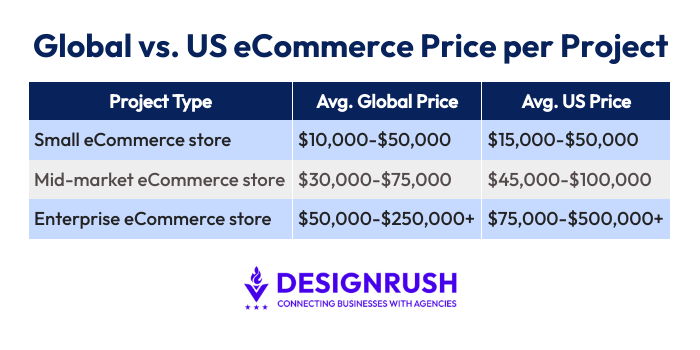
How much does eCommerce website development cost globally by project type?
Global eCommerce development costs range from $5,000 for a templated starter store to $250,000 or more for a fully custom, enterprise-grade build.
The widest cost gap in any project is driven by two factors: how much of the design is custom, and how many systems the store needs to connect to.
| Project type | Estimated amount | What may be included |
| Starter eCommerce store | $5,000-$25,000 |
|
| Small eCommerce store | $10,000-$50,000 |
|
| Mid-sized eCommerce store | $30,000-$75,000 |
|
| Complex eCommerce store | $50,000-$250,000+ |
|
What is the eCommerce website development cost breakdown?
A typical eCommerce project budget is split across six phases: research and discovery, data migration, UI/UX design, front-end development, back-end development, and testing and quality assurance. Development accounts for the highest cost at ~$10,000-$50,000+.
Understanding how costs are distributed across phases helps you identify where a proposal is underpriced, which is usually where scope problems surface later.
| Phase | Approximate costs |
| Research and discovery | $2,500-$5,000, depending on the research depth and complexity. Price can be lower if there is already available data on competitors and target user behavior. |
| Data migration (if required) | $5,000-$25,000+, depending on complexity and sensitivity of the data |
| UI/UX design | $1,000-$50,000 for template-based designs. $15,000-$100,000 for custom UI/UX design and checkout flows. $2,000-$5,000 to make the design mobile responsive, especially when using templates. This phase is critical considering mobile eCommerce is projected to capture a dominant 62% share of all global online sales by 2027, according to Statista's global mobile eCommerce data. |
| Front-end development | $3,000-$10,000+ when using platforms like WooCommerce and Shopify. $5,000-$20,000+ for a fully customized platform or app. |
| Back-end development | $5,000-$20,000+ for WooCommerce, Shopify, and BigCommerce platforms. $10,000-$50,000+ for a fully customized platform or app. |
| Testing and quality assurance | $3,000-$8,000, depending on testing rubrics, compliance requirements, scale, number of screens and devices, and overall complexity. |
What is the typical eCommerce website development cost in the United States?
US-based eCommerce development companies typically charge $100-$200 per hour, with more experienced or specialized firms billing at $200-$300+ per hour.
At these rates, a fully scoped project with a US agency costs more than the global averages above. However, US eCommerce companies have the advantage in communication, time zone alignment, and familiarity with US compliance requirements, like ADA accessibility and state-level tax rules.
| Project type | Approximate costs |
| Small eCommerce stores | $15,000-$50,000 |
| Mid-market stores | $45,000-$100,000 |
| Enterprise stores | $75,000-$500,000+ |
Building a digital storefront enters an increasingly lucrative arena. According to the U.S. Census Bureau, eCommerce sales reached $326.7 billion in the first quarter of 2026 alone, maintaining a strong 16.9% share of all retail sales in the United States.
What are the recurring eCommerce development costs that proposals often exclude?
Recurring eCommerce costs can typically add $15,000 to $75,000 or more per year on top of the initial build cost. Some of these items include hosting, licensing, security, marketing, and fulfillment tools.
To avoid surprises on your bills, request a detailed eCommerce website development cost breakdown.
Here is a list of the recurring eCommerce development costs:
| Cost item | Approximate cost |
| Hosting and domain | $120-$600+ per year |
| Third-party plugins and tools | $200-$5,000+ per year |
| SSL certification | $100-$500+ per year |
| Payment gateways | 0.5%-5% of revenue per year |
| Inventory, shipping, and fulfillment tools | $100-$5,000+ per month |
| SEO and marketing | $12,000-$50,000+ per year |
| Security and maintenance | 5%-15% of initial cost per year |
Review contract terms for clauses that define what falls under "maintenance" versus "new development.” Doing so helps you determine whether a post-launch fix is covered or billable.
eCommerce development companies sometimes bundle the first 30-90 days of support into the project fee, after which ongoing work rolls into a separate agreement.
What pushes eCommerce development pricing up?
Several factors consistently drive eCommerce development costs, including platform choice, features and functionality, third-party integrations, catalog size, multi-store requirements, and content migration.
Knowing which factors apply to your project before briefing an agency is the fastest way to narrow the gap between your budget and the first proposal you receive.
Below is how each factor can affect eCommerce development prices:
Platform choice. Using an open-source platform (e.g., WooCommerce or Magento) provides flexibility but requires more development hours. A SaaS-based platform (e.g., Shopify or BigCommerce) accelerates launch but requires annual licensing fees. Lastly, headless commerce offers seamless UI/UX across devices but requires highly specialized expertise, driving costs upward.
Features and functionality. A standard store with product pages, cart, checkout, basic search, and a contact form sits at the low end of any range. Costs climb when you add functionality, like real-time inventory sync, subscription billing, loyalty programs, advanced filtering, product configurators, or customer account portals.
Third-party integrations. Connecting your store to an ERP, CRM, PIM, or warehouse management system is among the highest-cost line items. A single enterprise-grade integration typically adds $10,000-$50,000, depending on whether a pre-built connector exists or custom API work is required.
The need for deep system coordination is a rising standard; Eurostat data indicates that 46.45% of modern enterprisesnow integrate a core ERP application to synchronize information across their operational divisions.
Custom checkout and payment flows. Standard checkout is inexpensive. Multi-step checkout with logic for subscriptions, split payments, or B2B purchase orders demands intense development hours, increasing prices.
Catalog size and product complexity. Stores with thousands of SKUs, configurable products, or variant-heavy catalogs require more database architecture, search functionality, and migration work, which can increase costs by 40%-60%.
Multi-store or multi-region requirements. Each additional locale, with its own currency, tax logic, language, and shipping rules, adds meaningful scope.
Content migration and legacy data. If you're moving from an existing platform, cleaning, mapping, and migrating order history, customer accounts, and product data is labor-intensive work that rarely fits into a flat estimate.
How to read an eCommerce development proposal and spot problems?
A well-structured eCommerce development proposal should itemize hours or cost by phase, name the platform and tech stack, specify which integrations are in scope, and define what constitutes a change order.
Vague line items like "development work" or "design and build" without further breakdown signal that the agency hasn't fully scoped the project, which typically means the estimate will shift once work begins.
Before signing, check four things:
- Ownership of assets. Confirms that you own the source code, data, and design files upon project completion.
- Project scope and deliverables. Defines exactly what is being built and, equally important, what is out of scope.
- Dispute resolution. Specifies how timeline delays, out-of-scope fees, and early exit are handled.
- Post-launch support terms. States what support is included in the project fee, for how long, and what ongoing work will cost after that period ends.
How to receive more accurate eCommerce development pricing quotes?
Agencies produce more precise estimates when clients arrive with a documented list of required features, current platform details (or confirmation that this is a new build), expected catalog size, and any integration requirements.
Sharing a rough monthly order volume or revenue figure also helps, since high-traffic and high-transaction stores require infrastructure decisions that affect cost from day one.
If you have an existing site, provide a copy of your analytics or performance report. Doing so removes guesswork around the project’s scale.
The clearer your brief, the less time an agency spends estimating, and the closer the first proposal lands to the final contract value.
Looking for eCommerce development companies within your budget? Browse DesignRush's directory, and filter by budget range, specialty, and verified client reviews.