
We prepared this guide to help you understand exactly what you're buying when you hire an eCommerce development agency. Before you write a brief or sign a contract, you need to know which eCommerce development services are standard, which are optional, and which fall entirely outside the agency's scope.
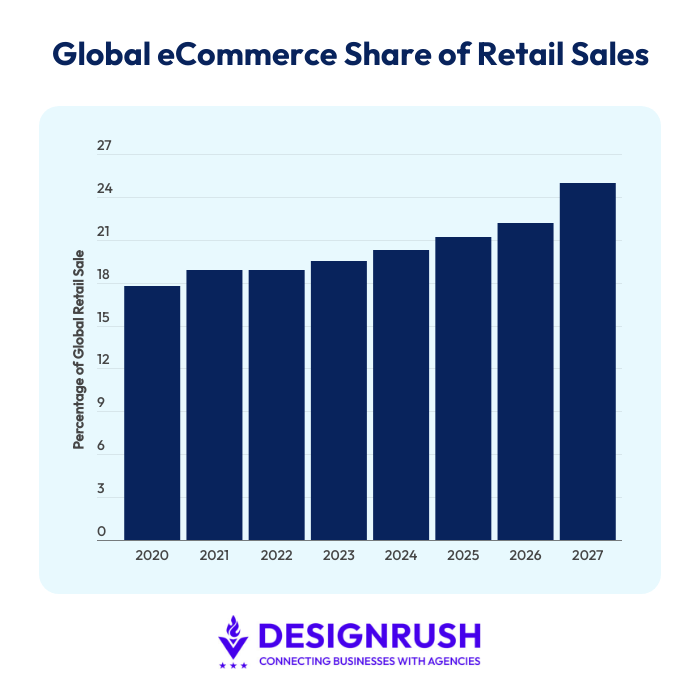
According to Statista’s global retail data, eCommerce accounted for over 19% of retail sales worldwide in 2023, and forecasts indicate that by 2027, the online segment will make up close to a quarter (25%) of total global retail sales.
Core Services
Custom eCommerce website development
Custom eCommerce development is the process of building an online store from the ground up, or significantly rebuilding an existing one, to match specific business requirements.
Agencies deliver a fully functional storefront, including a product catalog, shopping cart, checkout flow, and backend management system. Theme-based or template builds are typically not included in this category. They are usually lower-cost projects that agencies handle separately.
Platform selection and configuration
Platform selection is the process of recommending and configuring the right eCommerce platform. An agency recommends a headless commerce solution, a SaaS platform, or a self-hosted system based on your catalog size, transaction volume, and integration needs.
The eCommerce development agency configures the platform, sets up the store structure, and establishes the technical foundation. You will pay ongoing platform licensing fees directly to the vendor, and those fees are not part of the agency's scope.
Systems integration
Systems integration is the technical work of connecting your eCommerce store to third-party software, such as payment processors, inventory management systems, ERPs, CRMs, and shipping carriers.
A live data connection allows these systems to share information without manual intervention. Basic payment gateway setup is usually included; complex ERP integrations typically add cost and time.
UX and conversion-focused design
UX design for eCommerce is the structured process of designing the customer journey, from landing page to checkout, to reduce friction and increase conversion rates. Agencies deliver wireframes, visual mockups, and a design system that developers implement.
Brand identity work (logos, brand guidelines) is generally a separate engagement unless the agency has a dedicated branding practice.
Performance optimization and technical architecture
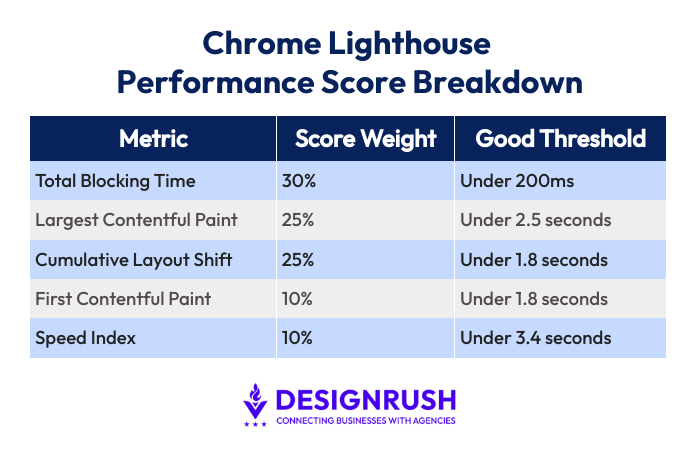
Performance optimization is the technical work of ensuring your store loads quickly, scales under traffic, and maintains uptime during peak periods. It includes server configuration, CDN setup, database optimization, and front-end rendering strategy.
A well-optimized store typically achieves a Google Lighthouse performance score above 85 and loads in under 2.5 seconds on mobile. With these measurable deliverables, you can hold the agency accountable for its work.
Quality assurance and launch support
Quality assurance (QA) is the structured testing process that verifies an online store functions correctly across devices, browsers, and user scenarios before going live. Most agencies include QA and a defined launch window in their eCommerce development services.
Post-launch support periods vary widely. While 30 days is common, some agencies offer longer retainers at an additional cost.
Additional and Optional eCommerce Development Services
Ongoing maintenance and support
Ongoing maintenance covers the work required to keep a live store functioning correctly after launch. Agencies apply platform and plugin updates, resolve bugs, monitor uptime, and make minor content or configuration changes.
You will receive a stable, up-to-date store that does not degrade over time as the underlying platform evolves. Not all agencies offer this; some hand off the codebase at launch and do not provide post-launch support.
SEO technical setup
Some agencies include technical SEO configuration as part of their eCommerce software development services. They configure URL structures, schema markup, sitemap generation, and page speed optimization. This is not the same as an ongoing SEO or content strategy. It is a separate service typically delivered by an SEO agency.
As highlighted in Moz’s Technical SEO guide on Core Web Vitals, Google uses metrics like Largest Contentful Paint (LCP) and general page speed as critical signals for ranking. If your site has poor technical architecture, your organic search performance will suffer before you even write your first blog post.
Email and marketing automation integration
Some agencies connect your store to an email marketing or automation platform at build time, wiring up triggered flows like abandoned cart sequences, post-purchase follow-ups, and welcome series.
Setting this up is vital to plugging revenue leaks. According to the Baymard Institute's ongoing eCommerce research, the average documented online shopping cart abandonment rate sits at 70.22%. Integrating automated email recoveries directly at build time gives you a pipeline to reclaim a portion of those abandoned checkouts, which can recover substantial lost revenue without requiring manual marketing intervention.
Writing the actual campaigns, managing lists, and running ongoing sends are usually not a part of this scope.
Migration from an existing platform
Platform migration, i.e., moving product data, customer records, and order history from one system to another, is a distinct service some eCommerce development agencies specialize in. They deliver data integrity and URL redirect mapping as a part of custom eCommerce development services. Not all agencies offer migration, and costs scale with catalog size and data complexity.
What an eCommerce Development Agency Does NOT Do
An eCommerce development agency builds and maintains the technical infrastructure of your store. Most of them DO NOT:
- Run Google Shopping, Meta, or other advertising campaigns.
- Handle ongoing SEO and content marketing, including keyword strategy, content production, and link building. Development agencies may configure technical SEO at launch, but do not manage it long-term.
- Deal with warehouse, fulfillment, and logistics.
- Offer brand strategy and identity.
- Sell on Amazon, Etsy, or similar platforms.
How to Tell If an Agency's Services Match Your Needs
Before you brief an agency, answer these four questions:
- What does your store actually need to do? Define your core transaction type and catalog complexity first.
- What systems do you already use that must connect? Make a list of every tool your business depends on, whether it’s your ERP, your 3PL, or your CRM, before your first call.
- What is your launch timeline, and is it fixed? A hard launch date (a product release or a seasonal window) changes the resourcing model and may require a premium.
- Do you need the agency after launch? If you have an internal team to manage the store post-launch, you need a project-based agency. If you don't, you need one with a support retainer model.
Ready to find an eCommerce development agency that matches your needs? Browse DesignRush's eCommerce development agency directory — filter by budget, specialty, and client reviews.