Looking for a web development company? Our team of 12 experts reviewed 9,800+ verified client reviews to shortlist partners that build high-performing websites and web applications — from CMS and eCommerce builds to custom platforms, portals and internal tools.
Organic rankings are determined by five factors: top services, reviews, portfolio, awards/press, and team expertise. Sponsored listings pay for a placement that appears above organic positions. Sponsorship does not affect star ratings or review content - read more on our methodology page.
Sorry, no agency was found by that name.
Please retry your search.
Web Development Companies by City
Web Development Companies by State
Web Development Specializations in the US
Hiring Guide: How to Choose a Leading Web Development Company in the US
How do I choose the right web development company for my business?
Start by assessing your business needs. Define what you want to build and why before speaking to agencies:
- Website vs. web application
- Core features and integrations
- Target users and scalability needs
- Short-term launch goals vs. long-term roadmap
Precise requirements make it easier to identify agencies that truly align with your objectives.
For instance, an agency might suggest Squarespace, one of the best website builders for visual-heavy sites, for design brands, and WordPress for content-reliant businesses.
Next, evaluate potential web development company candidates:
- Review portfolios, case studies, and past clients
- Look for experience with similar industries, project sizes, or technical complexity
- Check independent reviews and recommendations from your professional network
Then, dig deeper through direct conversations. A strong agency welcomes questions and explains its approach clearly.
What are the benefits of hiring an agency?
Hiring a web development company may help you access expertise you can’t always build in-house. Here are the types of benefits you can expect:
- Faster delivery and time to market
Agencies bring ready-made teams and proven workflows. Companies using outsourcing complete around 40% more projects per year compared to fully in-house teams, making agencies ideal for MVPs, replatforming, or tight deadlines.
2. Access to specialized skills on demand
Around 76% of companies outsource IT functions such as coding, QA, and UI/UX design because these skills are expensive and slow to hire internally. Agencies immediately fill gaps in areas such as backend, DevOps, mobile, and integrations.
3. Predictable costs and lower overhead
In-house teams come with recruiting delays, onboarding time, benefits, and long-term salary commitments. Agencies offer scoped pricing, clearer timelines, and easier budget control for defined outcomes.
4. Operational acceleration and innovation
According to Deloitte, 78% of companies outsource to accelerate operations and innovation, while 42% do so to access specialized talent. Agencies work across industries, exposing teams to emerging tools and best practices.
5. Flexible team models across growth stages
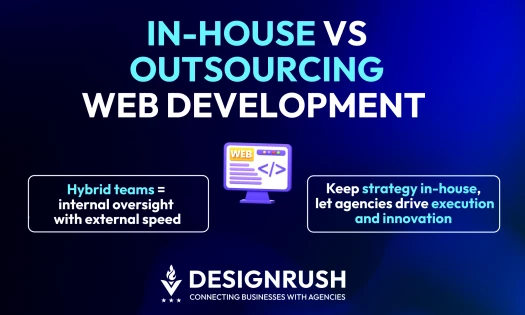
Startups gain speed without headcount risk, scaling companies add surge capacity, and enterprises use agencies for complex or skill-specific initiatives while retaining strategic control internally.
What questions should I ask web development companies?
Use the following questions to evaluate the agencies you’re considering:
Relevant Background
- Have you worked on projects with similar goals or complexity?
- How many viable approaches do you see for this project, and why?
Services and Processes
- What is your design and development process from start to launch?
- How do you estimate delivery time, and how do you separate contingency from scope?
- How do you manage third-party APIs and existing system integrations?
- How do you handle compliance, security patches, and recovery?
Relevant to Your Project
- What happens if we request changes mid-project?
- Who owns the code, hosting, licenses, and IP after launch?
- Who owns escalation if delivery timelines or budgets slip?
- Who is the day-to-day point of contact?
How long does it take to develop a website?
It takes a web development agency 14+ weeks from planning to launch to build a standard business website:
1. Planning (2-3 weeks)
Teams define goals, features, and technical requirements early. Weak planning often leads to confusing journeys later. According to the Digital Experience Benchmark Report, 39.6% sessions are impacted by frustration, reducing visit value by 15% through higher bounce rates and lower engagement.
2. Content creation (4-6 weeks)
Copy, visuals, and assets are prepared, often in parallel with design. Content delays frequently push timelines beyond initial estimates.
3. Design (2-3 weeks)
Designers create wireframes and responsive layouts. Custom UX and extended review cycles can add time.
4. Development (varies by complexity)
Front-end and back-end work, integrations, and CMS setup happen here. More features mean longer build times.
5. Testing and review (1-2 weeks)
Teams validate performance, usability, and responsiveness.
This stage matters more than ever, as 58% of websites saw session consumption drop. This means users viewed fewer pages and spent less time on-site, making engagement-sensitive testing critical.
How do I know if my website is performing well?
You know your website is performing well when it delivers measurable business impact. Your web development agency will help you track the following metrics:
- Conversion and revenue impact
A healthy website turns visitors into customers or leads. Improvements in UX and speed should translate into higher conversion rates, lower cart abandonment, and more qualified form submissions.
For example, Walmart recorded a 2% lift in conversions for every one-second improvement in load time, showing how performance translates into revenue.
- Speed and performance signals
Page speed, Core Web Vitals, and overall site stability shape how users experience your website and how search engines evaluate it.
When pages load slowly, elements break, or layouts shift unexpectedly, users struggle to complete journeys, and the site stops supporting real business goals.
- Engagement quality, not vanity metrics
Focus on consumption (pages viewed and time spent), bounce rate, and session depth to understand real engagement.
The 2024 Digital Experience Benchmark Report shows that overall digital consumption declined by 3%, meaning users viewed fewer pages and spent less time per visit.
That drop highlights how many websites struggle to hold attention, making engagement trends a stronger indicator of experience quality.
- User experience effectiveness
When a website feels easy and intuitive to use, visitors stay longer, explore more pages, and complete key actions, directly increasing engagement quality and overall visit value.
- Operational efficiency
A strong website reduces support load by answering common questions, guiding users effectively, and enabling self-service, which in turn lowers ongoing operational costs.
How can I find top web development companies on DesignRush that fit my budget?
Rather than researching agencies one by one, DesignRush lets you compare vetted web development companies in the USA based on budget range, expertise, and past performance.
| High budget: $50,000+ |
|
| Low Budget: $25,000-$50,000 |
|
Beyond budget, our agency directory allows you to filter agency profiles by location, area of expertise, agency reviews, client types, team size, and hourly rates.
Web Application Development vs. Website Development
What is a web application development company?
A web application development company builds interactive software that runs in a browser: users log in, enter data, and trigger business logic. A website development company builds a marketing site that mainly presents content.
The difference shows up in the work itself.
A website team designs pages, writes front-end code, and connects a CMS.
A web application team also designs a database, writes server-side business logic, builds user accounts with permission levels, and connects your product to other software through APIs.
Typical projects include client dashboards, customer and partner portals, SaaS products, internal tools that replace spreadsheets, and booking or marketplace platforms.
The stack matters more here than on a marketing site, because you will run the backend for years. Agencies on DesignRush commonly build front ends in React and Angular, and back ends in Node.js, Laravel, Python Django, and .NET. Filter by the stack your in-house team already knows, or the one your next hire will know, so you never depend on the original agency to change a line of code.
When you need a web app instead of a website
Answer four questions before you shortlist anyone.
- Do users need to log in? If customers, partners, or staff need accounts with different access levels, you are buying application work.
- Does it store data and act on it? A contact form that emails your inbox counts as a website. A system that saves records, calculates quotes, tracks order status, or triggers workflows counts as an application.
- Does it replace a manual internal process? If your brief starts with “our team currently does this in spreadsheets and email,” you are commissioning software. Judge agencies on how they map processes, not on how their homepages look.
- Will it connect to systems you already run? MuleSoft’s 2026 Connectivity Benchmark Report found that companies run an average of 957 applications, and only 27% of those applications connect to one another.
Ask each agency how many integrations it has shipped with your specific CRM, ERP, or payment provider.
Two or more “yes” answers point to a web app.
The honest answer for most businesses: you need both, with a marketing site to win customers and an application to serve them.
Many agencies listed on this page build both. Ask whether the same in-house team handles the backend or whether the agency subcontracts it and apply the portfolio relevance test to application work specifically.
How much does web application development cost?
Web application development typically costs $30,000 to $200,000+, compared with $5,000 to $30,000+ for a custom website, based on the project tiers in DesignRush’s Web Development Pricing Guide.
A focused internal tool or MVP with one user type and two or three integrations usually costs $30,000 to $100,000. Multi-tenant SaaS products and two-sided marketplaces with payments usually cost $100,000 to $200,000+. The same guide estimates roughly 1,200 hours for a complex custom project with integrations, 700 of them in development, against 80 hours for a small site.
Four cost drivers separate app quotes from site quotes:
1. Custom backend
DesignRush’s pricing guide puts back-end rates at $30 to $100 per hour, against $20 to $80 for front-end work, and app projects spend most of their hours on the backend.
2. Authentication and security
Logins, roles, password resets, multi-factor authentication, and security testing each take real hours. Verizon’s 2026 Data Breach Investigations Report found that vulnerability exploitation has overtaken stolen credentials as the most common way attackers gain initial access, and its Basic Web Application Attacks pattern recorded 3,217 incidents, 2,281 of which ended in confirmed data disclosure. Treat a proposal without a security testing line item as incomplete.
3. Third-party integrations
Every connection to a CRM, payment gateway, or accounting system needs data mapping, error handling, and rework whenever the vendor changes its API. Insist on a separate price per integration, not one bundled “integrations” fee.
4. Ongoing maintenance
DesignRush’s pricing guide estimates hosting and maintenance at roughly 10% of the build cost each per year. On an $80,000 app, plan for about $16,000 a year before you add a single new feature.
Sources
DesignRush sustains a directory of over 40,000 agencies categorized by service category, location, expertise, and reviews. We build our database in two ways:
- Our dedicated team of agency experts actively searches the web for top-performing companies. We then pull information from their websites, online presence, and client testimonials to verify their status and qualifications prior to listing.
- The agencies listed get notified of their profiles on the website, and they can choose to claim it or not, which suggests their availability for more collaborations.
Agencies can also reach out to DesignRush and must go through the verification process prior to being listed.
Latest Trends Related to Website Development