
I’ve sat through enough agency pitches to know: the difference between a site that accelerates growth and one that becomes a money pit usually comes down to what you ask before the contract is inked.
Questions To Ask A Web Development Agency: Key Points
- Demand a scope control process, because scope creep is behind 31% of project overruns and will sink your budget if it’s not managed.
- Do not sign unless ownership of source code, hosting, and licenses is in writing, otherwise you are paying rent on your own IP.
- Require security and compliance from sprint one, since the average breach now costs $4.88M and late fixes are always more expensive.
The Cost of Skipping Due Diligence
I’ve seen million-dollar companies locked out of their own source code, CEOs blindsided by scope creep that doubled their costs, and startups pushed live with glaring security holes because someone said, “we’ll patch it later.”
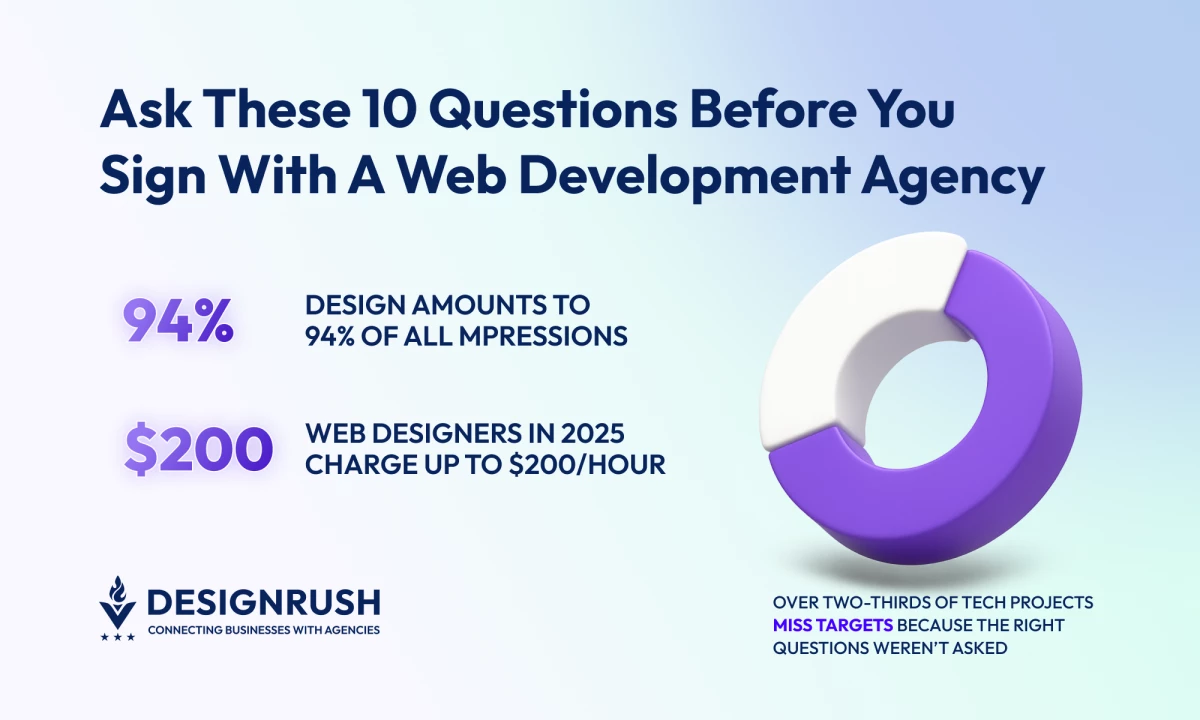
Two-thirds of projects miss targets and 40% fail from bad requirements, and I’ve seen exactly how that plays out: budgets spiral, deadlines slip, and the site falls short.
1. What Inputs Do You Need From Me To Scope This Properly?
I never let an agency start on assumptions. I ask them exactly what they need in discovery so that six months down the road we’re not measuring success by two different scorecards.
If they can list concrete inputs, for example like KPIs, and compliance requirements, then I know they’ve been burned before and built a process around it.
If all they want is a “brief,” I expect trouble. Misalignment is the most expensive mistake you can make, and I’d rather kill it before kickoff.
- Ideal answer:
“We run a short discovery before final scope. We need your business goals, KPIs, non-functional requirements such as security, compliance, performance, then integration map, stakeholder roster/availability, and decision cadence. We document assumptions and get written sign-off before we price and plan.”
- Red flag:
“Just send a brief and the NDA, we’ll figure the rest out during sprints.”
As Jack Miller, Founder and CEO of True Independent Holdings, points out:
“We want to ensure we have a competitive edge or knowledge of the client’s category before we even agree to pitch.”
I have seen the same. The strongest partnerships are the ones where the agency gets clarity upfront and confirms KPIs, compliance needs, and integration maps before scope.
The weakest are the ones that start on assumptions and adjust as they go.
2. If You Review Our Last Project, What’s the First Thing You’d Tighten?
I frame the question around one of our past projects because it forces the agency to show me how they would handle scope in practice.
I want to hear exactly where they see risk and what they would have tightened first.
If they cannot point to specifics, I know they lack control.
Scope creep is not abstract, it is the reason 31% of projects go over budget, and I want proof they know how to keep us out of that group
- Ideal answer:
“We baseline scope; any change goes through impact analysis, written approval, and planned into a future sprint. We set acceptance criteria per story, timebox spikes, and keep a visible risk register + buffer.”
- Red flag:
“We’re agile, we’ll just slot changes in.”
3. How Do You Manage Third-Party APIs and Existing System Integrations?
What I do here is zero in on integrations because they are the weakest link in most builds. I have seen launches fail outright when a payment gateway was never tested under load.
The data tells the same story: 63% of teams ship APIs in under a week but only 37% test them.
That is why I insist on asking developers to walk me through the last integration failure they dealt with and how they fixed it.
If they can show me concrete steps, I know they have control.
If the answer is “we’ll fix it if it breaks,” I know I will be paying for downtime.
- Ideal answer:
“We inventory all integrations in discovery, validate docs, versions, and rate limits, set up staging credentials, write contract tests, and monitor for breaking changes. We use secret-management and define fallbacks if an API deprecates.”
- Red flag:
“We’ll connect to whatever you use; if it breaks, we’ll fix it later.”
4. Who Owns the Code, Hosting, and Licenses After Launch?
This is non-negotiable. If the agency owns the repo and hosting, you’re locked in.
I’ve been brought in by CEOs who spent six figures only to realize they didn’t control their own site.
A credible agency makes a proper handover at project close; anything else from that is lock-in disguised as convenience.
And take my advice on it, if it’s not in writing, it doesn’t exist.
- Ideal answer:
“You own the code and repos. Production hosting/domains/SSL live in your accounts. We transfer admin rights and third-party licenses at handover; open-source obligations are documented. It’s all in the IP clause.”
- Red flag:
“We retain the core IP and host it for you as it’s simpler. We’ll give you exports if you ever leave.”
5. How Will You Report Progress to Me?
What I do here is push them to show me how they will keep progress visible without burying me in tickets.
I want outcome-level reporting because more than half of professionals admit communication is time-consuming, difficult, and often misread.
The only way to prevent that is through centralized, metric-driven updates that track milestones, risks, and budget against plan.
If an agency cannot show me that structure, I know I will spend more time chasing clarity than driving results.
- Ideal answer:
“Weekly exec-friendly status (milestones vs plan, risks, budget burn, decisions needed). Monthly and quarterly reviews tie deliverables to KPIs. If a blocker risks scope or budget, we escalate the same day.”
- Red flag:
“We’ll invite you to all our standups and drop updates in Slack.”
6. How Do You Estimate Delivery Time?
What I do here is press them on how they build estimates because optimism kills delivery.
I have never seen “two weeks per feature” hold up in practice, and I know that gut-feel timelines always lead to overruns.
The reason I ask for historical data is that it proves they track and learn from real delivery, not just promise best-case scenarios.
An agency that can show me how they baselined past projects and refined their estimates over time gives me confidence they can control this one.
- Ideal answer:
“We size work by story points with reference history, include QA, review, hardening time, and reserve buffer for unknowns. Estimates are revisited at each sprint boundary and re-baselined transparently if assumptions change.”
- Red flag:
“Two weeks per feature, we’ve done similar things before,” (no data, no ranges).
7. How Is Contingency Separated From Scope in Your Estimate?
Surprises are a given, whether it is legacy quirks, compliance checks, or API downtime.
What matters is if the agency priced for it.
I ask how much contingency they include and how it is managed, and I expect to see it clearly in their budgets.
A disciplined agency will include 10-20% contingency tied to identified risks, with unused funds returned or reallocated. Agencies that price tight are setting you up for constant change orders.
- Ideal answer:
“We cost identified risks and include a visible contingency governed by change control. Unused funds return to you or fund prioritized enhancements. Monthly reports show baseline vs. actual vs. remaining risk.”
- Red flag:
“We price tight to keep things competitive; if something pops up, we’ll discuss a change order.”
8. How Do You Define Success in the First 30 Days?
What I do here is make it clear they have to show progress in the first month.
By day 30 I expect a working deploy pipeline, a Core Web Vitals baseline, and KPIs tied to business goals.
If they push metrics later, I know the project will drift.
With only 46.8% of sites passing all Core Web Vitals, even hitting one or two targets like LCP or INP in that first month is proof the work is on track.
- Ideal answer:
“Day 30: pipeline green, weekly deploys, CWV baseline set, and 3–5 KPIs tied to your business case”
- Red flag:
“Let’s revisit metrics after the build, we need more time before measuring UX.”
9. Show Me How You Handle Compliance, Patches, and Recovery

I never ask agencies if they take security seriously, because everyone says yes.
Instead I ask them to walk me through their last patching cycle and show me how they handle dependency scans, backups, and incident drills.
If they cannot point to a repeatable routine, I know security is only a launch-day exercise.
That is a risk I will not carry, especially when the average breach cost reached $4.88M in 2024.
- Ideal answer:
“We follow secure SDLC, document data flows for GDPR/PCI, and include a post-launch plan: monthly patching, dependency updates, vulnerability scans, backups/DR tests, and SLA-bound incident response.”
- Red flag:
“We harden things at launch. After that, just open a ticket if you notice issues.”
10. Who Owns Escalation on Delivery or Budget Issues?
I push on escalation because the fastest way to lose control of budget is when problems are hidden or passed around without ownership.
I need to see severity levels, response times, and corrective steps because that proves the agency has discipline under pressure.
If the process is left vague or ad hoc, I know bad news will surface late, costs will climb, and accountability will disappear.
- Ideal answer:
“Severity-based escalation with response SLAs, daily war-room cadence for Sev-1, written RCAs, and corrective actions. We’ll alert you proactively when risk thresholds are crossed.”
- Red flag:
“Ping your project manager and we’ll find the right person. If it’s serious, we’ll pull people in ad hoc.”
Borislav Donchev, CEO of MAX Digital Bulgaria, applies the same principle to his client relationships:
“Most agencies hide the bad and highlight only the good. I’ve found that being brutally honest earns more respect than trying to polish every report.”
I have seen the same in my projects: If a red flag is raised early, even when it stings, it is the one I trust to protect the budget.
My Rule of Thumb To Walk in Prepared
If you only remember four things from me, make them these:
- I never start without a one-page alignment doc signed by both sides. That one page has saved me from months of scope debates later.
- Treat cloud spend like an engineering constraint. Tagging, budget alerts, and monthly showbacks prevent hidden overruns.
- I once dealt with a launch outage caused by a forgotten API dependency that no one had ownership over. Since then, I require a live dependency register that tracks APIs, SDKs, owners, and rollback plans.
- The worst projects I’ve seen had no clear owner. I insist on one named executive who owns delivery and budget. With that in writing, escalation is clear and accountability stays intact.
Find More Agency Hiring Resources:
1. Questions To Ask a Digital Marketing Agency
2. Questions To Ask a Web Design Agency
3. In-House vs. Web Development Agency

Our team ranks agencies worldwide to help you find a qualified partner. Visit our Agency Directory for the top web development companies, as well as:
- Top WordPress Development Companies
- Top Webflow Development Companies
- Top Web Development Companies for Fintech
- Top Front End Web Development Companies
- Top Backend Development Companies
Our experts also recognize the most innovative web design projects across the globe. Visit our Awards section to see the best and latest in website design.
Questions To Ask When Building a Website FAQs
1. Why is it important to ask detailed questions before hiring a web development agency?
Because nearly half of technology projects suffer delays or overruns due to misalignment or vague requirements. Clear, structured questions up front prevent costly surprises later.
2. What should I prioritize when choosing between two capable agencies?
Beyond technical skill, prioritize transparency in budgeting, clear ownership of code and infrastructure, and a proven approach to communication and risk management.
3. How can I tell if an agency is the right long-term partner?
Look for signs of maturity: documented processes for scope changes, security and compliance built into delivery, and a willingness to measure success in business outcomes, not just technical milestones.

-preview-webp.webp)