
Web Development Pricing Guide (2026)
The cost of web development can range from $12,000 to $150,000 for most businesses, though can run wider in both directions depending on who builds it, how complex it needs to be, and what features it requires. This guide breaks down every cost factor, so you can budget accurately before signing with an agency.
Website development price by project type
The biggest pricing variable is what you actually need the site to do. A brochure site and an enterprise platform do not fall under the same category of work, and the price gap will reflect that.
| Project type | Ideal for | Cost |
| Template-based site | Small businesses, simple eCommerce sites | $1,000 to $5,000 |
| Custom site | Medium-sized businesses, service providers | $5,000 to $30,000+ |
| Large business site | Multi-function sites, high-traffic businesses | $30,000 to $100,000 |
| Enterprise platform | Large corporations | $100,000 to $200,000+ |
Web development cost by provider
| Provider | Monthly cost |
| Shopify | $39 to $2,300 per month, plus transaction fees |
| Squarespace | $25 to $139 per month, plus transaction fees |
| Wix | $17 to $159 per month |
| WordPress | Free to $70 per month, plus hosting |
Core costs every project carries
Regardless of who you hire, every web development project involves a set of baseline costs. These are recurring expenses you'll carry for as long as the site is live.
| Element | Cost |
| Domain name | $10 to $50 per year |
| Web hosting | $24 to $10,000 per year |
| SSL certificate | Up to $1,500 per year |
| Website maintenance | $500 to $2,000+ per year |
Most hosting providers include a free SSL certificate in their plans. Premium SSL is only necessary if your site handles sensitive financial or medical data.
Additional costs
As requirements grow, so will the budget. These are the most common add-ons that will expand the scope and price, so it's best to factor them in upfront.
| Service | Cost range |
| Copywriting/content | $100 to $1,000 |
| Photography/video | $100 to $1,000 |
| SEO setup | $500 to $2,000 |
| Hosting and domain setup | $1,000 to $2,000 |
| Accessibility (WCAG) | $1,000 to $2,000 |
| Training / handoff | $200 to $500 |
SEO and content creation are the two most underestimated line items. A well-built site that isn't optimized for search or populated with quality content will struggle to generate traffic regardless of how it performs technically.
Pricing models
- Fixed-price. The agency quotes a total fee for a defined scope. This option protects you from hourly overruns and makes budgeting straightforward, but any scope change typically triggers a change order. Works best when requirements are clear before work begins.
- Hourly rate. The agency bills for time spent, usually between $50 and $500 per hour, depending on seniority and location. Works well for ongoing or evolving projects where requirements aren't fully defined upfront.
- Retainer. A fixed monthly fee that covers a set number of hours or deliverables. It’s commonly recommended for post-launch maintenance and ongoing development as it's useful when you expect regular updates and want cost predictability month to month.
- Value-based pricing. The agency prices against the business outcome the site is expected to generate, rather than the time spent. This is a less common model among businesses, but worth considering for eCommerce builds where conversion impact is measurable.
How do ongoing costs compare to the initial build?
Over two years, the running costs of a website can easily match or exceed what you paid to build it in the first place. According to Probey Services, there are three main buckets to think about:
- Hosting runs roughly 10% of your build cost per year, anywhere from $100 to $2,000, depending on your setup.
- Maintenance (security, backups, fixes) is another 10%, typically $200 to $2,000 a year.
- Updates and new features are the most fluctuating variable and can account for 80% of your original build cost annually, ranging from $500 to $10,000+.
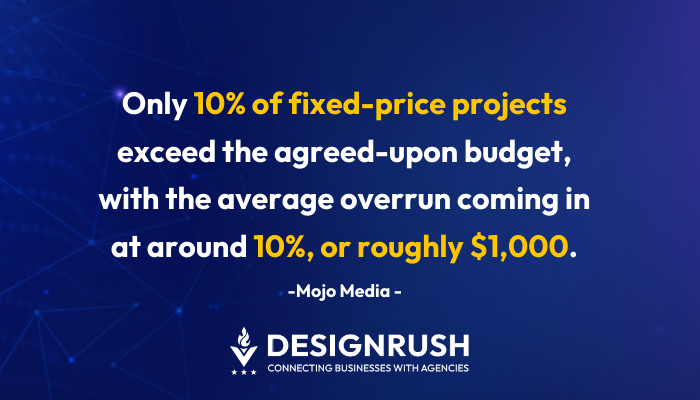
In practice, budget overruns are less common than clients fear. According to Mojo Media, only 10% of fixed-price projects exceed the agreed-upon budget, with the average overrun coming in at around 10%, or roughly $1,000. The most common causes are client-side content delays and excess revision rounds, both of which are controllable with a clear scope and locked content before development begins.
How many hours does a typical project require?
Every estimate is built from the same set of variables: the number of pages, design complexity, required functionality, third-party integrations, how ready the client's content is, and how many revision rounds are expected.
Once those are scoped, hours are distributed across six phases: discovery and strategy, UI/UX design, development, QA, deployment, and project management. Here's how that plays out across three common project sizes:
| Project size | Total hours | Strategy | Design | Development | QA |
| Small (~1-5 pages) | 80 | 10 | 20 | 40 | 10 |
| Mid-size (~10-20 pages) | 500 | 50 | 100 | 300 | 50 |
| Complex (custom/integrations) | 1,200 | 100 | 250 | 700 | 150 |
Progress is usually tracked throughout the engagement via project management tools, internal task sheets, milestone reviews, and client approvals.
How do website development prices in the US differ from global prices?
US web development agencies operate across a wide range of pricing structures, and understanding what drives those numbers makes it easier to evaluate quotes and set realistic budgets from the start.
As Probey Services reports, rates mostly vary by discipline. Specifically, back-end development commands a premium over design and front-end work.
| Role | Minimum rate per hour | Average rate per hour | Maximum rate per hour |
| Design | $20 | $40 | $80 |
| Front-end development | $20 | $40 | $80 |
| Back-end development | $30 | $50 | $100 |
In terms of how projects are structured, most US web development companies offer three engagement models. Fixed price is by far the most common.
| Model | Share of projects | Starting from | Up to | Avg. timeline |
| Fixed price | 60% | $600 | $15,000 | 8 weeks |
| Hourly rate | 30% | $600 | $15,000 | 8 weeks |
| Retainer | 10% | $800/month | $2,500/month | Ongoing |
How to read a web development proposal and spot problems
A well-structured proposal should name the tech stack, state the number of revision rounds explicitly, define who owns the code and design files at handoff, and list post-launch support as a separate line item rather than implying it is included. Vague scope phrases like "standard pages" or "as needed" are how projects accumulate charges after signing. Before you countersign, check three things:
- Who owns the repository and design files when the project ends?
- What are the exit terms for any hosting or third-party accounts the agency manages on your behalf?
- Whether post-launch support has a defined time limit or runs open-ended.
How to get a more accurate quote, faster
Agencies quote faster and more accurately when they receive a clear brief upfront. Before reaching out, prepare:
- A list of every page type you need
- Examples of sites you like and why
- Your CMS preference, if you have one
- A list of what content already exists and what needs to be created
- Your launch deadline
- Your budget range
An agency that receives this information can give you a detailed quote in 48 hours. One that receives "we need a new website" will spend time asking clarifying questions, or quote conservatively high to cover the unknowns.
Looking for web development companies within your budget? Browse DesignRush's directory and filter agencies by budget range, hourly rate, specialty, and verified client reviews.