-details-webp.webp)

I’ve seen too many businesses chase vanity metrics, page views, likes, or traffic for the sake of traffic. To me, that’s not ROI.
ROI is the measurable impact a website has on your business goals, whether that’s revenue, leads, efficiency, or brand credibility.
Web Development ROI: Key Points
- Expect measurable gains like increased sales, lead generation, and reduced support costs when your website converts visitors effectively.
- Optimize speed for more conversions. Walmart saw a 2% lift for every 1-second improvement.
- Real ROI compounds over time.Focus on email follow-ups, repeat-purchase flows, and scalable booking or sales systems.
What Should ROI from a Website Look Like?
ROI is any positive outcome from your website that actually impacts your business’s bottom line.
When I evaluate a website, I focus on four areas that consistently deliver measurable impact.
Here’s what website ROI typically looks like:
- Turning visitors into customers
- Reducing support costs
- Performance that actually pays off
- Building long-term gains
1. Turning Visitors Into Customers
For eCommerce or lead generation sites, this is where ROI is most obvious. A website should convert traffic into revenue opportunities.
I look for signs like:
- Purchases completed with fewer cart abandonments
- Newsletter, trial, or demo signups
- Contact form submissions feeding directly into the CRM
- Noticeable lift in leads or sales after UX/UI improvements
When your site reliably feeds your sales pipeline, you have measurable, tangible ROI.
Example:
I worked with an eCommerce client generating 20,000 visitors per month at a 2% conversion rate. That’s 400 sales.
By streamlining the checkout, improving page speed, and simplifying product pages, we lifted conversions to 3%.
That meant 600 sales, and with an average order value of $80, the additional $16,000 per month (nearly $200,000 annually) came from a $50K development investment.
2. Reducing Support Costs
A smart website reduces the need for live support.
Self-service tools like chatbots, FAQs, or intuitive product pages can replace dozens of repetitive support tickets.
The less time your team spends answering “Where’s my order?” the more they can focus on higher-value work.
Example:
A client's support team handled 2,000 tickets per month at $5 per ticket, amounting to $10,000 in labor.
Development upgrades and optimizations reduced ticket volume by 30%, saving $3,000 monthly, or $36,000 annually, without laying anyone off.
3. Performance That Actually Pays Off
A slow site loses people before they even see what you offer.
A fast, well-optimized one keeps them around and brings more people in without you having to throw money at ads.
When I evaluate performance, I focus on:
- Speed → faster load times mean fewer bounces and more conversions. Studies show that reducing page load time by just one second can lift conversion rates by up to 17% (Bidnamic).
- Core Web Vitals → smoother experience, better rankings
- SEO → more organic traffic, less reliance on paid ads
- Engagement → clicks, time on site, page views; all signal the site is working.
Example:
Take a B2B SaaS site generating 1,000 leads per quarter at $1,000 each. If faster load times lift leads by 20%, that’s 200 extra leads.
With a 20% close rate, you gain 40 additional customers, totaling $40,000 per quarter, or $160,000 per year, just from shaving a few seconds off page load.
4. Building Long-Term Gains
Now, I think of a website as an investment that keeps paying off over time.
Immediate sales and leads are important, but the real ROI compounds over months and years down the line.
Here’s what I look for:
- Brand authority and trust: Companies with strong brands see up to 20% lower customer acquisition costs over time.
- Customer retention & loyalty: Returning customers spend 67% more than first-timers and are about 5× more likely to repurchase. Even a 5% retention boost can increase profits by 25–95%.
- Easier operations and scalable systems: A well-designed site can handle order fulfillment, appointment bookings, and customer communications automatically. This makes it easier to grow without doubling headcount.
Example:
A consulting firm spent $100K annually on ads to acquire 200 clients ($500 per client). With a stronger digital presence, CAC dropped 15–20% ($15K–$20K saved).
Even a modest 3–5% boost in client retention. Say 6–10 additional clients retained at $5,000 each adds $30K–$50K in revenue.
Combined, that’s $45K–$70K in annual gains, with potential to grow year over year.



How To Calculate Website ROI
After decades of guiding businesses through web development investments, I always insist on a concrete way to measure value.
You can’t manage what you don’t track, and ROI gives you a single, actionable metric tying all improvements together.
Here’s the formula I rely on:
Website ROI Formula:
ROI = (Revenue from Website – Total Cost of Website) ÷ Total Cost of Website × 100
In plain English: subtract what you spent from what you earned, divide by the cost, and multiply by 100 to get your ROI percentage.
Example from practice:
I worked with a client whose website improvements (faster load times, optimized UX, and better lead capture) generated $200,000 in extra revenue over a year.
The development investment was $50,000.
Gain = $200,000 | Cost = $50,000
ROI = (200,000 – 50,000) ÷ 50,000 × 100 = 300%
This single figure ties all the benefits together and gives me a tangible way to track performance over time.
How ROI Varies Across Industries (At a Glance)
In my experience, success on a website isn’t universal and often depends heavily on the industry.
I always tailor my recommendations based on business model, customer behavior, and operational goals.
Industry | What ROI Looks Like | Key Metrics / Focus Areas | Example ROI Scenario |
eCommerce & retail | Sales, cart conversion | Streamline checkout, optimize AOV, reduce abandonment | Reduce cart abandonment 1% on 50K monthly visitors at $75 AOV → $37.5K extra/month |
B2B services (Consulting, SaaS) | Lead generation & nurturing | Prioritize high-quality form submissions, demos, and email follow-ups | 100 new demo signups/month × 10% close → 10 new clients × $5K LTV → $50K/month |
Healthcare & education | Access to services & trust | Simplify appointment/class booking, maintain compliance | 25 extra bookings/month × $200 → $60K/year |
Media & entertainment | Engagement, inquiries, and client retention | Focus on subscriptions, repeat visits, and ad revenue | 500 new subscriptions × $10/month → $5K/month |
Non-profits & charities | Donations and brand awareness | Clear CTAs, campaign optimization | 1.5–2% lift in donor conversion on $1M contributions → $25K/year |
Luxury goods & service-oriented businesses | Customer experience and brand credibility | High-touch UX, polished content, and client retention | 5 repeat purchases/month × $1,500 → $7.5K/month; total incremental revenue ≈ $32.5K/month |
Setting Realistic Expectations for Website ROI
A good agency gives realistic projections based on benchmarks, collaboration, and ongoing optimization. And they make it clear that results take time:
- SEO can take months before you see real impact
- CRO or paid advertising can deliver noticeable results in weeks
Here’s how I typically break down website ROI over time, from early wins to long-term:
Timeframe | Focus / Wins | What I Look For | Example ROI Scenario |
Short-Term (0–6 months) | Early improvements that build confidence | Faster site speed, lower bounce rates, stronger brand credibility In fact, Walmart observed a 2% increase in conversions for every 1-second improvement in load time. | Quick CRO tests might lift conversions by 0.5%. On 10,000 visits at $100 AOV, that’s $5,000 more per month. |
Mid-Term (6–12 months) | Tangible business impact | Conversion rate improvements, organic traffic growth, and operational efficiencies | SEO and content improvements kick in. 5,000 more organic visits at 3% conversion and $120 AOV → $18,000/month. |
Long-Term (12+ months) | Strategic growth & compounding ROI | Mature SEO, stronger brand reputation, customer loyalty, data-driven decision-making | Brand authority and retention grow. If 500 customers spend $300/year and retention rises 5% → $75,000 annual gain. |
I also make sure the agency prioritizes maintainability. A great website takes more than just going live; it should remain functional, easy to update, and scalable in the future.
Real-World Success Stories of Website ROI
Over my career, I’ve seen websites transform businesses when agencies focus on conversions, performance, and long-term strategy.
Here are three examples that really show how smart web development pays off.
1. CrawlSF – Digital Silk | 23% More Users, 214% Longer Session Duration
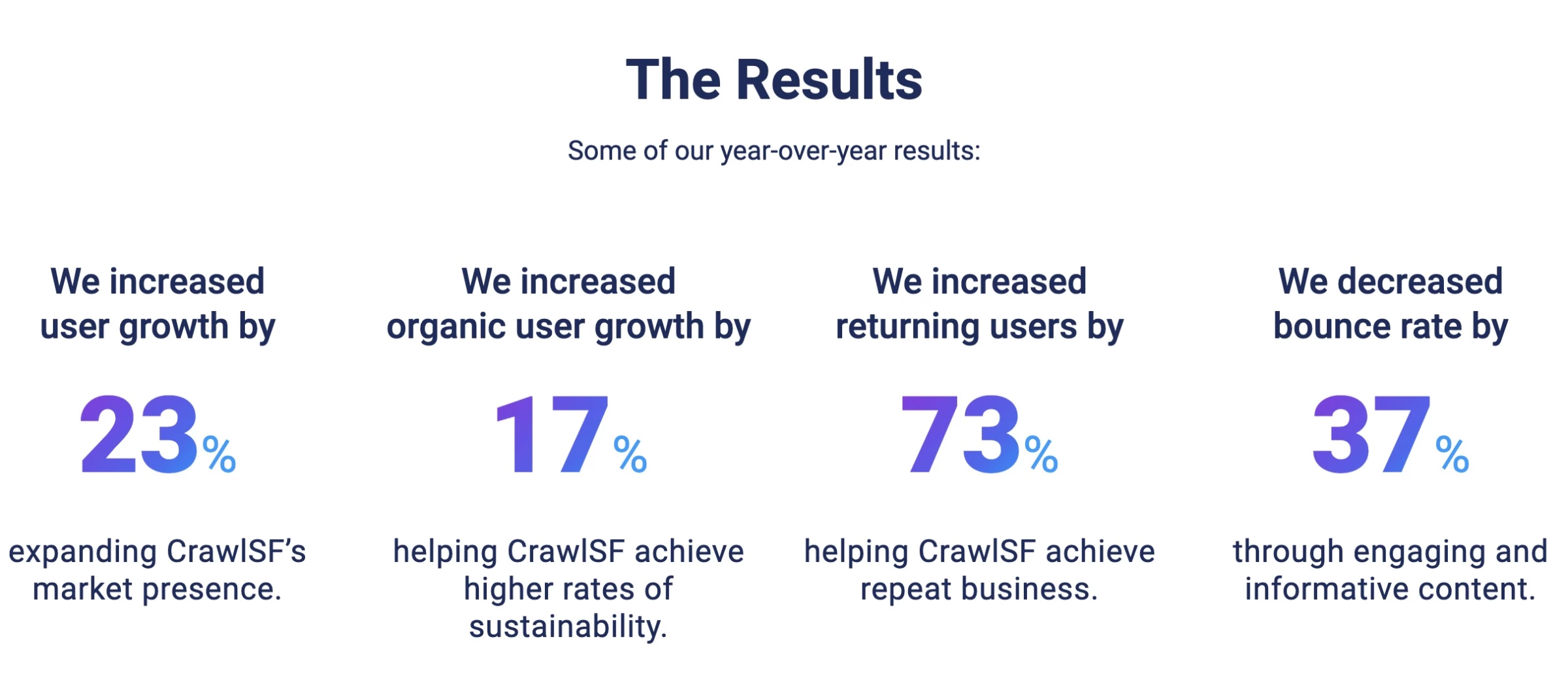
CrawlSF, a San Francisco-based event organizer, came to Digital Silk with the goal to become the city’s go-to resource for local events. However, their old site was cluttered, slow, and confusing.
Agency actions:
- Redesigned for intuitive navigation
- Optimized typography and visuals for readability
- Fine-tuned speed and responsiveness
Results:
- 23% increase in users
- 214% longer session duration
Focus on user experience first. Even incremental UX improvements can increase engagement and ROI.
2. Cleveland Brothers – WebFX | 82% Increase in Organic Traffic
Cleveland Brothers had multiple divisional websites that made the brand feel fragmented and left users unsure where to go.
WebFX ‘s actions:
- Consolidated all these sites into a single, cohesive platform.
- Rolled out responsive design and custom copy
- Applied industry-specific SEO
Results:
- 82% increase in organic traffic
- Recognition via a Horizon Interactive Award
Cohesive branding and technical SEO are as critical as design. Fragmented sites can undermine conversions, even with high traffic.
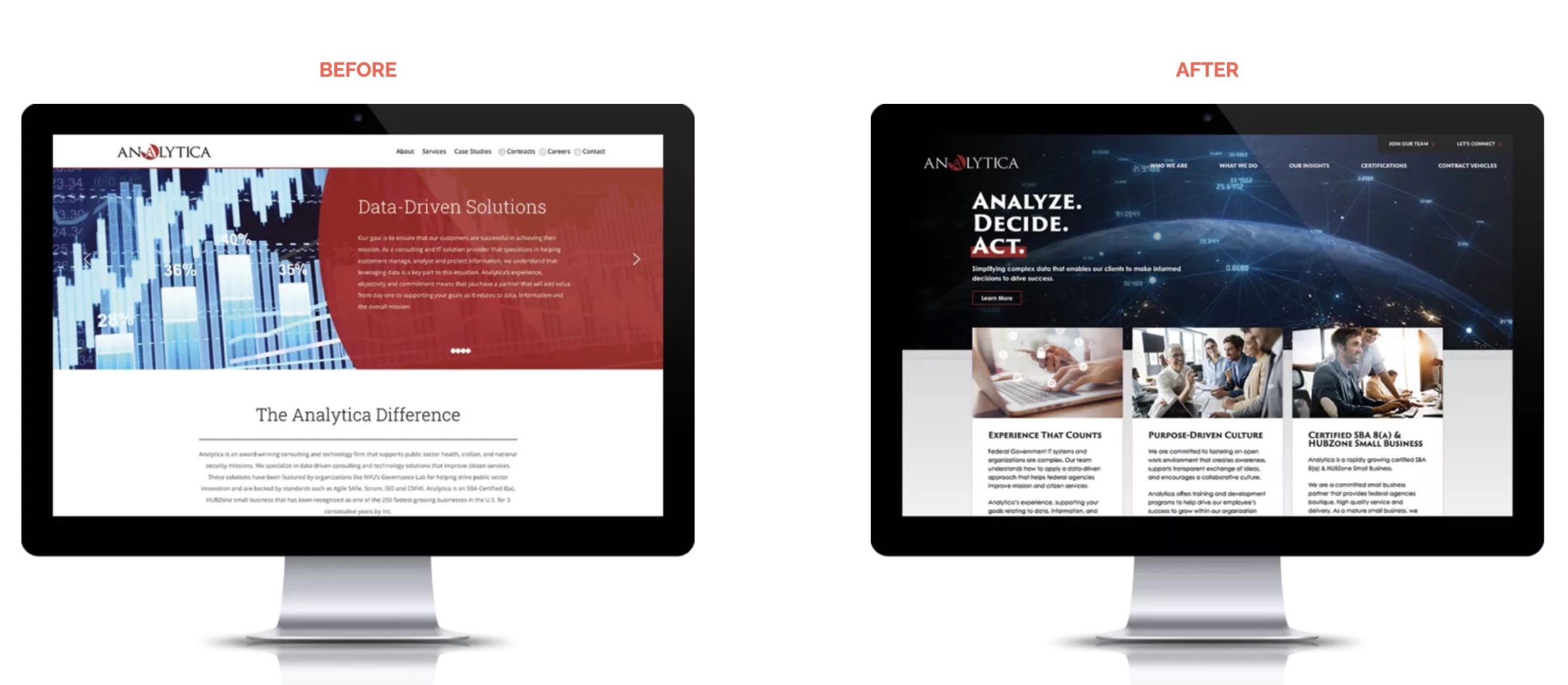
3. Analytica – Lounge Lizard | 68% More Backlinks, 98/100 PageSpeed Score

Analytica, a government-focused data analytics firm, aimed to increase leads, showcase thought leadership, and attract top talent, all while remaining fully compliant with regulations.
Lounge Lizard’s actions:
- Built a modern, clean UI with subtle animations
- Clear CTAs highlighting their expertise
- Optimized technical SEO performance, like backlinks, site speed, and assets
Results:
- 68% increase in backlinks
- Near-perfect PageSpeed score of 98/100
Measuring Website Success From Day One
From the very first day, I make sure we can track progress and measure real impact. That starts with the right setup and the right tools.
Analytics Setup: Getting the Foundations Right
Before I ever touch design or development, I ensure the data infrastructure is solid:
- Google Analytics 4 – This tells me how people are moving through the site, where they drop off, and, most importantly, which actions actually drive revenue.
- Google Search Console – Helps me understand organic performance: clicks, impressions, and which pages are showing up in search results.
- CRM integrations (like HubSpot) – Tracks lead quality, follow-ups, and where prospects are in the sales pipeline. Without this, you can’t tell if leads are turning into real business.
- Heatmaps & session tracking – These show me how users are navigating, where they hesitate, and which elements get attention, so we can make smarter UX decisions.
For me, this setup is like laying the foundation of a house. If it’s off, nothing you build on top will hold.
Testing & Optimization: Learning as We Go
A website is never “finished.” Continuous testing is how I ensure every improvement adds tangible ROI:
- A/B testing – Small tweaks can make a huge difference in conversion rates. I like to experiment, measure, and iterate.
- Customer journey mapping – Seeing exactly how users interact with the site tells me what’s working and what’s creating friction.
- Iterative improvements – Agencies that can run ongoing tests and experiments on larger sites make all the difference. I treat optimization as an ongoing conversation with the data, not a one-time checkbox.
Website ROI From Web Development Agencies: Final Words
Website ROI is all about outcomes that directly tie to your business goals, whether that’s more revenue, leads, or efficiency.
When working with website development agencies, I expect them to be upfront about what’s realistic in the short term while still keeping an eye on long-term value.
Find More Agency Hiring Resources:
1. Questions To Ask a Digital Marketing Agency
2. Questions To Ask a Web Design Agency
3. In-House vs. Web Development Agency
Finally, transparent reporting and proper tracking are non-negotiable. They’re what allow you to make informed decisions, adjust strategies, and ensure your website continues to deliver measurable results.

Our team ranks agencies worldwide to help you find a qualified partner to implement the latest AI solutions. Visit our Agency Directory for the Top Web Development Companies, as well as:
- Top Web Design Companies
- Top Custom Software Development Companies
- Top WordPress Development Companies
- Top WordPress Web Design Companies
- Top No Code Agencies
Website ROI: FAQs
1. What are the factors influencing website ROI?
From my experience, website ROI depends on a few key things:
- Clear business goals – Revenue, leads, efficiency, or brand credibility.
- User experience & design – Fast, intuitive sites convert better.
- Traffic quality – Relevant visitors drive meaningful results.
- Optimization & testing – Continuous A/B tests and improvements matter.
- Tracking & analytics – You can’t improve what you don’t measure.
- Industry context – ROI looks different for eCommerce, B2B, or non-profits.
2. Can a website ever deliver ROI without ongoing marketing?
In my experience, a website alone rarely generates maximum ROI. It’s the combination of strong design, SEO, content, and ongoing promotion that drives consistent results. Even the best site needs traffic and engagement strategies to turn visitors into leads or sales.

-preview-webp.webp)