
Referral program software helps you track customer recommendations and reward the ones that lead to qualifying sales, signups, or other actions. It connects the person making a recommendation with the new customer they bring in, then applies the program’s eligibility and reward rules.
Choosing a platform starts with how your business wins customers. An online store may reward a completed purchase, while a service company needs to follow a referral through its sales pipeline.
In this guide, we compare 10 options, including their pricing, practical limitations, and workflows worth testing before you commit.
Referral Program Software: Key Findings
- ReferralCandy suits post-purchase ecommerce campaigns, Referral Rock connects rewards to sales milestones, and GrowSurf supports signups and qualifying actions inside software products.
- Smile.io and Yotpo combine referrals with loyalty, but compare order allowances, integrations, and reward costs before estimating your budget.
- Mention Me captures recommendations shared by name, Friendbuy supports custom reward validation, and Talkable lets teams test referral offers and placements.
Personal Recommendations Reassure Nearly 42% of Holiday Shoppers. Is Your Brand Being Shared?
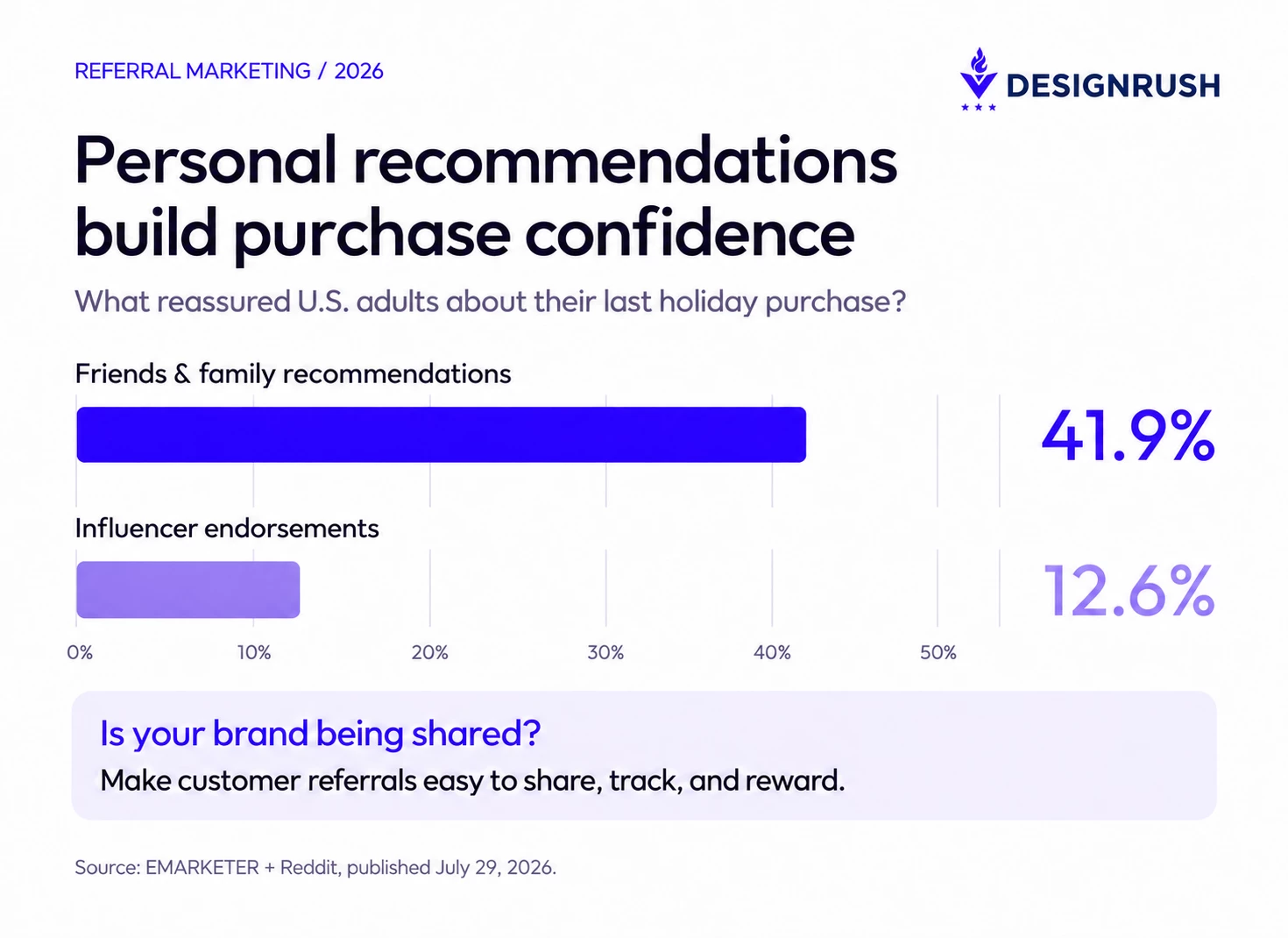 Personal recommendations build purchase confidence. EMARKETER research found that 41.9% of US adults credited a trusted friend or family member’s recommendation for confidence in their last holiday purchase, compared with 12.6% for influencer endorsements.
McKinsey’s research also ranked friends and family among the most trusted product research sources across Gen Z and baby boomers, ahead of social media and generative AI.
Referral program software helps turn that trust into a measurable acquisition channel.
The tools below make recommendations easier to share, connect referrals with qualifying sales, and reward customers who bring in new business.
Referral Program Software Compared
Start with the customer action you want to reward and the system that records it. Use the table to identify candidates, then check how each handles eligibility, reporting, and payment.
| Platform | Best Fit | Program Types | Free Plan/Trial | Starting Price |
| ReferralCandy | Ecommerce customer referrals | Customer referrals; affiliate programs | 7-day free trial | $39/month + 10.5% success fee |
| Referral Rock | Services and B2B sales workflows | Customer referrals; brand ambassador; partner/affiliate programs | 14-day free trial | $250/month |
| Referral Factory | Configurable programs connected to business systems | Customer referral campaigns | 15-day free trial | $200/month |
| GrowSurf | SaaS and product-led referral programs | Customer referrals; affiliate programs | 14-day free trial for customer referrals | $179/month |
| Friendbuy | Complex consumer referral programs | Customer referrals; loyalty; influencer programs | Demo available | Shopify estimator |
| Yotpo | Ecommerce loyalty and referrals together | Customer referrals; points; VIP tiers | Free plan available | Free |
| Mention Me | Capturing recommendations shared by name | Customer referral programs | Demo available | Custom quote |
| Talkable | Referral campaign testing and optimization | Customer referrals; loyalty programs | Demo available | Custom quote |
| Extole | Enterprise referrals across web, apps, and email | Customer referrals; loyalty; ambassador programs | Demo available | Custom quote |
| Smile.io | Shopify stores starting with points and referrals | Customer referrals; points; VIP tiers | Free plan for up to 200 monthly orders | Free |
How We Selected These Referral Program Platforms
We researched dedicated referral tools, combined loyalty and referral platforms, and enterprise advocacy software, then narrowed the list to 10 options representing ecommerce, SaaS, B2B, and service-business workflows.
This comparison focuses on customers recommending a business to others. For programs involving publishers or creators promoting offers, see our guide to AI affiliate marketing tools.
Our review focused on documented campaign setup, referral attribution, reward management, and reporting. We did not conduct hands-on product testing.
We also drew on published DesignRush interviewswith marketing and customer engagement professionals to inform our guidance on participant selection, measurement, and regional program management.
We evaluated every platform using the same six criteria:
- Referral attribution: We reviewed how each platform connects recommendations with qualifying actions, including support for links, codes, name-based referrals, and customer events.
- Reward flexibility: We compared supported incentives, qualification rules, approval controls, and options for handling refunds or cancellations.
- Fraud prevention: We examined documented safeguards against self-referrals, duplicate accounts, and code misuse, including which situations require manual review.
- Integrations: We checked connections with eCommerce platforms, CRMs, billing systems, and marketing tools, alongside API access and plan restrictions.
- Program management and reporting: We reviewed campaign controls, segmentation, testing, and reporting to assess how teams can operate and improve their programs.
- Total program cost: We compared subscriptions, success fees, usage allowances, reward expenses, and implementation requirements to understand how costs change as activity grows.
We checked pricing and feature details against official product pages, pricing pages, and help documentation.
Selected Capterra and Shopify reviews informed the user-experience summaries, including some reviews that disclose incentives.
1. ReferralCandy: Best for Automating Post-Purchase Referral Campaigns
For small and mid-sized Shopify and WooCommerce stores that want referral costs tied to the sales referrals produce.
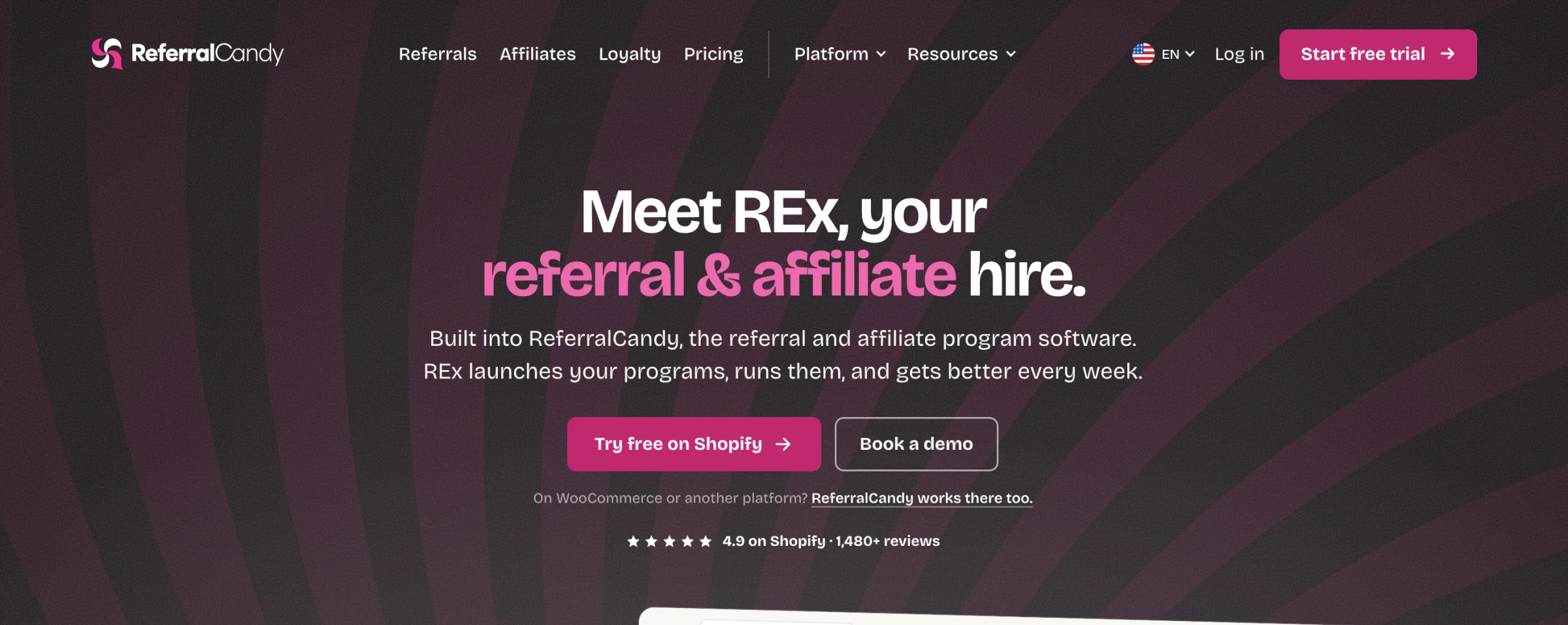
ReferralCandy is a referral and affiliate platform built for retail brands. It gives customers personal links and codes to share, then connects resulting purchases with the person who made the recommendation.
Invitations can appear after checkout, inside customer accounts, or through email flows.
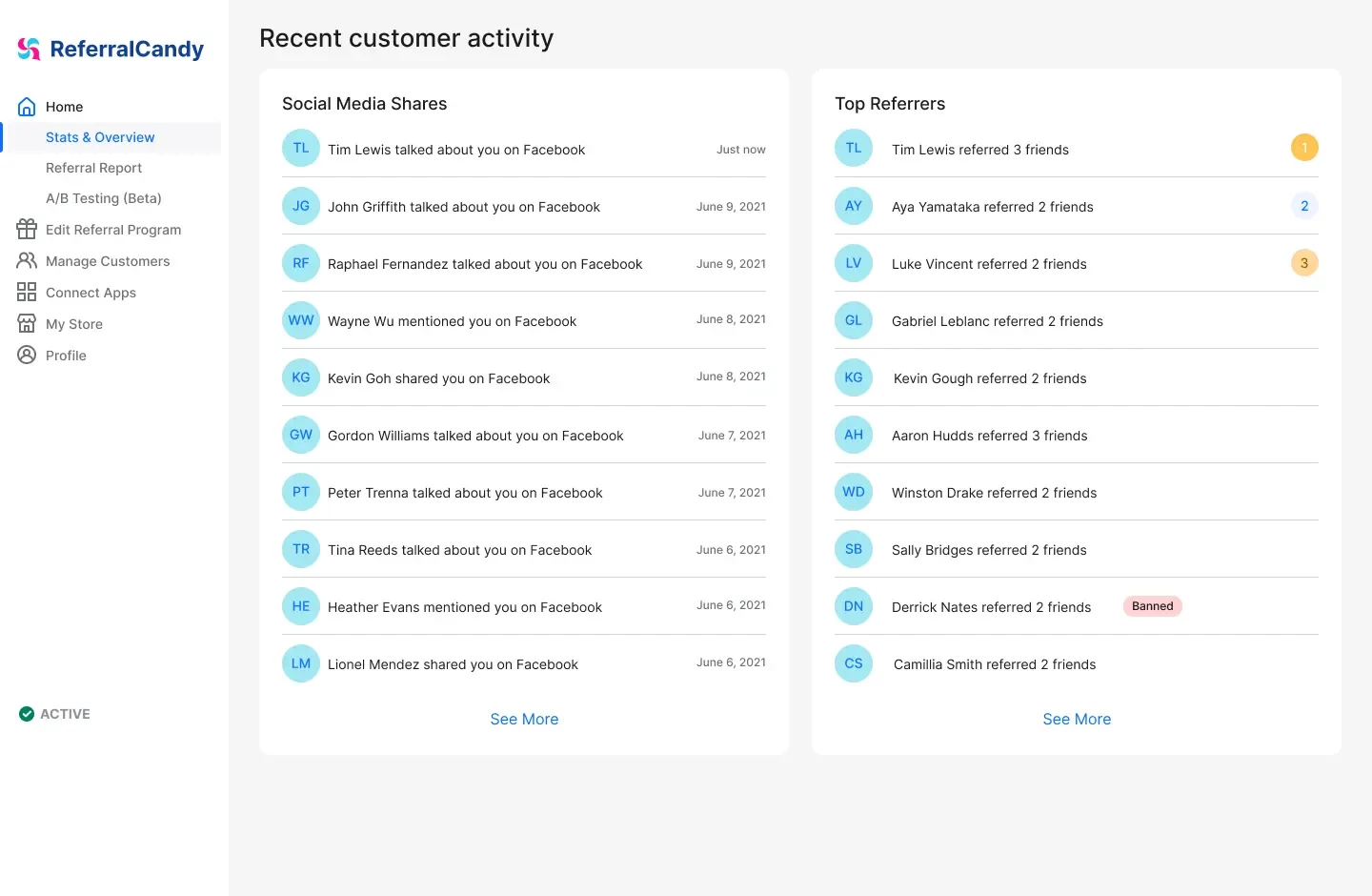
Its fraud checks are the practical safeguard for a discount-led program. The platform catches self-referrals and leaked codes and blocks suspicious orders before a reward goes out.
A skincare store could invite every customer to share a $10 discount after checkout, credit the referrer when the friend's first order ships, and check the dashboard for which advocates bring in repeat buyers.
Every plan includes a monthly fee plus a success fee on the first three orders of each net-new referred customer, and the percentage falls as the monthly fee rises.
Pricing
- Basic: $39/month + 10.5% success fee
- Grow: $79/month + 3.5% success fee
- Scale: $249/month + 1.5% success fee
- Enterprise: $799/month + 0.25% success fee
- Free trial: 7 days
Compare ReferralCandy plans using your expected referral revenue and reward budget.
Pros:
- Connects customer recommendations with eCommerce purchases
- Supports cash, store credit, and coupon rewards
- Offers higher-base plans with lower success-fee rates
Cons:
- Success fees add to the fixed subscription
- Some suspicious referrals require merchant review
- Refund synchronization depends on the integration and review period
What Users Say
ReferralCandy holds a 4.9-star rating from more than 1,400 reviews on the Shopify App Store.
A May 2026 Capterra reviewer praises straightforward setup but asks for more detail in suspicious-referral alerts. A November 2025 review credits helpful support while noting a learning curve in the menus.
Other Notable Features
- Rewards as discount codes, store credit or cash
- Tiered milestone rewards
- Dashboards for referral sales, revenue, traffic sources and top advocates
- Integrations with Shopify, BigCommerce, WooCommerce, Adobe Commerce, Recharge, Skio and Klaviyo
- JavaScript and API options for custom stores
2. Referral Rock: Best for Rewarding Referrals at Sales Milestones
For B2B companies, home-service providers, and other businesses with longer sales cycles.
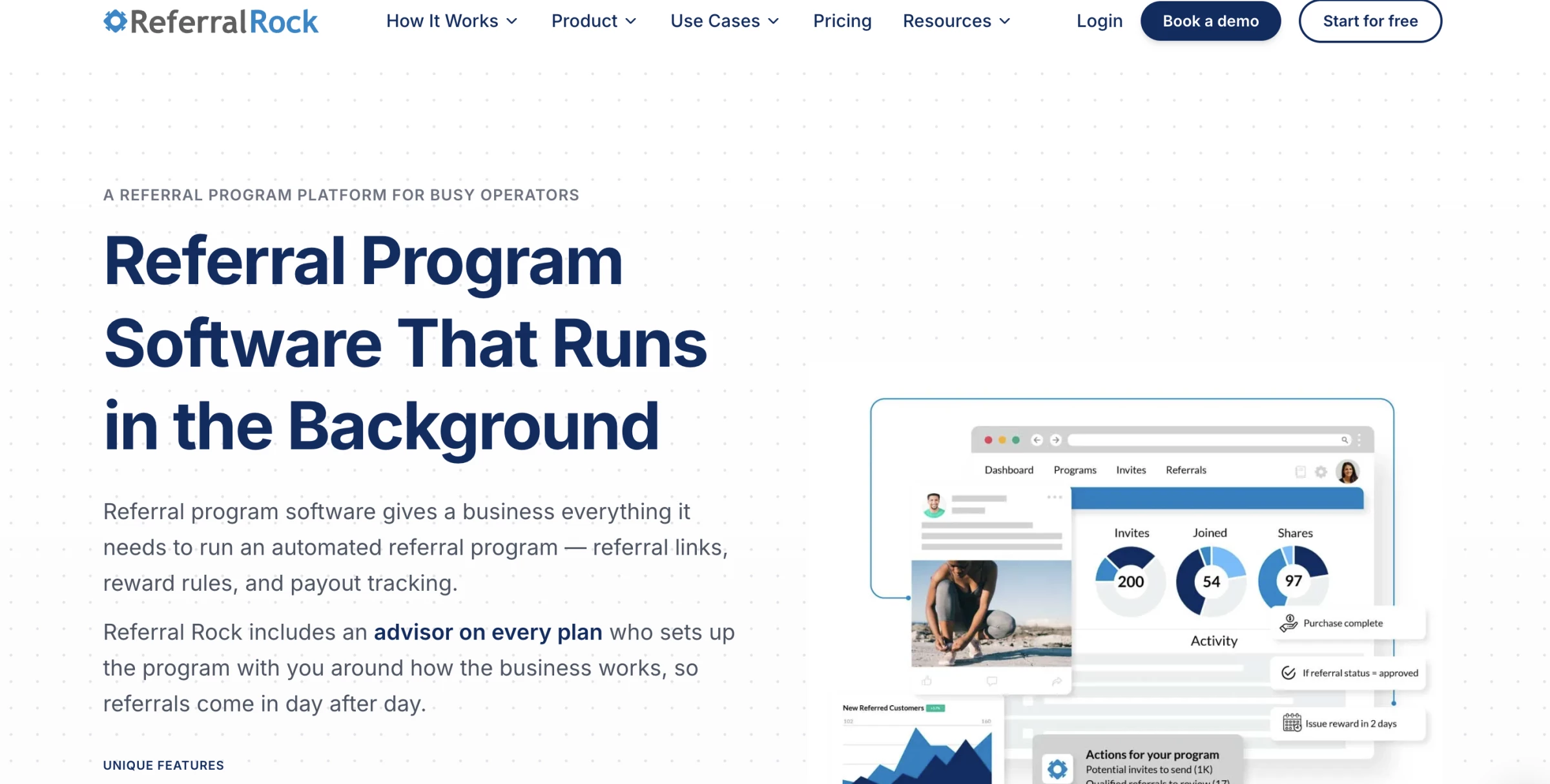
Referral Rock runs customer referral, brand ambassador, and partner or affiliate programs on one platform. Every plan includes concierge onboarding with a dedicated advisor, which the company presents as its main difference from self-serve competitors.
That support covers program design, audience-based recommendations and program copy, and continues after launch.
Referral Rock supports reward rules tied to CRM stages, including a new lead, closed deal, or completed job. This gives you a way to align incentives with a meaningful stage in a longer customer journey.
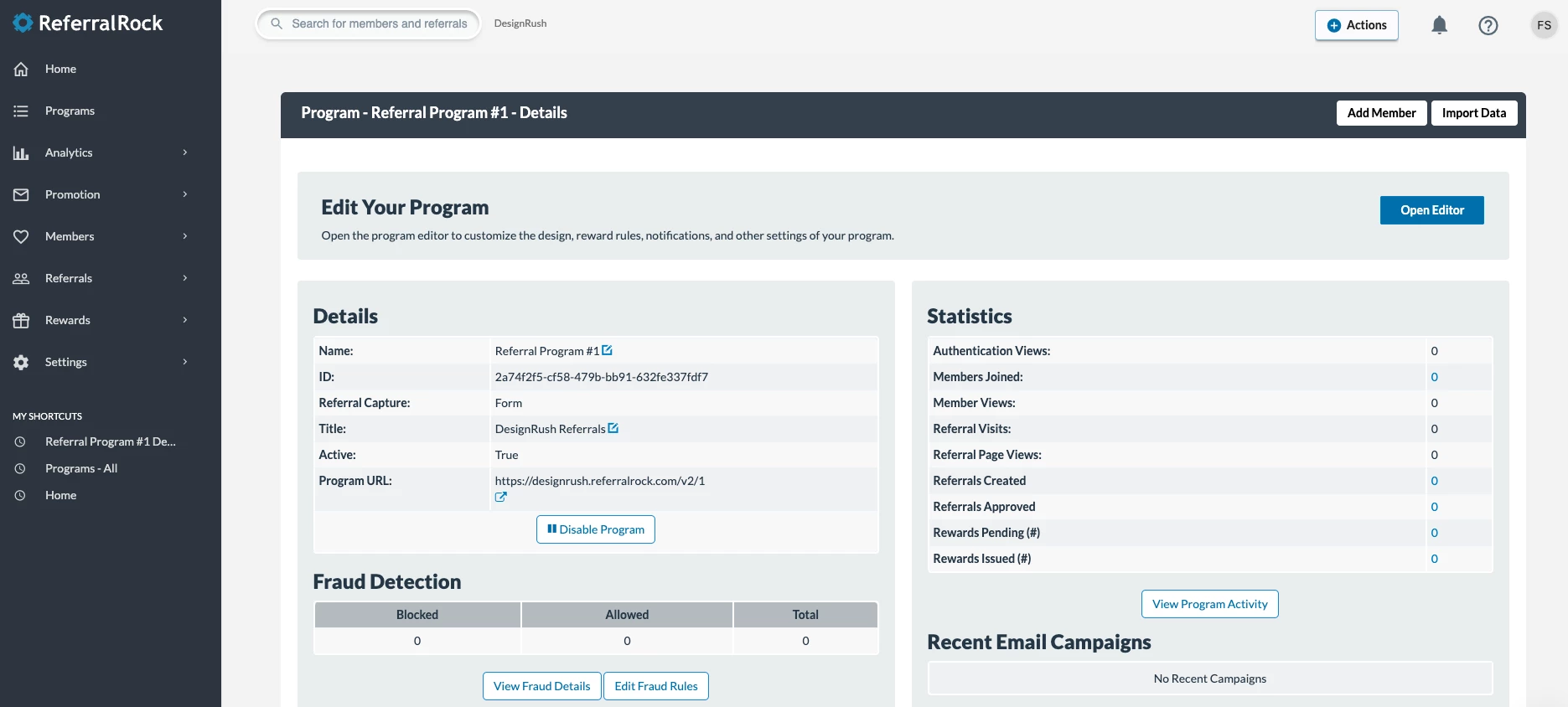
A home-service business, for example, could record the original recommendation when a prospect inquires, then reward the advocate after the job is completed.
Recruiter tools let customer-facing employees introduce people to the program.
Check the integration scope separately from the referral allowance. Unlimited referrals still come with defined member and program allowances.
Pricing
- Operator: $250/month; annual billing saves 10%
- Additional program: $100/month
- Free trial: 14 days
Use Referral Rock’s trial to map one referral from initial lead to the stage that earns a reward.
Pros:
- Supports rewards linked to CRM stages
- Includes a program advisor
- Gives frontline staff tools for customer enrollment
Cons:
- Member allowances and extra programs affect cost
- Advanced integration requirements need separate scoping
What Users Say
On Capterra, a June 2026 reviewer says the team launched without using its internal technical staff and appreciated help with emails and landing pages.
A July 2026 reviewer describes the interface as dated and requiring extra navigation.
Other Notable Features
- Customizable reward structures
- One-click sharing by email, social media or unique link
- Hosted referral portals and pages
- Integrations with HubSpot, Salesforce, Mailchimp, ActiveCampaign and Zapier
- Custom webhooks; Shopify via Zapier or API
3. Referral Factory: Best for No-Code, Flat-Rate Referral Launches
For marketing teams in any industry, from insurance brokers to field-service companies, that have no developer time to spare.
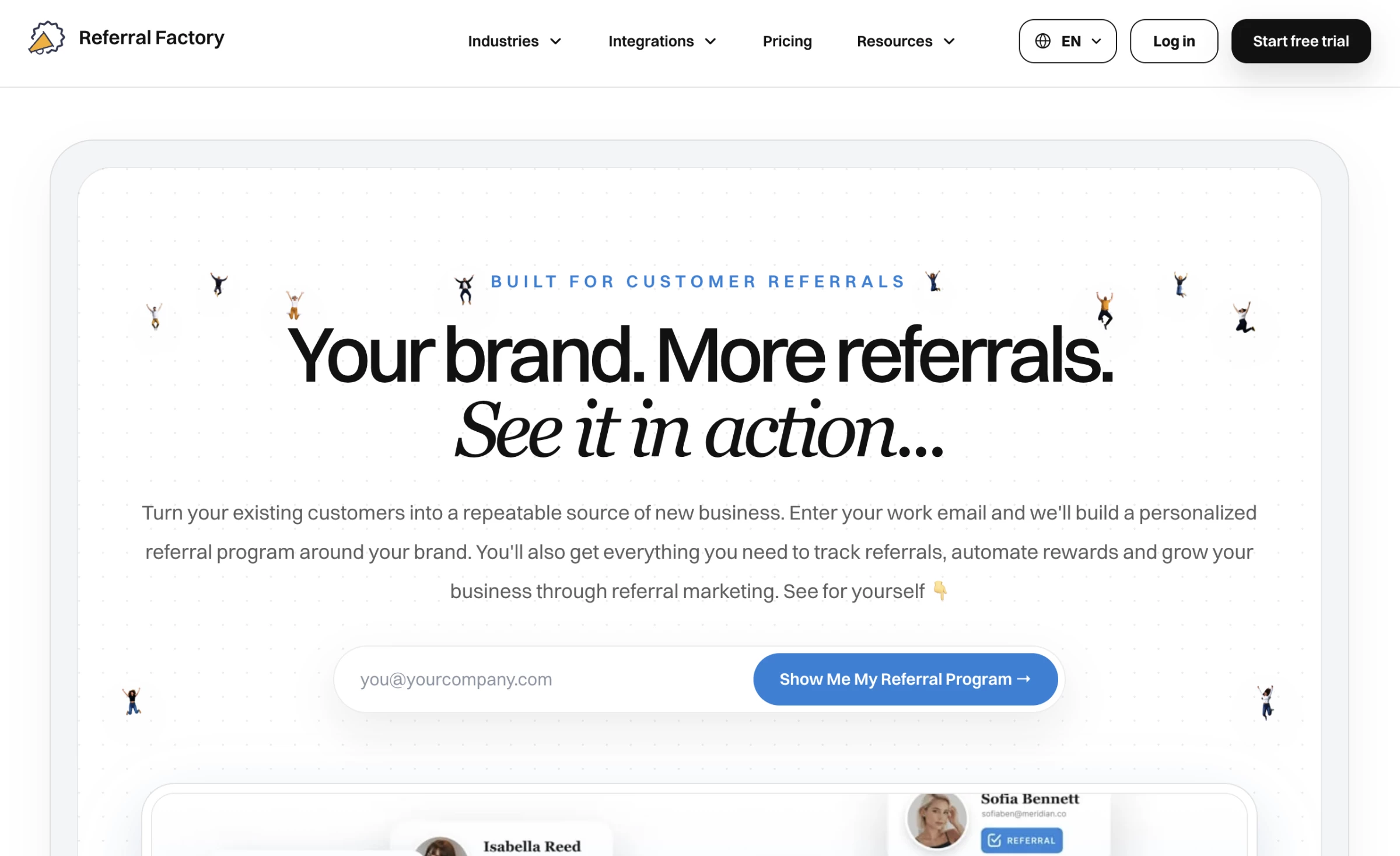
Referral Factory is a template-based platform for customer referral and affiliate programs, built so teams can launch without technical help.
It combines a campaign builder, referral tracking, and rewards. Connections include HubSpot, Salesforce, Zoho, and Stripe, with APIs and webhooks for other systems.
The relevant question is what happens after someone submits a referral. A service business may need that lead to enter its CRM and reach an agreed milestone before a reward becomes due.
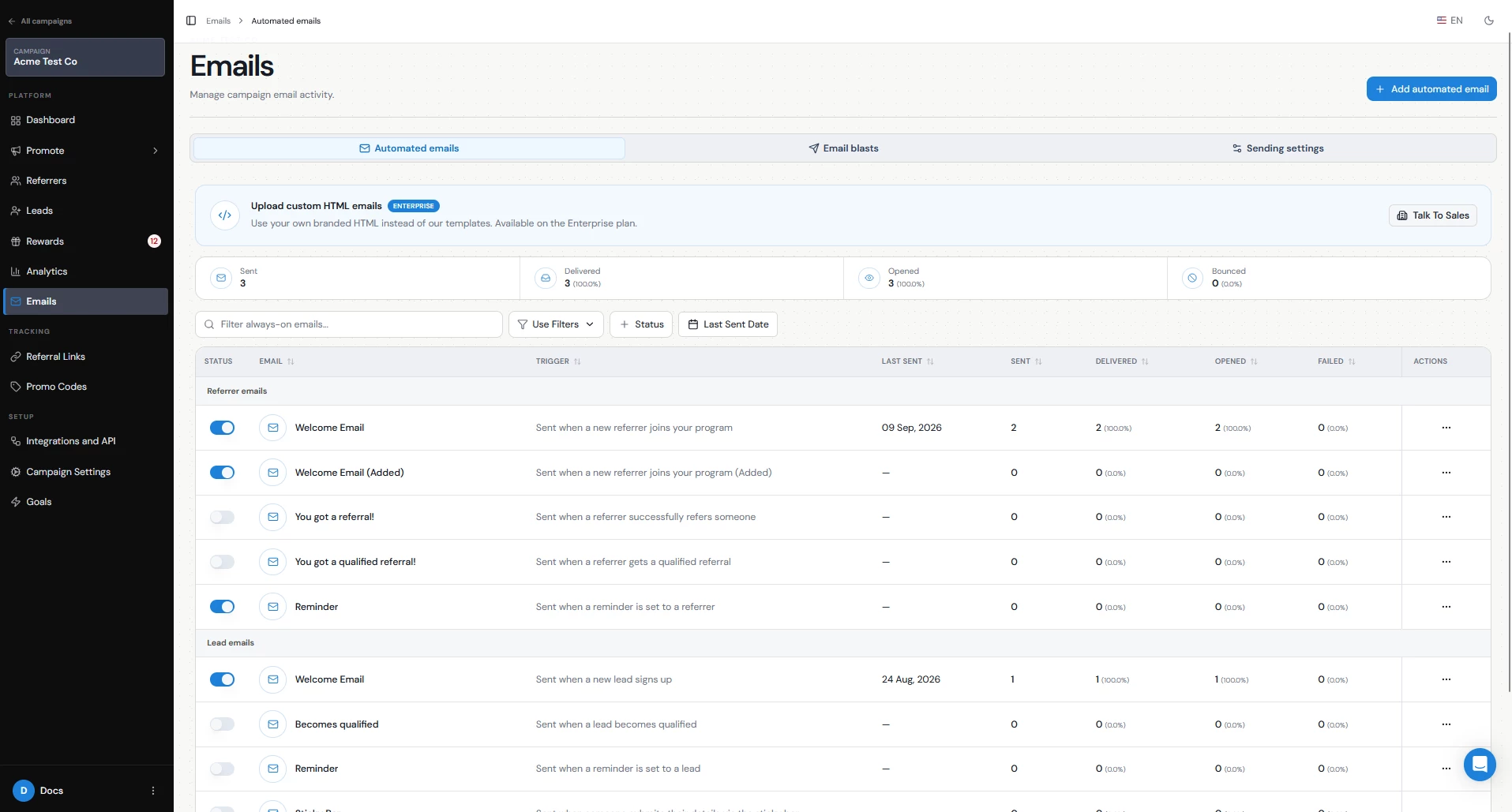
For example, an insurance broker could give each client a referral link, send referred leads straight into its CRM, and pay a gift card only once the new policy is signed.
Watch how capacity is counted. Plans are priced by the number of users the program tracks, with no success or transaction fee, so estimate how many customers you will invite, not just how many will refer.
Pricing
- Basic: $200/month for 20,000 users
- Pro: $400/month for 40,000 users
- Enterprise: From $1,000/month
- Free trial: 15 days
Try Referral Factory with your CRM fields, qualification event, and intended reward.
Pros:
- Combines campaign creation, tracking, and rewards
- Connects with several CRM and payment systems
- Supports qualification beyond an initial lead form
Cons:
- Removing vendor branding requires Pro or above
- Custom qualification workflows can require integration work
What Users Say
Capterra feedback includes a July 2026 review praising automated email notifications and reporting, while describing a learning curve during setup.
Other 2026 reviewers find reward qualification or the amount of dashboard information difficult to interpret.
Other Notable Features
- Unlimited campaigns for always-on programs
- Referral links and codes with more than 200 reward options
- Fraud alerts
- Built-in tracking, analytics and reporting
- Enterprise options for on-premise or cloud data hosting and custom HTML pages and emails
4. GrowSurf: Best for Rewarding Product Signups and Qualifying Actions
For SaaS, fintech, telehealth, and subscription startups with large user bases and a smaller group of active referrers.
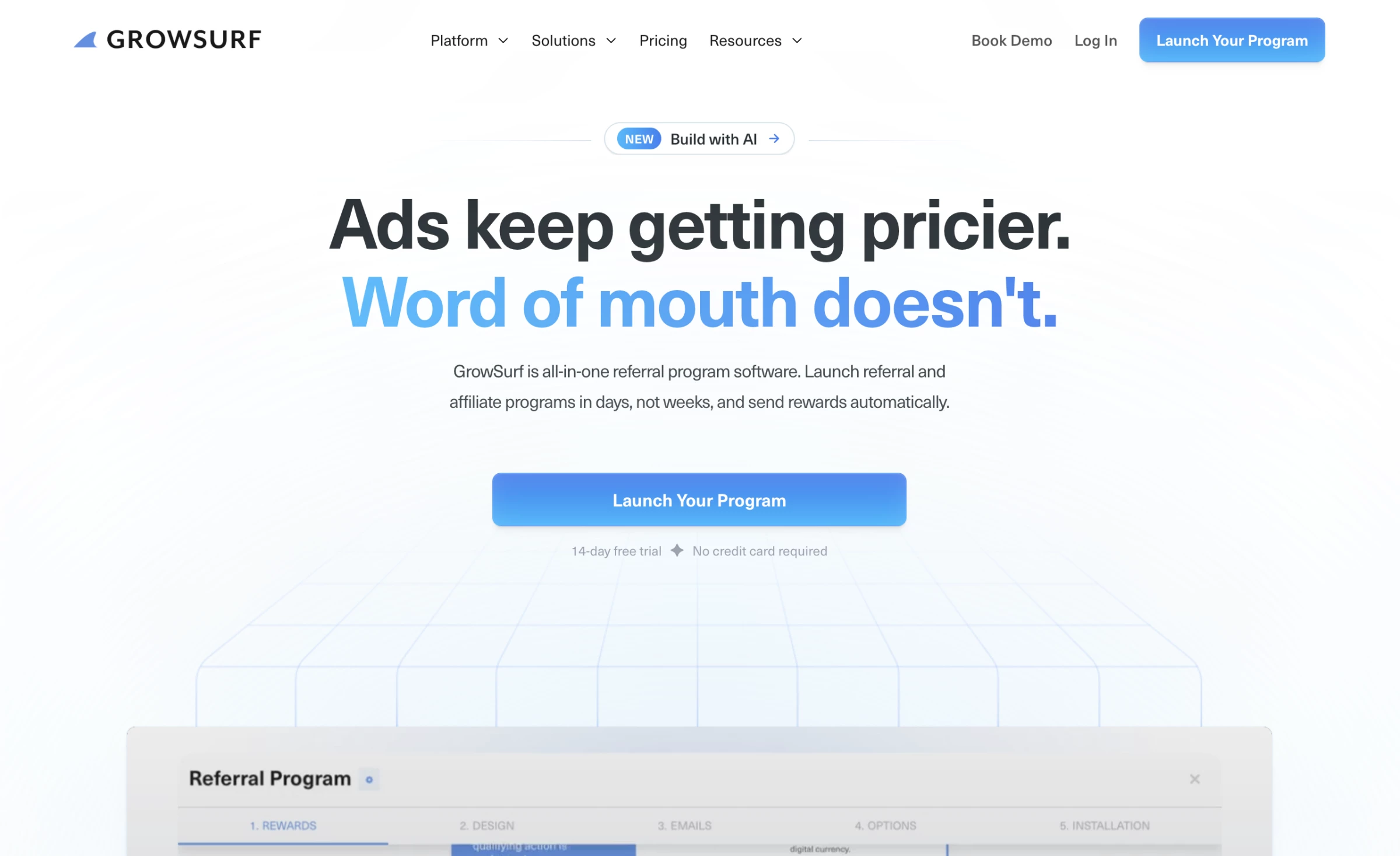
GrowSurf builds branded refer-a-friend, customer advocacy, and affiliate programs from one platform, and is used by B2C and B2B SaaS, fintech, telehealth, insurtech, AI, education, and subscription businesses.
It is built for software products and can embed the referral program inside your app, so users see the invite where they already work.
GrowSurf can reward a referred signup or wait for a later qualifying action. A product team could use that distinction to design a program around activation or a first payment.
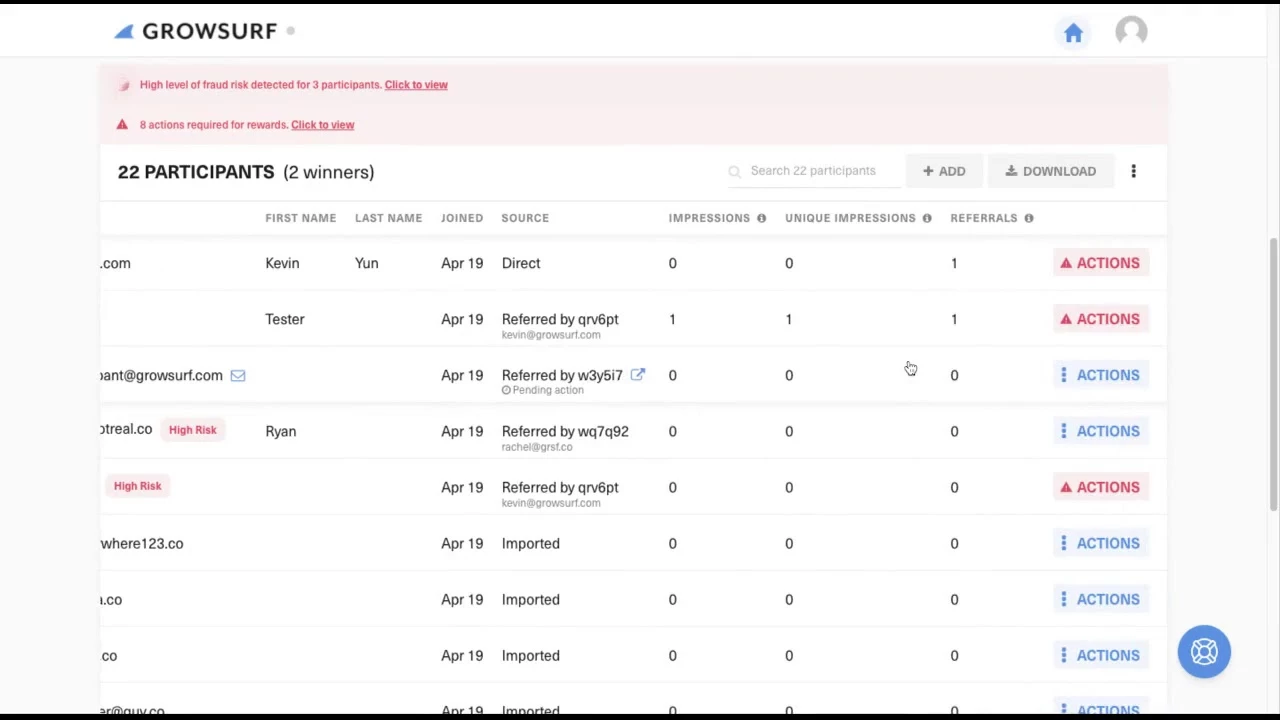
Its API documentation makes the separation explicit. The source application or billing system needs to communicate the qualifying action so that referral credit follows the intended rule.
Establish the engineering work still required, the owner of the event connection, and how participant growth affects pricing.
Pricing
- Startup: From $179/month for up to 2,500 participants
- Business: From $449/month for up to 10,000 participants
- Custom: Contact sales
- Free trial: 14 days; annual billing is also available
Test GrowSurf with a signup followed by the action your business intends to reward.
Pros:
- Separates referred signups from later qualifying actions
- Provides APIs, webhooks, and SDKs for supported workflows
- Offers connections to billing, CRM, and reward tools
Cons:
- Participant growth can increase costs before customers convert
- Custom qualifying actions depend on reliable event integration
What Users Say
In a January 2026 Capterra review, a marketing manager describes replacing a manual spreadsheet-based referral process and receiving responsive support.
The same reviewer notes longer onboarding for complex eligibility and difficulty with campaign assets and approval administration.
Include your eligibility rules and operator tasks in the trial, alongside the customer-facing experience.
Other Notable Features
- Refer-a-friend, advocacy, and affiliate programs in one account
- Multiple programs and team seats by plan
- Custom referral portal domain on Business
- API and webhooks
- Tax forms for reward payouts
5. Friendbuy: Best for Validating Rewards With Custom Business Rules
For established consumer brands with custom, headless, or subscription commerce setups.
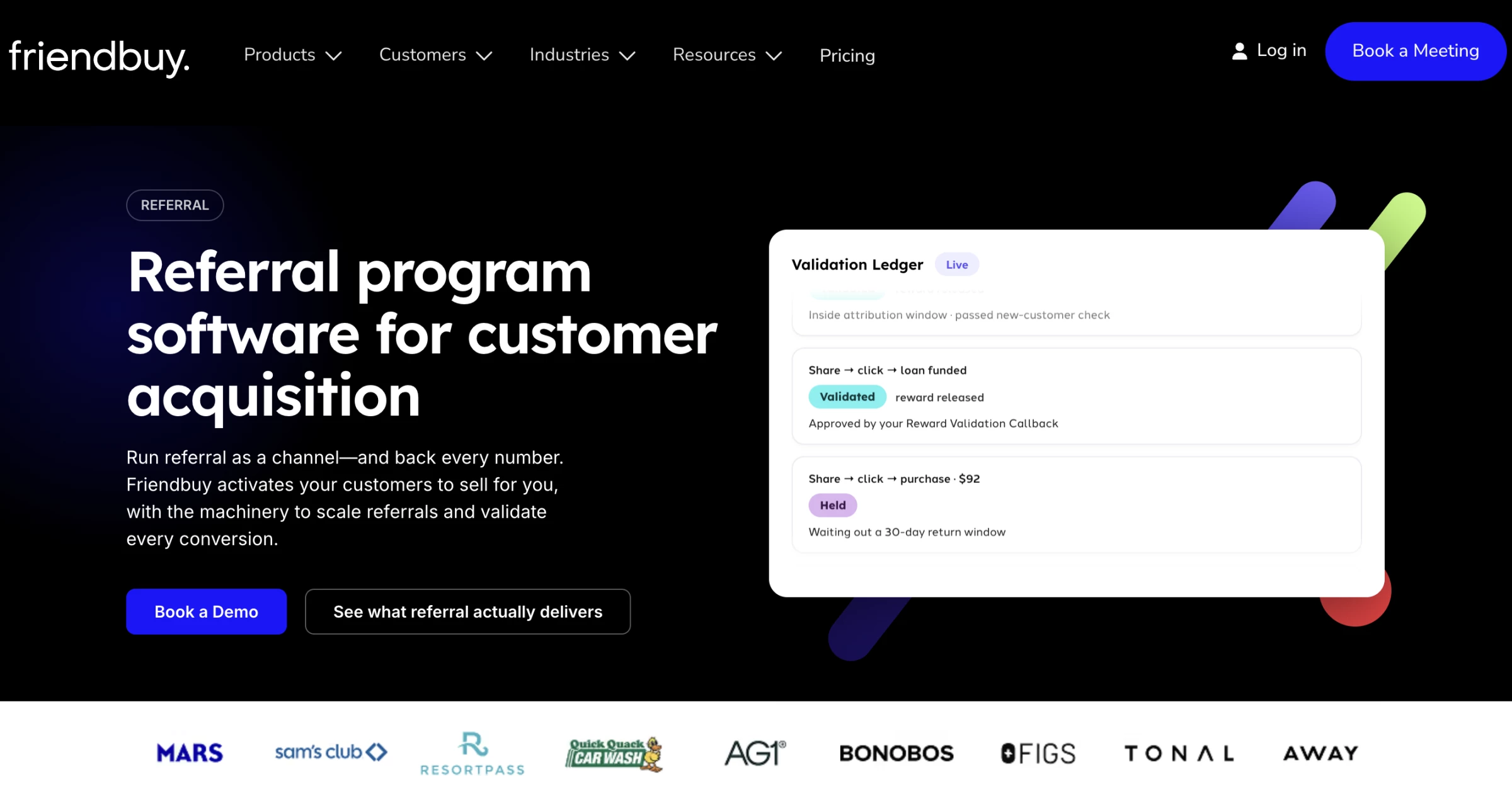
Friendbuy combines referral, loyalty and influencer programs, and positions its current offering for enterprise consumer brands. It has powered programs for brands including Disney, Nestlé, and Walmart.
Its Reward Validation Callback lets your own system determine whether a reward should be fulfilled, including decisions involving returns or cancellations. You can therefore investigate whether your internal records can approve the reward before money moves.
Friendbuy combines referral experiences with testing and reward controls. It supports custom and headless environments alongside commerce and messaging connections.
For example, a subscription coffee brand could give referrers loyalty points instead of cash, test a free bag against a percentage discount for referred friends, and sync results to Klaviyo for follow-up emails.
For procurement, define the referral-only configuration and the work required to operate custom validation.
Pricing
- Shopify: Estimated pricing depends on monthly order volume, selected products, and add-ons.
- Other environments: Custom pricing based on program requirements.
Request a Friendbuy estimate and demonstrate your approval and cancellation rules.
Pros:
- Can use merchant-system logic to validate rewards
- Supports custom and headless referral experiences
- Combines referral testing with eligibility controls
Cons:
- Pricing requires a defined configuration
- Custom validation needs development and failure monitoring
What Users Say
In an August 2026 Shopify review, SeaBear Smokehouse praises Friendbuy’s customer support and fraud detection.
Naked & Thriving Skincare describes smooth onboarding and responsive assistance in January 2026.
Other Notable Features
- Rewards as coupon codes, loyalty points, account credits, and gift cards
- Fraud detection that checks reward eligibility
- A list of rejected referral codes to block misuse
- Email templates, personalized messages, and reminders
- Integrations with Shopify, Klaviyo, Braze, Iterable, Segment, Stripe, Chargebee, and ReCharge
6. Yotpo Loyalty & Referrals: Best for Combining Referral Incentives With Loyalty Rewards
For eCommerce brands with an existing or planned loyalty program.
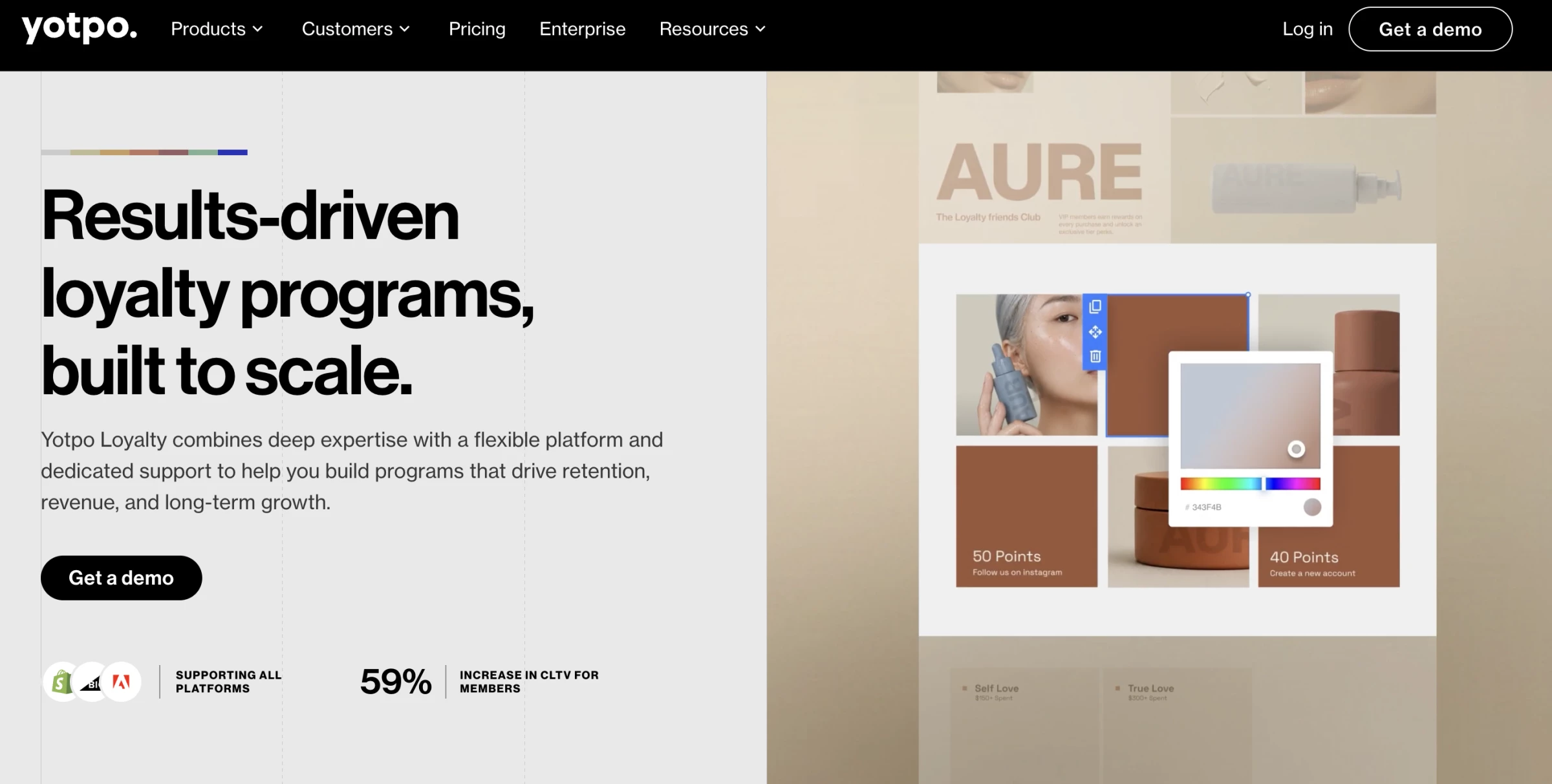
Yotpo Loyalty & Referrals is an eCommerce platform for managing customer rewards and refer-a-friend programs.
You can reward advocates and their friends with points, coupons, or a combination of both, alongside earning rules for purchases, birthdays, and other customer actions.
Customers can earn referral rewards within the same program they use to collect purchase points and redeem discounts.
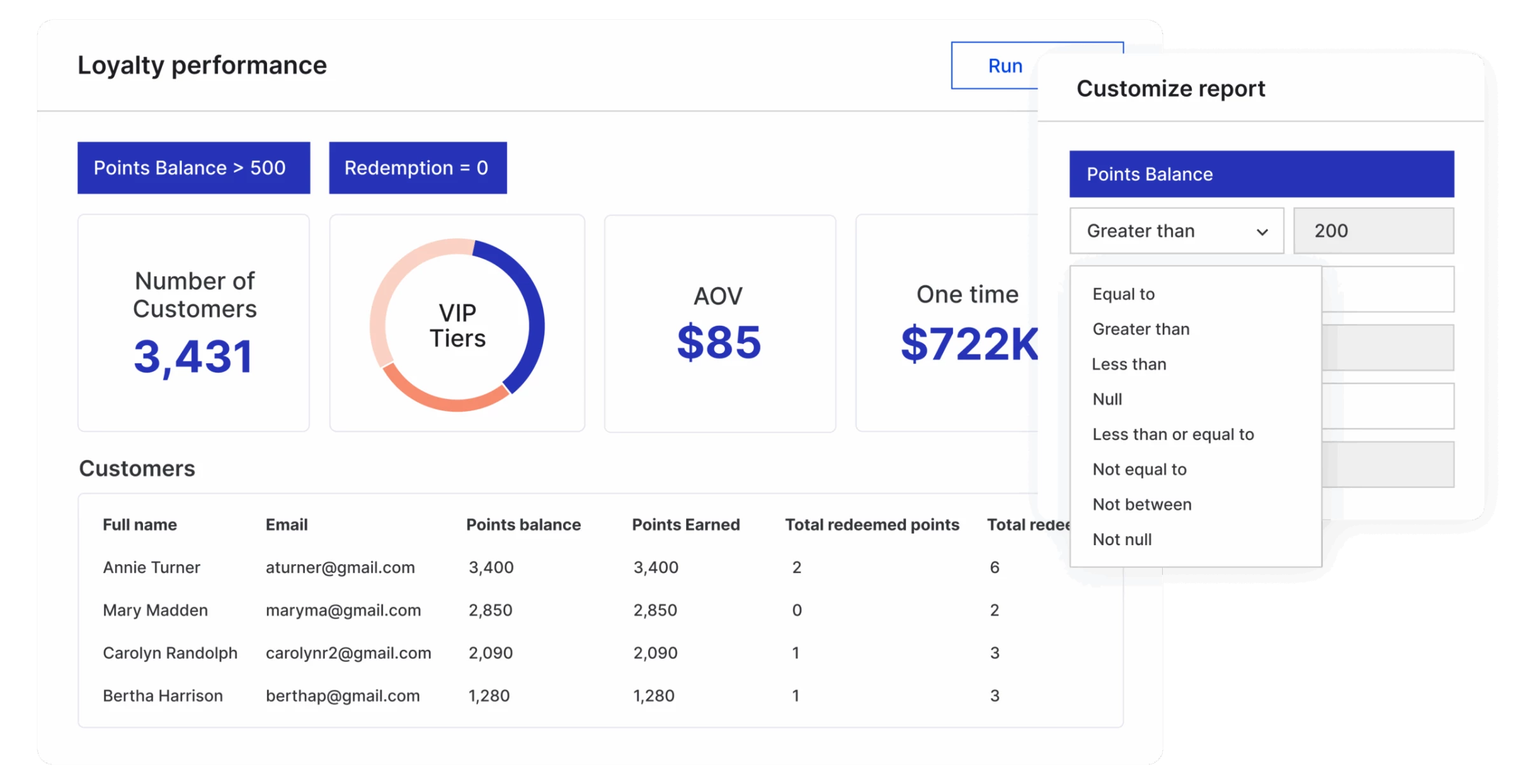
Integration with Yotpo Reviews also lets you award points for submitting reviews, bringing purchases, advocacy, and customer feedback into one rewards strategy.
Higher plans include VIP tiers and targeted campaigns.
Pro pricing scales with total monthly store orders, so costs reflect overall store activity, including purchases unrelated to referrals.
Pricing
- Free: Includes a basic points and referral program
- Pro: From $199/month, including the first 500 monthly orders; additional order-based charges apply
- Premium and Enterprise: Custom pricing
Compare Yotpo plans using total monthly orders and the loyalty capabilities you need.
Pros:
- Combines loyalty and referral workflows
- Offers a free entry plan
- Supports incentives for referrers and their friends
Cons:
- Paid costs can rise with total store-order volume
- VIP tiers and dedicated onboarding require higher plans
What Users Say
In Shopify reviews for the Loyalty app, Schneiders describes helpful migration and customer support in May 2026.
Noordcode’s May 2026 review says multilingual configuration and translation documentation fell short of expectations.
For a multilingual store, test the complete invitation, reward, and redemption experience in every required language before committing.
Other Notable Features
- Referral fraud prevention using IP address, billing address, and browser information
- Customizable emails for referral activity, earned rewards, and points reminders
- Widgets for viewing points and redeeming rewards at checkout on Pro plans and above
- Points expiration settings and customer or product exclusions on Pro plans and above
- Dashboards tracking referral engagement, revenue, reward performance, and program ROI
- Integrations with Shopify POS, Klaviyo, Recharge, and ShoppingGives
7. Mention Me: Best for Tracking Referrals Shared by Name
For established eCommerce and consumer brands with enough order volume for regular testing.
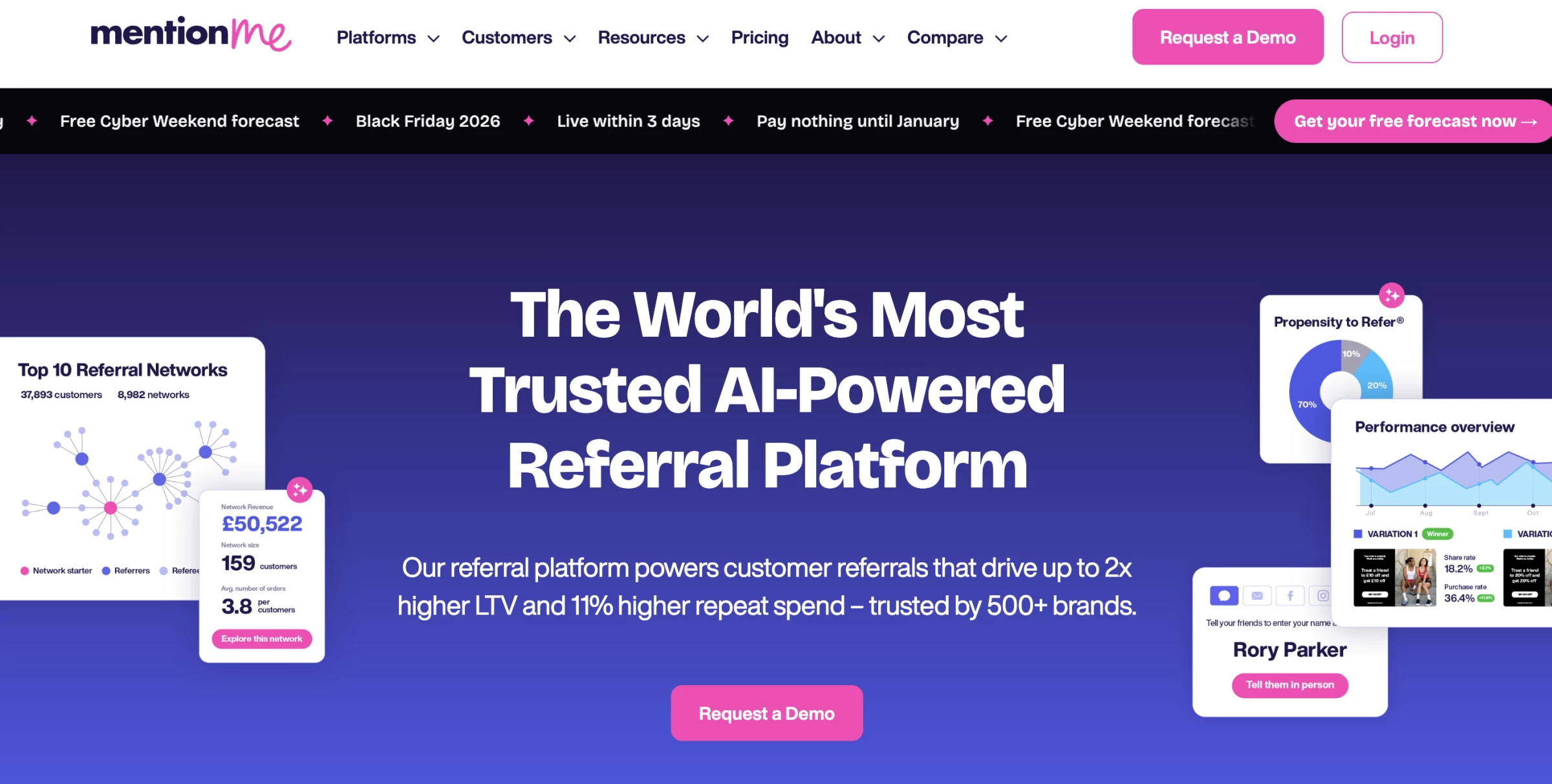
Mention Me is a referral marketing platform that manages customer recommendations, referral incentives, and campaign performance.
It supports sharing through email, personalized links, social channels, and its distinctive Name Share feature.
Mention Me’s Name Share feature lets a new customer enter the recommending friend’s name at checkout. It adds a way to capture referrals that happen without a shared link.
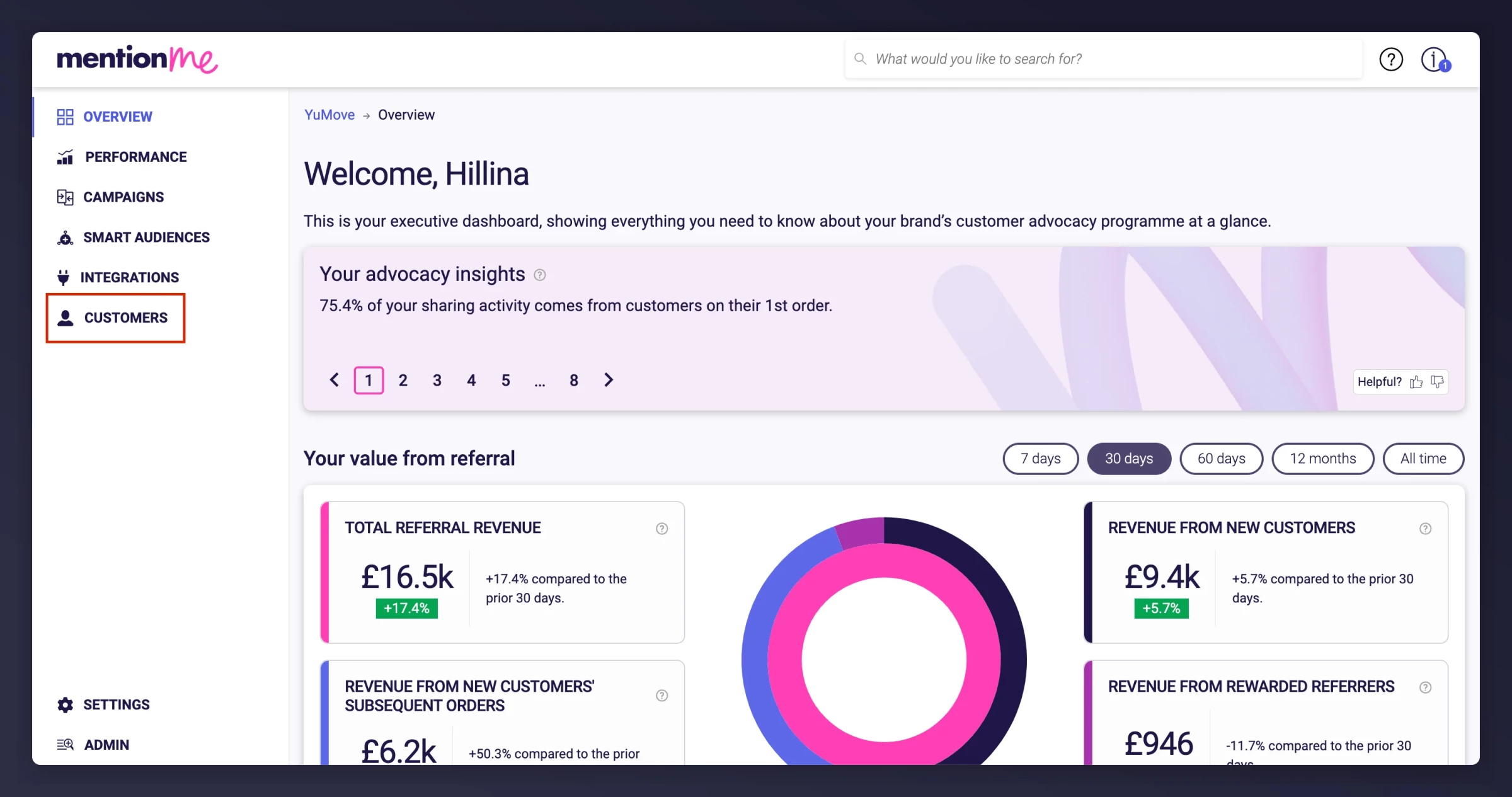
The platform also supports referral experiments, customer segmentation, and reporting that considers an advocate’s own spending alongside referred revenue.
A brand can evaluate which offers work for different customer groups.
Mention Me positions its offering for mature eCommerce brands with sufficient order volume for meaningful testing. Confirm that your program has the activity and resources needed for that approach.
Pricing
- Custom quote: The platform fee depends on the package, business objectives, and forecast.
Discuss Mention Me’s checkout setup and package scope using your forecast referral volume.
Pros:
- Captures recommendations shared by name
- Supports segmented referral experiments
- Connects advocate spending with referred revenue analysis
Cons:
- Smaller programs need to confirm fit and testing volume
- Name-based sharing requires checkout implementation
What Users Say
A January 2026 Capterra reviewer praises Mention Me’s ease of setup but describes an initial learning curve and says contacting support to change codes can be time-consuming.
Clarify which campaign settings and code changes your team can manage directly and which require vendor assistance.
Other Notable Features
- Flexible incentives, including coupons, free delivery, and third-party rewards
- Customer dashboards for tracking referrals
- Referral templates for desktop and mobile, with multiple language options
- Audience Builder for creating lookalike audiences from referral data across Google, Meta, and TikTok
- Integrations with Shopify, Klaviyo, Attentive, and Emarsys, plus API and webhook connectivity
8. Talkable: Best for Testing Referral Offers and Campaign Placements
For eCommerce brands with marketing teams running ongoing acquisition campaigns.
Talkable is a referral and loyalty platform that runs refer-a-friend programs for brands including American Eagle, L'Occitane and TOMS, and also supports influencer, post-purchase and giveaway campaigns.
Marketers can target offers by behavior and purchase history, run A/B tests, and collect video referrals that customers record for the brand.
For example, an apparel brand could test a $20 credit against a 20% discount for first-time buyers in one segment while keeping its standard offer for repeat customers, then roll out the winner.
Talkable offers four quote-based service levels with varying launch support. Light includes limited managed launch assistance, while Standard and higher tiers add a dedicated success team, managed campaign placements, and professional-services hours.
Contracts require a 12-month commitment, and implementation fees apply.
Pricing
- Contact sales
Compare Talkable’s service levels and scope a referral campaign around your existing touchpoints.
Pros:
- Supports testing across offers, creative, and placements
- Includes segmentation and configurable fraud controls
- Offers service levels with campaign and operational assistance
Cons:
- Light excludes a dedicated success team, managed campaign placements, and professional-services hours.
- Ongoing experimentation needs clear responsibilities and review time
What Users Say
In a January 2024 Capterra review, a user praises Talkable’s responsive support but says the dashboard can be confusing and certain reports are difficult to pull.
Another reviewer values the account team’s campaign recommendations and reporting but wants more insight into the program’s incremental impact.
Ask the vendor to demonstrate your required reports and explain how it distinguishes referral-attributed sales from additional sales generated by the program.
Other Notable Features
- Video referrals customers record and share
- Blocklist of disposable email domains for fraud prevention
- Influencer, post-purchase and giveaway campaigns
- APIs and webhooks for CRM and internal systems
- Integrations with Shopify, Adobe Commerce, Salesforce Commerce Cloud, BigCommerce, Klaviyo, Attentive, HubSpot, and Yotpo
9. Extole: Best for Managing Referral Programs Across Web and Mobile
For enterprise consumer brands operating across multiple digital channels.
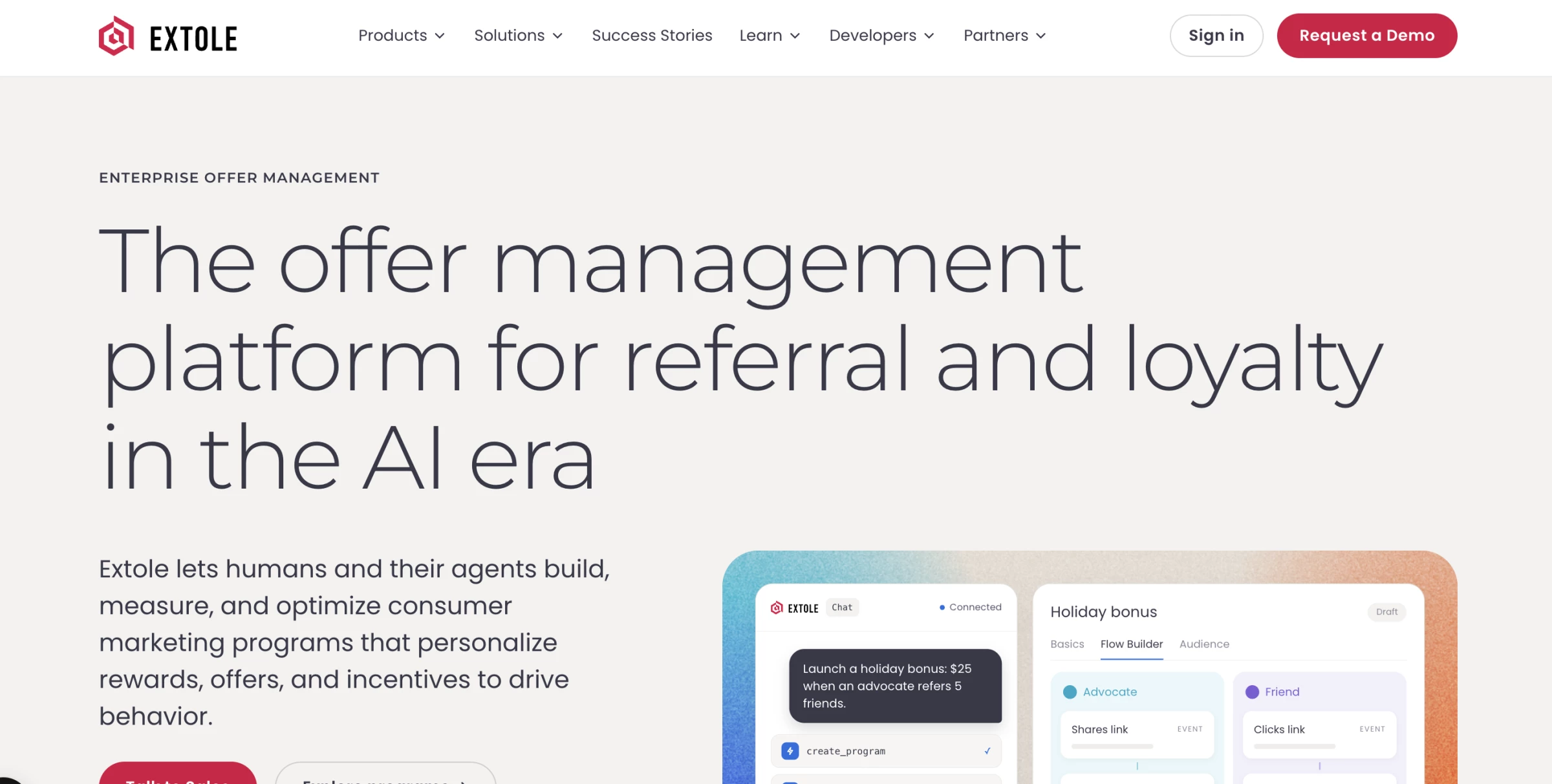
Extole is an enterprise offer management platform built for referral and engagement programs, combining a rewards engine with advocate segmentation.
It connects customer experiences with qualification rules and reward management. You can define who sees an offer, which event qualifies, and when rewards become payable.
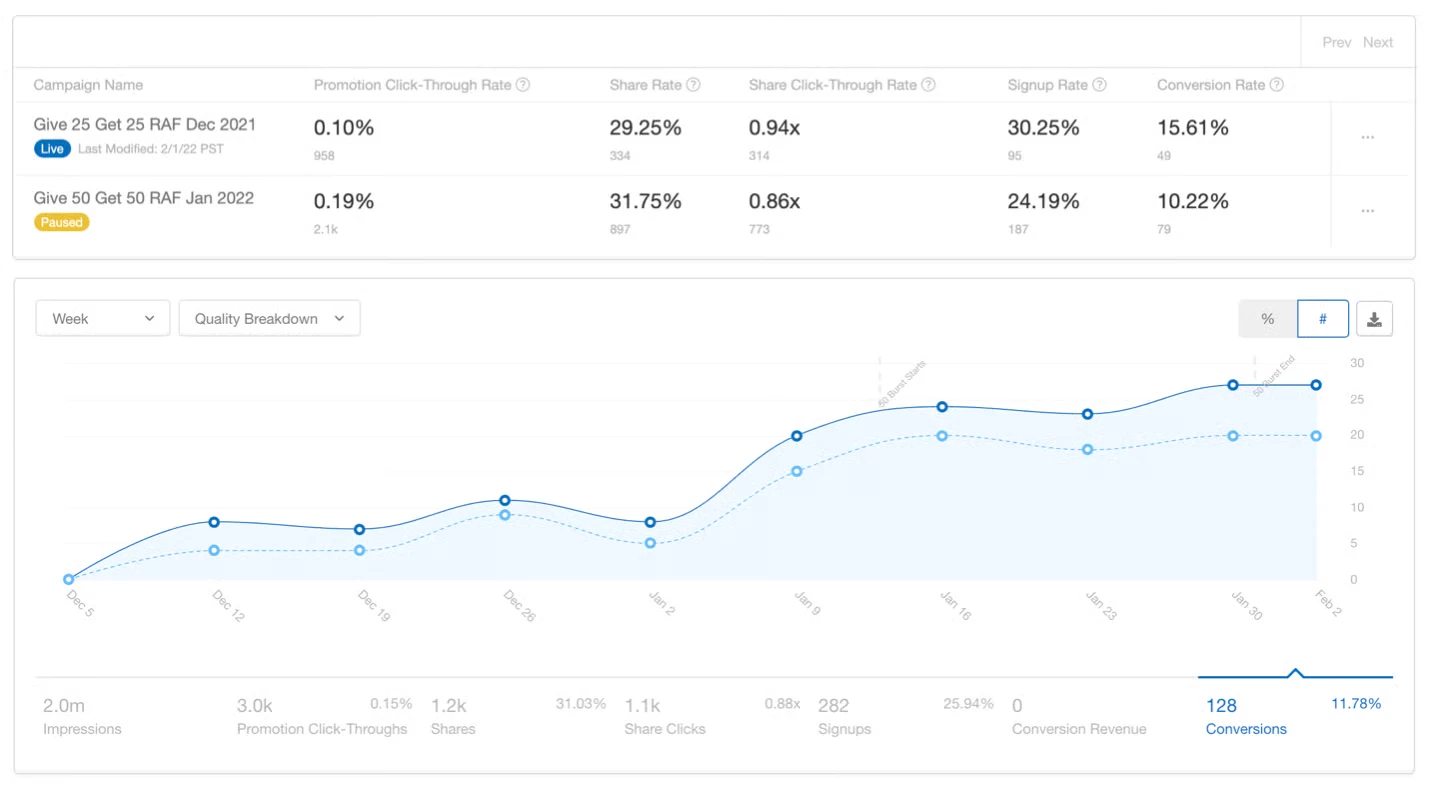
APIs, SDKs, and webhooks connect the experience with backend purchases or signups. This matters when several systems contribute to deciding whether a referral should earn a reward.
Its Flow Builder offers drag-and-drop templates for refer-a-friend, ambassador, welcome-offer and reward-for-action programs.
A financial services brand could run a refer-a-friend program for existing customers, a separate ambassador program for its most active advocates, and a welcome offer for new sign-ups, each with its own eligibility rules.
Pricing
- Request a quote
Request an Extole demo covering your customer events, qualification rules, and support workflow.
Pros:
- Supports web, app, and email referral experiences
- Combines qualification and reward controls
- Provides event integrations for connected systems
Cons:
- Implementation requires connected customer events and systems
- Reward exceptions need a defined internal support process
What Users Say
A Capterra reviewer praises Extole’s responsive team, straightforward setup, and custom API integration but notes the lack of a fully separate staging environment.
Another reviewer values the guidance from onboarding through optimization while noting that some customizations take time to implement.
Ask how campaign changes are tested before going live and agree on turnaround times for customizations.
Other Notable Features
- Reporting on customer behavior, beyond link tracking
- Robust API
- AI agent support for configuring and validating programs
- Technology partners including HubSpot, Klaviyo, Okta, and Amplitude
- Shopify and Zapier connections
10. Smile.io: Best for Launching a Basic Referral and Points Program
For small Shopify stores and merchants, starting their first loyalty program.
Smile.io is a loyalty platform for Shopify and BigCommerce that combines points, referrals, and optional VIP tiers.
Merchants can reward purchases, account signups, birthdays, and social engagement, with points redeemable for benefits such as discounts and free shipping.
Its referral program automatically generates a unique sharing link for each customer and supports rewards for both the advocate and their friend.
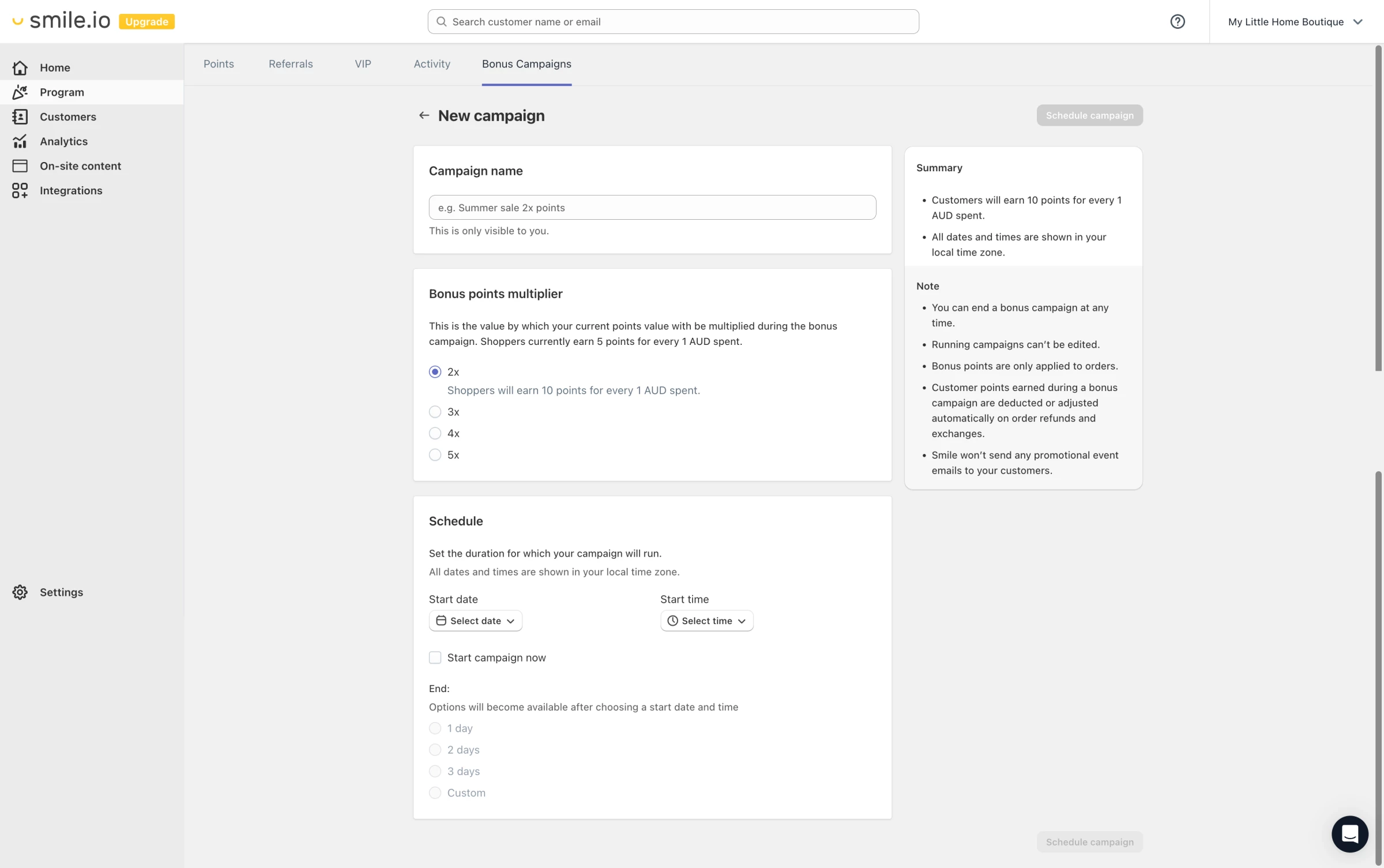
Advocates can earn loyalty points for successful referrals, connecting customer acquisition with the same rewards program that encourages repeat purchases. Referral links can also appear in storefront prompts and marketing emails.
Points and referrals are included together on the free plan, which supports up to 200 monthly orders and includes branding customization.
Paid tiers expand the program with dedicated loyalty pages, on-site reminders, additional integrations, and, on Growth and above, VIP rewards.
Pricing
- Free: 200 monthly orders
- Essential: $15/month for 500 monthly orders
- Standard: $79/month for 1,000 monthly orders
- Growth: $199/month for 2,500 monthly orders
- Smile Plus: $999/month, billed annually
- Enterprise: Custom annual pricing
Compare Smile’s order allowances and test a referral from shared link to code redemption.
Pros:
- Includes points and referrals on a free plan
- Supports rewards for both sides of a referral
- Offers paid tiers for expanding store requirements
Cons:
- Lower paid plans limit integrations
- VIP capabilities and API access require higher tiers
What Users Say
Merchant reviews highlight straightforward rewards configuration, an intuitive interface, and helpful support during onboarding and everyday management.
Positive feedback also mentions flexible reward options, branding controls, and the ability to launch a useful program on the free plan.
More complex setups can require additional technical work. One review describes difficulty synchronizing loyalty points across multiple sales platforms, although support helped establish the necessary connections.
Other Notable Features
- Customizable rewards launcher and panel with store-matched colors and branding
- Points for purchases, account signups, birthdays, and social engagement
- Dedicated loyalty pages and on-site reward reminders on paid plans
- Points earning and redemption through the store’s point-of-sale system
- Referral and points analytics, with data exports on paid plans
- Connections to email and review tools, with integration allowances varying by plan
How To Choose Referral Program Software for Your Business
Start with where your referrals happen. This narrows the shortlist around the sharing experience, conversion event, and business systems your program needs to connect.
| Where Referrals Happen | What the Tool Must Do Well | Tools To Shortlist |
| At online checkout | Read orders and refunds, attribute referrals, issue eligible rewards, and control code misuse | ReferralCandy, Talkable, Friendbuy, Yotpo, Smile.io |
| Inside a software product | Embed the referral experience and connect rewards with activation or billing events | GrowSurf; Extole for custom enterprise implementations |
| Through in-person recommendations | Capture referrals through QR-linked forms or identify the referrer when the friend later buys online | Referral Rock; Mention Me for name-based attribution at checkout |
| Between businesses | Send leads into the CRM, follow sales milestones, and support approved reward types | Referral Rock, Referral Factory |
| During a first referral pilot | Offer a free plan or trial, clear usage limits, and a manageable launch scope | Smile.io, Yotpo, ReferralCandy |
| Across multiple programs and markets | Coordinate segmentation, testing, reward rules, integrations, and implementation support | Extole, Talkable, Friendbuy, Mention Me |
If You Sell Online (eCommerce and DTC)
Look for an integration with your store platform that captures purchases and updates refunds.
ReferralCandy, Talkable, and Friendbuy are candidates for dedicated referral campaigns; Yotpo and Smile.io suit stores evaluating referrals alongside loyalty.
Ask how each handles codes posted on coupon sites and whether new-customer checks and reward rules still apply.
If Referrals Happen Inside Your Product (B2B SaaS and Apps)
Start with GrowSurf when the referral experience belongs inside your application. Its qualifying-action controls let you distinguish a signup from a later action, such as a first payment.
Extole is another candidate for a custom enterprise implementation, with APIs and SDKs for web and mobile experiences.
If Referrals Happen Offline (Local and Home Service Businesses)
Referral Rock supports QR sharing and customer enrollment, making it a candidate for businesses introducing the program through staff conversations or printed materials. Confirm how the resulting lead reaches your CRM, booking system, or completed-job record.
Mention Me addresses a different situation: someone recommends a brand in conversation, and their friend later enters the referrer's name at online checkout.
Evaluate that flow for offline word of mouth leading to eCommerce purchases; it does not establish support for every phone or appointment-booking workflow.
If You Are B2B and Incentives Are Sensitive
Compare Referral Rock and Referral Factory when referrals need to enter your CRM sales pipeline and progress through a sales process.
Both are relevant to milestone-based qualification, and Referral Factory also supports credits and custom rewards.
If You Are Running Your First Referral Pilot
Smile.io and Yotpo offer free plans; Smile's entry allowance is 200 monthly orders. ReferralCandy offers a seven-day trial for testing its eCommerce workflow.
Start with one offer, one customer group, and one qualifying event. Choose that first customer group based on its relationship with your business.
“For those most engaged, offer a referral program,” advises Modalyst co-founder Jill Sherman in her interview with DesignRush.
For an eCommerce pilot, you could apply that advice by inviting repeat purchasers or customers who have shared positive feedback, then measuring which invitations produce qualifying referrals before expanding.
If You Run Multiple Programs at Enterprise Scale
Shortlist Extole, Talkable, Friendbuy, and Mention Me around the workflows you need to coordinate. Compare audience segmentation, testing, localized experiences, reward controls, and implementation responsibilities. Confirm which capabilities the proposed package includes.
Check whether reporting shows how rewards perform in each market.
Discussing global engagement programs in his DesignRush interview, Brandmovers founder Andrew Mitchell explains: “Cultural engagement metrics, such as reward redemption rates by region, help assess how well programs align with local consumer preferences.”
For your referral program, ask vendors to demonstrate country-level reporting for qualifying referrals and reward redemption, alongside the ability to configure different offers for each market.
This gives your team a way to investigate regional differences that an overall program average could conceal.
Features That Matter and How To Test Them in a Demo
In our assessment, tracking, rewards, and integrations deserve close attention when comparing referral software. Use the demo to evaluate how each platform handles your customers, qualification rules, and data.
Define what success looks like before evaluating a platform’s reporting.
Discussing ambassador programs in her DesignRush interview, Scott Social’s CEO Chelsea Evans-Flower explains: “A business needs to create a strong foundation for an ambassador program to be successful and have systems in place to track the results accurately.”
Apply that principle to customer referrals by defining the action that qualifies, the system that confirms it, and the costs included in your performance calculations.
Then ask each vendor to demonstrate that measurement process using a complete referral journey.
Attribution and Tracking
This decides whether the right person gets credit. We recommend testing whether referrals still receive credit when customers switch devices, return days later, or clear their browser storage.
What to Ask
How do you attribute a referral if the friend converts days later on a different device?
Do you support server-side or account-level attribution?
Can referees enter a code or the referrer's name at checkout as a fallback?
Reward Rules
Decide what earns a reward before you compare tools: a sign-up, a first order, a paid invoice or a booked appointment. Then check that each tool can hold the reward until your refund window closes.
What to Ask
Can rewards differ by customer segment or product?
What happens to a reward if the referred order is refunded?
Fraud Controls
Expect some customers to refer themselves with a second email address and some codes to end up on coupon sites.
For purchase-based programs, we recommend considering completed payment as a requirement for reward eligibility, alongside checks for self-referrals and duplicate accounts.
What to Ask
Show us a flagged referral in the dashboard. Which checks run automatically, and which need manual review?
Integrations
A referral tool is only useful if its data reaches the systems your team already works in.
Confirm it connects to your store or billing system, CRM and email platform on the plan you can afford, not just on the top tier.
What to Ask
Which fields sync to our CRM, in which direction, and how often?
Choosing Your Referral Platform
Choose two candidates that fit your qualifying event, technology stack, and expected activity. Compare their complete costs, then use the same success and failure scenarios to evaluate them.
If program design or integration work needs outside support, define your requirements before choosing a digital marketing agency.
Compare digital marketing agencies and ask for examples of customer referral implementations involving your CRM or commerce platform, reward rules, and post-launch reporting.

Book a strategy session today with one of the best affiliate marketing agencies.
Alternatively, visit our Agency Directory for expert guidance in the following categories: