
Your CRM, website, and email platform may each hold a different piece of the same customer’s history. A customer data platform (CDP) connects those records into unified profiles for segmentation, personalization, and customer interactions.
This guide reviews 10 of the best customer data platforms to help you choose the one that fits your marketing goals and existing systems.
Key Findings: Customer Data Platform Comparison
- Twilio Segment and mParticle help existing tools share consistent customer data. Hightouch puts the customer information already in your warehouse to work.
- Amperity connects fragmented purchase and loyalty records, giving retailers a clearer customer history. Tealium adds controls for how data is collected and shared.
- Insider One and Bloomreach use unified customer profiles to personalize and deliver campaigns across email, SMS, and other channels.
Why CDP Selection Matters Even More in 2026
Google kept third-party cookies available in Chrome under its existing user-choice settings, then announced plans to retire several Privacy Sandbox technologies developed for advertising and measurement.
Businesses preparing for those alternatives have had to reassess their plans, reinforcing the value of customer data collected directly through their own websites, apps, and transactions.
Using that first-party data still requires care. U.S. state privacy laws differ in the rights they give consumers and the obligations they place on businesses, so if you're serving customers in different states, you must account for varying requirements.
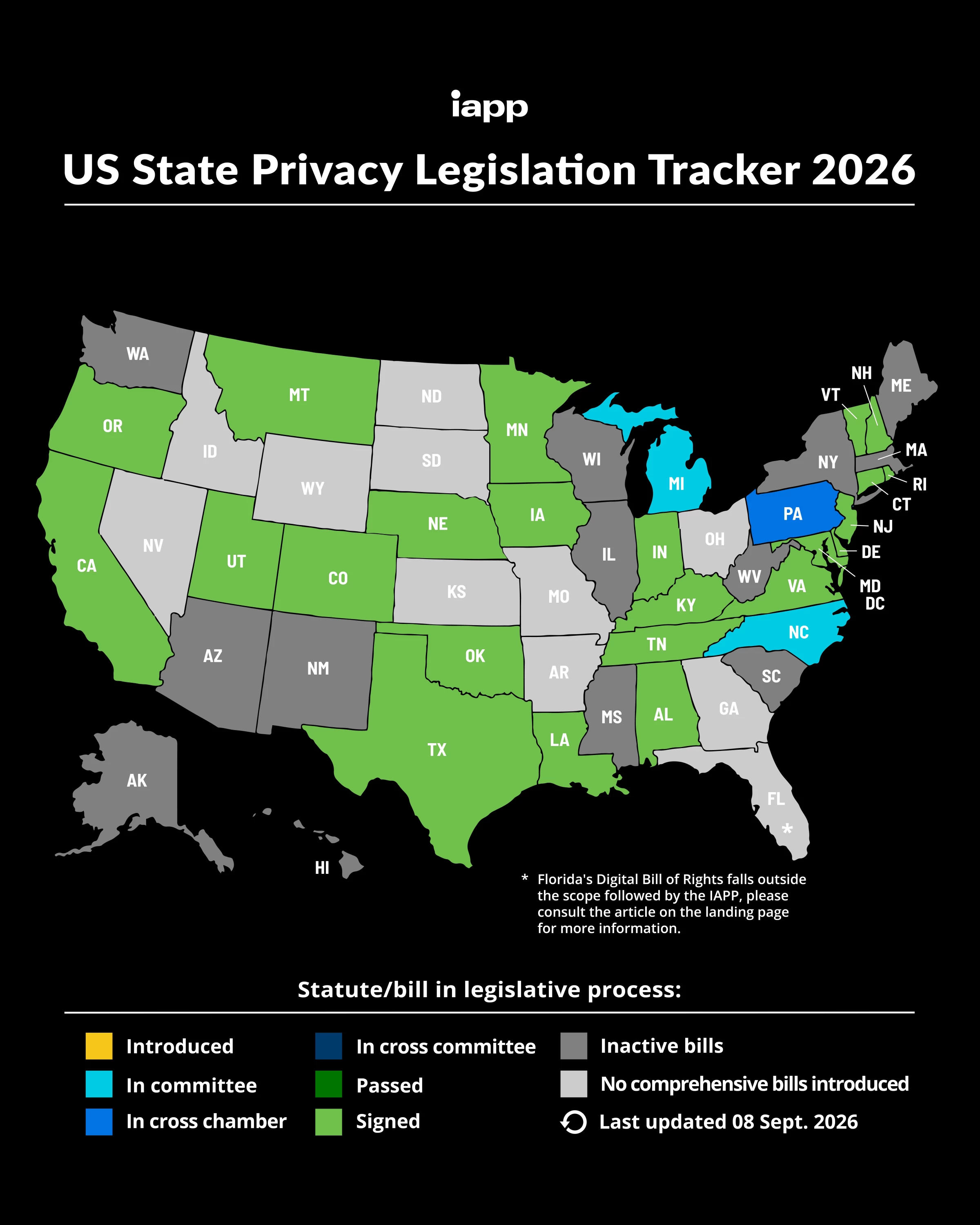
When choosing a CDP, check how it handles those requirements in practice.
Can it exclude customers who have opted out of a particular use, pass updated preferences to connected marketing tools, and support deletion requests?
These capabilities help determine whether your team can act on customer data responsibly as targeting options and privacy requirements change.
How We Selected the Best CDPs
We chose these customer data platforms for the problems they help marketing teams solve, including disconnected customer records, time-consuming audience preparation, and gaps between customer insights and campaign delivery.
Our review drew on official product documentation, pricing details, customer stories, and insights from experts.
We looked at how each platform matches customer records, connects with existing tools, supports consent preferences, and makes audiences available for campaigns.
Setup requirements and paid add-ons also informed our picks, so each recommendation reflects the resources a team needs to use it.
| Platform | Best For | How Campaigns Are Delivered |
| Twilio Segment | Connecting customer data across existing tools | Through connected marketing tools |
| Salesforce Data 360 | Using customer data across Salesforce applications | Through Marketing Cloud and other connected applications |
| Adobe Real-Time CDP | Audience activation within Adobe Experience Cloud | Through connected applications such as Journey Optimizer and Target |
| Hightouch | Activating data from an existing warehouse | Through connected marketing tools |
| Tealium | Managing customer data and consent preferences | Through connected marketing tools |
| Amperity | Unifying online and offline customer records | Through connected advertising and marketing tools |
| Treasure AI | Enterprise customer data and AI-assisted marketing | Through integrations or additional AI Suites, depending on the workflow |
| mParticle | Managing web and mobile event data | Through connected marketing tools |
| Insider One | Cross-channel customer journeys | Built-in campaign channels, depending on the package |
| Bloomreach | Ecommerce lifecycle marketing | Built-in campaign channels, depending on purchased modules |
Discussing AI-driven personalization with DesignRush, Sheetal Pansare, president and CEO of Futurism Technologies, explained:
“By unifying data across the customer journey, these services create meaningful experiences that enhance brand loyalty and increase revenue.”
1. Twilio Segment: Best for Connecting Customer Data Across Your Technology Stack
For marketing operations and data teams managing customer information across multiple business tools.
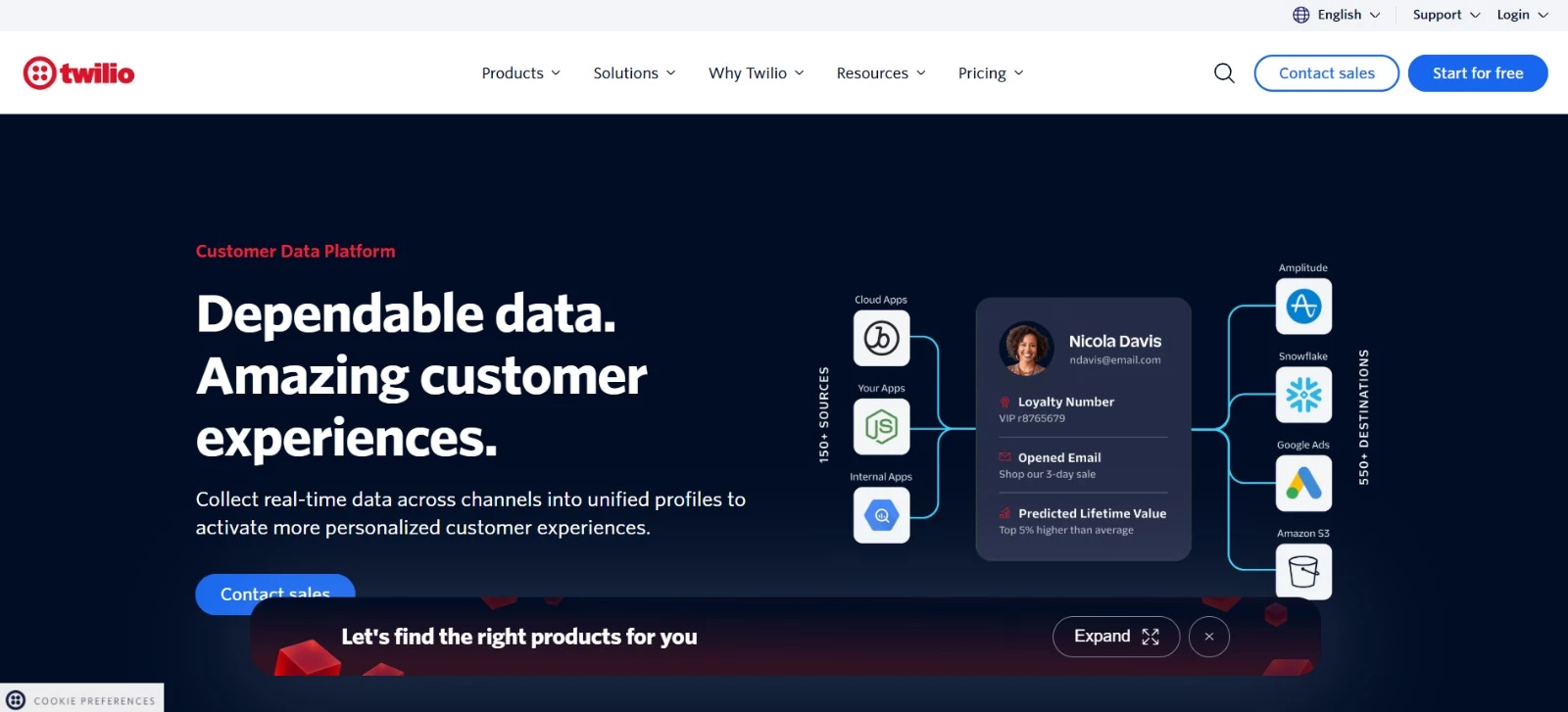
Twilio helps your marketing, analytics, and customer support tools work with consistent customer data. It collects activity across websites and apps, connects it with warehouse records, and builds profiles you can use across your existing systems.
It’s a great fit if you want to keep your current tools but improve how they share information. Your team can build audiences using both recent behavior and customer history, then use those audiences for onboarding, retention, or paid media campaigns.
Key Features
- Prebuilt integrations: Connect data sources and destinations through a catalog of 700+ connectors, with APIs and developer tools for custom requirements.
- Identity resolution: Link anonymous activity with known customer records through Unify to build profiles that update as new interactions occur.
- Warehouse enrichment: Use warehouse data to add context to profiles and create audiences based on purchases, account details, or product usage.
- Audience building and journeys: Engage supports segmentation and journey orchestration, with AI predictions and recommendations for more targeted outreach.
- Data quality controls: The optional Protocols add-on validates incoming events against tracking plans and helps prevent inconsistent data from reaching the connected tools.
Pricing
- Full Customer Data Platform: Custom pricing for Connections, Unify, and Engage
- Connections Free: For 1,000 monthly visitors and two sources
- Connections Team: From $120/month, including 10,000 monthly visitors
- Connections Business: Custom pricing
The Free and Team plans cover the Customer Data Pipeline offering. The full CDP, including unified profiles and advanced audience capabilities, requires a separate quote.
Potential Limitations
- Initial setup requires technical work to define events, configure identity matching, and connect the relevant systems.
What Sets Twilio Segment Apart
Twilio’s Asana case study shows how event collection and warehouse-based audiences can reduce manual campaign preparation.
Asana connected web and product activity with customer records, allowing marketing and customer success teams to create audiences without waiting on analytics requests.
The company reported:
- Same-day audience execution, replacing waits of up to two days
- More than 250 working days saved through audience creation in just over a year
- Up to a 57% increase in web leads through paid media campaigns


2. Salesforce Data 360: Best for Activating Customer Data
For marketing, sales, and service teams already working in Salesforce.
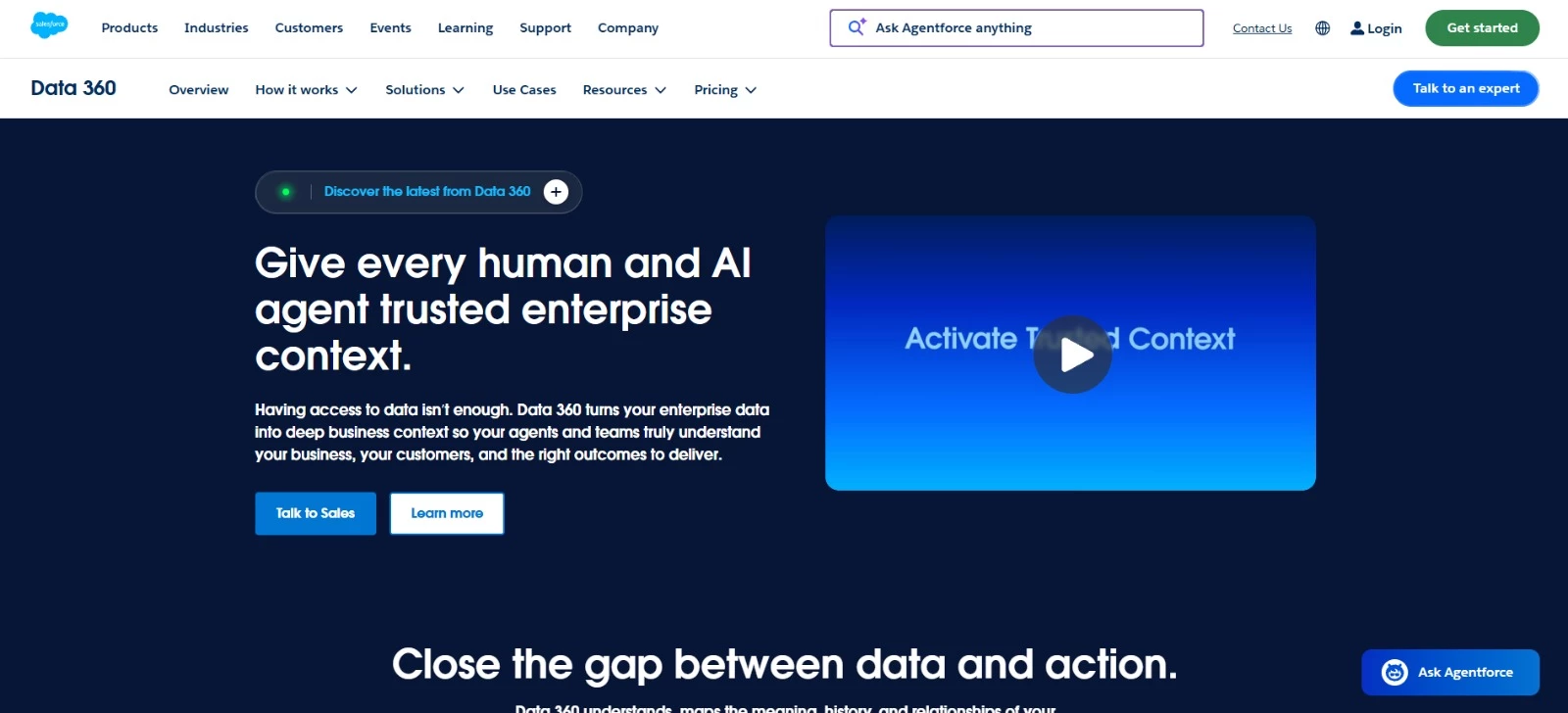
A customer’s purchase history, support requests, and website activity can inform several teams’ next steps.
Salesforce Data 360, formerly Data Cloud, brings that information into unified profiles that your Salesforce applications can use for targeting, automation, and customer service.
Marketers can build audiences using purchase and interaction data, and service representatives can access customer context within their existing workflows. Connections to external databases and cloud warehouses extend that view beyond Salesforce records.
Key Features
- Configurable identity matching: Define which records belong to the same person or account and which values take precedence when details conflict.
- Calculated insights and segmentation: Create metrics such as customer lifetime value and use them to build targeted audiences.
- Salesforce workflow activation: Make audience data available to Marketing Cloud and trigger Salesforce Flows for follow-up actions.
- Zero-copy integrations: Access data in supported platforms, including Snowflake and Databricks, without first copying the underlying datasets into Salesforce.
- Customer context for AI: Supply unified customer information to Agentforce so agents can use relevant history when responding or taking action.
Pricing
- Free provisioning: Available to Salesforce customers with limited storage and consumption credits
- Flex Credits: $500 per 100,000 credits
- Profiles: $240 per 1,000 profiles/year
- Enterprise Profiles: $420 per 1,000 profiles/year
Potential Limitations
- Campaign delivery depends on connected applications such as Marketing Cloud as Data 360 doesn’t replace those tools
- You should consider the costs carefully because profile counts and chargeable data operations both affect the total
What Sets Salesforce Data 360 Apart
Heathrow Airport’s Salesforce implementation illustrates how customer data can support several connected services. Data Cloud brought together passenger interactions across service, marketing, and eCommerce, helping teams anticipate travelers’ needs before their next visit.
Marketing Cloud used more than 30 data sources to support targeted communications, including shopping recommendations and lounge options.
Salesforce reported these results across Heathrow’s broader implementation:
- 30% growth in digital revenue since 2019
- 49% open rate for personalized customer emails
3. Adobe Real-Time CDP: Best for Audience Activation Within Adobe Experience Cloud
For enterprise marketing and customer experience teams using Adobe’s personalization, campaign, and analytics tools.
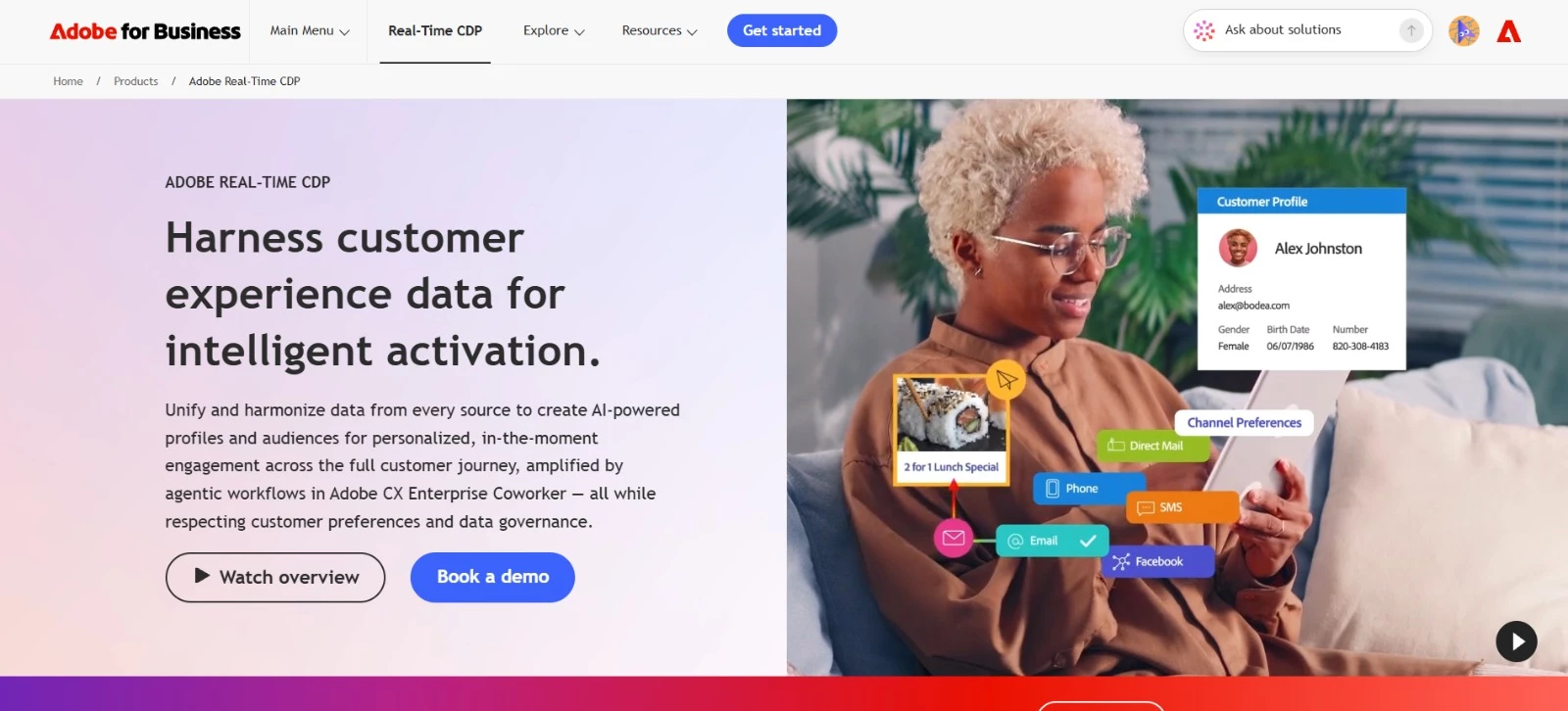
Adobe Real-Time CDP gives your campaigns a shared audience foundation. It connects customer records and behavioral data so the segments you build can inform website personalization, advertising, and customer messaging.
For teams using Adobe Target or Journey Optimizer, that connection makes customer insights easier to apply.
You can identify shoppers likely to purchase, for example, then make that audience available to the application delivering the offer.
Key Features
- Unified customer profiles: Link known customer records with pseudonymous activity, such as browser identifiers, using Adobe Experience Platform’s identity services.
- Flexible segmentation: Build audiences through batch, streaming, or edge evaluation, depending on how quickly the use case requires updates.
- Predictive audiences: Use AI-generated propensity scores to identify customers likely to convert or disengage.
- Data governance: Apply usage labels, policies, and access permissions to restrict how customer information is shared and activated.
- Adobe and external destinations: Send audiences to connected personalization, marketing, and advertising tools through prebuilt integrations and APIs.
Pricing
- Custom pricing
Potential Limitations
- Message delivery and website personalization require connected applications, such as Journey Optimizer or Adobe Target.
- Real-Time doesn’t apply to every audience workflow.
What Sets Adobe Real-Time CDP Apart
HanesBrands used Real-Time CDP and Adobe Target to improve retargeting targeting audiences based on shopping behavior and purchase propensity.
The team refined email campaigns and personalized landing pages with recently viewed products.
Adobe reports that this work produced:
- 57% more revenue
- An additional 1,000 customers reached per week
- Retargeted customers becoming three times more likely to purchase
4. Hightouch: Best for Activating Data From Your Existing Warehouse
For marketing teams with an established cloud data warehouse and data engineering support.
Your warehouse may already hold the purchase history, product activity, and customer scores needed for better targeting.
Hightouch makes that data available to the marketing tools running your campaigns, with support for Snowflake, Databricks, BigQuery, and other sources.
Once your data team sets up the connections and data models, marketers can build audiences without writing SQL.
That could mean excluding paying customers from acquisition ads or identifying frequent buyers for a loyalty campaign, using the data your business already maintains.
Key Features
- Visual audience builder: Create segments using customer attributes, purchases, and behavioral data through Customer Studio.
- Reverse ETL: Sync warehouse data to advertising platforms, CRMs, and messaging tools.
- Identity resolution: Define matching rules to link fragmented customer records and build an identity graph in your warehouse.
- Journey orchestration: Set up campaign sequences with delays, branches, and exit conditions.
- Audience experiments: Create randomized audience splits and holdout groups to measure campaign impact.
Pricing
- Free: Two active syncs, with hourly updates
- Self-serve: Includes 10 active syncs, also limited to hourly updates
- Business/Composable CDP: Custom pricing based on the selected capabilities and usage. Customer Studio requires a Business plan
Potential Limitations
- Data teams must prepare the models, relationships, and connections before marketers can build audiences independently.
- Warehouse refreshes and sync schedules affect how quickly changes reach campaign tools
What Sets Hightouch Apart
Grammarly’s customer story shows how Hightouch puts existing data science work into daily marketing use.
Grammarly used customer models in its existing data platform, Databricks, to update advertising audiences and send personalized product usage data to Iterable for its weekly insights emails.
Here’s what they achieved:
- Campaign turnaround fell to three days, down from four weeks
- More than 20 dynamic advertising audiences replaced five or six static audiences.
- Lifetime value increased by 4.1% for new Google Search conversions after Grammarly introduced value-based bidding using conversion data sent through Hightouch
5. Tealium: Best for Managing Customer Data and Consent Preferences
For enterprise marketing operations and data teams managing customer information across multiple channels and systems.
Tealium connects data collection, customer profiles, and activation with controls that govern which information reaches your marketing tools.
You can collect website and app activity, enrich profiles with CRM or offline records, and trigger actions as customer behavior changes. Its consent integrations and server-side rules help apply customer preferences throughout those workflows.
Key Features
- Multichannel data collection: Capture events through web tags, mobile SDKs, APIs, and server-side connections.
- Consent orchestration: Apply purpose-based rules to control event processing and sharing with connected systems.
- Identity resolution: Link activity across devices and sessions to persistent customer profiles.
- Audience activation: Trigger downstream actions when customers enter or leave an audience, or use scheduled updates.
- 1,300+ integrations: Connect with advertising, analytics, CRM, personalization, and cloud data tools.
Pricing
- Data Cloud Activation: $1,000/month, billed annually
- Data Collection: Custom pricing
- CDP: Custom pricing, including real-time profiles and identity resolution
Potential Limitations
- Setting up consent controls requires technical support to map customer preferences to the relevant data collection and sharing rules.
- Sending email or SMS campaigns requires a separate messaging platform, with its own subscription and delivery costs.
What Sets Tealium Apart
DIRECTV used Tealium to rebuild its customer data operations after separating from its former parent company. Snowflake served as its central data platform, with Tealium handling real-time activation.
The team replaced manual campaign lists built separately for each channel with:
- Hundreds of reusable audiences
- Customer journeys based on unified identities
- More streamlined campaign execution
6. Amperity: Best for Unifying Online and Offline Customer Records
For retail, hospitality, and other consumer brands with fragmented purchase, loyalty, and customer account data.
Amperity matches customer records even when details differ between systems, such as a misspelled name or an outdated address.
Its identity resolution engine, Stitch, uses matching rules and AI-based scoring to link online orders, store purchases, and loyalty activity to the same person. Those profiles support audience targeting based on purchase history, predicted lifetime value, and churn risk.
Key Features
- Identity resolution: Use Stitch to match customer records through deterministic rules and probabilistic scoring.
- Match transparency: Review why records were linked and investigate the resulting customer profiles.
- Unified profiles: Organize transactions, loyalty information, and digital activity into customer histories.
- Predictive insights: Build segments using predicted lifetime value, churn risk, and purchase likelihood.
- Audience activation: Send customer segments to connected advertising and marketing platforms for targeting, suppression, and personalization.
Pricing
- Standard Edition: Custom pricing, with full platform access and weekday support
- Enterprise Edition: Custom pricing, adding 24/7 support, priority response commitments, and instructor-led training
Potential Limitations
- Costs depend on processing and campaign activity, so customer record counts alone aren’t enough to estimate your budget
- Standard support runs Monday through Friday, 6 a.m. to 6 p.m. Pacific. Round-the-clock coverage requires Enterprise
What Sets Amperity Apart
Catalyst Brands used Amperity to identify high-value customers across its retail brands and build more targeted advertising audiences.
The retail group brought online and offline records together, then used predicted customer lifetime value to build audiences for Meta and Google. Amperity reports:
- 5x return on ad spend using predicted lifetime value for segmentation
- Automatically refreshed first-party audiences
- Direct audience delivery to media platforms, replacing manual transfers
7. Treasure AI: Best for Enterprise Customer Data and AI-Assisted Marketing
For enterprise marketing and data teams building customer audiences, journeys, and AI workflows across brands or business units.
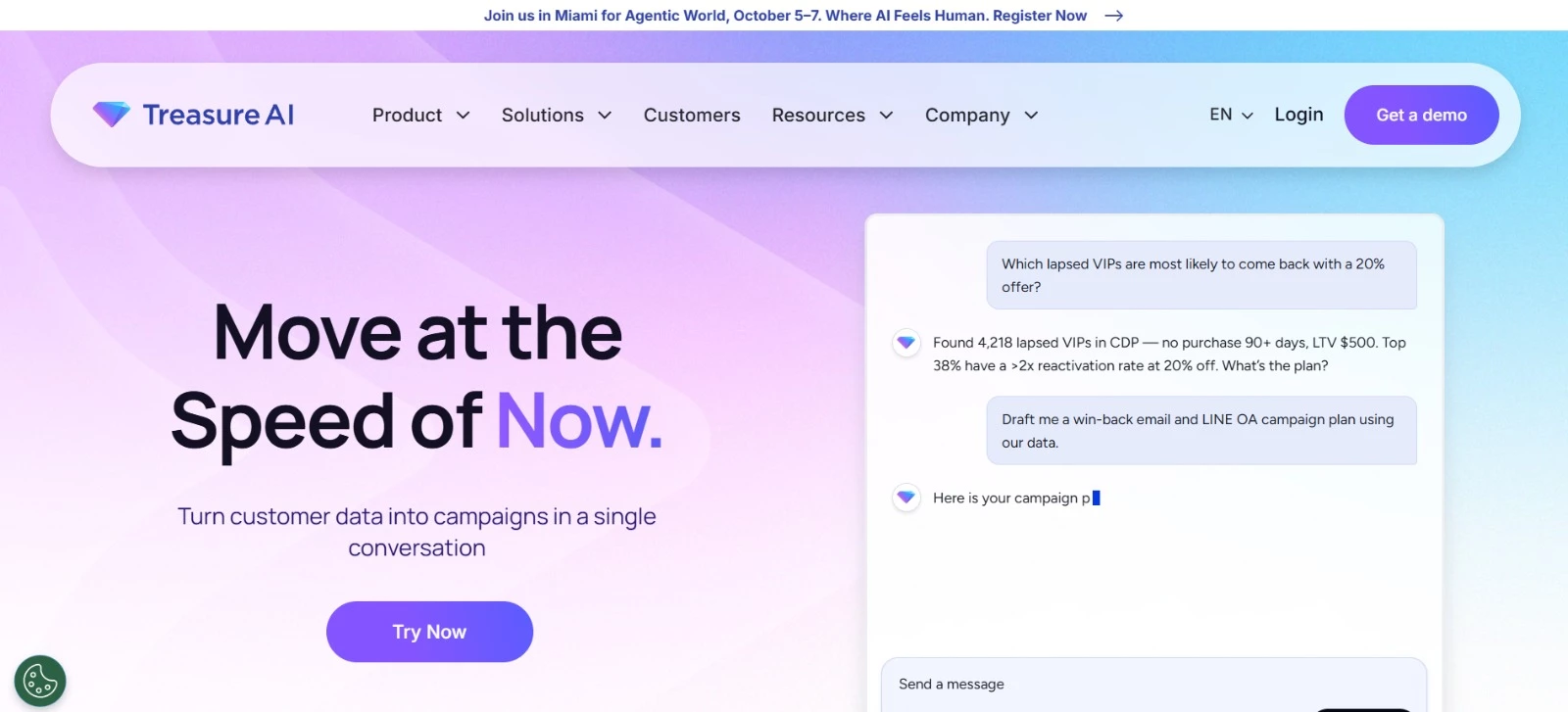
Treasure AI, formerly Treasure Data, offers a CDP with built-in AI assistance for segmentation and customer journeys. Its Complete CDP includes managed storage and profile unification.
The Composable option works with an existing cloud data warehouse and caches customer profiles for faster activation.
Adding an AI Suite lets your team use those audiences to run campaigns or personalize website content, depending on the suite selected.
Key Features
- Unified customer profiles: Link customer identities and behavioral data to support segmentation and personalization.
- AI-assisted audiences: Use Audience Agent to help build customer segments.
- Journey orchestration: Define customer journeys and coordinate audience activation.
- Custom AI agents: Build specialized agents through AI Agent Foundry, included in the CDP subscription.
- Data and AI controls: Apply fine-grained access permissions, mask personally identifiable information, and audit activity.
Pricing
- Intelligent CDP: Custom annual subscription based on customer profiles and behavioral data
- AI Suites: Additional annual licenses, with consumption-based credits for real-time features
- Treasure AI Studio: Included with the plans, with credit-based usage and no separate seat fee
Potential Limitations
- The CDP subscription doesn’t include every activation capability. Additional AI Suites introduce separate licensing and usage costs
What Sets Treasure AI Apart
Shiseido Interactive Beauty used the CDP to give marketers more direct access to customer data previously separated by brand and sales channel.
Audience Studio helped them create segments, and Journey Orchestration supported campaigns based on customers’ purchasing progression.
Here are the results:
- One hour to view the full range of customer data, previously requiring about a week
- 15% less time exchanging information between marketers and data engineers
8. mParticle: Best for Managing Customer Event Data Across Web and Mobile Apps
For product, engineering, and marketing teams that need consistent behavioral data for apps, websites, and campaign tools.
mParticle collects actions such as sign-ups, purchases, and app activity, then distributes that data to connected marketing analytics tools.
Shared tracking rules help keep event names and attributes consistent across platforms, reducing discrepancies between the systems your teams rely on.
Its Data Plans flag tracking errors and can block unplanned events before they reach the connected tools.
Key Features
- Web and mobile collection: Capture customer activity through SDKs for iOS, Android, and web, plus server-side APIs.
- Data quality controls: Define expected events and attributes, validate incoming data, and investigate tracking errors.
- Identity resolution: Associate incoming activity with customer profiles to connect interactions from different sources.
- Selective data routing: Control which events and attributes each connected destination receives.
- Warehouse audiences: Build segments using customer history and models stored in your warehouse, with scheduled audience updates.
Pricing
- Custom pricing: Contact sales for a quote
Potential Limitations
- Developers must implement tracking and update it when new events or app features are introduced
- Data Plans flag tracking issues, but blocking is limited to unplanned events and attributes. Incorrect values and other validation errors still require correction
What Sets mParticle Apart
ChowNow implemented mParticle across its websites and iOS and Android apps to address inconsistent customer data and repeated engineering work.
A centralized data plan gave teams common tracking definitions, and server-side integrations made it easier to connect new tools after the initial implementation. This led to the following:
- Six data sources unified into a customer view
- Four tools integrated without engineering support
ChowNow also linked experiment assignments with subsequent product activity, helping its product team evaluate how new features affected customer behavior.
9. Insider One: Best for Cross-Channel Customer Journey Orchestration
For CRM and lifecycle marketing teams coordinating campaigns for websites, apps, email, and messaging channels.
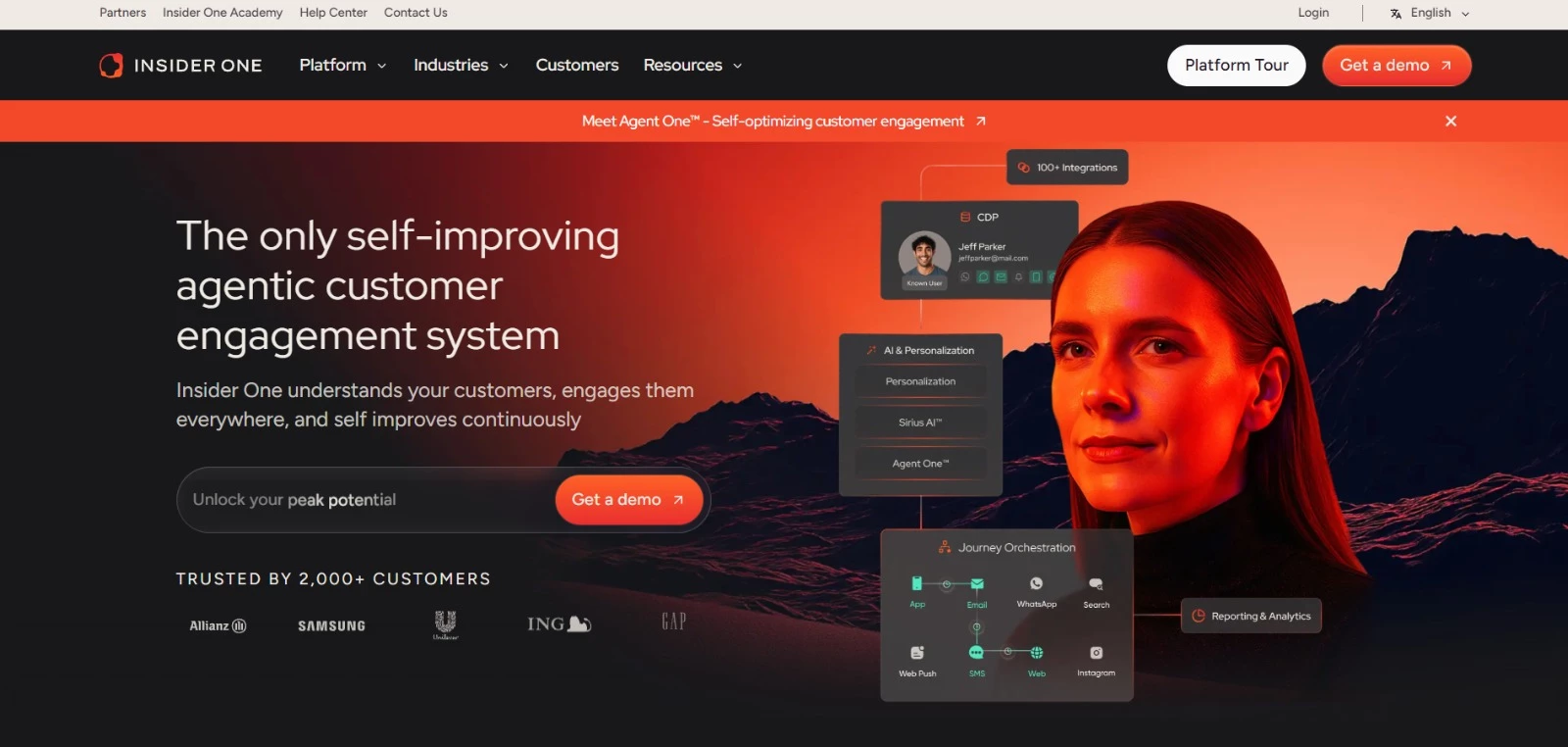
Insider One connects unified customer profiles to campaign delivery tools. Its CDP supplies the customer history and audience criteria.
Architect, its visual journey builder, controls when messages go out and how follow-ups change based on customer behavior. The broader offering includes email, SMS, WhatsApp, and push notifications.
A cart recovery journey, for example, can include a delay, check whether the customer purchased, and send a follow-up only if they still qualify.
Key Features
- Unified customer profiles: Bring customer attributes and interactions together, with integrations for CRM, analytics, and warehouse data.
- Behavioral and predictive segments: Target audiences using purchase history, channel engagement, and predicted likelihood to buy.
- Visual journey builder: Arrange triggers, waiting periods, conditions, and messages in Architect.
- Built-in campaign channels: Coordinate email, SMS, WhatsApp, web push, and app experiences using shared customer data.
- Journey testing and reporting: Compare paths with A/B splits and control groups, then track conversions, engagement, and journey exits.
Pricing
- Contact sales for a quote
Potential Limitations
- Journey setup still requires validated event tracking, customer attributes, and channel integrations before campaigns can run reliably.
What Sets Insider One Apart
NA-KD used Insider One’s CDP and Architect to connect fragmented customer data and coordinate personalized journeys across its website, app, email, SMS, and push notifications.
Insider One reports that the program achieved these results over 12 months:
- 25% increase in customer lifetime value
- 72x return on investment
10. Bloomreach: Best for Ecommerce Lifecycle Marketing
For ecommerce and retention teams personalizing campaigns around shopping behavior, product preferences, and repeat purchases.
Bloomreach brings customer and product data into the same marketing workflow. Its Data Engine supplies the CDP capabilities, including unified profiles and audience segmentation, within a broader offering that includes campaign delivery and personalization.
Purchase history and recent interactions inform who receives a message and which products appear.
Key Features
- Customer profiles: Connect historical purchases, current interactions, and predicted behavior in a single marketing view.
- Dynamic segmentation: Build audiences using customer attributes and calculated values, with membership updated as data changes.
- Product recommendations: Personalize product suggestions in messages and website sessions.
- Lifecycle campaigns: Coordinate email, SMS, and web or app personalization through Bloomreach’s marketing automation tools.
- Consent and frequency controls: Maintain consent histories and adjust messaging frequency based on customer engagement.
Pricing
- Custom annual subscription: Pricing consists of a module fee and a usage fee
Potential Limitations
- Channels and features are sold through separate modules, so one subscription doesn’t automatically include every capability shown on the website
What Sets Bloomreach Apart
ThirdLove worked with Bloomreach and agency IM Digital to personalize shopping experiences using purchase records and fit quiz responses.
Those quiz responses supplied zero-party data, giving the brand preferences customers had shared directly.
Customers were assigned to five groups based on bra size, with new purchases or quiz answers updating their profiles and triggering updates across connected marketing systems.
- Bloomreach reports that the project delivered:
- Personalized website experiences for 3.5 million customers
- More than $256,000 in incremental revenue within a few months
CDP vs. CRM vs. DMP: What Is the Difference, and Which Do You Need?
A CDP unifies customer data for segmentation and activation. A CRM manages customer relationships and the work around them. A data management platform (DMP) organizes audiences primarily for advertising.
Their capabilities overlap, so the choice depends on what your existing tools cannot handle.
| Factor | CDP | CRM | DMP |
| Primary role | Connect customer data across systems and make it available for marketing and other teams | Manage leads, accounts, sales activity, and customer service | Build and activate advertising audiences |
| Typical data | Website and app behavior, purchases, preferences, and CRM records | Contact details, deal history, communications, and support records | Audience attributes and online behavior sourced from the business, partners, or data providers |
| Main users | Marketing operations, lifecycle marketing, and data teams | Sales, service, and marketing teams | Paid media teams and ad operations |
| Example use case | Identify repeat buyers across online and store purchases for a retention campaign | Track a sales opportunity and schedule the next follow-up | Build prospecting audiences using interest and intent signals |
Start with the gap in your current setup:
- Choose a CRM if the priority is tracking prospects, managing deals, or giving sales and service teams a shared interaction history.
- Consider adding a CDP if campaigns require customer data scattered across your CRM, ecommerce platform, website, and app, and your team repeatedly reconciles those records or rebuilds audiences manually.
- Evaluate a DMP if your media strategy requires audience data and advertising integrations your existing CDP and ad platforms don't provide.
A CDP doesn’t replace the CRM’s pipeline or service workflows. For example, the CRM can manage a customer’s account, and the CDP can connect that record with shopping behavior to determine which retention audience they belong to.
Before buying another platform, establish whether your current tools can support the intended campaign with the data and update frequency it needs.
How To Choose the Right Customer Data Platform
Build your shortlist around a campaign your team needs to run and the data required to support it.
Ask vendors to demonstrate the full workflow using a sample of your data, including how an audience reaches the tool delivering the campaign.
| Your Priority | Platforms To Consider | What To Verify Before Buying |
| Keep customer data consistent across existing tools | Twilio Segment, mParticle | Support for your events, data validation rules, and required destinations |
| Activate data already maintained in a warehouse | Hightouch | Data preparation responsibilities, audience refresh frequency, and warehouse costs |
| Use customer profiles within an established marketing suite | Salesforce Data 360, Adobe Real-Time CDP | Compatibility with your existing applications and any additional activation licenses |
| Apply customer preferences across collection and activation | Tealium | How preference changes affect each connected destination and which rules require configuration |
| Match fragmented online and offline records | Amperity | Matching accuracy on your data and the ability to investigate incorrect profile merges |
| Manage enterprise customer data with AI-assisted workflows | Treasure AI | Which workflows the CDP subscription covers and which require AI Suites or usage credits |
| Build audiences and deliver lifecycle campaigns | Insider One, Bloomreach | Included channels, message charges, and the work needed to migrate existing campaigns |
If your team needs help turning those customer insights into campaigns, DesignRush’s top digital marketing agencies can help with audience strategy, marketing integrations, and execution.
Our team ranks agencies worldwide to help you find a qualified partner. Visit our Agency Directory to find top-rated digital marketing companies, as well as: