
In 2026, AI web scraping platforms power pricing engines, competitive intelligence, market research, and AI model training.
However, not all AI scrapers are built for enterprise needs. Selecting the right platform can determine whether your data strategy scales successfully or stalls under pressure.
AI Web Scraping Tools: Key Findings
- Bright Data, Import.io, and Diffbot deliver scalable, governed, production-ready web data systems with advanced orchestration and compliance capabilities.
- Browse AI, Thunderbit, Gumloop, Octoparse, and Firecrawl focus on AI-driven automation, offering adaptive extraction, faster deployment, and workflow-friendly platforms.
- Kadoa, Diffbot, and Tavily emphasize intelligence and context, extending beyond basic extraction to provide semantic understanding and real-time relevance.
The Rise of AI for Web Scraping in Modern Enterprises
AI web scraper platforms are now core enterprise infrastructure in 2026.
These tools power everything from pricing optimization to competitive intelligence and large-scale research.
As organizations increasingly operationalize web data for strategic decision-making, demand for structured external intelligence continues to accelerate. Major analysts agree the web scraping market will more than double by 2030, underscoring its long-term enterprise relevance.
At the same time, AI-powered approaches are delivering measurable efficiency gains, reducing maintenance effort by up to 85% and improving accuracy from 85% to as high as 99.5% with machine learning validation.
Below are the best AI web scraping tools leading this transformation.
1. Bright Data: The Best AI Web Scraper for Enterprise-Scale Data
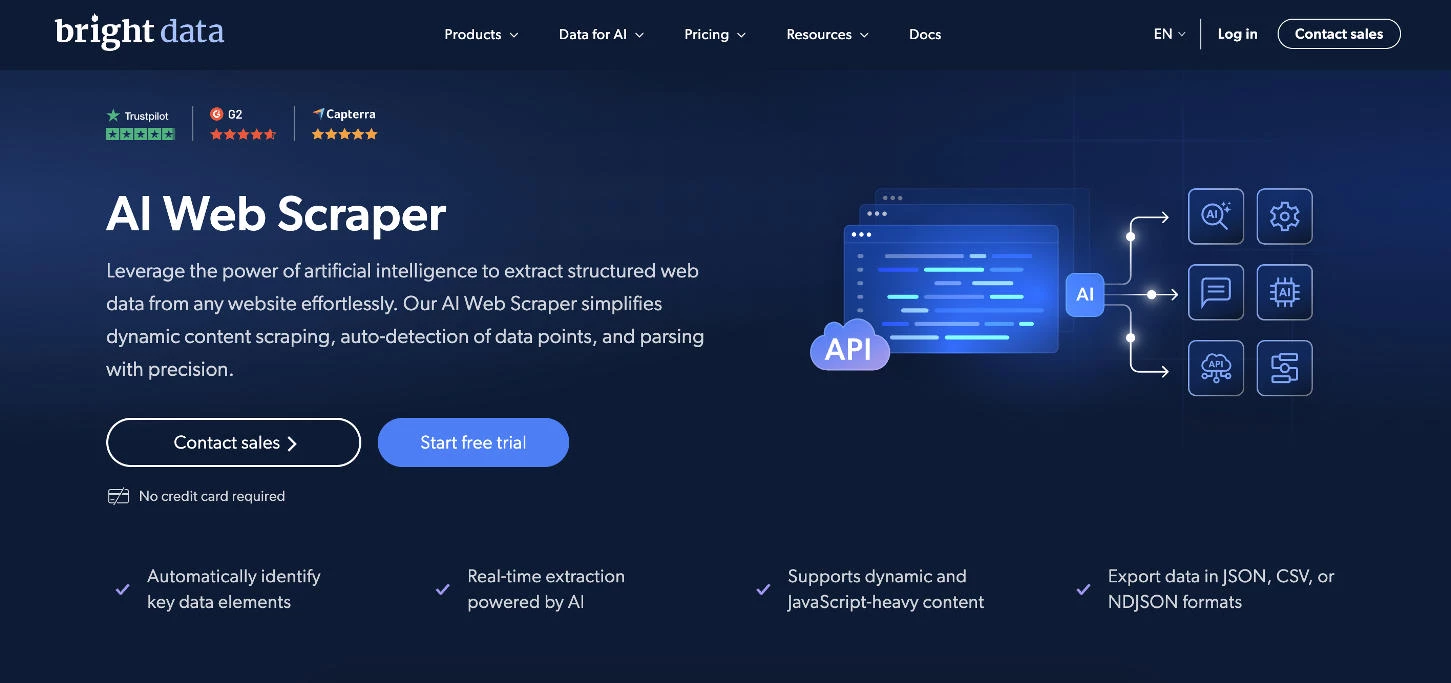
Bright Data stands out for enterprises that need reliable, AI-powered web data collection at global scale.
Its platform combines automated data extraction with intelligent orchestration, enabling teams to gather structured datasets from complex, dynamic websites with minimal manual intervention.
The real advantage is operational resilience. AI-driven rendering and adaptive scraping workflows reduce breakage when site structures change, keeping data pipelines stable and production-ready.
Pricing:
- Starts at $1.50/1K records (no commitment, pay as you go)
Get an exclusive discount. Use code APIS25 to receive 25% off.
Notable Features
- Scraper Studio, Data Feeds, and Datasets feature for data collection, from no-code pipelines to real-time and pre-collected data
- Search & Extract for real-time data retrieval tailored for AI systems
- GDPR, CCPA, ISO 27001, SOC 2/3 certified, backed by a global Compliance & Ethics team
- Native MCP Server (free) enabling direct integration with Claude, Gemini, and LangGraph-based AI agents
- Agent Browser for autonomous, multi-step web interactions
Who’s It For?
Bright Data is built for Fortune 500 enterprises, AI/ML teams training foundation models, and government and financial institutions requiring full compliance documentation.
It also supports eCommerce leaders monitoring millions of SKUs daily, as well as any organization where data pipeline failures have material business consequences.
It’s best suited for teams that need dependable, high-frequency web data integrated into production workflows, not one-off extraction projects.
Get started with Bright Data’s free trial – no credit card needed.
2. Browse AI: Best AI Web Scraping Tool for Fast Deployment
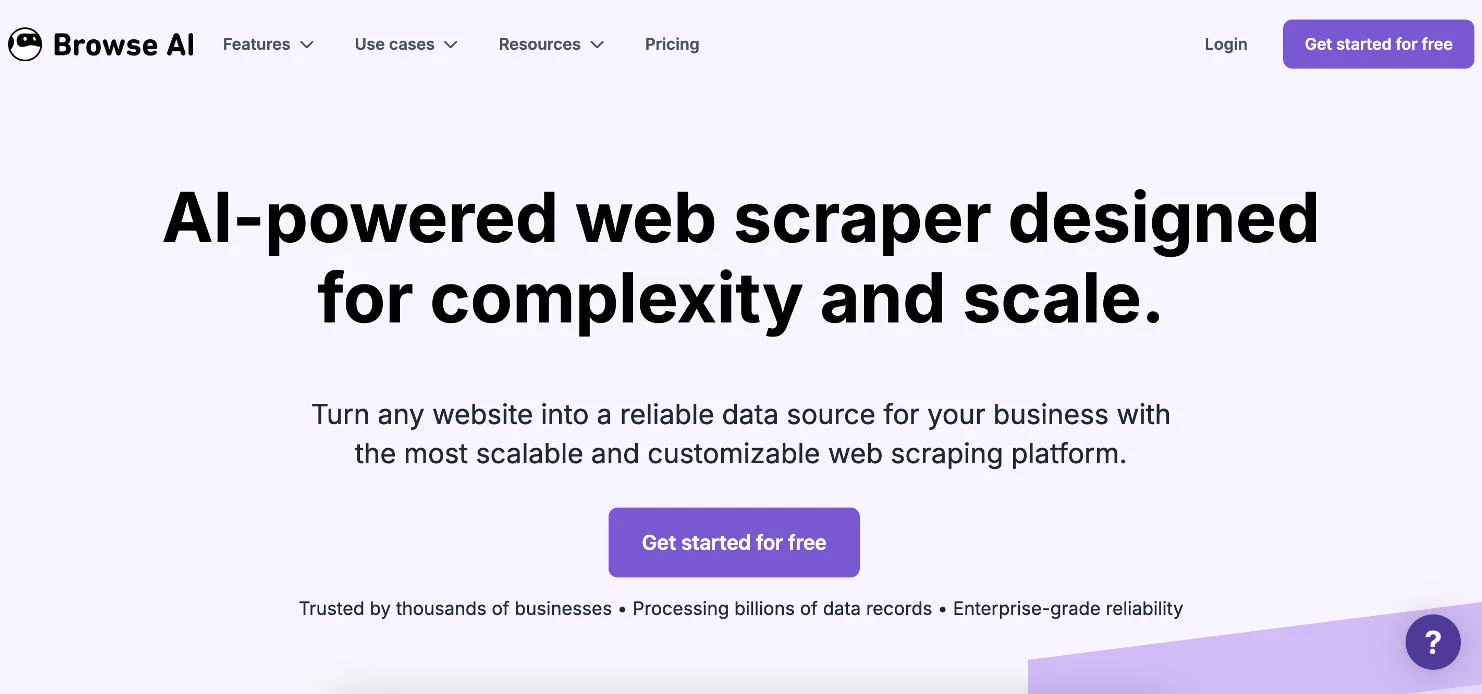
Browse AI differentiates itself with an AI-driven, no-code approach to structured data extraction and website monitoring. Enterprise teams can train robots to capture specific data points in minutes, reducing dependency on engineering resources while accelerating deployment timelines.
Its AI continuously adapts to layout changes, helping maintain data accuracy without constant reconfiguration. This makes it especially effective for recurring competitive tracking and operational intelligence.
Pricing:
- Free
- Personal: $48/month
- Professional: $87/month
- Premium: Starts at $500
Notable Features
- Visual robot training interface for rapid, non-technical deployment
- Scheduled monitoring with automated change alerts
- Built-in data validation and formatting controls
- Team collaboration workspaces with role-based access
Who’s It For?
Browse AI shines in fast-moving enterprise environments where marketing, eCommerce, and operations teams can’t afford long implementation cycles.
For organizations under pressure to deploy quickly and share insights across departments, it delivers scalable, AI-powered data collection that keeps pace with business demands.
3. Thunderbit: AI for Web Scraping with Prompt-Based Control
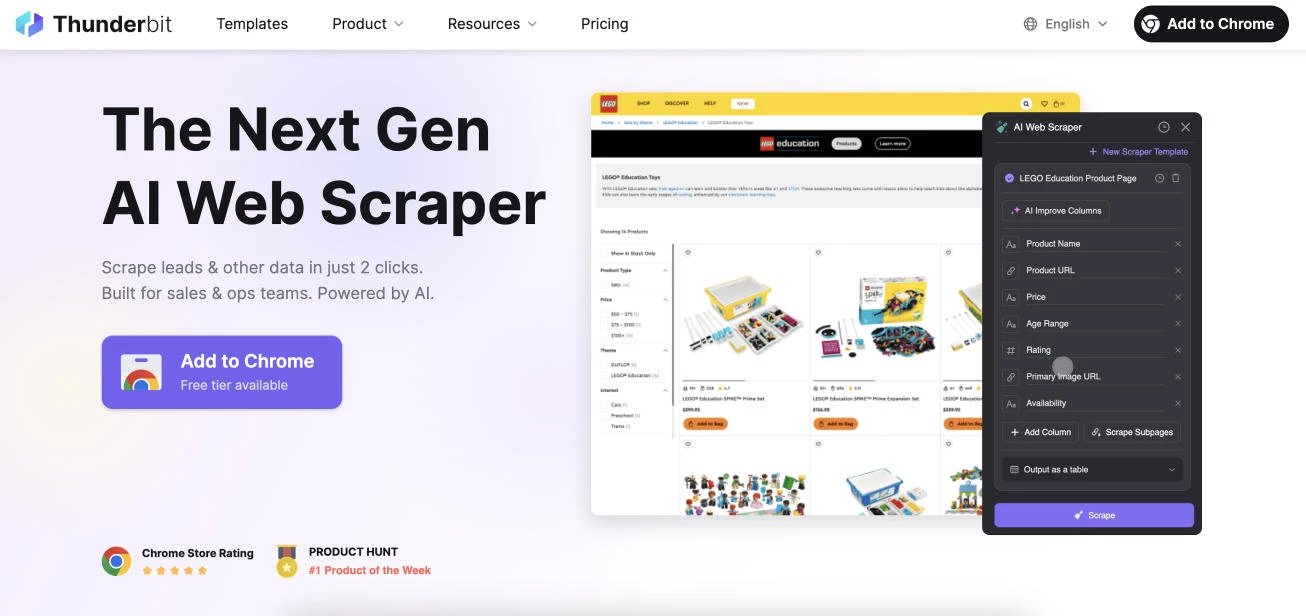
Thunderbit takes a prompt-driven approach to AI web scraping, allowing enterprise teams to describe the data they need instead of manually defining complex extraction rules. Its AI interprets page structure, identifies relevant elements, and converts unstructured content into clean datasets.
The platform excels on dynamic, content-rich websites where traditional rule-based scraping struggles. AI models continuously refine extraction logic, reducing manual oversight and improving long-term stability.
Pricing:
- Free
- Starter: $15/month
- Pro: $38/month
- Business: Custom pricing
Notable Features
- AI-powered field recognition and classification
- Automatic handling of pagination and nested content
- Data normalization for structured analytics pipelines
- Workflow automation for recurring extraction tasks
Who’s It For?
Thunderbit is built for enterprise analytics, research, and strategy teams that need structured intelligence from messy, fast-changing websites. When speed, flexibility, and reduced engineering dependency matter, it enables organizations to operationalize AI-driven data extraction.
4. Import.io: Best AI Web Scraper for Managed Data Pipelines
Import.io has a fully managed approach to AI-powered web data extraction. Rather than simply providing tooling, it delivers structured, reliable datasets that are ready for enterprise analytics and decision-making.
Its AI models interpret complex site structures and maintain extraction logic as pages evolve, minimizing disruption. This reduces operational risk for teams that depend on continuous, accurate external data streams.
Pricing available by request.
Notable Features
- End-to-end managed data services with SLA-backed delivery
- AI-driven site structure analysis and adaptive extraction models
- Automated data cleansing and enrichment workflows
- Enterprise governance, compliance, and audit controls
Who’s It For?
Import.io is built for enterprises where web data feeds pricing engines, market intelligence dashboards, and executive reporting.
When downtime, inconsistency, or internal bandwidth constraints aren’t acceptable, it provides a structured, service-backed solution that turns external web data into dependable business intelligence at scale.
5. Kadoa: AI Web Scraping with Semantic Intelligence
Kadoa stands out by combining AI-driven semantic understanding with web data extraction, enabling enterprises to pull not just text and tables but context-rich insights from complex online sources.
Its models interpret meaning and relationships within content, producing more nuanced, business-ready datasets.
This intelligent approach minimizes manual rule-setting and enhances consistency across varied web structures. Enterprises benefit from cleaner, more relevant data streams tailored for advanced analytics.
Pricing:
- Flex: Free trial available
- Enterprise: Contact Kadoa
Notable Features
- Semantic content understanding for deeper context extraction
- Entity recognition and relationship mapping
- Integrated data tagging and classification workflows
- Enterprise-level security and role-based access controls
Who’s It For?
Kadoa excels for enterprise research, customer insights, and strategic analytics teams that need meaning beyond raw data.
When the goal is to transform web content into actionable intelligence for forecasting, segmentation, or competitive strategy, Kadoa delivers context-rich datasets that fuel smarter decisions.
6. Gumloop: Best for Conversational, Intent-Driven AI Web Scraping
Gumloop stands out by transforming web data extraction into an interactive, intent-driven experience. Instead of rigid workflows, enterprise teams can define what they need through conversational inputs, and the AI intelligently interprets and retrieves relevant structured data.
This approach accelerates deployment for non-technical stakeholders while maintaining robust output quality across varied content types. Gumloop’s AI continually refines its understanding, minimizing manual adjustments and enhancing reliability.
Pricing:
- Free
- Pro: $37/month
- Enterprise: Custom pricing
Notable Features
- Intent interpretation to guide data retrieval logic
- Adaptive learning from team feedback
- Smart data formatting and cleansing
- Unified workspace for cross-team collaboration
Who’s It For?
Gumloop empowers enterprise strategists, product teams, and market researchers who want to bridge business questions with web data outcomes.
When clarity of intent and rapid, reliable results matter more than traditional configuration, Gumloop turns human insight into structured datasets without losing quality or scale.
7. Firecrawl: Autonomous AI Web Scraping for Continuous Intelligence
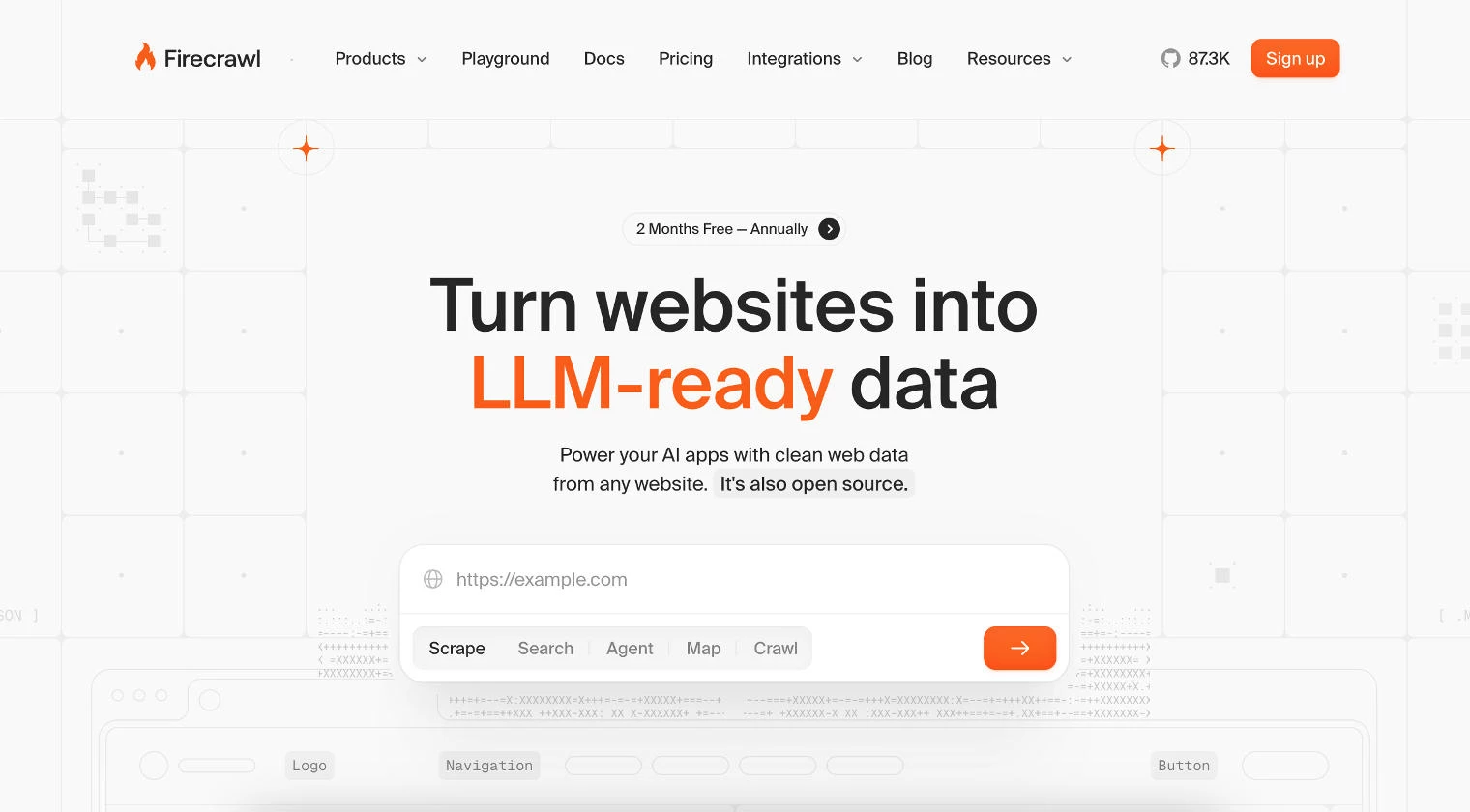
FireCrawl delivers autonomous, AI-powered web crawling that continuously discovers and extracts business-critical data. Designed for enterprise environments, it operates at scale with minimal human intervention, delivering fresh, structured datasets on a consistent cadence.
Its intelligent learning adjusts to site changes and content patterns, reducing operational friction and maintenance overhead. This ensures downstream analytics and decision systems receive reliable, timely data.
Pricing:
- Free
- Hobby: €17
- Standard: €87
- Growth: €349
- Scale: €656
- Enterprise: Custom
Notable Features
- Continuous data refresh schedules with change monitoring
- Scalable multi-domain extraction orchestration
- Automated dataset versioning and lineage tracking
- Enterprise governance and access controls
Who’s It For?
FireCrawl is built for enterprises where relentless market shifts and competitive dynamics make fresh data non-negotiable: think real-time pricing groups, portfolio analysts, and operations teams.
When the business stakes require always-on, low-touch data feeds that keep pace with change, FireCrawl delivers dependable, enterprise-grade web intelligence.
8. Diffbot: Enterprise AI Web Scraping Platform for Deep Data
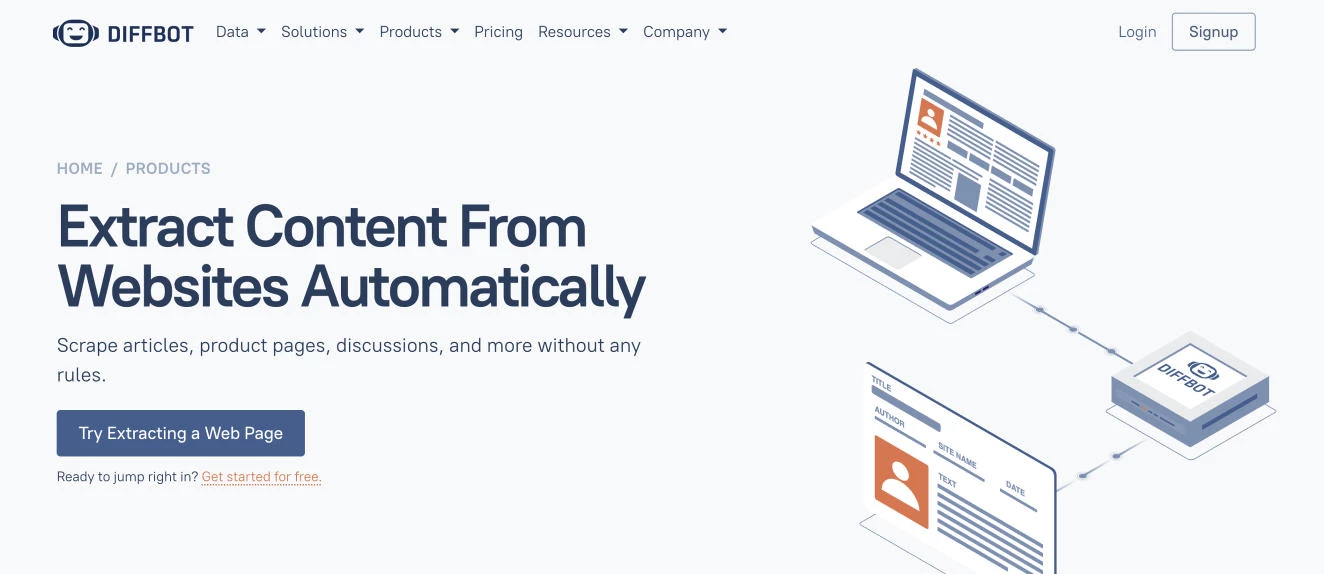
Diffbot excels at turning unstructured web content into highly structured, enterprise-ready knowledge. Its AI models analyze pages to extract entities, relationships, and semantics, creating a rich, interconnected dataset that goes far beyond simple tables and lists.
Enterprises can leverage this depth to power advanced analytics, trend detection, and automated insights. The platform’s understanding of context and structure reduces the need for complex rule definitions and frequent maintenance.
Pricing:
- Free
- Startup: $299/month
- Plus: $899/month
- Enterprise: Custom pricing
Notable Features
- Global web-scale knowledge graph construction
- Entity extraction with relationship linking
- Automated taxonomy and schema generation
- Semantic tagging and classification at scale
- Enterprise-grade security and compliance controls
Who’s It For?
Diffbot is a game changer for enterprises that need rich, interconnected web data rather than flat spreadsheets.
It supports competitive intelligence, AI model training, and deep research functions where understanding relationships and context across millions of sources drives strategic advantage and innovation.
9. Tavily: AI Web Scraping for Real-Time Intelligence
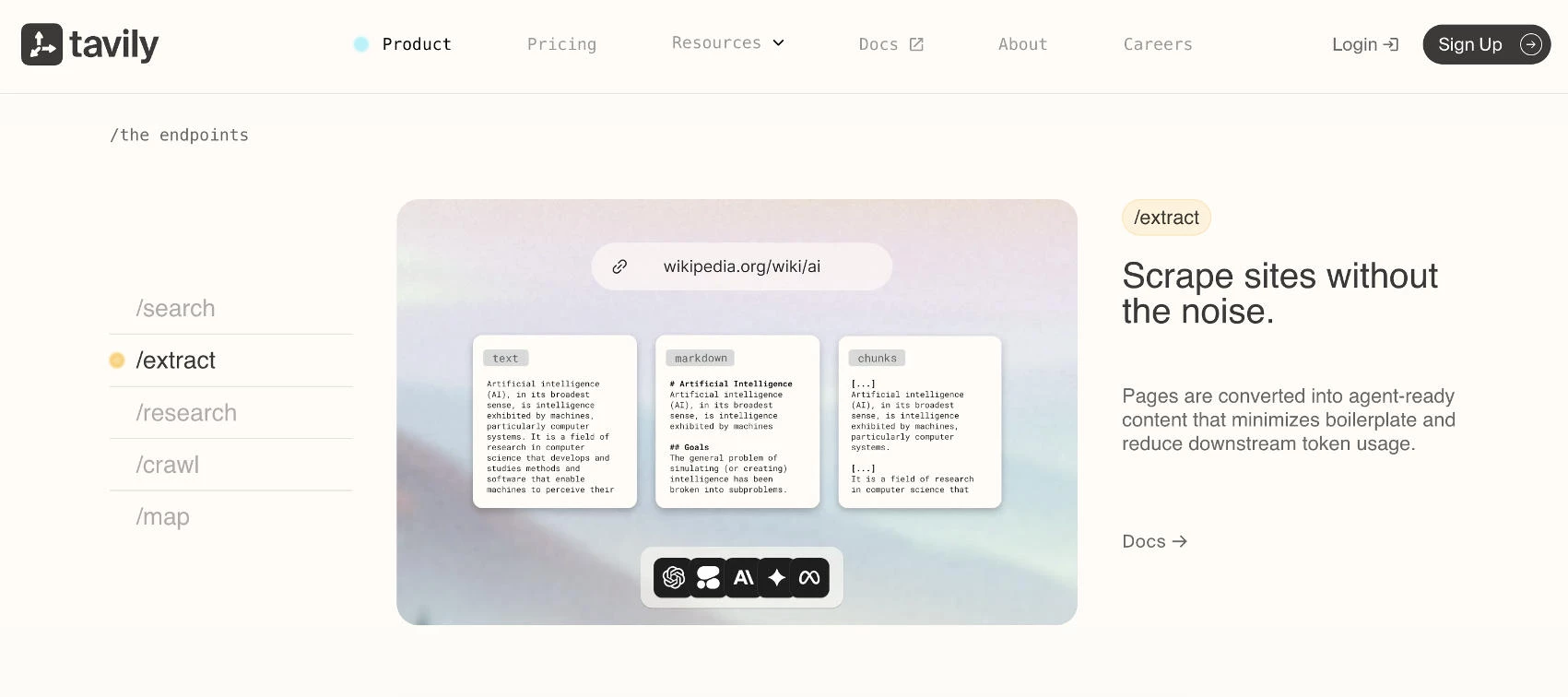
Tavily specializes in delivering real-time, AI-optimized web intelligence designed for enterprise environments.
Instead of traditional extraction workflows, it focuses on retrieving and refining relevant live web content that can directly support analytics systems, research workflows, and AI applications.
Its AI models prioritize relevance, filtering, and contextual understanding to ensure outputs are structured, accurate, and decision-ready. This reduces noise while improving the quality of downstream insights.
Pricing:
- Free
- Pay as you go: $0.008 / credit
- Project: $30/month
- Enteprise: Custom pricing
Notable Features
- AI-driven relevance filtering for cleaner outputs
- Depth-controlled exploration for focused intelligence gathering
- Structured result formatting for enterprise workflows
- Optimized performance for AI and analytics integrations
Who’s It For?
Tavily is built for enterprise AI teams, research departments, and product organizations embedding live web intelligence into their systems.
When up-to-date context, precision filtering, and scalable information retrieval are mission-critical, Tavily enables dependable web-driven insight without slowing innovation cycles.
10. Octoparse: Visual AI Web Scraper for Enterprise Workflows
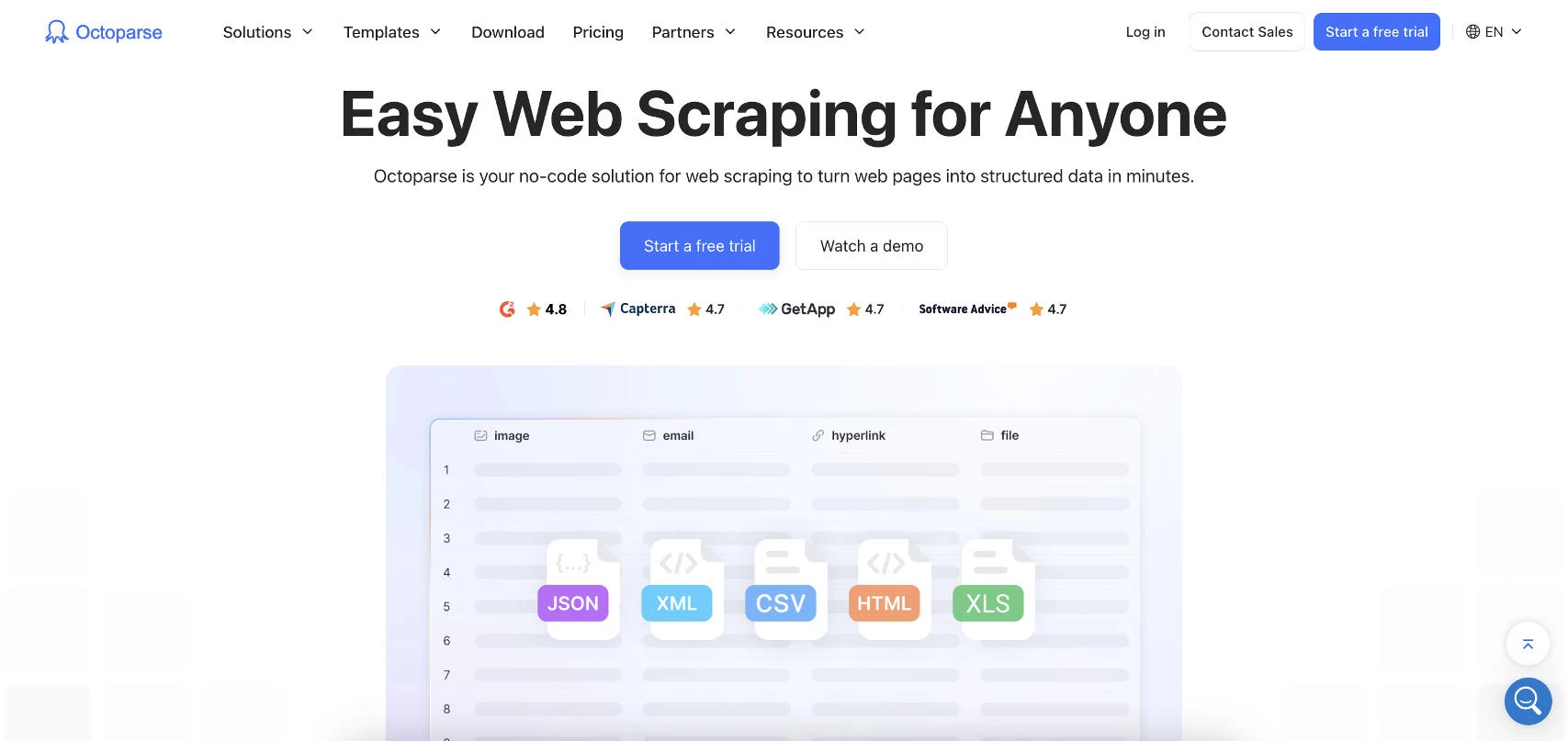
Octoparse combines visual workflow design with AI-assisted extraction, making it easier for enterprise teams to build structured data pipelines without complex configuration. Its interface supports scalable automation across diverse websites, reducing dependency on engineering resources.
The platform uses intelligent pattern recognition to adapt to layout variations and dynamic content. This helps maintain consistency in large-scale data operations, even as target sites evolve.
Pricing:
- Free
- Standard: $83/month
- Professional: $299/month
- Enterprise: Custom pricing
Notable Features
- Cloud-based task execution for scalable operations
- Pre-configured templates for common enterprise data sources
- Automated scheduling and recurring task management
- Multi-format structured data export options for analytics systems
Who’s It For?
Octoparse is well-suited for enterprise operations, marketing intelligence, and data teams that need structured web data without building complex internal systems.
When organizations require repeatable extraction processes that can be deployed across departments and scaled over time, Octoparse supports dependable, workflow-driven automation.
ChatGPT Web Scraping: How LLMs Work With Dedicated Scrapers
ChatGPT, Claude, and Gemini can access up-to-date web information via search and URL retrieval tools. These features are useful for researching topics, reading selected pages, and analyzing live online content, but they do not provide the same capabilities as a dedicated web scraping platform.
Built-in LLM tools may be sufficient for one-off research, but they’re not designed to replace dedicated infrastructure for repeated extraction across large numbers of URLs.
A typical LLM web scraping workflow divides the work between two systems:
- The LLM interprets the request: ChatGPT, Claude, Gemini, or another model identifies the information needed and determines how the results should be organized.
- The scraper collects the content: A dedicated tool loads pages, follows links, processes dynamic content, and returns clean or structured data.
- The LLM analyzes the results: The model can classify records, extract relevant details, summarize findings, or convert the data into a defined schema.
An automation layer sends the output elsewhere: The finished data can be delivered to a spreadsheet, a database, an application, or an AI agent.
For example, Firecrawl supports this type of setup by turning web pages into formats such as Markdown, HTML, screenshots, links, and structured JSON. Its scraping tools can also process JavaScript-rendered pages and extract specific fields using a supplied schema.
Firecrawl also offers an MCP server that lets compatible AI applications and agents use its search, scrape, map, crawl, and extraction capabilities. This allows the LLM to direct the task while Firecrawl handles the underlying web collection.
Using an LLM’s built-in web tools may be enough when the task involves:
- Checking or summarizing a small number of accessible pages
- Answering a research question using current information
- Reviewing content supplied through a specific URL
A dedicated AI scraping tool is more important when the project requires:
- Hundreds or thousands of pages
- Pagination or site-wide crawling
- JavaScript-heavy or frequently changing websites
- Scheduled collection and change monitoring
- Consistent fields across every result
- Structured outputs for production systems
Best AI Tools for Web Scraping: Side-by-Side
This table compares the leading enterprise-focused AI web scraping platforms based on core capabilities.
| Tool | Best For | Enterprise & Governance Controls | Built-in AI Knowledge Layer | High-Volume Processing | Pricing Starts At |
| Bright Data | Enterprise-scale data infrastructure | ✅ | ✅ | ✅ | $1.50/1K records |
| Browse AI | No-code deployment | ❌ | ❌ | ✅ | $48/month |
| Thunderbit | Prompt-based scraping | ✅ | ❌ | ✅ | $15/month |
| Import.io | Managed data pipelines | ✅ | ❌ | ✅ | Custom pricing |
| Kadoa | Semantic data extraction | ✅ | ✅ | ✅ | Custom pricing |
| Gumloop | AI workflows | ✅ | ❌ | ✅ | $37/month |
| Firecrawl | Autonomous web intelligence | ✅ | ❌ | ✅ | $17/month |
| Diffbot | Knowledge graph & web intelligence | ✅ | ✅ | ✅ | $299/month |
| Tavily | Real-time intelligence retrieval | ✅ | ❌ | ✅ | $0.008/credit |
| Octoparse | Visual workflow automation | ✅ | ❌ | ✅ | $83/month |
Choosing the Best AI Web Scraper for Your Enterprise
The best AI web scraping tools combine automation, adaptability, governance, and scalability while keeping long-term maintenance manageable.
As Bright Data Chief Product Officer Ariel Shulman emphasizes, accuracy and governance are foundational:
“Today’s AI models need constant access to fresh, structured, and compliant data. That requires infrastructure that’s always on, adapts automatically, and can be governed centrally.”
With that in mind, here are the key factors enterprises should evaluate when comparing AI web scraping platforms:
- Data accuracy and validation: Prioritize platforms with automated validation, anomaly detection, and continuous learning to ensure structured outputs remain reliable.
- Automation depth and workflow integration: Select solutions that connect seamlessly with analytics tools, dashboards, and enterprise workflows across departments.
- Adaptability to website changes: Choose AI systems that dynamically adjust to layout updates, content shifts, and structural changes.
- Scalability for high-volume collection: Ensure the platform can handle parallel tasks, large datasets, and cross-domain extraction without performance degradation.
- Governance, compliance, and audit controls: Look for role-based permissions, activity logging, centralized management, and documentation features that support regulatory requirements.
- Operational reliability and performance consistency: Evaluate uptime guarantees, monitoring capabilities, and infrastructure resilience to ensure uninterrupted data delivery.
AI Web Scraping: Final Thoughts
From autonomous crawling to semantic intelligence and managed enterprise pipelines, these platforms reflect how AI is reshaping structured web data collection in 2026.
The right solution depends on your scale, governance needs, and intelligence goals, but the shift toward AI-powered automation is undeniable.
Our team ranks agencies worldwide to help you find a qualified partner to implement the latest AI solutions. Visit our Agency Directory for the Top IT Services Companies, as well as:
- Top IT Consulting Companies
- Top IT Outsourcing Companies
- Top IT Services for Startups
- Top AI Automation Companies
- Top IT Services Companies in Florida
AI Web Scraping FAQs
1. How Is AI Scraping Different From Traditional Web Scraping?
Traditional web scraping usually relies on fixed rules, selectors, and scripts to locate specific elements on a page. These workflows can break when a website changes its layout, requiring developers to manually update the extraction logic.
An AI scraper uses machine learning or language models to interpret page structure and identify relevant content with less reliance on rigid rules.
This can help AI scraping workflows adapt to layout changes, process less predictable pages, and reduce ongoing maintenance.
2. What industries benefit most from AI web scraper platforms?
Finance, eCommerce, retail, SaaS, investment research, logistics, and enterprise analytics teams benefit most.
These industries rely on timely competitive intelligence, pricing signals, market trends, and structured external data to power forecasting, optimization, and data-driven strategic decisions.
3. Can AI web scrapers support real-time data needs?
Yes. Many AI platforms support continuous monitoring, automated refresh cycles, and real-time intelligence retrieval. This enables live dashboards, alerts, and AI systems to access up-to-date web data without manual intervention or recurring reconfiguration.
4. What should enterprises look for in AI web scraping tools?
Enterprises should evaluate scalability, governance controls, automation depth, data validation capabilities, reliability, and compliance features.
Strong platforms also offer centralized oversight, performance monitoring, and seamless integration with analytics environments to support long-term operational use.
5. How does AI web scraping support AI model training?
AI web scraping supplies structured, high-quality external datasets that improve model accuracy, contextual understanding, and generalization. By continuously feeding fresh, diverse web data into training pipelines, organizations can enhance performance and reduce model drift over time.