Handing technical SEO to a generalist is how small issues become serious ranking problems. Find vetted technical SEO services providers here, compare expertise, offerings, and track records before you commit.
Organic rankings are determined by five factors: top services, reviews, portfolio, awards/press, and team expertise. Sponsored listings pay for a placement that appears above organic positions. Sponsorship does not affect star ratings or review content - read more on our methodology page.
Sorry, no agency was found by that name.
Please retry your search.
Explore SEO Specializations
- Amazon
- Automotive
- B2B
- Construction
- Consulting
- Dental
- eCommerce
- Enterprise
- for Moving Companies
- Generative Engine Optimization
- Google My Business
- Healthcare
- Home Services
- Hospitality
- Insurance
- International
- Law Firm
- Link Building
- Local Optimization
- Manufacturing
- Mobile
- Multilingual
- Nonprofit
- On-Page Optimization
- Outsourcing
- Personal Injury
- Professional Services
- Real Estate
- Restaurants
- Shopify
- Small Business
- Startup
- Veterinarian
- Video
- YouTube
How to Hire Technical SEO Consultants
We've had two agencies in three years show traffic and ranking reports that looked good while our leads were flat. How do we structure accountability so we're not buying impressive dashboards again?
Require the agency to map target keywords to estimated revenue, showing search volume, realistic conversion rates, and projected pipeline, before the first month of work, so you've agreed on business metrics, not traffic metrics, as the measure of success.
Traffic and rankings are inputs.
Leads, qualified sessions from target-intent queries, and revenue influence are outputs.
Technical SEO services providers that report only on inputs are either not confident in their business-level impact, not tracking it, or optimizing for optics over outcomes.
The table below compares vanity reporting versus business reporting, so you can identify which type you're being sold.
| Metric type | Vanity | Business-tied |
| Traffic | Total organic sessions up 34% | Sessions from bottom-funnel queries up 18%; lead form completions from organic +22% |
| Rankings | We rank #1 for [broad keyword] | #1 ranking for [purchase-intent keyword] generating estimated 400 qualified visits/month |
| Links | 47 new backlinks acquired | 12 editorial placements in named industry publications; 3 DR 70+ domains |
| Content | 8 blog posts published | 3 bottom-funnel pages ranking in top 5; attributed to 14 demo requests last month |
If a proposal or monthly report looks like the left column, you're being measured on the agency's effort, not your business outcome.
The contract clause that enforces this will define success as a specific number (e.g., a 20% increase in organic-attributed MQLs over 12 months), agreed in writing before kickoff.
Technical SEO consultants who resist putting a business metric in the contract are telling you they don't plan to be held to one.
What appears on my first invoice beyond the retainer, and how much higher is my real monthly spend than the number quoted in the proposal?
Your all-in spend is typically 40-60% above the quoted retainer once setup fees, tool pass-throughs, content add-ons, and link-building tiers are included.
The retainer closes the deal because it's the number that sounds manageable.
The real budget conversation happens after you've signed.
Common add-on costs to standard technical SEO services include:
- Extra content beyond the base package: $200-$500 per article
- Standalone technical fixes: $500-$5,000
- Link building: $100-$500 per link
- SEO tool subscriptions passed through to clients: $200-$500/month
- Early contract termination fees of one to three months of the retainer.
The table below shows the specific line items that regularly appear outside the quoted retainer, with typical ranges.
| Add-on category | Typical range | Disclosed upfront? |
| Initial technical audit | $500-$7,500 | Sometimes |
| GA4 / Search Console setup | $300-$1,500 | Rraely |
| Tool subscriptions | $200-$500/month | Sometimes |
| Content beyond base package | $200-$500/article | Rarely |
| Premium link placements (DR 60+) | $200-$600/link | Rarely |
| Mid-contract strategy pivot | $500-$2,000 | Almost never |
| Early termination fee | 1-3 months retainer | Sometimes |
Ask for a full cost disclosure meeting before signing. Technical SEO experts who resist itemizing these categories are showing a serious red flag.
The mandatory ask before signature: "Show me a sample of a first invoice for a client within my scope, including every line item."
How do they stay current, and is the team working on my account actually up to date?
Technical SEO in 2026 looks materially different from technical SEO two years ago.
One of the clearest indicators of a technical SEO services provider's expertise is how they talk about Core Web Vitals.
They measure load speed (LCP — Largest Contentful Paint), page responsiveness (INP — Interaction to Next Paint), and visual stability (CLS — Cumulative Layout Shift).
In March 2024, Google retired the responsiveness metric it had used since 2021 — FID (First Input Delay), and replaced it with INP.
FID only measured how quickly a browser began responding to a user's first click on a page. It measured only the initial delay, ignoring execution time and the subsequent visual update.
INP measures every interaction throughout the entire visit, and captures the full cycle from click to on-screen response.
A site could pass FID comfortably while failing INP badly because the two metrics test fundamentally different things.
INP scores on mobile are, on average, 35.5% worse than FID scores on the same sites, meaning a large share of sites that looked healthy under the old metric are now failing the current one.
The business cost is real: when the world's largest online bus ticket booking brand optimized specifically for INP, the result was a 7% increase in overall sales.
AI Overviews changed how structured data translates to visibility.
GEO and AEO emerged as named disciplines.
A technical SEO company can have a strong track record and a genuinely outdated methodology, and the gap between the two is not always visible in a proposal deck.
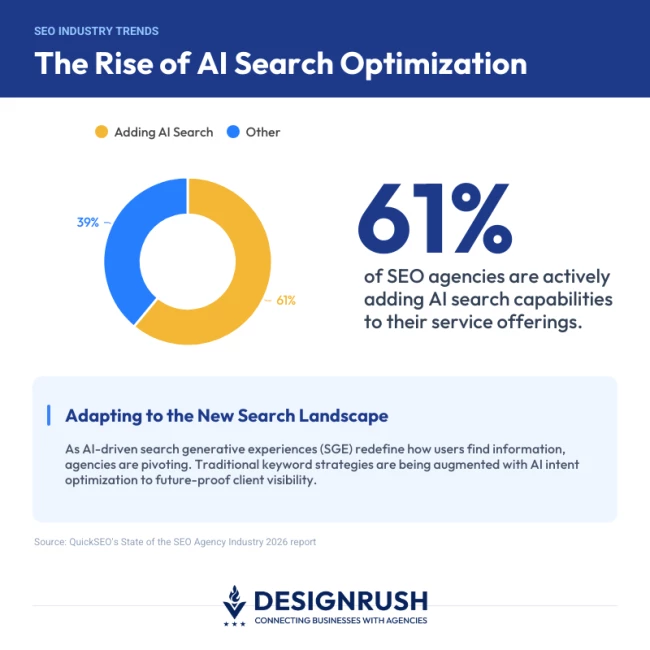
According to QuickSEO's State of the SEO Agency Industry 2026 report, 61% of SEO agencies are adding AI search to their services.
Most agencies are reacting to the shift rather than leading it, and "we offer GEO" on a website does not mean the team executing your account can do so.
Between 40% and 60% of cited sources change month-to-month across Google AI Mode and ChatGPT, making AI visibility far less stable than organic search rankings, and requiring a technical SEO firm that monitors and adapts continuously, not one that runs a quarterly audit cycle.
When is a 12-month contract with a technical SEO agency justified, and when is it a trap designed to lock me in before I can assess the work?
A 12-month commitment is justified when the agency ties it to a phased roadmap with measurable 90-day milestones.
It's a trap when the long term is used to justify delayed accountability, with results promised only "after month six."
Technical SEO compounds over time.
Crawl improvements, link authority, and content indexation take months to fully register.
“SEO takes time" is the most-abused phrase in the industry, and time is not a blank check.
A structured agency should give you a concrete roadmap before you sign:
- Month 1: Technical audit complete, baseline established, priority issues identified with business impact estimates.
- Months 2-3: Critical technical fixes implemented and validated, keyword mapping complete, content calendar live.
- Months 4-6: Indexation improvements visible in Search Console, early ranking movement on long-tail queries; link outreach underway.
- Months 7-12: Measurable traffic growth on target queries, lead attribution data available for quarterly business review.
If technical SEO consultants can't give you this structure before you sign, they haven't built one.
Confident agencies don't need 24-month contracts.
Look for month-to-month or six-month maximum arrangements with proven results as the baseline.
The negotiation move that protects you: request a three-month trial period at full scope before the 12-month term begins.
Technical SEO services providers with a strong process will agree. Those who refuse are betting on lock-in rather than performance.
What questions should I ask technical SEO agencies before hiring one?
Before hiring this agency, ask potential candidates the following questions:
Relevant Background
- Can you show me case studies from sites with similar architecture, scale, or problems to mine?
- Who has worked at your agency the longest, and will any of them be on my account?
- Have any of your clients been penalized by a Google algorithm update, and what happened?
- What percentage of your clients renew after their first contract term?
Services and Processes
- What does your audit actually deliver? Is it a report, a prioritized backlog, or tickets my dev team can act on?
- How do you handle the gap between your recommendations and my development team's sprint capacity?
- What is your monitoring protocol the week after a Google core update drops?
- Who specifically works on my account day-to-day, and what happens if that person leaves?
Related to Your Project
- What do you need from us in the first 30 days, and what blocks most engagements from starting well?
- Have you worked with a site on our CMS and tech stack before, and what were the main issues you encountered?
- If our dev team has limited capacity, how do you adjust your roadmap and timelines?
- What would you flag as the biggest risk in our current site before you've even run an audit?
Sources
DesignRush sustains a directory of over 40,000 agencies categorized by service category, location, expertise, and reviews. We build our database in two ways:
- Our dedicated team of agency experts actively searches the web for top-performing companies. We then pull information from their websites, online presence, and client testimonials to verify their status and qualifications prior to listing.
- The agencies listed get notified of their profiles on the website and they can choose to claim it or not, which suggests their availability for more collaborations.
Agencies can also reach out to DesignRush and must go through the verification process prior to being listed.