




When I set SEO goals for clients, I don’t start with keywords or audits. I start with business outcomes: demos booked, trials started, revenue influenced.
That’s what determines whether SEO is working, not how many impressions you got last month.
Defining SEO Goals: Key Points
Why It’s Crucial to Set SEO Goals Before Hiring an Agency
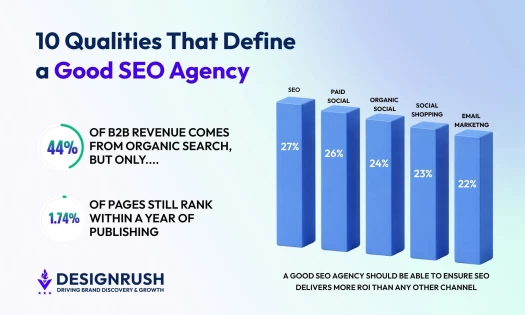
Organic search generates 44.6% of all B2B revenue.
But I’ve seen a 40% traffic increase that drove zero new business because it came from existing customers or irrelevant searches.
Traffic is vanity if you can’t separate brand from non-brand performance.
When I help clients set goals before hiring an agency, I start with one question: “What’s the most valuable action a visitor can take on your site?”
- For B2B SaaS, that’s usually a demo request.
- For eCommerce, it’s a product purchase.
- For local service businesses, it’s a booked appointment.
That’s your unit of value, and every SEO goal should drive more of it.
Setting SMART SEO Goals: A Blueprint for Businesses
Here’s how I approach it with actionable depth.
1. Define Specific Goals
Vague objectives like “get more traffic” are useless. I always drill down to the exact outcome that matters.
Examples from my experience:
- “Increase non-brand organic traffic to product pages by 25% in 3 months.”
- “Grow demo request submissions from organic search by 15% in 6 months.”
- “Reduce bounce rate on top blog posts by 10% in 90 days.”
Actions I take to make it real:
- Conduct a keyword gap analysis using Ahrefs or SEMrush to identify high-intent queries your competitors rank for, but you don’t.
- Map every target keyword to a landing page with a conversion goal.
- Audit underperforming URLs and prioritize optimization based on potential pipeline impact.
2. Make It Measurable
Without tracking, you can’t manage or justify SEO efforts. I tie every goal to KPIs that directly influence revenue.
Example measurable goals:
- “Generate 50 demo requests per month from organic search by end of Q2.”
- “Achieve 1,000 non-brand visits per month to new blog content within 90 days.”
How I measure success:
- Track organic form submissions via GA4.
- Measure non-brand clicks from Search Console.
- Track revenue attributed to organic traffic in your CRM.
- Monitor Core Web Vitals improvements (LCP, INP) over time.
3. Keep It Achievable
I set goals that stretch teams but remain realistic based on site authority, resources, and market conditions. Overly ambitious targets are a waste of budget.
My approach:
- Target keywords with medium difficulty rather than high-competition head terms.
- Prioritize pages with existing traffic that can be optimized.
- Focus on improving content that ranks on page 2 for quick wins.
- Set incremental backlink targets (e.g., 5–10 high-quality links per month).
4. Ensure It’s Relevant
Every SEO goal must align with business objectives. If it doesn’t drive revenue, leads, or strategic growth, I don’t pursue it.
Example relevance-driven decisions I make:
- Target keywords for high-margin products/services rather than low-value pages.
- Focus content and SEO on pages that drive demo requests or purchases.
- Optimize internal linking to strengthen revenue-generating pages.
- Align blog content with calls-to-action that support your sales funnel.
5. Set Time-Bound Targets
Deadlines enforce focus and accountability.
Setting time-bound targets turns SEO from a long, uncertain slog into a series of actionable sprints.
Examples I use:
- Improve Core Web Vitals to target LCP <2.5s within 90 days.
- Publish 5 optimized blog posts per month for the next 3 months.
- Launch technical SEO fixes (broken links, crawl errors) in the first 30 days.
- Achieve top 10 SERP ranking for 3 primary keywords within 6 months.
Here’s how I make it actionable:
- Break goals into smaller sprints:
- Month 1: Technical fixes (page speed, crawl errors, schema updates)
- Month 2–3: Content rollout (new pages, refreshes, internal linking)
- Month 4–6: Off-page SEO (backlink acquisition, PR outreach)
- Assess progress at 30/60/90-day marks. If results aren’t moving the needle on pipeline metrics, I pivot rather than blindly continue.
Example SMART SEO Goal
Increase organic traffic to underperforming product pages by 20% in six months by optimizing for high-intent long-tail keywords, improving Core Web Vitals to LCP <2.5s, implementing schema markup, and measuring SQLs via GA4 → CRM integration.
Translating Defined SEO Goals into Business KPIs
Defining goals is useless unless you translate them into KPIs that matter. Here’s how I approach it in practice.
- Organic traffic growth: Turning visibility into revenue
- Lead generation for eCommerce: Capturing high-value leads
- Brand visibility: Building authority & trust
- Local rankings: Driving local business growth
- Cost-per-lead reduction: Making organic SEO more efficient
- Customer lifetime value: Driving long-term growth
1. Organic Traffic Growth: Turning Visibility into Revenue
Traffic alone is meaningless unless it converts. I helped a SaaS startup pivot from broad keywords to high-intent queries = demo requests jumped 22% in two quarters.
SEO goal example: Increase non-brand traffic by 20% over the next six months.
How I tie this to KPIs:
- High-intent keyword targeting: I focus on queries that show strong purchase intent, not just broad informational searches.
- Content quality & optimization: Every page I optimize answers real customer questions and addresses pain points.
- Technical SEO: Page speed, mobile experience, and Core Web Vitals are key to keeping visitors on site and reducing bounce rates.
Metrics to track:
- SEO-sourced Sales Accepted Opportunities (SAOs)
- Organic conversion rate and contribution to the pipeline
- Revenue influenced by SEO
2. Lead Generation for eCommerce: Capturing High-Value Leads
For eCommerce businesses, lead generation strategies turn visitors into potential customers and revenue opportunities.
SEO goal example: Generate 500 qualified leads per month through optimized landing pages and email campaigns.
How I tie this to KPIs:
- Dedicated landing pages and lead magnets with clear CTAs.
- Seamless integration with CRM to capture every lead.
- Targeted nurture campaigns to move prospects closer to purchase.
Metrics I track:
- SEO-sourced leads and Cost Per Lead (CPL)
- Lead-to-SQL conversion rate
- ROI from organic lead generation
SEO leads close at 14.6%, compared to just 1.7% for outbound leads, an 8.5 times higher close rate. This really demonstrates how SEO can bring in better quality leads.
3. Brand Visibility: Building Authority & Trust
Strong brand visibility increases direct traffic, referral traffic, and ultimately trust, which influences conversions.
SEO goal example: Achieve a 30% increase in branded search queries over the next quarter.
How I tie this to KPIs:
Optimize for branded keywords and related content.
Publish guest posts, thought leadership articles, and press releases.
Align social messaging with SEO content to amplify visibility.
Metrics I track:
- Organic impressions and share of voice
- Branded search traffic
- Referral traffic from authoritative sites
Also: 91% of marketers reported that SEO had a positive impact on their website performance.
4. Local Rankings: Driving Local Business Growth
If you’re a local business, local SEO can literally drive foot traffic and booked appointments.
The goal here is visibility where it counts: geographically.
SEO goal example: Rank in the top 3 local search results for primary service keywords within 3 months.
How I tie this to KPIs:
- Optimize Google Business Profile with accurate info and photos.
- Ensure local citations and reviews are consistent.
- Implement local schema for search relevance.
Metrics I track:
- Local pack visibility
- Booked jobs/appointments from SEO
- Local traffic and conversions
5. Cost-per-Lead Reduction: Making Organic SEO More Efficient
I help clients reduce CPL by focusing on high-converting organic content.
SEO goal example: Reduce CPL from $150 to $90 by increasing SEO-sourced leads over the next quarter.
How I tie this to KPIs:
- Optimize content to address buyer pain points and drive qualified conversions.
- Ensure CRM accurately attributes leads to organic channels.
- Compare SEO leads versus paid campaigns to shift spend efficiently.
Metrics I track:
- CPL from organic traffic
- SEO-sourced leads versus paid channels
- Lead-to-SQL conversion rate
6. Customer Lifetime Value: Driving Long-Term Growth
SEO helps maximize customer value through retention and long-term growth.
I’ve increased long-term revenue by using content to educate, onboard, and upsell customers.
SEO goal example: Increase CLV by 10% by guiding organic traffic to onboarding and support content.
How I tie it to KPIs:
- Retention-focused content like product guides, FAQs, and educational resources.
- Upsell/cross-sell campaigns embedded in content.
- Use customer feedback to refine SEO content and drive repeat purchases.
Metrics I track:
- Repeat purchase rate from SEO-acquired customers
- CLV of SEO-sourced customers
- Engagement with high-value content
Best Tools for SEO Metrics in 2026
@webhivedigital Looking for free SEO tools that still work in 2025? These are my go to SEO tools for on-page, off-page, technical SEO and competitor analysis. You can’t go wrong with these! #searchengineoptimization#digitalmarketing#marketing♬ original sound - Kate Smoothy | SEO Specialist
I’ve tested dozens of SEO tools over the years, and honestly, the best setup depends on your stage of growth.
Startups need agility, SMBs need clarity, and enterprises need integration.
Here’s what I recommend, based on what has worked in real campaigns:
SEO Tool | Best For | Key Strengths |
Google Search Console | Site performance & indexing | Direct insights from Google |
SEMrush | Comprehensive SEO management | All-in-one platform with extensive features |
Ahrefs | Backlink & competitor analysis | Robust backlink database & keyword research |
Google Analytics 4 | User behavior tracking | Advanced event-based tracking & reporting |
My approach: I use these tools together rather than in isolation. GSC shows me what Google sees, SEMrush and Ahrefs reveal opportunities and gaps, and GA4 tells me whether my optimizations are translating into business outcomes.
This combination gives me a complete picture, from visibility to conversions, and ensures my SEO efforts work.
Defining SEO Goals: Final Words
If there’s one piece of advice I always give before bringing an SEO agency on board, it’s this: know what success looks like for your business first.
Don’t chase traffic. Instead, define outcomes that move the business forward: revenue, qualified leads, and long-term customer value.
Find More Agency Hiring Resources:
1. How To Strategically Plan Your SEO Budget
2. Questions To Ask an SEO Company
3. SEO In-House vs. Outsourcing
For me, the difference between “busy work” and real impact comes down to clarity: know your goals, track them carefully, and make every SEO move purposeful.

Our team ranks agencies worldwide to help you find a qualified partner. Visit our Agency Directory for the top SEO agencies, as well as:
Defining SEO Goals FAQs
1. Why do I need specific SEO goals before hiring an agency?
Without clearly defined goals, SEO efforts can generate traffic without impact. Tying targets to revenue, pipeline, or CLV ensures every action is accountable and measurable.
2. How do I connect SEO metrics to business KPIs?
Track SEO-sourced Sales Accepted Opportunities (SAOs), cost-per-lead, and customer lifetime value. Technical levers like high-intent keywords, optimized landing pages, and Core Web Vitals directly influence these metrics.
3. Should SEO strategies differ by industry?
Absolutely. E-commerce focuses on product pages, internal linking, and reviews. B2B SaaS prioritizes thought leadership and lead capture.
Local businesses target Google Business Profile optimization, local schema, and review acquisition.