
eCommerce stores face an uphill battle to get noticed in today's crowded digital world. Quick wins come from paid advertising, but a solid SEO strategy remains the lifeblood of lasting online growth.
That's why we've created this comprehensive eCommerce SEO checklist. Whether you're launching a new store or optimizing an existing one, our SEO checklist for eCommerce websites covers everything from technical fundamentals to advanced optimization techniques.
Ready to boost your store's visibility and drive more organic traffic? Let's dive into the essential SEO steps that will set your eCommerce site up for success in 2026 and beyond.
Prepare Your eCommerce Store

Before diving into specific eCommerce SEO optimizations, you need to ensure your eCommerce store has a solid foundation. Research shows that 92.4% of analyzed eCommerce sites had concerning security issues, making proper preparation crucial for success.
- Conduct an SEO audit of your store
- Optimize your store for mobile commerce
- Secure your eCommerce website



Conduct an SEO Audit of Your Store
Before optimizing and choosing a type of SEO to work on, know where you stand. Checking only your title tags and meta description won’t do. A comprehensive SEO audit helps identify all areas needing improvement in your store's search engine friendliness. We recommend conducting these audits semi-annually to maintain optimal performance. Here are the key elements to evaluate:
- Technical SEO elements
- On-page optimization
- Site architecture
- Product page structure
- User experience factors
- Backlink profile
Use tools like Google Search Console and Screaming Frog to uncover problems and fix them. Your audit sets the stage for everything else.
Optimize Your Store for Mobile Commerce
Mobile commerce isn’t the future — it’s now. Research shows that smartphones accounted for over three-quarters of retail site visits in the United States and generated roughly two-thirds of online shopping orders. This translates to the fact that more shoppers are making eCommerce purchases on mobile devices than ever before.
To enhance mobile experience, focus on:
- Responsive design implementation
- Text size and readability optimization
- Touch-friendly navigation
- Interactive elements adaptation
- Mobile page speed improvement
If it's not easy to shop on mobile, your customers will bounce faster than a checkout cart left at the register.
Secure Your eCommerce Website
Security isn't just about protection — it's about building trust. With eCommerce sites handling sensitive data, implementing robust security measures is essential. Google gives ranking preference to secure sites, as it has confirmed HTTPS as a ranking factor, and your customers will too.
Here are the essential security measures:
- SSL certificates for data encryption
- Regular malware scans
- Two-factor authentication implementation
- Regular security updates
- PCI DSS compliance
- Secure payment gateway integration
By implementing these foundational elements, you’re setting up your eCommerce store for sustainable growth and improved search visibility.
Optimize Product Pages
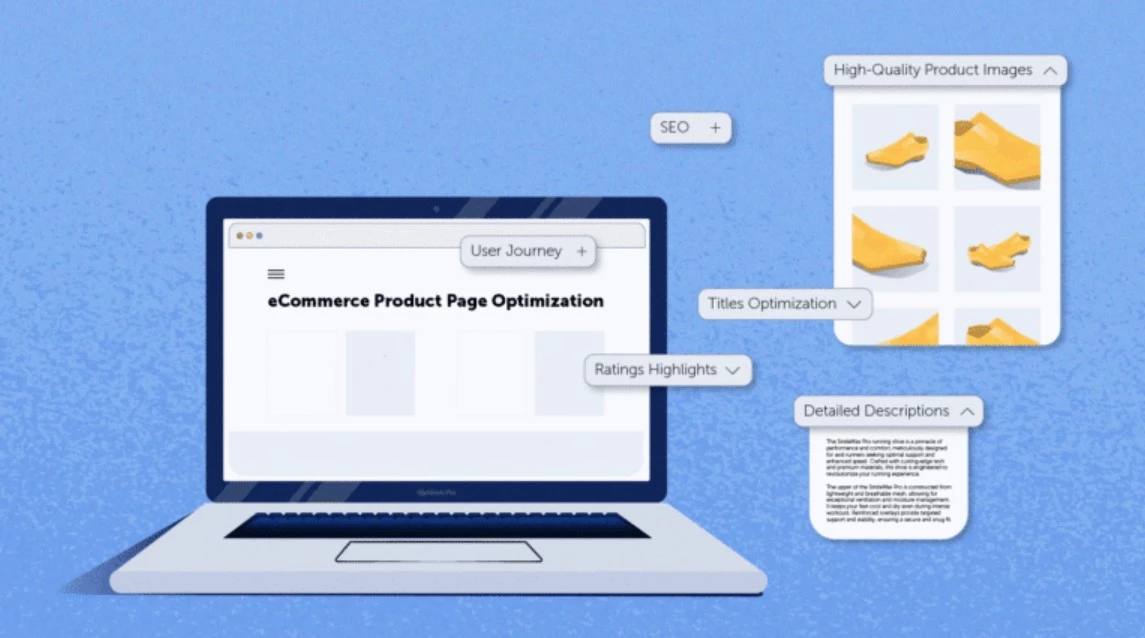
Product page optimization stands as the cornerstone of an eCommerce SEO strategy. Let's explore the essential elements and SEO best practices that will help your products rank higher and convert better.
- Perform keyword research for eCommerce products
- Write SEO-friendly product descriptions
- Add schema markup
- Add videos to product pages
- Use local SEO for multi-location eCommerce stores
Perform Keyword Research for eCommerce Products
Your products need to speak your customer’s language. Successful eCommerce keyword research needs a smart approach that zeroes in on commercial intent. Long-tail keywords pack extra value, especially when you have people closer to buying.
Your keyword selection should include:
- Search terms with monthly volume above 20
- Words showing buying intent
- Keyword difficulty scores
- Branded product terms
- Local search variations
Write SEO-Friendly Product Descriptions
Gone are the days of stuffing descriptions with awkward keywords. Unique, detailed product descriptions make a vital difference in SEO success. Also note that duplicate content can hurt visibility across your pages. You should create different descriptions for each platform rather than using similar content everywhere.
Craft compelling, informative, and keyword-rich descriptions that solve your customer’s problems. For example, describe benefits, unique selling points, and use cases to make your product irresistible.
Add Schema Markup
Schema markup helps search engines grasp your product information and improves how your products show up in search results by a lot.
As Nicolas Rotermund, Managing Director of k.u.r.s. mediasystems, explains, “Implementing structured data with schema markup is one of the most powerful ways to improve eCommerce visibility in search results. Schema markup helps search engines better understand your site's content, allowing them to display advanced search features such as rich snippets."
The product schema should show:
- Price information
- Availability status
- Review ratings
- Product variants
- Shipping details
“For eCommerce stores, schema markups can dramatically improve click-through rates (CTR) and user engagement by providing users with key information directly in search results,” Rotermund concludes.
Add Videos to Product Pages
Videos increase engagement and conversions. Add product demos, tutorials, or testimonials to your pages. Not only do videos keep users on your site longer, but they also improve your ranking potential. Also, optimize video titles, descriptions, and transcripts with relevant keywords.
Use Local SEO for Multi-Location eCommerce Stores
Businesses with multiple locations need separate landing pages for each store. This helps optimize local search queries better. Each location page needs:
- Store details and contact information
- Location-specific content and news
- Customer reviews for that location
- Local business schema markup
Adding structured data markup for each location makes location-based information more visible in search results and gets more clicks. Also, don’t forget to claim and optimize your Google Business Profiles for each location.
Enhance User Experience

User experience is a vital ranking factor in our eCommerce SEO checklist. A smooth shopping experience directly affects both rankings and conversions. Let’s see what you can do about that.
- Speed up your eCommerce site
- Improve checkout page SEO and user experience
- Create category-specific landing pages
Speed Up Your eCommerce Site
Site speed goes beyond fast loading — it keeps customers involved. These core web vitals improvements will make a difference:
- Optimize image sizes and formats
- Implement content delivery networks (CDN)
- Minimize HTTP requests
- Enable browser caching
- Reduce server response time
Improve Checkout Page SEO and User Experience
The checkout page is where the magic happens — or doesn’t. Research shows that 7 out of 10 shopping carts are abandoned. This makes checkout optimization a vital part of the process. A simplified process builds trust and reduces friction.
Here are the key elements for an optimized checkout:
- Clear progress indicators
- Guest checkout options
- Multiple payment methods
- Visible security badges
- Mobile-friendly design
Create Category-Specific Landing Pages
Category pages help visitors navigate your eCommerce site structure. Google uses these pages to understand your site's hierarchy, making them vital to your SEO success.
Reliable filtering options let shoppers refine their searches based on different attributes. This helps search engines understand your product relationships better and improves user's experience.
Let’s go briefly through the elements that ensure optimal category page performance:
- Clear, high-quality product images
- Dynamic product recommendations
- Optimized page load speeds
- Responsive layouts for all devices
These user experience improvements have helped reduce bounce rates. Note that good user experience goes beyond esthetics — it creates a natural path from landing to purchase.
Work on Your Content

Quality content creation lies at the heart of successful eCommerce SEO. Think of it as the storyteller behind your eCommerce success.
- Build a content marketing strategy for your store
- Leverage reviews and UGC
- Optimize for voice search shopping queries
- Focus on backlink building for product pages
Build a Content Marketing Strategy for Your Store
A well-laid-out content strategy streamlines both traffic and conversions. Use your content to solve customer pain points and subtly direct them to your products. And yes, every piece should be optimized for SEO.
Here's what you should focus on:
- Product-focused blog posts
- Educational guides and tutorials
- Visual content (infographics, videos)
- Email newsletters
- Social media content
- Share industry insights
As Kate Bourque, Founder of Nioma, explains, “Even small eCommerce sites can outrank larger competitors by focusing on highly targeted long-tail keywords and creating specialized, high-quality content that provides value and speaks to their customers' needs.”
Leverage Reviews and UGC
User-generated content (UGC) has emerged as a powerful trust signal for eCommerce sites. Encourage customers to leave reviews and share their experiences. Not only do reviews build trust, but they also add fresh, keyword-rich content to your site. Customer reviews and authentic user content help search engines understand your products better and build credibility with potential buyers.
Optimize for Voice Search Shopping Queries
Voice search optimization is vital now that 38.8 million people in the US use smart speakers for shopping-related activities, accounting for 13.6% of the population.
Here's what to prioritize:
- Incorporating conversational keywords
- Answering specific customer questions
- Using natural language in product descriptions
- Optimizing for local voice queries
- Creating FAQ sections
Focus on Backlink Building for Product Pages
Quality matters more than quantity in our backlink strategy. For product pages specifically, reach out to industry experts and leverage product feedback techniques. Build links naturally through partnerships, guest posts, or by creating sharable content like infographics.
eCommerce SEO Checklist: The Bottom Line
SEO isn’t a set it and forget it strategy — it’s more like tending to a garden. You need to regularly water it with fresh data, prune what isn’t working, and keep an eye on the weather (Google’s algorithm update). Use analytics tools like Google Analytics and Ahrefs to monitor performance metrics such as organic traffic, bounce rate, and keyword rankings.
Partnering with an experienced eCommerce SEO agency can also provide valuable insights and expertise to fine-tune your strategy. These professionals can help you identify which strategies are driving results and where improvements are needed.
Identify which strategies are driving results and double down on them. For those that aren’t, tweak or replace them. The secret lies in constant iteration, data-driven decisions, and staying adaptable to trends.
If you want to move faster and avoid trial and error, partnering with an experienced eCommerce SEO agency is a smart next step.

Our team ranks agencies worldwide to help you find a qualified partner. Visit our Agency Directory for the top eCommerce SEO agencies, as well as:
- Top SEO Agencies in Chicago
- Top Advertising Agencies
- Top Conversion Rate Optimization Agencies
- Top PPC Agencies
- Top Social Media Marketing Agencies
eCommerce SEO Checklist FAQs
1. How long does it typically take to see results from eCommerce SEO efforts?
SEO success generally requires patience, with significant impacts often taking three to six months to materialize. However, you can track progress through leading indicators while working toward long-term goals.
2. How can I measure the success of my eCommerce SEO efforts?
To measure eCommerce SEO success, track key metrics such as organic traffic growth, keyword position rankings, and conversion performance. Use tools like Google Analytics and Search Console to monitor these metrics and calculate ROI by dividing business impact by investment to demonstrate value and guide future strategy decisions.
3. How often should I perform an SEO audit?
At least twice a year, or whenever you experience significant changes in your traffic or rankings.