
We're diving in the details on how to get monetized in 2026, what eligibility looks like, how to avoid the compliance pitfalls that delay approval, and what to do once revenue activates.
YouTube Monetization Requirements: Key Findings
- Early monetization begins at 500 subscribers with 3 uploads and either 3,000 watch hours or 3 million Shorts views.
- Full YPP requires 1,000 subscribers and either 4,000 watch hours or 10 million Shorts views, plus original and advertiser-safe content.
- Compliance determines eligibility with clean guidelines history, proper rights management, a linked AdSense account, and 2 Step Verification.
YouTube Monetization as a Growth Engine for Companies
YouTube has become one of the most powerful revenue channels available to businesses.
In 2025, YouTube reports more than 2.5 billion monthly active users, giving brands access to one of the largest video audience on the internet.
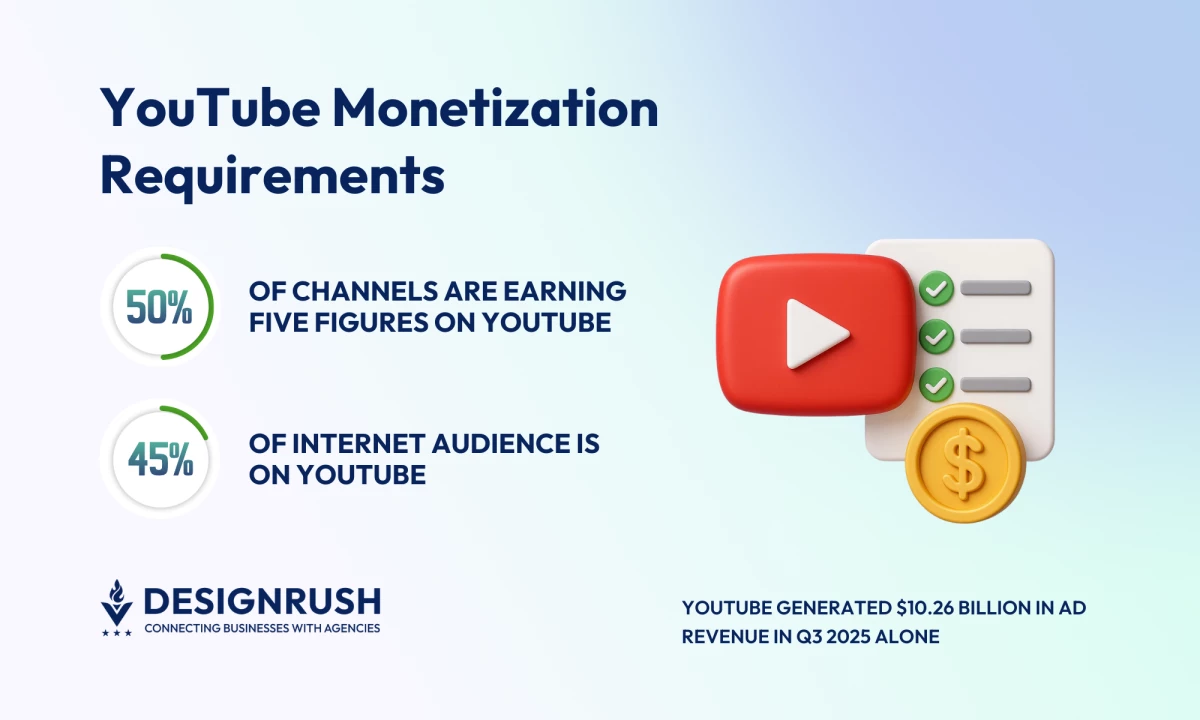
And the money flowing through the system is accelerating as YouTube generated $10.26 billion in ad revenue in Q3 2025 alone, up 15% from the previous quarter.
With monetization enabled, companies can tap into that growth through ads, Premium views, Shopping integrations, memberships, and live support features, turning a YouTube channel into a real revenue driver rather than just a marketing asset.
YouTube Monetization Requirements in 2026
Monetization only works if your channel meets YouTube’s core eligibility standards. These are the rules every business must follow to qualify smoothly and stay approved long term.
- Early Access YPP: Fan funding and shopping (no ads yet)
- Full YPP: Ad revenue + premium revenue + all features
- Universal requirements for all monetizing brands
- Additional feature requirements
Early Access YPP: Fan Funding and Shopping (No Ads Yet)
The Early Access YouTube Partner Program (YPP) gives businesses a way to start earning from their audience early, even before ad monetization is unlocked.
Use this tier if your business wants to activate Memberships, Super Chat, Super Stickers, Super Thanks or Shopping integrations before ad eligibility.
This one is ideal for brands building early community engagement or testing commerce formats.
What Your Channel Must Have
These are the minimum signals YouTube uses to confirm your brand is active, consistent, and producing original content.
Hitting these requirements lets you unlock memberships, live donations, and product tagging, which are useful tools for nurturing early supporters and validating engagement strategies.
- 500 subscribers
- 3+ public uploads in the last 90 days
- Either:
- 3,000 valid public watch hours in the last 12 months
- 3,000,000 valid public Shorts views in the last 90 days
- Clean compliance record: no Community Guidelines strikes
- Original, policy-compliant content
- 2-Step Verification enabled on Google account
- Linked AdSense account (18+)
- Channel located in an eligible Early Access YPP country
Full YPP: Ad Revenue + Premium Revenue + All Features
Once unlocked, your long-form videos, Shorts, and Premium views all generate income.
In 2024, YouTube paid out more than $32 billion to partners globally, underscoring how powerful this tier becomes for businesses that treat YouTube as a true revenue engine.
What Your Channel Must Have
These requirements ensure your brand is consistently producing original, advertiser-safe content at a level that supports long-form monetization.
The thresholds signal to YouTube that you offer reliable value to viewers and to advertisers who ultimately fund the payouts.
- 1,000 subscribers
- Either:
- 4,000 valid public watch hours in the last 12 months
- 10,000,000 valid public Shorts views in the last 90 days
- No Community Guidelines strikes
- Full compliance with:
- Advertiser-friendly content guidelines
- Copyright rules
- Reused/inauthentic content policies
- 2-Step Verification enabled
- Linked AdSense account (18+)
- Channel in a YPP-eligible country
If you already entered through the 500-subscriber tier, YouTube automatically moves your brand into full monetization once you meet the higher thresholds.
No extra steps, as long as your compliance remains clean.
Universal Requirements for All Monetizing Brands
These rules apply across all monetization tiers and act as the foundation for keeping your channel eligible.
Businesses often overlook these operational details, but they determine whether monetization activates smoothly or gets stalled during review.
This becomes even more important in high-CPM niches like making money online, digital marketing, personal finance, education, and tech, where brands compete for premium ad rates and any compliance issue can block access to those earnings.
Content and Policy Compliance
YouTube expects monetized channels to publish original, brand-safe content that advertisers can trust. Any copyright issues, strikes, or reused formats can delay approval or trigger demonetization.
This is especially critical for agencies producing content at scale.
- Must follow YouTube Community Guidelines
- No reused, repetitive, or inauthentic content
- No copyright violations or unlicensed material
- Must meet Advertiser-Friendly Content Guidelines
- Must follow regional laws (COPPA, FTC sponsorship disclosures, etc.)
Technical and Account Standards
YouTube requires verified accounts and a single AdSense entity to ensure payouts go to the correct business owner. These are simple steps but often bottleneck enterprise channels if not set up early.
- 2-Step Verification required
- Approved AdSense account
- One AdSense per entity
- Channel owner or business payee must be 18+
Content Eligibility Rules
These details matter for brands planning multi-format content strategies or refreshing their content libraries.
- Only public videos count toward monetization thresholds
- Shorts views count only from the Shorts feed
- Deleted/unlisted videos remove associated watch time
- Strikes can pause monetization eligibility
Additional Feature Requirements
These optional tools unlock stronger commerce and sponsorship revenue. They aren’t required for basic monetization but become important as your channel matures.
YouTube Shopping Affiliate Program
This is YouTube’s built-in revenue engine for product-driven brands.
If your channel complies with these rules, you can earn commissions directly from product tags, which is a strong fit for retail, beauty, tech, and lifestyle brands.
- US-based channels only
- Must already be in YPP
- 20,000+ subscribers required
YouTube BrandConnect (Sponsorship Marketplace)
NEW 🔴 Get Paid Sponsorships with YouTube Brand Connect (2023 Update)
— Sean Cannell (@seancannell) February 16, 2023
YouTube is pivoting its influencer-marketing program to a self-service mode.
YouTube BrandConnect is a monetization service that connects creators with brands for branded content campaigns. pic.twitter.com/ehBUF0VRVM
BrandConnect matches channels with advertisers.
While mostly invite-only, it becomes available as your channel grows and maintains strong engagement. Useful for brands seeking additional revenue streams or agencies running influencer-style channels.
- YPP membership required
- Typically 10,000+ subscribers with strong engagement
- Invitation-based rather than publicly applied
Merch Shelf
Merch Shelf is a low-friction way for brands to offer merchandise inside YouTube. Subscriber minimums have largely been removed, making this an easy add-on for companies with existing product catalogs.
- YPP required
- Subscriber minimum removed in most regions
- Availability depends on approved retailer integrations
It is useful for: branded merchandise, product drops, DTC storefront visibility.
Are You Eligible for Monetization: Quick Checklist
| Requirement Category | Early Access YPP | Full Monetization |
| Subscriber Count | 500 subscribers | 1,000 subscribers |
| Content Activity | 3 public uploads in 90 days | No specific requirements, but profile must be active |
| Watch Time/Shorts Views | 3,000 watch hours OR 3M Shorts views | 4,000 watch hours or 10M Shorts views |
| Policy Compliance | Required | Required + must meet advertiser-friendly guidelines |
| Account Requirements | 2-Step Verification, Linked AdSense | 2-Step Verification, Linked AdSense |
| Geographic Eligibility | Must be in Early Access–enabled country | Must be in YPP-supported country |
YouTube Monetization Challenges and How To Solve Them
Building a monetized YouTube presence comes with its share of challenges.
Stacy Peled, Vice President of Publisher Partnerships & Growth at AnyClip, says:
“These hurdles become even more complex when you’re trying to engage different audience segments, manage licensing and rights, and piece together fragmented data that makes it hard to make confident decisions.”
Here’s how to address these issues before they slow your momentum or push back your path to eligibility.
- Slow early traction: Use multi-format publishing to accelerate discovery
- Low watch time: Prioritize long-form and live content
- Shorts vs. long-form confusion: Assign each format a specific role
- Compliance risks: Run a pre-YPP audit
- Alternative monetization tactics: Earn revenue before YPP
- Advertiser-safety issues: Build brand-safe creative standards
Slow Early Traction: Use Multi-Format Publishing to Accelerate Discovery
Most business channels grow slowly because they rely on one content format. YouTube rewards variety, especially when Shorts drive discovery and long-form content delivers depth.
- Publish Shorts for reach and long-form videos for retention.
- Repurpose webinars, podcasts, demos, and social clips to speed up volume.
- Maintain a predictable weekly schedule to strengthen algorithm trust.
Low Watch Time: Prioritize Long-Form and Live Content
@alex.b.sheridan Long form video content is KING And here’s 5 BIG reasons why 1.) It allows you to build a video content machine Meaning you can take one long form YouTube video or podcast and repurpose it into the following: -Micro video clips -Text posts -Picture posts -Blogs -Newsletter/Emails -Etc. 2.) You can go DEEP with your audience in ways that you just can’t with short form content If I spend 8-10 minutes with someone, and you spend 60 seconds with them, I’ve got way more time to build trust, build credibility, and add value to their lives 3.) You create a library of binge-worthy type content for your customers and prospects to consume Think about this… When’s the last time you found a great YouTube channel or podcast and started binge-watching it? Or at minimum saved it for later? But how many times do you binge-consume someone’s LinkedIn content? 4.) Your viewers/listeners can consume on the go, while working out, while doing laundry, etc. No-one is reading your LinkedIn post or scrolling through your carousel while doing any of those things lol sorry 5.) YouTube is still a MASSIVE growth opportunity for pretty much every B2B company Go check out ours to see what we’re up to and to learn more about how to use video to build your brand and scale your business (Link in featured content section) ❤️ABS Alex B Sheridan PS: I also think short form video is king too for a TON of reasons. Remember, there's more than one Kingdom in the Game of Content. And these two Kings together, working side by side, run the world 🌎 #videomarketing #longformcontent ♬ original sound - Alex | Video Marketer
Businesses often lean too heavily on short videos, which rarely generate the watch hours needed for monetization. Longer content signals value and keeps users engaged.
- Produce 8-15 minute videos designed for repeat viewing.
- Host live sessions (Q&A, product walk-throughs, interviews) to accumulate hours quickly.
- Use playlists and end screens to extend viewing sessions.
Shorts vs. Long-Form Confusion: Assign Each Format a Specific Role
Shorts grow your audience, but long-form content monetizes it. Treat each format as a stage in your funnel rather than a standalone strategy.
- Use Shorts as top-of-funnel hooks.
- Insert CTAs in Shorts pointing viewers to your main videos.
- Build series formats that guide viewers from Short → long-form → subscribe.
Compliance Risks: Run a Pre-YPP Audit
Businesses are at higher risk for copyright mistakes and reused-content violations because teams repurpose assets from multiple sources. Clean compliance is essential for YPP approval.
- Audit all videos for copyrighted audio/visuals.
- Remove reused, repetitive, or non-transformative content.
- Ensure sponsorship disclosures meet FTC and YouTube rules.
Alternative Monetization Tactics: Earn Revenue Before YPP
@thecarolejones Building momentum with the algorithm is usually a slow process but what sets apart those who succeed and those who give up is keeping the long game in mind #thecarolejones #creatortips #womenover50 #monetization ♬ original sound - Carole Jones | Content Coach
Your brand can sponsor its own channel long before YouTube pays you, which is especially effective for B2B companies and agencies building authority.
And the reach is worth it. YouTube ads can tap into 45.5% of all internet users worldwide, giving businesses a massive audience even before formal monetization kicks in.
- Insert mid-roll brand mentions promoting your own offerings.
- Run case study segments or client success features as sponsored content.
- Partner with aligned brands to secure early paid sponsorships, even with modest subscriber numbers.
- Use clear CTAs that drive viewers into strategic business actions (book a call, download a resource, start a free trial).
Advertiser-Safety Issues: Build Brand-Safe Creative Standards
Even if a channel qualifies for monetization, advertiser-unfriendly content will receive limited ads. Establishing internal guidelines prevents revenue loss.
- Avoid profanity, sensitive topics, or graphic visuals.
- Train your team to self-rate ad suitability accurately.
- Use consistent tone, scripting, and metadata aligned with brand-safe messaging.
What Happens After You Qualify for YouTube Monetization
Once your channel meets the monetization thresholds, the real operational work begins. You must complete several verification, compliance, and setup steps before YouTube can release revenue.
Here’s exactly what happens next and how to handle each stage smoothly.
- Open an AdSense account through YouTube
- Submit tax and identity documentation
- Wait for channel review
- Enable monetization on videos
- Verify your address via mailed PIN
- Add and confirm your bank account
- Reach the payment threshold
1. Open an AdSense Account Through YouTube
YouTube only pays through AdSense, so connecting it correctly is the first critical step. Errors here can delay revenue for months.
What to do:
- Go to YouTube Studio → Earn Tab
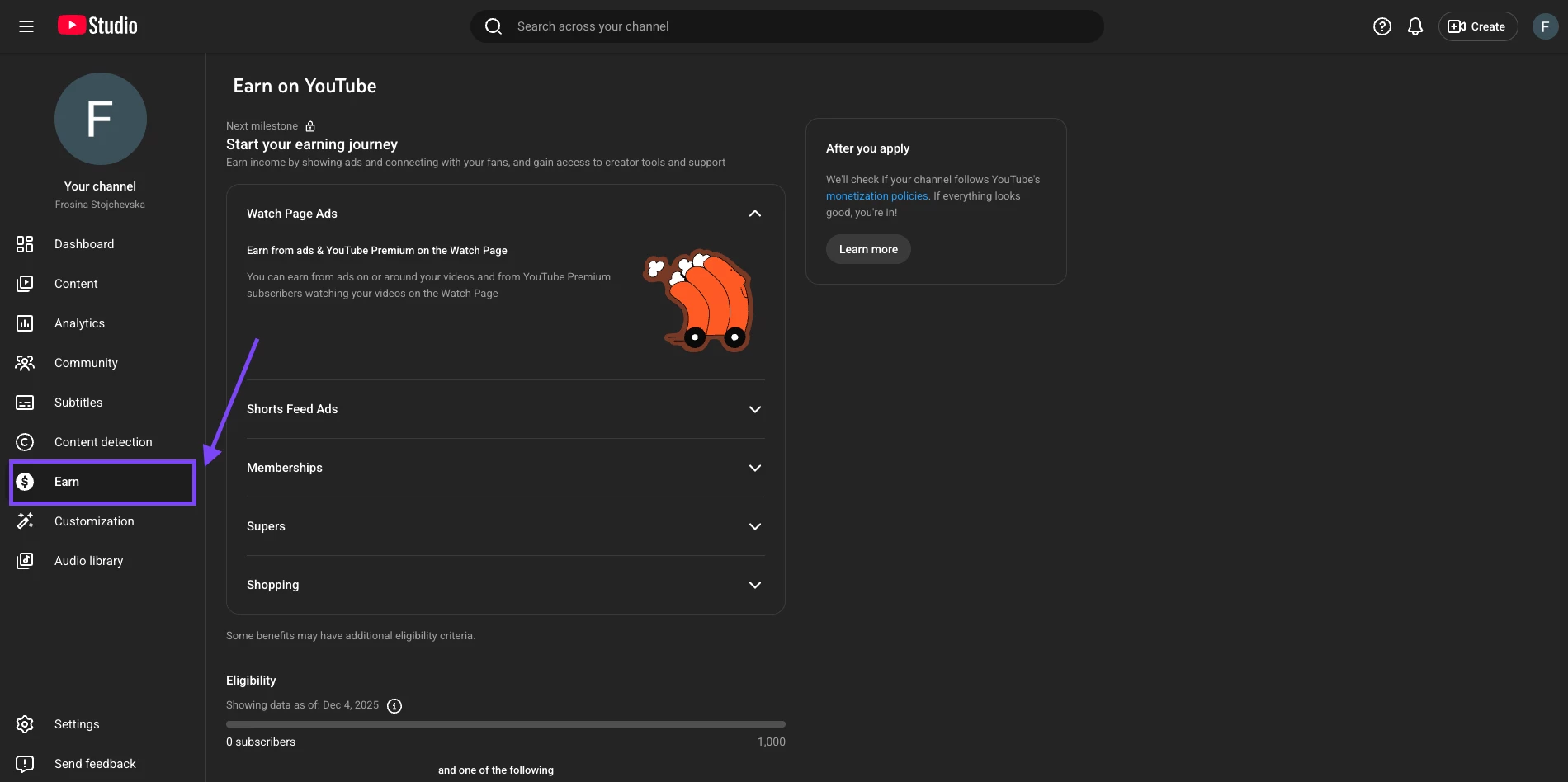
- Follow the prompts to create or link your AdSense account
Avoid this mistake: Creating a standalone AdSense account outside YouTube, as it often fails to link and must be deleted before you can try again.
2. Submit Tax and Identity Documentation
Google must verify your identity and tax status to comply with global regulations (FATCA, GDPR, local tax laws).
What to submit:
- Government ID (passport, national ID) or company documents
- Tax form (W-9 for US, W-8BEN for non-US creators)
- Full legal name and address
- Optional: business banking details
Ensure your name and address match your documents exactly. Even small mismatches cause delays.
3. Wait for Channel Review
After applying, YouTube manually reviews your entire channel to confirm it aligns with monetization standards.
What YouTube checks:
- Community Guidelines compliance
- Original, non-reused, non-AI-spam content
- Clear category and content value
- No recent strikes or rule violations
Timeline: Most reviews are completed within 30 days, though regional volume can extend this.
Keep uploading during review. Active channels demonstrate ongoing value and reduce the risk of borderline rejections.
4. Enable Monetization on Videos
Acceptance into YPP doesn’t automatically turn ads on. You must do this yourself.
What to do:
- Go to Studio → Content
- Use Bulk Actions → Monetization → On
- Select ad formats (pre-roll, mid-roll, display)
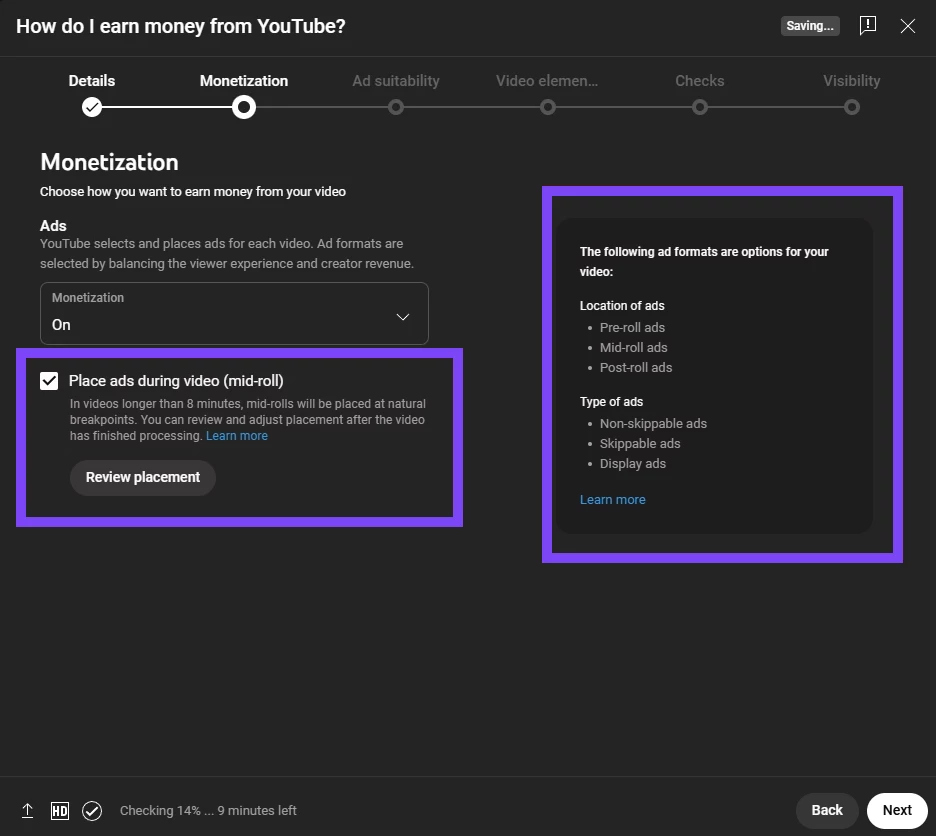
You would want to set defaults here so new uploads automatically have monetization enabled.
5. Verify Your Address via Mailed PIN
Before AdSense can release funds, Google must confirm your physical mailing address.
What to expect:
- A 6-digit PIN mailed to your listed address
- Arrival in 2-4 weeks depending on location
What to do:
- Check with your local post office if it’s delayed
- Use correct local formatting for your address
- Enter the PIN in AdSense as soon as it arrives
6. Add and Confirm Your Bank Account
AdSense won’t release payments until your bank account is verified.
Process:
- Enter your banking details in AdSense
- Google sends a small test deposit (e.g., $0.25–$0.50)
- Confirm the amount in your account to verify
How to do this right:
- Use a bank account in the same currency to reduce conversion fees
- Double-check account/routing/SWIFT numbers to avoid failed deposits
7. Reach the Payment Threshold
YouTube only pays once your accumulated revenue meets the minimum threshold.
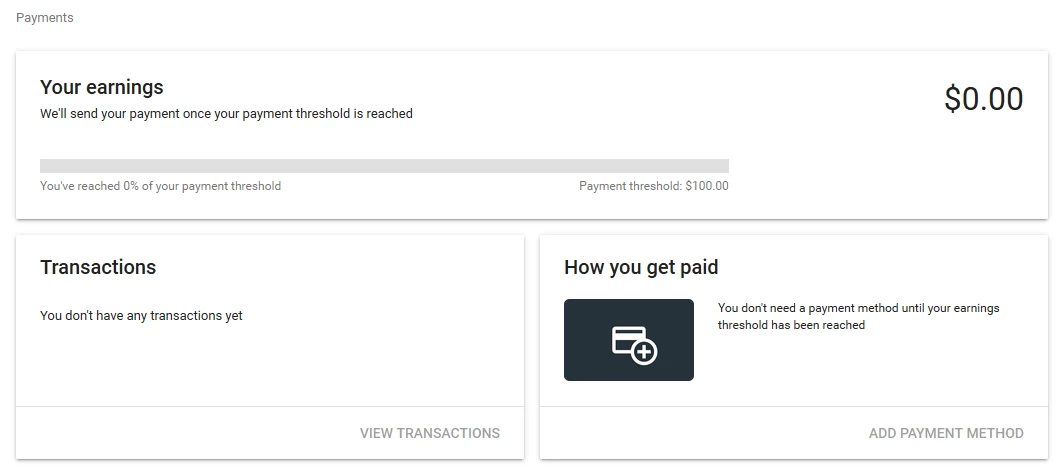 You need:
- At least $100 (or local equivalent)
- Verified tax info
- Verified address (PIN)
- Verified bank account
Payment schedule:
- Earnings finalize on the 12th of the month
- Payments are issued 21st-26th each month
Our team ranks agencies worldwide to help you find a qualified partner. Visit our Agency Directory for the top video marketing companies, as well as:
- YouTube Marketing Companies
- Video Production Companies
- AI Video Marketing Companies
- Branded Video Production Companies
- Digital Marketing Companies
Our design experts also recognize the most innovative design projects across the globe. Check out our Awards section for the best & latest in video designs.
YouTube Monetization Requirements FAQs
1. Do Shorts views count toward monetization requirements?
Yes, but only for the Shorts-based eligibility pathway.
- Shorts views do NOT count toward the 4,000 long-form watch-hour requirement.
- They do count toward the 3M Shorts views (Early Access) and 10M Shorts views (Full YPP) pathways.
2. Can a business or agency monetize a YouTube channel without being a “creator”?
Yes. YouTube allows brands, agencies, companies, and publishers to monetize as long as the content is original, transformative, and policy-compliant, the channel meets the required subscriber and watch-time thresholds, and a business entity can be verified through AdSense, tax, and identity documentation.
3. What types of content disqualify a channel from monetization even if requirements are met?
YouTube rejects channels with reused footage, copyrighted material, low-value AI content, or advertiser-unfriendly themes. The content must clearly follow YouTube’s monetization and ad-safety rules.