
Email marketing compliance means following applicable laws and provider requirements for collecting subscriber data, sending promotional messages, protecting personal information, and honoring opt-outs.
As your list grows, so does the challenge of knowing who you can contact, what they agreed to receive, and whether their preferences are reflected across your systems. Gaps in that process can put customer trust, inbox placement, and your ability to keep sending at risk.
This guide explains which email marketing laws apply to your campaigns, how consent and data management affect compliance, and what to check before your next send.
Email Marketing Compliance: Key Findings
- Email marketing regulations shape how you collect consent, manage subscriber data, and honor opt-outs across campaigns.
- Mailbox providers use engagement signals to assess sender trust, making consent quality a key indicator of compliant email practices.
- Consent must be consistently stored, updated, and applied across all systems, making compliance an operational process rather than a one-time action.
Which Email Marketing Laws Apply to Your Business?
GDPR, CCPA, CAN-SPAM, and CASL differ in who they cover, consent rules, and opt-out obligations.
| Regulation | Who it applies to | Consent standard | Opt-out requirement | Enforcement example |
| GDPR | EU/EEA orgs and overseas firms targeting or monitoring people there | Freely given, specific, informed, unambiguous, provable consent | Easy withdrawal. Stop direct marketing upon objection. | Meta, €390M, for advertising data-processing violations |
| CCPA | Businesses meeting CCPA thresholds that handle Californians’ personal data | Generally notice and opt-out | Honor data sale/sharing opt-outs, including Global Privacy Control signals. | Sephora, $1.2M settlement, over undisclosed data sales and ignored opt-outs |
| CAN-SPAM | Commercial email subject to US law, including B2B | Prior opt-in generally not required | Clear unsubscribe option. Process within 10 business days. | Experian, $650K settlement, for missing email opt-outs |
| CASL | Commercial messages sent to or from Canada | Express or qualifying, time-limited implied consent | Unsubscribe link valid for 60 days. Process within 10 business days. | Scott William Brewer, CAD $75K, for emails sent without consent. |
How Consent Quality Affects Email Deliverability
How you collect an email address now determines whether it reaches the inbox. Weak consent, like pre-checked boxes, purchased lists, and addresses harvested from a gated download, produces subscribers who don't remember opting in and don't engage.
Mailbox providers like Gmail, Yahoo, and Microsoft no longer evaluate senders based only on technical setup or sending volume, they now rely heavily on engagement signals to determine sender trust, namely:
- Spam complaints
- Deletes without reading
- Inactivity
- Unsubscribe behavior
These signals point to a simple question: did the user expect and intend to receive this email? When people don’t clearly expect your emails, they’re more likely to ignore them, delete them, or mark them as spam.
That’s why the quality of consent matters: how clearly consent was given, how recently, and for what purpose all shape how recipients respond. That makes it a measurable deliverability signal.
The Three Thresholds Providers Watch: Complaints, Bounces, and Unsubscribes
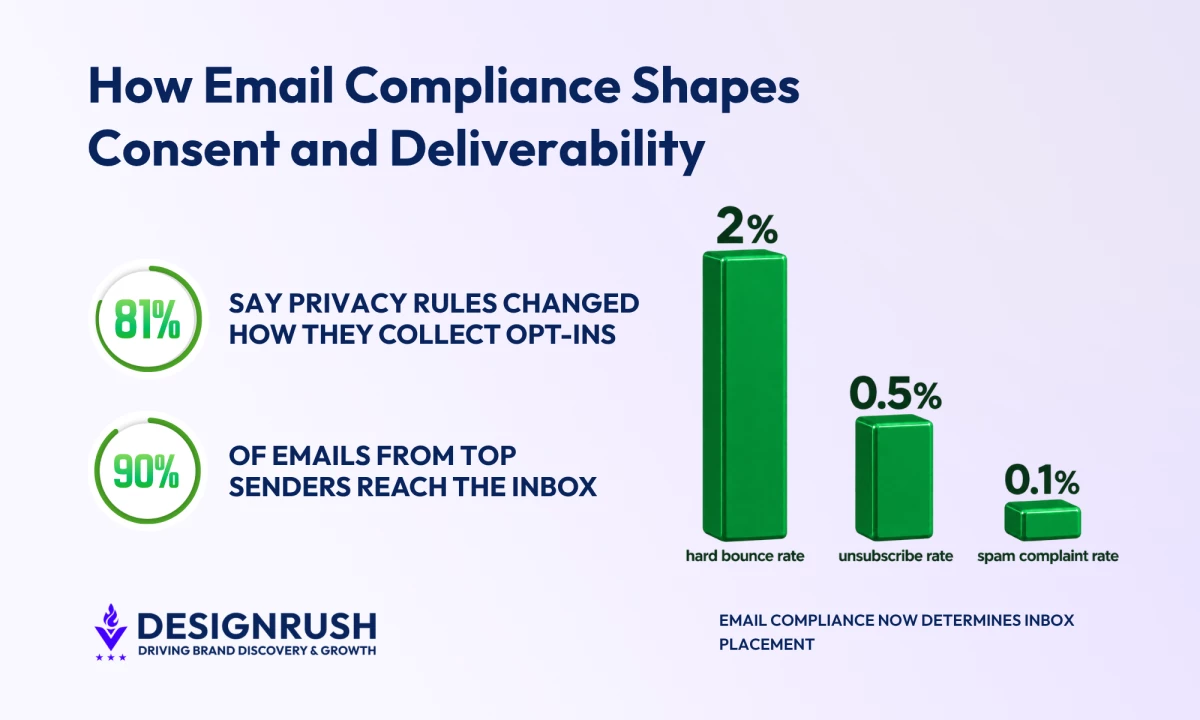
High-performing senders can achieve inbox placement rates above 90%, as Validity’s 2026 Benchmark Report shows, while lower-quality programs, often driven by poor list hygiene and weak engagement, can fall into the 70% range or below.
Spam complaints get the most attention, but they aren't the only number under watch. Mailbox providers and ESPs treat bounce rate and unsubscribe rate as core account-health metrics as well, and they act on all three:
- Bounce rate: A hard bounce rate above roughly 2% signals a list that wasn't verified or has decayed. Sustained high bounces suggest purchased data or stale records.
- Unsubscribe rate: Anything meaningfully above 0.5% per campaign suggests a mismatch between what people agreed to and what they're getting.
- Spam complaint rate: Most providers now expect spam complaint rates to stay below 0.1% (just 1 in 1,000 emails), where historically 0.2-0.3% was considered acceptable.

Exceeding industry-standard thresholds on any one of the three can trigger a warning from your provider or outright suspension of your sending account, regardless of whether you've broken a single law.
Liviu Tanase, founder and CEO of ZeroBounce, explains in a DesignRush interview that internet service providers and email providers are combatting spam through stronger systems.
“For senders, that means tougher rules,” he says, “But if you want results from your email marketing, you must follow these rules.”
List Hygiene Is Now a Compliance Issue
All three numbers come back to the same variable: who is still on the list. Continuing to email inactive or unengaged contacts pushes complaints, bounces, and unsubscribes up at the same time, and the reputation damage compounds with every send.
That is what turns list hygiene into another compliance task. A clean, engaged list is now part of staying compliant with how mailbox providers evaluate sender behavior.
For the operational fixes, like authentication, list decay, HTML, see how to improve email deliverability in 2026.
GDPR, CCPA, CAN-SPAM, and CASL: What Each One Requires of Email Marketers in 2026
Meeting email marketing legal requirements starts with identifying which rules apply to your business, your recipients, and how you use their data.
According to DesignRush’s 2026 Email Marketing Benchmark Survey, 81% of marketers say privacy regulations have significantly changed how they collect opt-ins, and just 14% report no impact.
GDPR, CCPA, and CAN-SPAM take different approaches, but all define how consent is collected, data is managed, and users retain control. Compliance depends on how those requirements are enforced across your systems, not just captured at signup.
That means:
- Consent and preferences must be accurately recorded and retrievable
- User requests (access, deletion, correction) must be processed across all systems
- Data must remain consistent between your CRM, ESP, and other tools
Technical infrastructure also plays a role in compliance. While protocols like SPF, DKIM, and DMARC aren’t explicitly required under GDPR or CCPA, they support core obligations to:
- Protect personal data
- Preventing unauthorized use
- Ensuring secure communication
Each regulation defines these requirements differently, so it’s important to understand how they apply in practice.
- GDPR: The strictest consent standard, and the one you have to prove
- CCPA: Opt-out rights that have to be enforced across every system
- CAN-SPAM: The U.S. baseline – Disclosure and easy opt-outs
- CASL: Canada's express-consent test, and why it catches U.S. senders out
1. GDPR: The Strictest Consent Standard, and the One You Have to Prove
GDPR email compliance requires a lawful basis for processing subscriber data. When you rely on consent, it must be freely given, specific, informed, unambiguous, and provable.
Applicable ePrivacy rules also govern permission to send marketing emails.
In practice, that means:
- Explicit consent is the default: Users must take a clear action to opt in. Pre-checked boxes or passive consent mechanisms don’t meet the standard.
- Consent must be specific and purpose-based: Users should know exactly what they’re signing up for, whether that’s newsletters, product updates, or promotions. Broad or bundled consent is not valid.
- Consent must be separate from other agreements: You can’t hide marketing consent inside terms and conditions or make it a condition of access.
- Consent must be revocable: Users can withdraw at any time, through a visible unsubscribe link and an easy way to update their preferences.
- Consent can't be transferred or purchased: Permission given to one company doesn't carry over to another. Purchased, rented, scraped, or appended lists never qualify, regardless of source.
And whichever basis you're relying on, it has to be something you can produce on request, which means a record of how and when permission was obtained, tied to the specific messaging you sent.
The Two Exceptions to Opt-In: Legitimate Interest and Soft Opt-In
Not every email requires consent, though. Two narrow routes let you email someone without an opt-in:
- GDPR's legitimate interest basis allows data processing without consent, as long as the company's purpose is genuine and doesn't override the individual's privacy rights.
- Soft opt-in comes from the ePrivacy rules and allows you to email existing customers without explicit consent, based on an existing relationship. It usually applies when a user has purchased or shown clear intent, you're promoting similar products, and an opt-out was offered upfront.
When working with UK email marketing agencies, ask how they verify soft opt-in eligibility and document the opt-out offered when each address was collected.
Put simply, legitimate interest is about whether you may hold the data; soft opt-in is about whether you may hit send. Neither is a loophole. Both still require relevance, transparency about why you're making contact, and an easy opt-out in every message.
Even if technically valid, low-intent contacts are more likely to disengage, increasing complaint rates and reducing inbox placement. If engagement drops, suppress or remove those contacts.
Enforcement in Practice: Meta’s €390 Million Fine for an Invalid Advertising Legal Basis
Meta required Facebook and Instagram users to accept updated terms to continue using the platforms. It argued that processing their personal data for behavioral advertising was necessary to fulfill that contract.
In January 2023, the Irish Data Protection Commission announced €390 million in fines. Its final decisions found that Meta could not rely on a contract to justify that processing.
For email marketers, the relevant lesson is that accepting service terms does not automatically authorize marketing. Where consent is required, collect and record a separate, freely given choice to receive promotional emails.
2. CCPA: Opt-Out Rights That Have to Be Enforced Across Every System
CCPA takes a different approach. Rather than focusing primarily on consent, it centers on transparency and user control over personal data.
For email marketers, that means:
- Clear notice at the point of data collection: Users must understand what data is being collected and how it will be used.
- The right to opt out of data selling or sharing: Even if you have permission to send emails, users must be able to control how their data is used beyond the inbox.
- The right to access, delete, and correct personal data: These rights extend beyond consent and require systems that can respond to user requests accurately and quickly.
Compliance comes down to how well user data and consent are captured, synchronized, and acted on across every system in your stack. It means email marketers need systems that can track, update, and act on user data in real time.
For example, if a user requests deletion or opts out of data sharing, those changes must be reflected across your CRM, ESP, and any connected tools. Without this level of coordination, it becomes difficult to meet CCPA requirements consistently.
Enforcement in Practice: Sephora's $1.2 Million Fine for a Missing Opt-Out
Sephora was fined $1.2 million for failing to disclose data sharing practices and provide a clear opt-out mechanism.
The case highlighted that compliance requires systems that can track, honor, and enforce user choices across all touchpoints.



3. CAN-SPAM: The U.S. Baseline – Disclosure and Easy Opt-Outs
In the U.S., the CAN-SPAM Act sets baseline rules for commercial email. While less strict than GDPR, it still defines key email compliance requirements around transparency and user control.
At a minimum, your emails must:
- Use accurate “from,” “to,” and subject line information
- Clearly identify the message as an ad where applicable
- Include a valid physical mailing address
- Provide a clear and easy unsubscribe option
- Honor opt-out requests promptly
CAN-SPAM doesn’t always require explicit consent, but it does require that recipients can easily understand who you are and control what they receive.
While CAN-SPAM is less restrictive than GDPR, failing to meet these requirements can still lead to penalties and increased spam complaints.
Poor identification or difficult unsubscribe processes often result in users marking emails as spam, which directly impacts deliverability and sender reputation.
Enforcement in Practice: Experian's $650,000 Fine for a Buried Unsubscribe
In 2023, the Federal Trade Commission fined Experian Consumer Services $650,000 for sending marketing emails without a clear opt-out mechanism.
Regulators found that recipients were not given a “clear and conspicuous” way to unsubscribe, violating core CAN-SPAM requirements.
4. CASL: Canada's Express-Consent Test, and Why It Catches U.S. Senders Out
Canada's Anti-Spam Legislation (CASL) is the email regulation most North American teams overlook, and it is closer to GDPR than to CAN-SPAM.
It applies to any commercial electronic message sent to or from a computer in Canada, which means a U.S. company with Canadian subscribers is in scope whether or not it has a Canadian entity.
CASL's consent standard has two forms:
- Express consent: The contact actively agreed to receive commercial messages. It doesn't expire, and the burden of proving it sits entirely with the sender.
- Implied consent: Available only in defined cases, and it expires. Existing business relationships support it for 24 months; inquiries or applications, 6 months.
Every commercial message must also identify the sender and anyone it's sent on behalf of, include valid contact information that stays live for at least 60 days after sending, and offer an unsubscribe mechanism that is honored within 10 business days.
CASL compliance requires its own checks for consent, implied-consent expiry, sender identification, and unsubscribe handling.
Keep sender contact information and unsubscribe links valid for at least 60 days after sending.
Enforcement in Practice: Why CASL Penalties Land on Ordinary Senders
The CRTC's actual penalties against commercial senders in 2025 ranged from roughly CAD $5,000 to $250,000.
In its largest-ever penalty against an individual, the CRTC issued a CAD $75,000 fine in 2021 over more than 670,000 emails sent without any evidence of consent had been obtained. Under CASL, that absence is the violation.
If you outsource campaigns for Canadian audiences, ask email marketing agencies in Canada how they document consent, track implied-consent expiry, and honor unsubscribe requests.
Before the Opt-In: Why Your Signup Page Is Already a Liability
Every email list starts on a web page, and that page is usually already busy in the background running analytics, ad tracking, screen recording, and chat tools often before the visitor has agreed to any of it.
A valid email opt-in can still come through a signup page with website privacy compliance gaps, such as undisclosed tracking or ignored opt-out choices.
The first thing that breaks is measurement. Google Consent Mode needs those signals passed from the page into Google Ads and GA4 for EEA traffic. Without them, your data on what's working gets murky.
A misconfigured consent setup in Google Tag Manager can quietly break your ad tracking, so you don't know which campaigns are bringing in subscribers, and you end up optimizing signups based on bad data.
There's an upside to getting this right, too. A clear, honest prompt about what you're collecting, and why, gets more people clicking “accept” than a vague one does.
What Cookiebot Automates on the Website Side of Compliance
Europe and most US states generally take different approaches. In the EU, nonessential trackers require prior opt-in consent, while most US privacy laws use an opt-out model.
However, California’s CIPA litigation has increased pressure on businesses to obtain consent before deploying certain tracking technologies, making the distinction less clear-cut.
Either way, the same signup page needs to behave two different ways depending on who's looking at it.
Chris Elsheikhi, VP of Demand Generation at Cookiebot, explains how a marketer running both EU and US traffic handles that without building two separate setups:
“You don't need two or even more tools. You need one that changes behaviour based on the website visitors’ geolocation.
The same website can serve an opt-in cookie consent banner to a visitor in Germany, and a "Do Not Sell or Share My Personal Information" opt-out path to a visitor in California. Cookiebot™ allows you to do exactly that.”
Cookiebot handles the website half of a compliant email program the way an email compliance tool handles the sending half:
- Inventory what's already running. Cookiebot scans your domain and categorizes the cookies and scripts it finds, then rescans on a schedule – which matters, because tag managers, embedded forms, and third-party widgets add trackers usually without anyone noticing.
- Holds trackers back until someone agrees. Nothing fires before consent. A prompt that shows up after tracking's already started isn't doing its job.
- Adjusts by location. European visitors get an opt-in prompt, US visitors get an opt-out option. All in one setup, no manual switching.
- Store the consent record. A timestamped, per-visitor audit trail of what was shown, what was chosen, and which banner and policy version was live, with consent state passed downstream to Google Tag Manager, analytics, and your ad platforms.
That last point is where this starts to matter for reporting. An email platform can prove someone signed up for a newsletter. A website should be able to prove, just as clearly, what tracking that same person agreed to.
Email marketing compliance also extends to your signup page, where consent management platforms can record tracking choices and pass consent signals to connected tools.
In the U.S. especially, that second record is increasingly the one requested first.
For agencies, developers, and freelancers, consent setup is something you build and own. It's now standard on every site build and ad campaign, and usually what clients find missing during a compliance review or when their Ads numbers stop making sense.
So, this comes full circle: get consent wrong and your campaign numbers go wrong with it. Cookiebot handles the geolocation logic in one setup, with a consent record ready whenever someone asks.
Collecting Consent Across Every Channel: Online, Over Time, and In Person
Consent can enter your database through forms, preference updates, events, and offline interactions.
Every channel should capture the person’s intent, source, and permission in a form you can prove later.
- Zero-Party data: Collecting better consent instead of more contacts
- Progressive profiling: Build consent over time instead of all at signup
- Offline signups: How to make event and paper consent provable
1. Zero-Party Data: Collecting Better Consent Instead of More Contacts
Zero-party data is the more compliant alternative to traditional list-building. It's information users choose to share, which makes consent clearer and easier to act on across your systems.
That consented signal is also what high-performing behavioral email triggers rely on, especially for pricing-page, milestone, and post-purchase flows.
Just collecting an email isn't enough anymore. To meet compliance standards, you need to capture clear intent and context at the point of signup – what content someone wants, how often they want to hear from you, and what they're interested in.
Just as important is when and how you ask.
- At signup: Keep it simple and focused on core preferences
- Post-signup: Use follow-up emails or onboarding flows to gather more detail
- Over time: Build a clearer picture through progressive interactions
“Zero-party data, in conjunction with traditional first-party data sources, is really the best answer for brands looking to deliver personalized experiences in a more privacy-focused world,”
Jennifer Sego, former head of marketing at Wyng and current director of demand generation at Aampe, shares with us.
2. Progressive Profiling: Build Consent Over Time Instead of All at Signup
Instead of asking for everything upfront, progressive profiling builds consent and preference data over time.
This can be small asks at different touchpoints or profiles updated from what people tell you rather than what you infer from behavior.
Preference centers are where this lives long-term. A good one lets people adjust content type and frequency, reflects what they originally signed up for, and makes it easy to update or withdraw their consent at any point.
3. Offline Signups: How To Make Event and Paper Consent Provable
Online signup flows have forms that capture a timestamp, a source, and the exact wording the user agreed to.
Offline collection has none of that by default, which is why contacts gathered at trade shows, in-store, at events, or on paper forms are usually the weakest records in a database.
The standard doesn't change because the channel did. Offline consent still has to be freely given, specific, informed, and provable. To get there:
- Put consent language on the artifact itself. Paper forms and badge scans need a clear, unticked opt-in that states the sender, content, and frequency. If scanning badges, say what it subscribes them to.
- Capture metadata. Record date, event, collector, and consent wording version. Keep the physical forms or scans.
- Digitize fast. Contacts entered weeks later without source or date look unsourced. Transfer within days, and tag the source.
- Send a confirmation email first. Double opt-in turns a paper signature into a verifiable record and catches bad addresses before they bounce.
- Never merge lists you didn't collect. A conference attendee list belongs to the organizer, not you. Sponsorship isn't consent.
Email Compliance Checklist: How to Validate Your Program in 2026
Most email programs break compliance when it comes to how consent is stored, updated, and applied over time. You need to ensure that permission is consistently reflected across your systems, campaigns, and data flows.
Use this email compliance checklist to assess how your program meets applicable email marketing regulations and your mailbox providers’ sending rules.
- Can you prove where and how consent was given?
- Does your current messaging match the original consent?
- Are inactive contacts still being treated as “permissioned”?
- Are unsubscribes and preferences fully enforced across systems?
- Are you transparent about data use and tracking?
- Is consent consistent across your marketing stack?
- Would your program hold up under audit?
- Is tracker consent on your signup page recorded too?
1. Can You Prove Where and How Consent Was Given?
For every contact, you should be able to answer:
- Where did this email address come from?
- What exactly did the user agree to?
- When was that consent given?
This requires:
- Stored consent language (not just a checkbox)
- Timestamped records
- Clear source tracking
If you can’t reconstruct the original context, your consent may not be defensible.
2. Does Your Current Messaging Match the Original Consent?
Consent is tied to purpose, not just permission.
Check whether:
- You’re sending the types of emails users originally signed up for
- Messaging hasn’t expanded beyond that scope
- Frequency aligns with expectations set at signup
Drift between consent and communication is a common compliance gap, and a key driver of disengagement.
3. Are Inactive Contacts Still Being Treated as “Permissioned”?
Consent degrades over time.
Review:
- How you define inactivity
- Whether disengaged users are still being emailed
- Whether re-permissioning workflows are in place
Continuing to email unengaged contacts increases both compliance risk and negative engagement signals.
4. Are Unsubscribes and Preferences Fully Enforced Across Systems?
User intent must be reflected immediately and consistently. Any gap between user action and system response is a compliance failure.
Validate that:
- Unsubscribes are processed without delay
- Suppression lists are applied across all tools
- Preference changes update how users are segmented and targeted
5. Are You Transparent About Data Use and Tracking?
Compliance extends beyond sending emails to how data is used.
Check whether:
- Tracking (e.g. opens, clicks) is clearly disclosed
- Data usage aligns with what users were told
- You avoid relying on opaque or inferred signals where consent is unclear
Transparency is increasingly scrutinized, especially as tracking practices evolve.
6. Is Consent Consistent Across Your Marketing Stack?
Consent is only as strong as its weakest system.
Audit:
- Whether consent status is synced between CRM, ESP, and other tools
- How updates propagate across systems
- Whether conflicting data exists in different platforms
Fragmented systems often lead to inconsistent enforcement and hidden compliance risks.
Each of those gaps also shows up as email marketing budget waste in duplicate sends, suppression failures, and re-acquisition costs all compound.
7. Would Your Program Hold Up Under Audit?
Finally, step back and assess the full picture.
Ask:
- Can you demonstrate compliance without manual reconstruction?
- Are your processes documented and repeatable?
- Would an external reviewer see clear alignment between consent, data, and messaging?
If not, your compliance model may rely too heavily on assumptions rather than verifiable controls.
If those checks reveal gaps, ask compliance consultancies to review your consent evidence, documented procedures, and how consistently your systems enforce user choices.
8. Is Tracker Consent on Your Signup Page Recorded Too?
Newsletter permission and website tracking consent need separate records. Check that your signup page’s consent log shows:
Which analytics, advertising, and other tracking categories the visitor accepted or rejected
When the choice was made and which banner and policy versions were shown
Whether later preference changes or withdrawals were recorded
Verify that these choices reach Google Tag Manager and connected tools, so the consent record matches what actually runs on your signup page.
What Compliance Requires Beyond Consent: Accessibility, Data Security, and ESP Terms
Check the email marketing legal requirements that apply to your content and subscriber data, then review your ESP’s separate acceptable-use rules.
The sections below cover accessibility, data security, and platform restrictions.
- Accessibility: What WCAG requires, and what makes it enforceable
- Data security: Protecting the list after you've collected it
- ESP terms: The rules with no regulator behind them
1. Accessibility: What WCAG Requires, and What Makes It Enforceable
Accessibility complaints have expanded from websites to emails, and one a screen reader can't read is a legitimate complaint.
WCAG is a technical standard, written by the W3C, that spells out what "accessible" means in practice. It becomes enforceable when a law adopts it as the definition of compliance.
US courts and the DOJ use WCAG this way for the ADA, and the EU's Accessibility Act, in effect since June 2025, works the same way.
Six things that matter most:
- Real heading structure. Screen readers navigate by headings, so use semantic markup (<h1>, <h2>, <p>) in a logical order.
- Meaningful alt text. A file name like "banner_v3_final.jpg" tells a screen reader user nothing, and since many email clients block images by default, alt text is often what people read.
- Contrast minimums of 4.5:1 for body text and 3:1 for large text. Text and background need enough contrast to read easily, especially in parts that matter most legally: who the email's from, the unsubscribe link, and disclosures.
- No critical text inside images. Image text can't be resized, translated, or read aloud, so an unsubscribe link or physical address buried in a graphic is a CAN-SPAM problem as much as an accessibility one.
- Descriptive link text. "Click here" gives no context out of sequence; "Read the 2026 deliverability report" does.
- A set language attribute, so screen readers pronounce the content correctly.
Emails that are hard to read also get deleted without reading, one of the engagement signals from the start of this piece.
2. Data Security: Protecting the List After You've Collected It
Consent tells you whether you were allowed to collect an address. Security determines whether you deserve to keep it. GDPR, CCPA, and CASL all assume you're protecting what you hold.
This is ground compliance software rarely covers, since it lives in your stack. SPF, DKIM, and DMARC protect your messages; these protect the list:
- Encrypt data at rest and in transit, including exports.
- Restrict access by role. Review quarterly, revoke on exit.
- Enforce secure logins — unique credentials, SSO, MFA. Shared accounts make audits impossible.
- Train the team. Leaks usually come from a stray spreadsheet or phished credentials, not sophisticated attacks.
- Use DLP tooling to catch bulk exports before they leave.
- Back up and test restoration. Untested backups aren't backups.
- Audit periodically. apps, API keys, admin rights, and whether retention is enforced, not just documented.
3. ESP Terms: The Rules With No Regulator Behind Them
The entity most likely to shut down your program is your own email service provider.
Breach the acceptable-use policy and an account can be suspended within hours, with no notice period and no appeals process.
Common ESP terms include:
- Prohibited content categories: Gambling, crypto, CBD and cannabis, adult content, firearms, debt relief, MLM, and some lending and supplement categories, even where the business is entirely legal.
- Required disclosure of affiliate links, with undisclosed affiliate sending a common suspension trigger.
- Bans on imported lists, covering contacts collected off-platform and any purchased data.
- Account-health thresholds: The bounce, complaint, and unsubscribe ceilings from earlier, usually written into the contract rather than just monitored informally.
- Restrictions on send-from domains and no-reply addresses that can't receive opt-out replies.
Read the platform's policy before building on top of it, and again if your offering shifts into a restricted category. A campaign can be fully lawful and still break the platform's terms.
Email Marketing Compliance: Wrapping Up
Make consent provable by recording the signup source, timestamp, and exact wording each contact agreed to, then checking that your messages match that permission.
CASL can catch US senders with Canadian subscribers because it requires express or qualifying implied consent, including expiry tracking when implied consent is time-limited.
Watch three deliverability benchmarks closely: roughly 2% for hard bounces, 0.5% for campaign unsubscribes, and 0.1% for spam complaints, alongside your provider’s specific limits.
Your ESP can suspend even a lawful campaign for restricted content, prohibited lists, undisclosed affiliate links, or breaches of its account-health rules.
| DesignRush Email Marketing Benchmark Survey, conducted Apr 2026. Respondents include agency professionals (53%), small business owners (18%), enterprise marketers (11%), and in-house teams (10%). Annual email send volumes range from under 10,000 to over 1 million. |

Our team ranks agencies worldwide to help you find the right fit. Visit our Agency Directory for the top email marketing agencies, as well as: