
Email is still one of the most effective marketing channels in 2026, but the teams seeing them are not necessarily the ones sending more.
Some of the biggest drivers of performance are also the ones companies tend to underestimate.
We’re unpacking email marketing statistics that show what is driving performance, what is limiting it, and where companies should focus next.
Email Marketing Statistics 2026: Key Findings
- Automation is now a core revenue engine, with 43% of marketers attributing more than half of total email revenue to automated flows.
- The biggest value from AI in email marketing comes from personalization, as 71% of respondents report at least a 20% engagement lift from dynamic, personalized content.
- Deliverability remains one of email’s biggest performance leaks, with 62% of marketers citing spam filtering as their top challenge.
Is Email Marketing Still Worth It?
Email still delivers some of the strongest returns in digital marketing, with broader email marketing ROI statistics showing an ROI of 26.9% and an average email conversion rate of about 8%, ahead of social.
But the more useful story for 2026 is how email marketing works now.
DesignRush’s 2026 Email Marketing Benchmark Survey shows that results depend less on send volume and more on deliverability, relevance, automation, consent, and usability.
43% of Marketers Attribute More Than 50% of Email Revenue to Automation
Automated email flows have crossed a threshold and, for most teams in DesignRush’s survey, they are a primary revenue driver inside the email program.
The email marketing automation statistics below show how triggered sends are shifting from a support tactic to core revenue infrastructure.
- Why triggered sends outperform broadcast by up to 2,361%
- Which tool categories are powering email programs
- The underestimated case for re-engagement
- Where email automation is heading next
82% of respondents use behavioral triggers at least to some degree, with 37% deploying them extensively.
And a substantial amount of them are seeing measurable results:
- 43% attribute 50% to 75% of total email revenue to automation
- 20% attribute 24% to 50% of email revenue to automation
- 14% attribute 75%+ of total email revenue to automation
Combined, that means 77% of respondents are running programs in which the majority of email revenue comes from triggered sequences instead of broadcast campaigns.
Why Triggered Sends Outperform Broadcast by Up to 2,361%
That adoption profile is consistent with broader email marketing automation statistics, including Omnisend’s 2025 eCommerce report stating that:
- Automated emails drove 37% of all email-generated sales while making up just 2% of email volume.
- Automated messages delivered 52% better open rates, 332% higher click rates, and 2,361% better conversion rates than regular campaigns.
Within the DesignRush data, respondents identified the clearest performance advantages of triggered sends over broadcast:
- Opens: 43%
- Conversions: 35%
- Clicks: 21%
The conversion advantage is particularly significant. Opens can reflect habit or curiosity. Conversions reflect intent and relevance, which is precisely what behavioral triggering is designed to capture.
Which Tool Categories Are Powering Email Programs
The strongest investment is going into tools that help teams measure performance, improve efficiency, and protect revenue:
- Analytics tools: 60%
- AI tools: 57%
- Deliverability tools: 52%
- ESP tools: 43%
For our hands-on comparison of the platforms behind that 57%, see the top email marketing AI tools roundup.
Taken together, the data shows that budget is moving toward tools that make email programs smarter, more measurable, and more resilient.
The Underestimated Case for Re-Engagement
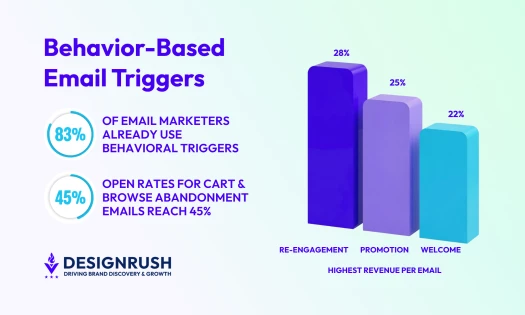
One finding deserves more attention than it typically gets in email strategy discussions: re-engagement emails were identified by the largest share of respondents as the funnel stage generating the most revenue per email sent.
- Re-engagement: 28%
- Promotional sends: 25%
- Nurture emails: 24%
- Welcome emails: 22%
Broadcast campaigns dominate planning cycles and creative investment.
But on a per-email basis, win-back flows appear to be more efficient revenue generators than the campaigns most teams spend the most time on.
For teams that haven't built robust re-engagement sequences, or that sunset contacts too aggressively, there is likely recoverable revenue sitting in lapsed subscriber segments.
Where Email Automation Is Heading Next
One of the clearest email marketing trends for 2026 is that triggered email is already responsible for a large share of email-driven revenue, while leading teams are starting to build beyond email alone.
How to improve email automation ROI is now a top operational priority.
Jackie Palmer, VP of Product Marketing at ActiveCampaign, says the strongest programs now connect email with channels such as SMS and WhatsApp instead of managing each one separately. She describes the goal as creating “a single, orchestrated conversation.”
That means a customer’s actions in one channel can shape what happens in another.
An email click, a purchase, a missed message, or a transactional update can all act as signals that determine the next touchpoint, the next channel, and the next message.
In this setup, email still plays a central role because it carries more context and storytelling. But it works as part of a broader system that responds to customer behavior in real time.
According to Palmer, this kind of cross-channel automation will define best-in-class programs in 2026.
ActiveCampaign’s example of Spark Joy New York shows the upside: triple the sales, 85% less campaign production time, and consistent $10,000 months from only three targeted emails per week.
AI Is Already Part of the Email Workflow for 87% of Marketers
87% of respondents use at least one AI tool in their email workflow. That means that AI has become a mainstream part of email production rather than novelty or an emerging experiment.
The remaining 13% who use none are now the outliers.
Where adoption is concentrated tells a more specific story:
- Subject line optimization: 69%
- Content generation: 63%
- Send time optimization: 47%
- Behavioral prediction: 31%
The pattern reflects where AI is easiest to implement and measure, namely, production and optimization tasks that sit close to campaign output.
Vendor-reported results suggest the time savings can be meaningful at that level of use.
ActiveCampaign says its AI agents saved marketers more than 13 hours per week by handling content creation, testing, and optimization.
Behavioral prediction, which sits further upstream and requires more sophisticated data integration, shows notably lower adoption despite having arguably greater commercial potential.
Where AI Personalization Appears To Create the Most Value
The personalization data makes the gap between production and behavioral prediction worth closing.
Among the most important email marketing trends for 2026, personalization stands out because 71% of respondents report a 20% or greater engagement lift from dynamic, personalized content versus non-personalized sends:
- 53% report a 20% to 50% lift
- 18% report a 50%+ lift
- 13% report no lift or are not using personalization
A 50%-plus engagement lift is a meaningful performance differential, and the teams achieving it are using AI to improve message relevance and timing, rather than merely speeding up copy production.
- AI that helps marketers send more emails faster is a productivity tool.
- AI that helps marketers send more relevant emails is a revenue tool.
Spam Filtering Remains the Top Deliverability Problem for 62% of Marketers
Nearly all teams are monitoring deliverability, but it has rarely translated into improvements.
96% of respondents monitor deliverability at least monthly.
That is near-universal attention to a metric that still shows alarming gaps in outcome.
- More than one in ten respondents (11%) said fewer than 50% of their emails reach the primary inbox.
- Just 35% said they achieve inbox placement between 86% and 95%.
For the operational playbook on each of the five problems below, see how to improve email deliverability in 2026.
The Problems Keeping Emails out of Inboxes
The causes are well-documented in the data:
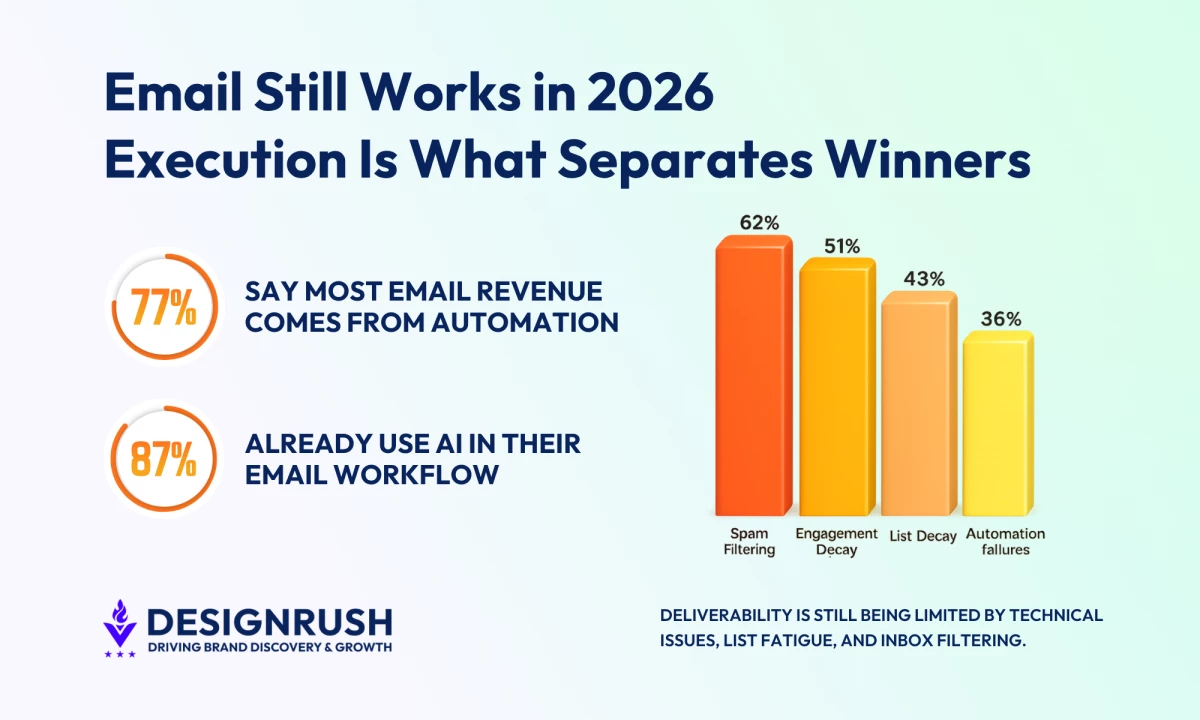
- Spam filtering: 62% of respondents
- Engagement decay: 51%
- List decay: 43%
- Authentication failures (SPF, DKIM, DMARC): 36%
Only 4% of respondents have abandoned deliverability monitoring altogether, which means the issue is not negligence but the gap between monitoring and remediation.
Teams know there is a problem, although few have truly solved it.
What Poor Inbox Placement Actually Costs You
Every percentage point of emails that miss the primary inbox represents spend on content, design, and infrastructure that returns nothing.
Klaviyo reports average revenue per recipient at $0.11 for standard email campaigns, $1.94 for automated flows, $2.65 for welcome series, and $3.65 for abandoned-cart emails.
Applied to a 100,000-email send using the global average inbox-placement shortfall, that puts roughly $1,815 in campaign revenue, $32,010 in flow revenue, $43,725 in welcome-series revenue, and $60,225 in abandoned-cart revenue at risk.
For teams where automation handles a large share of revenue-generating sends, which, as the data below shows, is most teams, inbox placement failures hit directly at the bottom line.
Spam filtering is the dominant challenge, but it is also the most responsive to structural fixes:
- Authentication protocols
- Engagement-based list segmentation
- Sunset policies for disengaged contacts
Teams still losing a meaningful share of sends to spam folders are leaving the most tractable improvements on the table.
Tuesday Morning Still Wins While Send Frequency Varies by Audience
DesignRush's 2026 Email Marketing Benchmark Survey found that Tuesday is the strongest engagement day, cited by 50% of respondents.
The full day-of-week pattern looks like this:
- Tuesday: 50%
- Thursday: 40%
- Wednesday: 39%
- Monday: 33%
- Friday: 24%
- Saturday: 11%
- Sunday: 6%
Where Email Engagement Peaks by Time of Day
The strongest engagement window is clearly in the morning:
- Morning (9:00-12:00): 55%
- Early afternoon (12:00-15:00): 24%
- Evening (18:00-21:00): 20%
Why More Sends Does Not Reliably Mean Better Results
Another one of the clearest email marketing trends for 2026 is that higher send frequency does not automatically create stronger engagement.
The most common send cadence among respondents is:
- Several times per week: 38%
- Weekly: 19%
- Daily: 18%
When teams test different send frequencies, the results are unresolved:
- 35% see engagement decline when they send more
- 25% see engagement improve when they send more
- 34% report mixed results
ZeroBounce reports similar results that more opportunities to appear do not automatically translate into stronger results:
- 46% say they consistently open brand emails when the content feels relevant.
- 43% unsubscribe because brands email too often.
What Actually Drives Frequency Tolerance
- Subscribers who find emails useful will tolerate higher cadences.
- Subscribers receiving generic or repetitive content will exit faster regardless of volume.
The teams seeing engagement improve when they send more are likely also sending content worth reading. The teams seeing it fall are asking more of subscribers than their content justifies.
Value-Led Content Is Setting the Tone for Email Strategy in 2026
DesignRush found that value-led content is the top-performing copy approach by a clear margin:
- Value-led content: 72%
- Promotional copy: 28%
This is a clear indicator that companies are seeing better engagement when emails lead with relevance, usefulness, and audience value instead of pushing the offer too hard.
Where Interactive Email Still Looks Underused
According to DesignRush’s survey, interactive email elements represent a low-competition area with a measurable subscriber appetite.
Here’s how often businesses use them in their email campaigns:
- Often: 33%
- Rarely: 45%
- Never: 21%
That means 66% of respondents are largely bypassing this highly underutilized tool.
Now here’s where it gets interesting:
- 60% of people are likely to engage with an interactive email.
- More than 50% say they like being able to interact with content directly inside the message.
Put together, the numbers suggest marketer adoption is still lagging behind subscriber interest, which represents a tangible opportunity for teams willing to test it deliberately.
GDPR and CCPA Now Shape How 81% of Businesses Collect Email Subscribers
Two regulatory regimes are now shaping how email lists are built, and the effects are showing up in both acquisition and retention.
- In California, businesses already have to provide notice at or before data collection, honor consumer opt-out rights, and avoid consent flows that rely on dark patterns.
- In Europe, regulators are still actively enforcing consent standards, including a €900,000 CNIL fine in May 2025 against SOLOCAL MARKETING SERVICES for commercial prospecting without valid consent.
The DesignRush data shows the effect of that pressure in practical terms.
- 81% of respondents said GDPR or CCPA has changed how they collect email subscribers
- 78% said privacy concerns have increased unsubscribes or reduced list quality
It is showing up at the top of the funnel, where brands collect subscribers, and further down the funnel, where privacy concerns affect retention and list health.
For the full breakdown of what GDPR, CCPA and CAN-SPAM now require in practice, see our email marketing compliance guide.
Why Subscriber Quality Is Harder To Sustain
The mechanics of building a healthy email list have changed for good, and that broader shift also shows up in Mailchimp’s 2026 Art of the Opt-In research, which argues that brands need to move away from passive list growth and focus more on healthier audiences and measurable revenue.
Mailchimp found that:
- 50% of consumers fear an immediate message surge after signing up.
- 44% say messages felt spammy.
- 42% report irrelevant communication.
Teams still prioritizing subscriber acquisition volume over subscriber quality are likely accumulating lists that perform worse over time and cost more to maintain.
Where Accessibility Fits Into The Quality-First Shift
Among respondents who apply WCAG standards in their email design, 61% report measurable engagement uplift. 34% always apply accessibility standards; 9% never do.
If privacy rules are raising the bar for earning a subscriber's consent, the emails sent afterward need to be easier to read, navigate, and act on.
The most important takeaways you get from this data are that:
- Privacy rules are making permission more important.
- Accessibility may help you get more value from that permission once you have it.
- Both push email strategy away from volume and toward quality, trust, and usability.
Email Marketing Statistics 2026: The Channel is Fine — The Execution Gap Is Not
Email marketing is struggling where teams are still running 2020 playbooks against 2026 subscriber expectations.
The data in this survey points consistently to:
- Deliverability that actually gets fixed, not just monitored.
- Automation treated as a revenue infrastructure, not a time-saving convenience.
- Consent earned through clear value, not extracted through low-friction tactics.
- Content that leads with usefulness instead of an offer.
- AI deployed where it improves what subscribers receive, not just how fast teams produce it.
None of that requires a platform overhaul or a larger budget, but a clearer set of priorities and the discipline to stop optimizing the wrong things.
For practitioners going deeper, our best email marketing conferences in 2026 lists where the field is meeting next.
| DesignRush Email Marketing Benchmark Survey, conducted Apr 2026. Respondents include agency professionals (53%), small business owners (18%), enterprise marketers (11%), and in-house teams (10%). Annual email send volumes range from under 10,000 to over 1 million. |
Our team ranks agencies worldwide to help you find the right fit. Visit our Agency Directory for the top email marketing agencies, as well as:
- Top UI/UX Design Agencies
- Top Conversion Rate Optimization Agencies
- Top Content Marketing Agencies
- Top Digital Strategy Agencies
- Top Email Marketing Companies In Houston
Looking for visual inspiration to use in your email campaigns? Explore our Design Awards, including recent winners recognized for standout video design.
Email Marketing Statistics FAQs
1. How do I build an email list without hurting quality?
Use clear opt-ins and make the value obvious from the start. The goal is not to collect the most subscribers, but to attract people who actually want the emails.
2. How do I know if I am emailing too often?
Watch engagement, unsubscribe, and complaint trends. If opens and clicks fall while unsubscribes rise, your cadence may be outpacing your value.
3. What makes subscribers keep opening brand emails?
Relevance does more than frequency ever will. People keep opening when the content feels useful, timely, and worth the attention.
4. What is the difference between a campaign and an automated email?
A campaign is a scheduled send to a selected audience. An automated email is triggered by behavior or timing, such as a signup, purchase, or abandoned cart.
5. How can I improve email performance without sending more?
Focus on stronger segmentation, better timing, clearer messaging, and more useful content. Better emails usually outperform more emails.
6. Why does deliverability matter so much in email marketing?
Because an email cannot perform if it does not reach the inbox. Deliverability affects everything that comes after, from opens to clicks to conversions.