
AI marketing tools use machine learning and generative AI to support tasks such as content creation, personalization, campaign optimization, automation, and performance analysis.
As the number of platforms grows, the challenge is identifying which ones offer genuinely useful capabilities.
These tools cover email, content, video, paid media, attribution, influencer marketing, and AI-search visibility, with each considered for its strengths, limitations, and best-fit marketing teams.
Best AI Digital Marketing Tools: Key Findings
- AI marketing tools increasingly focus on specific functions. Omnisend and ActiveCampaign support lifecycle execution, Pixis optimizes paid media, and Brandi AI tracks visibility in AI-generated answers.
- StoryChief, Descript, and Syllaby automate parts of content and video production while leaving strategy and final editorial decisions with marketing teams.
- Measurement is expanding beyond clicks and last-touch attribution, with Prescient AI analyzing channel contribution and Brandi AI showing how brands appear across AI platforms.
AI Marketing Tool Trends Shaping 2026
AI marketing tools have already become routine for 91% of marketing leaders, per Jasper’s research. Many platforms are now concentrating on a specific marketing job, while others take on more campaign decisions and execution.
- AI is moving from assistance to execution
- Specialized tools are replacing the one-platform promise
- Measurement is expanding beyond the last click
- Webinars are expanding into an AI-assisted content channel
1. AI Is Moving From Assistance to Execution
Early marketing AI was mainly used to produce copy and images, but newer systems can build workflows or change campaigns while they’re running.
ActiveCampaign adjusts automations and send timing, while Pixis and Plai can reallocate spend or refine targeting based on performance.
Similar capabilities are appearing across AI-powered advertising, programmatic advertising, and personalization.
2. Specialized Tools Are Replacing the One-Platform Promise
It's hard to find a platform that handles every marketing function equally well. A video editor, attribution platform, or AI-visibility tracker earns its place by doing one job well.
Smaller groups of connected tools tend to work better, especially when chosen around actual workflow gaps.
A practical plan for using AI in business should account for existing systems, staff responsibilities, and overlapping features before adding another subscription.
3. Measurement Is Expanding Beyond the Last Click
Clicks and last-touch conversions leave much of a campaign unexplained. Predictive attribution and marketing mix modeling estimate how several channels contributed when a sale followed multiple interactions.
Prescient AI applies this analysis to campaign and revenue data. Brandi AI covers an earlier point in the buying process by showing whether a brand appears in AI-generated answers, where discovery may happen before a website visit.
4. Webinars Are Gaining an AI Layer
Established marketing formats are also gaining AI capabilities, and webinars are one example.
WebinarGeek demonstrates this clearly by using AI to help teams run webinars and get more from the recordings afterward.
It can suggest webinar copy, provide live captions, handle audience questions, and generate chapters, transcripts, summaries, and performance insights. The AI Assistant is a paid add-on, while other AI features vary by plan.
Recordings can be reused as automated or on-demand webinars, and viewer-level engagement data can feed audience segmentation and CRM follow-up.
How These AI Marketing Tools Were Chosen
The selection here focuses on AI-native platforms while also covering established marketing tools with useful AI capabilities.
Together, they span email, paid media, attribution, content production, influencer marketing, video, and AI-search visibility.
Each tool’s core workflow was considered for usability, AI usefulness, control, integrations, and audience fit. Product documentation and public reviews were checked to verify features, drawbacks, and pricing.
Use the table below to compare each tool’s main function, ideal user, and starting price:
| AI Digital Marketing Tool | Best For | Content Generation | Paid Ads Management | Tracking, Analytics, & Reporting | Pricing Starts At |
| Omnisend | eCommerce multi-channel campaigns | ✅ | ❌ | ✅ | $11.20 monthly |
| ActiveCampaign | Email and sales automation | ✅ | ❌ | ✅ | $15 monthly |
| Descript | All-in-one video and podcast editor | ✅ | ❌ | ❌ | $16 per person monthly |
| Brandi AI | AI visibility (GEO) | ❌ | ❌ | ✅ | $349.99 per month |
| Pixis | AI media buying and campaign optimization | ❌ | ✅ | ✅ | Inquire |
| Prescient AI | Predictive marketing attribution | ❌ | ✅ | ✅ | Inquire |
| StoryChief | Content planning and publishing | ✅ | ❌ | ✅ | From ~$80/seat/month, billed annually |
| Modash | Influencer discovery and vetting | ❌ | ❌ | ✅ | $199/month, billed annually |
| Syllaby | AI multichannel video marketing | ✅ | ❌ | ✅ | $24.67 monthly |
| Plai | AI-assisted ad campaign management | ✅ | ✅ | ✅ | From ~$66/month, billed annually |
Pricing and AI features vary by plan; check each provider’s site for current details.
1. Omnisend: Best for eCommerce Email and Multi-Channel Campaigns
For eCommerce teams running multi-channel campaigns
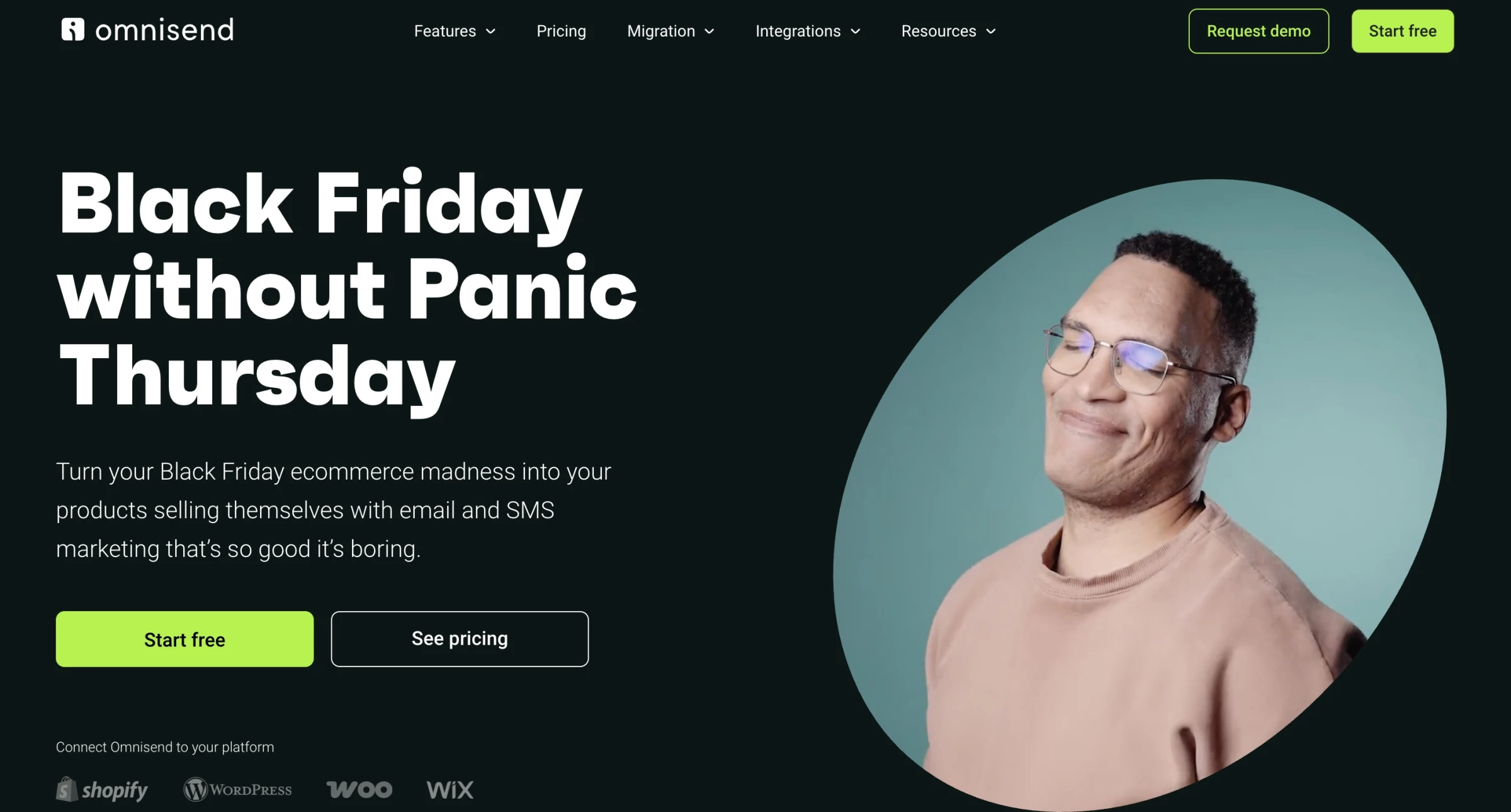
I’ve tried a lot of email marketing platforms, but Omnisend felt like it was built with online stores in mind from day one.
The platform combines email, SMS, and web push notifications in one place, eliminating the need to juggle different dashboards or log into multiple tools.
Pros:
- Email, SMS, and web push notifications in one platform
- Drag-and-drop builder
- Pre-built automation templates
- Supports audience segmentation and scheduling
- Personalized product suggestions
- Responsive support team
Cons:
- AI suggestions sometimes need refining
- Advanced marketers may find reporting and automation limited
- Form creation can be tricky
- Limited customization for larger businesses
Using the drag-and-drop builder, I was able to create a shoppable email in minutes, complete with product blocks, discount codes, and a professional-looking layout, all without hiring a designer.
The AI templates guided me gently, suggesting optimizations and helping me structure campaigns.
What impressed me most was how quickly Omnisend let me iterate. I could A/B test subject lines, tweak messages, and see results almost immediately.
Integrations with Shopify, WooCommerce, and BigCommerce made the workflow seamless, and their support team was responsive when I had questions.
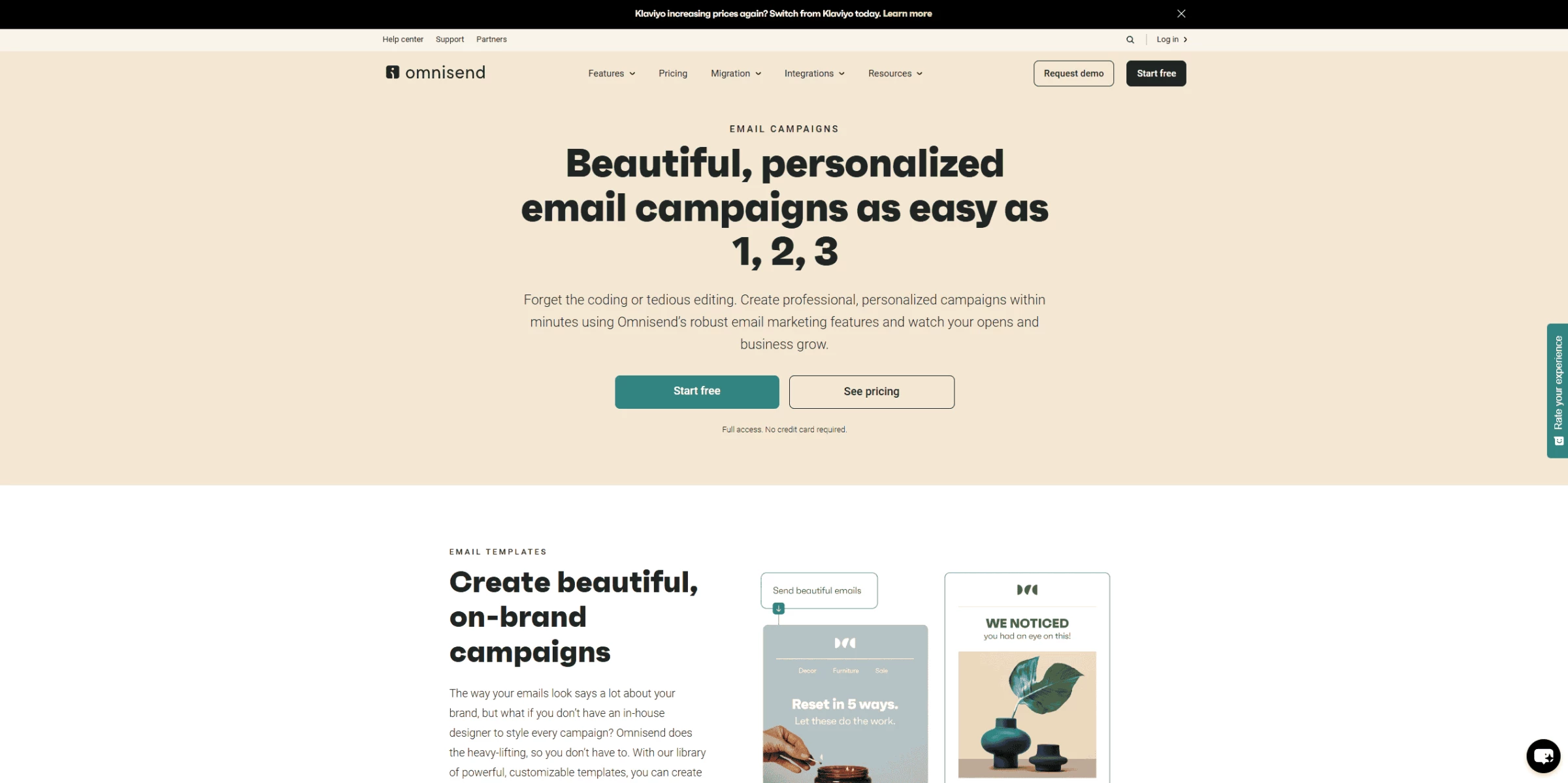
Of course, it’s not flawless. Some of the AI suggestions need refining. Also, more advanced marketers might notice limits in reporting and automation complexity.
For smaller or mid-sized online stores, Omnisend feels like an efficient marketing partner. It doesn’t replace creative input, but it speeds up campaign creation and helps you stay consistent across channels.
Pricing
- Free: Up to 250 contacts and 500 emails/month
- Standard: From $16/month for 500 contacts
- Pro: From $59/month for 2,500 contacts
What Users Say
Omnisend is widely praised for its automation tools, multi-channel reach, and solid ROI.
Users especially like how easy it is to launch email and SMS campaigns, segment audiences, and manage sales workflows without getting bogged down in technical details.
Of course, it’s not perfect. Creating forms can be a bit tricky, and larger businesses might find the customization options a little limited compared to more advanced platforms.
Who’s It For?
Omnisend is perfect if you run an online store and want to make your marketing smarter without extra hassle.
It’s especially handy for small to mid-sized shops that want to reach customers and boost sales, all through simple, automated workflows.
Other Notable Features
- Up to 8 personalized product suggestions per email for upsells and cross-sells
- Easy-to-use drag-and-drop email builder
- Segmentation and scheduling tools for targeted campaigns
- Pre-built automation templates for quick deployment
2. ActiveCampaign: Best for Autonomous Customer Lifecycle Marketing
For teams managing full-funnel automation in marketing and sales
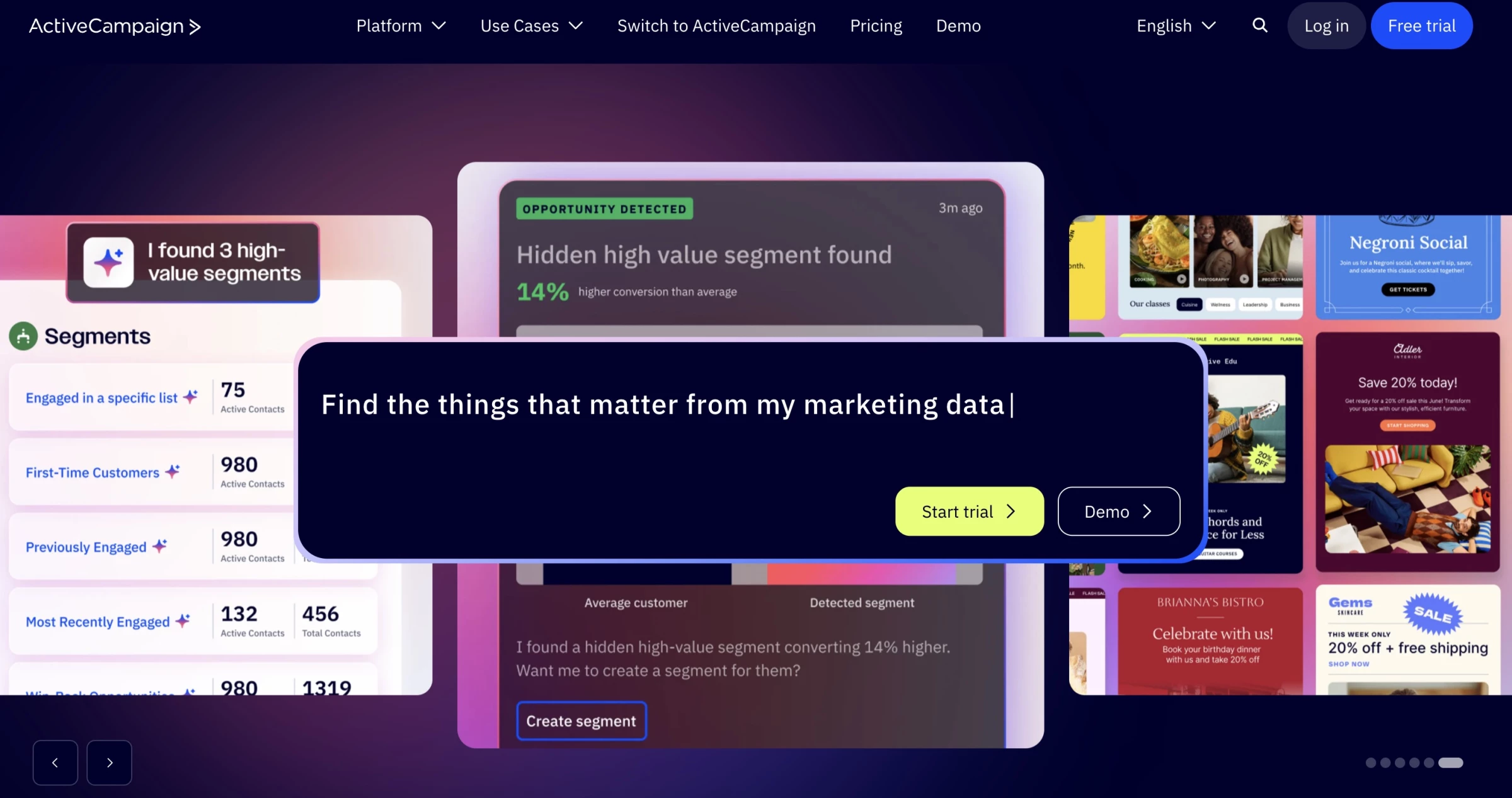
I've tested a lot of automation platforms, and most of them still rely on you to think through every branch, delay, and condition manually. ActiveCampaign felt different.
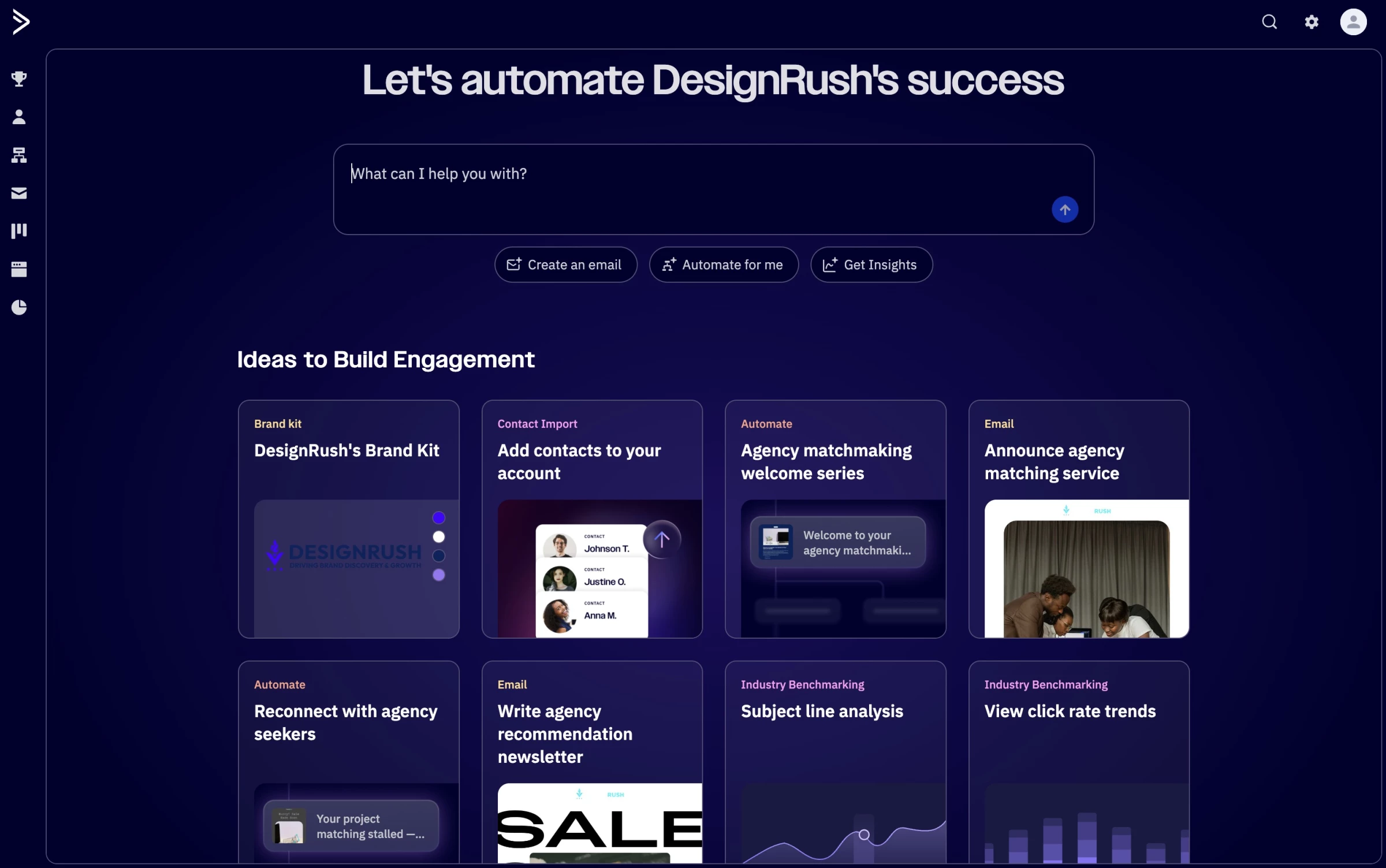
I didn't have to stitch together workflows step-by-step. Instead, I simply had to describe a goal like booking more demos or re-engaging cold leads, and ActiveCampaign's AI agents built the automation system for that outcome.
Pros:
- True autonomous marketing
- Predictive Sending with weekly recalibration
- 250+ prebuilt email templates and 1,000+ integrations
- Cross-channel orchestration (email, SMS, WhatsApp)
- Built-in CRM with AI scoring
Cons:
- Full power requires consistent data volume
- Pricing scales with contact count
- Setup can feel overwhelming without clear goals
Everything was consolidated into one predictive system.
Predictive Sending recalculates the best send time weekly for each contact, while AI-Suggested Segments surface high-value audiences that marketers might otherwise miss.
And because the CRM sits inside the same ecosystem, its win probability scoring highlights which deals deserve attention.
ActiveCampaign's AI impressively coordinated the full lifecycle for me, from first touch to closed deal.
I was also able to connect email, SMS, WhatsApp, CRM pipelines, and behavioral tracking under one layer. Meaning that if engagement patterns shift, the timing automatically adjusts.
If leads go cold, nurture flows adapt. If the deal probability drops, the system flags the next steps. It feels less like I'm running campaigns and more like simply managing a system that's continuously optimizing behind the scenes.
Jackie Palmer, ActiveCampaign's VP Product Marketing, puts it this way:
“Traditional email automation was about drawing boxes and arrows; autonomous marketing is about setting goals and letting AI figure out the next best move.”
Palmer also reports that teams using the platform reclaim “13+ hours a week” as AI agents handle campaign building, testing, and optimization.
“The competitive edge now comes from how well you orchestrate AI across the full lifecycle, not whether you use it at all."
Pricing
- Starter: Starts at $15/month
- Plus: Starts at $49/month
- Pro: Starts at $79/month
- Enterprise: Starts at $145/month
What Users Say
Users consistently praise ActiveCampaign for its advanced automation.
They love how it allows them to automate almost every aspect of marketing and sales, from campaigns and ecommerce flows to contact management.
View this post on Instagram
They caution, however, that the platform's depth can make it challenging for beginners, and some have noted that rising costs make it hard to justify for smaller lists.
Still, many see ActiveCampaign as superior for email automation. It is widely respected for its power and flexibility, while pricing and the learning curve are the main drawbacks.
Who's It For?
ActiveCampaign is best suited for teams that manage full customer lifecycles and not just one-off campaigns.
It fits SaaS companies with multi-touch funnels, ecommerce brands moving beyond basic flows, and sales-driven teams that need marketing and CRM tightly aligned.
If you only need AI to write emails, this may be more than you need. But if you want AI to coordinate segmentation, timing, and follow-up across the entire journey, ActiveCampaign is built for that level of sophistication.
Other Notable Features
- AI Campaign Builder (turn prompts into full campaigns)
- AI Brand Kit (auto-import brand assets from your website)
- AI Actions Library for automation enhancements
- Integration with ChatGPT and Claude via the MCP server
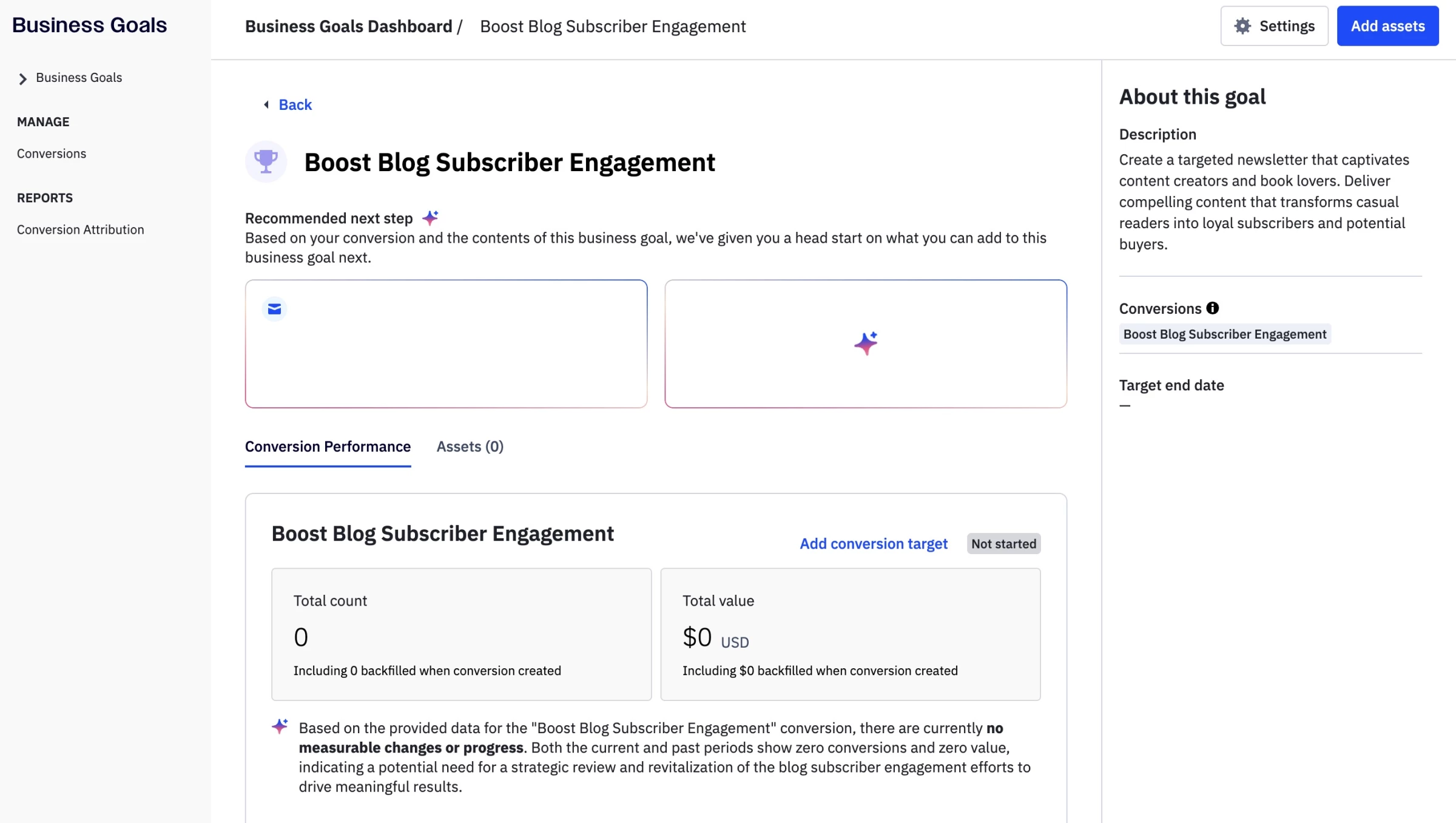
- Business Goals tracking with next-step recommendations
3. Descript: Best for All-in-One Video and Podcast Editor
For content teams producing video and audio without editing overhead
I’ve tried Descript for our marketing videos, and it has made editing much simpler for our team.
Pros:
- Edit video by editing the transcript
- All-in-one screen + webcam recording
- Shareable drafts and commenting for collaboration
- Works on Mac and Windows
Cons:
- Not designed for advanced visual effects
The best part is how it lets you edit video like a Google Doc. You don’t need to figure out and manually edit timelines. Instead, you just delete, insert, or rearrange words in the transcript, and the video updates automatically.
For someone without professional video editing background, this makes trimming webinars, product demos, or training videos faster, more precise, and far less intimidating.
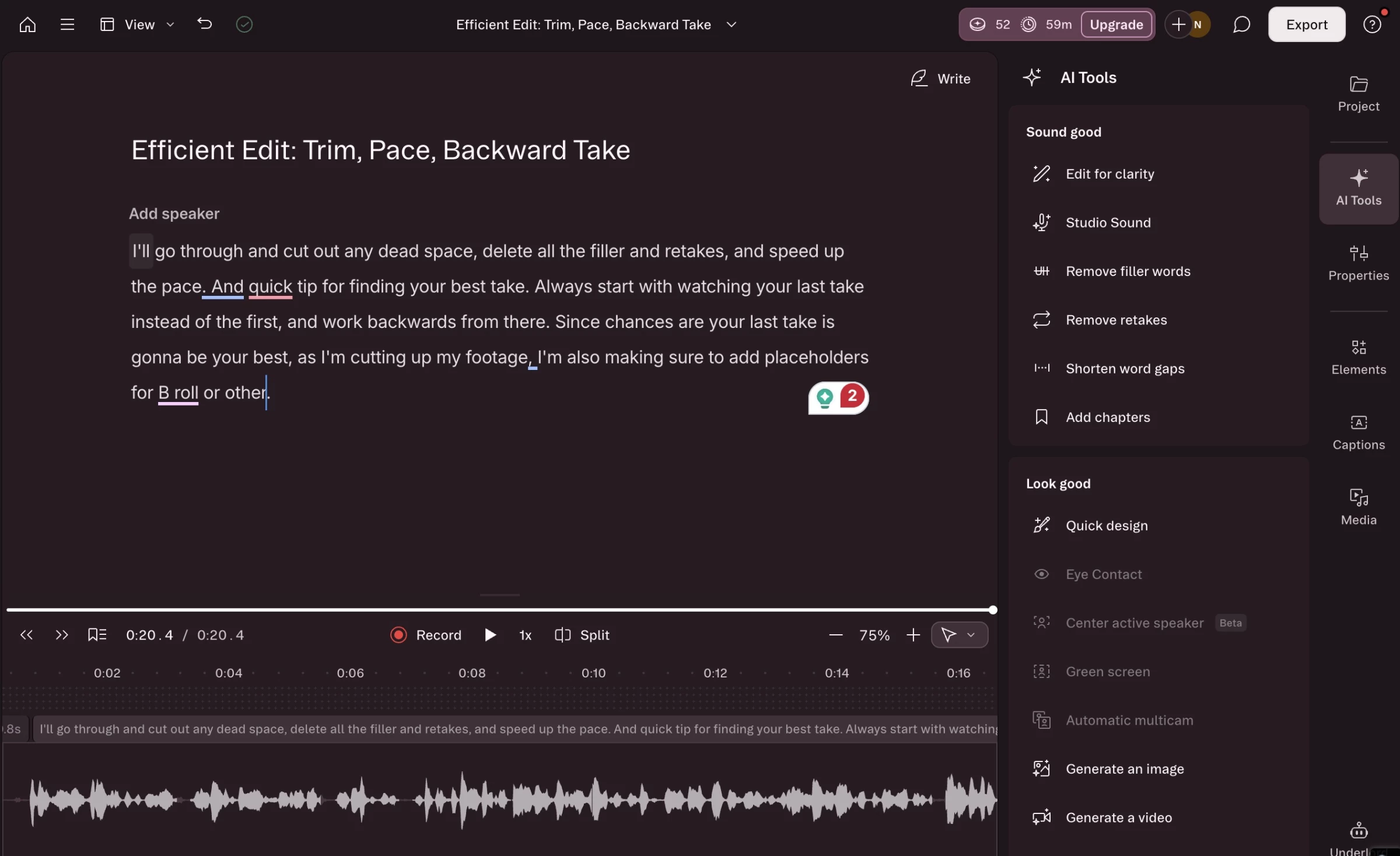
Recording is straightforward, too. Descript combines screen and webcam capture into a single tool, which is useful for product walkthroughs, feature demos, or educational content.
For example, I can record a 10-minute demo, clean up my speech using Descript’s AI tools, and have a polished video ready in under an hour.
Descript’s AI features are genuinely useful. They save time on tedious tasks like cleaning up filler words, improving audio, or adding captions.
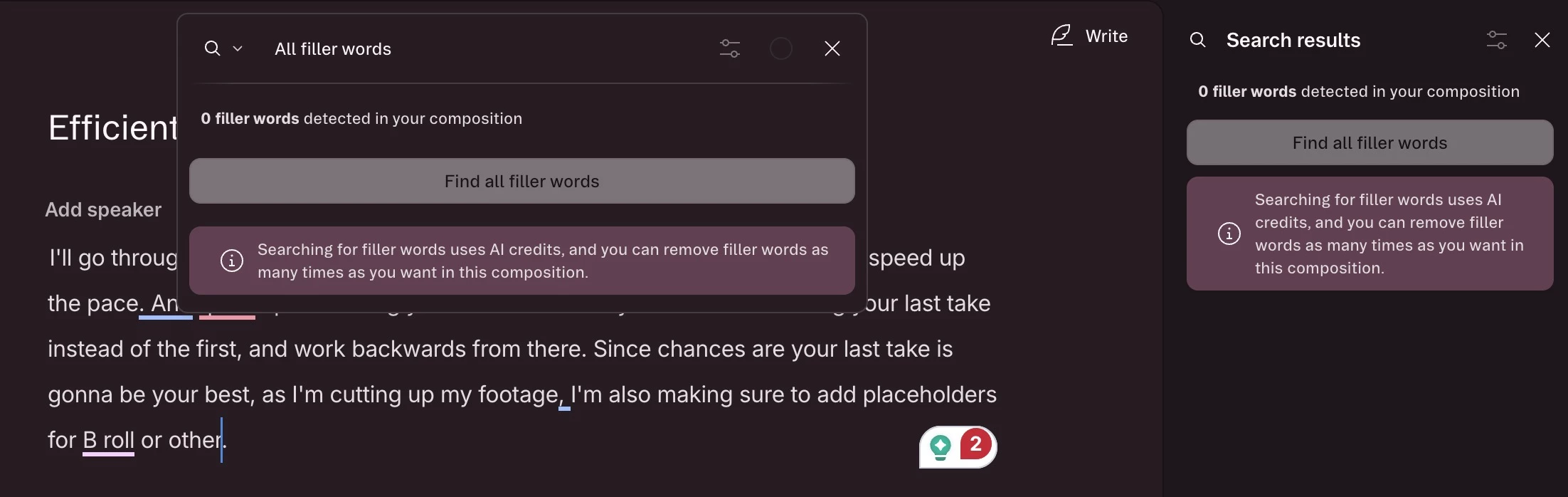
Filler Word Removal automatically trims “ums,” “uhs,” and other non-essential words, while Overdub lets you fix mistakes or add narration without having to re-record.
I’ve found these tools amazing for cutting down the back-and-forth and manual cleanup that usually slows video production.
I love how Descript makes collaboration and feedback easy with shareable links, collaborator commenting, and versioning that keeps track of changes so nothing gets lost.
With Descript, you don’t need multiple tools to go from idea to published video. You still get polished, professional videos faster, with less tool-switching and minimal reliance on external editors.
Pricing
- Free plan with limited recording and exports
- Hobbyist: $16/person/month (billed annually)
- Creator: $24/person/month (billed annually)
- Business: $50/person/month (billed annually)
- Enterprise: Custom pricing
What Users Say
People love how Descript makes podcast and video editing so much simpler. The text-based workflow makes it easy to cut filler words, rearrange segments, and polish recordings without fuss.
Many find it a huge time-saver for cutting, arranging, and creating social clips.
At the same time, some users do run into glitches, slow performance, and a learning curve, particularly with video or large projects.
Still, for many creators, especially small teams or solo podcasters, Descript is a handy all-in-one tool that keeps editing fast and manageable.
Who’s It For?
Descript is designed for marketers and creators. Product marketing managers, content marketing managers, developer advocates, and technical marketers will find it especially useful.
Built for modern content teams, it empowers resource-constrained teams to produce high-quality videos quickly and efficiently, without needing professional editing experience.
Other Notable Features:
- Short-form clip creation to repurpose content for social
- Multi-track audio and video editing
- Templates for demos and webinars for fast styling
- AI tools like filler word removal, Studio Sound, Overdub, auto captions
4. Brandi AI: Best for AI Search Visibility & GEO Strategy
For SEO and content leaders tracking visibility in AI search
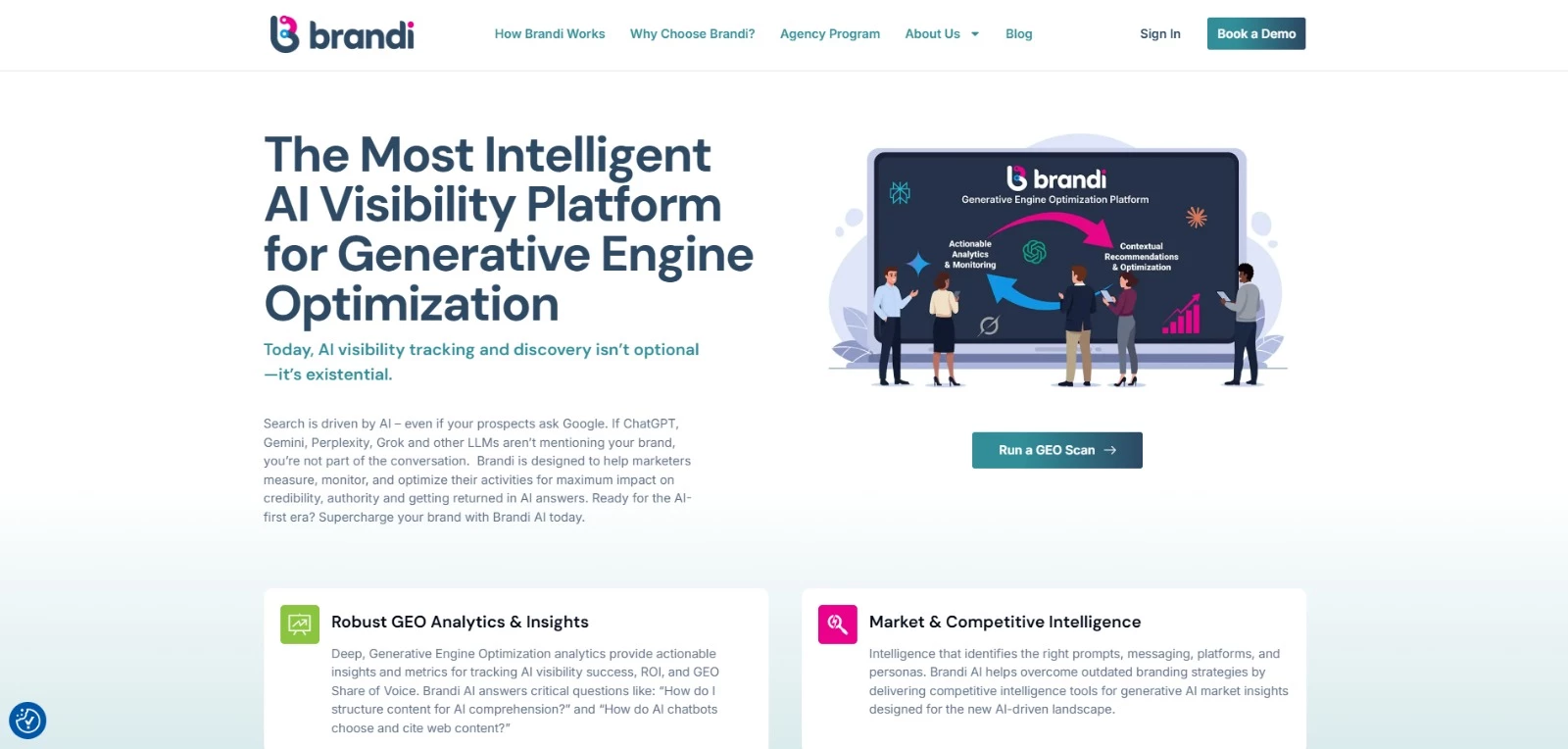
Brandi AI focuses on a problem most marketers are only starting to notice, which is your brand’s visibility inside AI-generated answers.
Brandi shows how your brand appears in tools like ChatGPT, Google AI Overviews, Gemini, and Perplexity. It finds the actual questions buyers ask AI and reveals whether your brand is cited, how often, and in what context.
What stood out to me is how it connects visibility to action. It identifies the prompts driving competitor visibility and guides you on restructuring content so it becomes AI-readable and more likely to be cited.
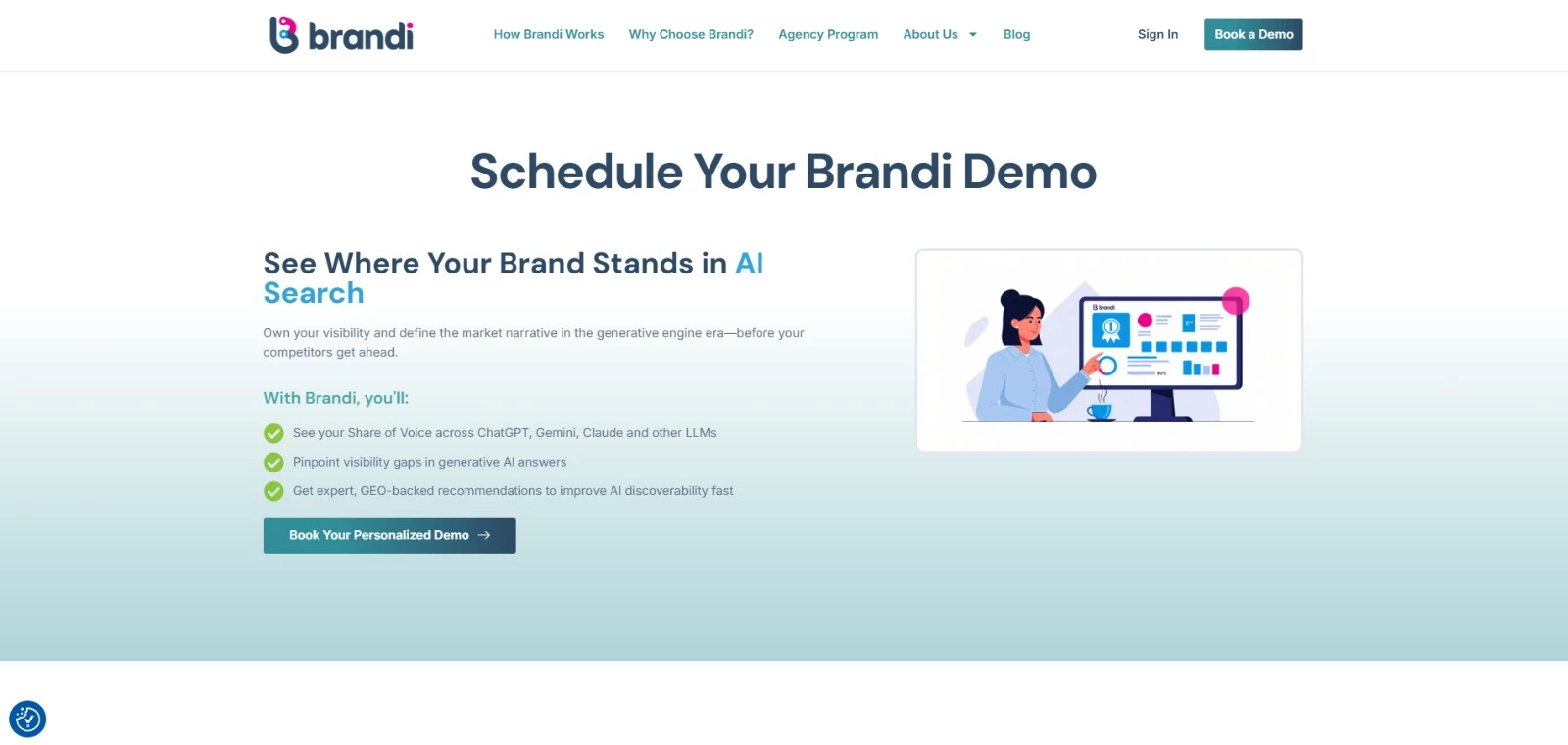
This moves content strategy away from keyword targeting toward answering real buyer questions in a format AI systems can extract and reference.
For global teams, the platform provides an extra layer of visibility into AI across languages and regions, helping you understand how they appear in different markets.
Pros:
- Tracks brand mentions across AI platforms (ChatGPT, Gemini, Perplexity, etc.)
- Identifies high-intent prompts influencing visibility
- Compares your brand’s presence in AI-generated answers against competitors
- GEO (Generative Engine Optimization) system for optimizing content for AI citations
- Multi-language and regional visibility tracking
Cons:
- Not a content creation tool itself
- Requires existing content to optimize effectively
Pricing
- Starting at $349.99/month
What Users Say
Brandi AI is often described as intuitive to navigate, with clear visibility into how brands appear in AI-generated answers. Features like the prompt hub and optimization tools make it easier to track performance, spot gaps, and adjust content to improve citation rates.
Users also mention the pace of product updates and a responsive team that actively incorporates feedback.
On the flip side, the amount of data can take time to get used to, and maintaining prompt coverage requires ongoing input.
Who’s It For?
Brandi AI is built for CMOs, SEO leaders, and content teams focused on maintaining visibility as discovery expands to AI platforms.
Other Notable Features
- AI discovery intelligence layer
- Competitive AI visibility benchmarking
- Prompt-level content optimization insights
5. Pixis: Best for AI Media Buying and Campaign Optimization
For performance marketers scaling paid campaigns with AI optimization
Running paid campaigns always felt like trial and error taken to the extreme until I tested Pixis.
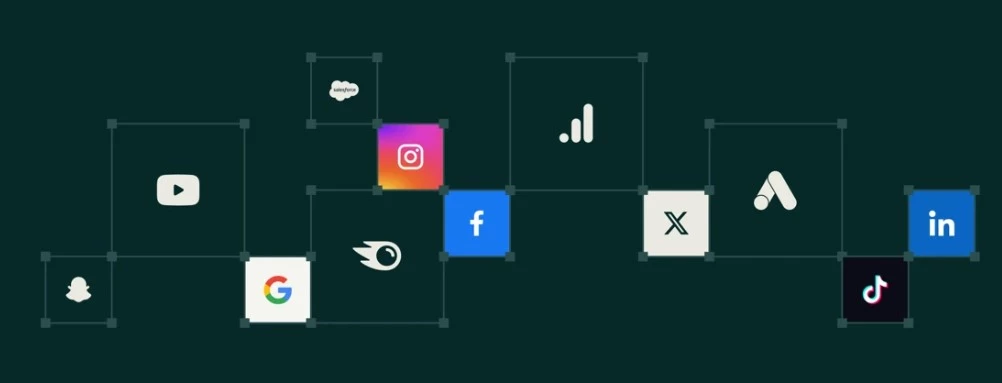
I connected it to both my Meta and Google Ads accounts, and almost immediately, it began working behind the scenes like a smart media buyer.
Pros:
- Continuously optimizes performance and reallocates spend automatically
- Works across Google, Meta, and other major channels
- Improves conversions, targeting, and creatives using predictive algorithms
Cons:
- Steep learning curve
- Setup requires careful configuration to avoid misfires
- Limited transparency into optimization logic
- Less control for hands-on marketers
Within days, it started reallocating budget across ad sets, automatically testing creatives, and refining audience targeting based on live performance data.
What surprised me most was that the overall results improved while my budget remained unchanged. It was like plugging in an invisible campaign manager who doesn’t sleep and never misses a beat.
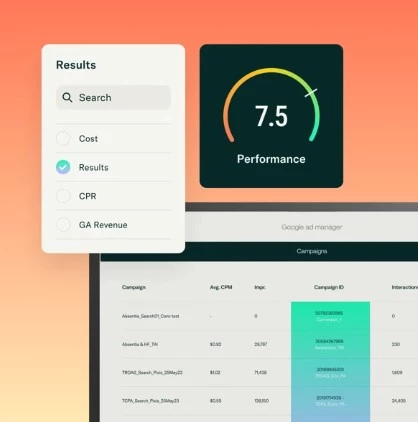
Pixis uses predictive AI models that continuously analyze what’s working and what's not. It efficiently scales marketing campaigns.
I could see performance lift even in underperforming segments because the system quickly caught and corrected issues in real time.
This AI digital marketing tool may not be built for beginners. You need active campaigns and a decent ad volume for the AI to learn from.
When I started from scratch, the insights were limited, but once it had historical data to work with, it really hit its stride.
Pricing
- From $200/month, with a 14-day trial
- Contact Pixis for enterprise and Adroom pricing
What Users Say
While the results were strong, Pixis can sometimes feel like a black box, i.e., you don’t always know why it made certain decisions unless you dig deep.
However, when set up correctly, Pixis genuinely felt like a predictive, algorithmic partner that fine-tuned campaigns with impressive speed.
Who’s It For?
Pixis is a strategic tool for high-leverage accounts.
Hence, mid to large-scale growth marketing agencies can benefit greatly from it, particularly those spending $10,000 or more in monthly paid media and needing to scale without constantly babysitting every detail.
Other Notable Features
- Predictive AI optimization engine
- Autonomous budget reallocation and budget pacing controls
- Real-time targeting refinement
- Cross-platform ad management
- Automatic A/B testing
6. Prescient AI: Best for Predictive Marketing Attribution
For growth teams needing accurate multi-channel attribution insights
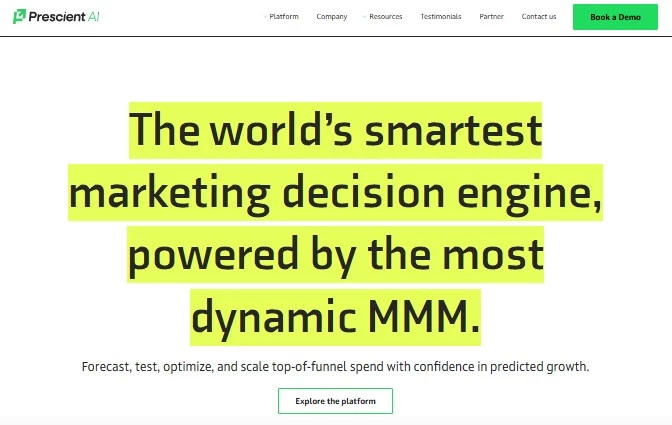
Prescient AI wasn’t on my radar until I hit a wall trying to understand where my conversions were coming from.
Standard attribution models like last-click or platform-specific reports from Meta and Google weren’t telling the full story. This especially applies to longer customer journeys that cover multiple touchpoints.
Pros:
- Identifies undervalued channels with measurable impact
- Continuously improves attribution accuracy
- Integrates with major platforms and first-party data
- Advanced marketing mix modeling (MMM)
- Fast implementation (as little as 48 hours)
Cons:
- Less suitable for small or single-channel campaigns
- Analysis-only (no direct campaign management)
- Built for consumer brands, not B2B
When I tested Prescient AI, it felt like someone finally turned the lights on.
The AI digital marketing tool uses machine learning (ML) to predict and map multi-touch attribution to show how different channels contribute to conversion outcomes over time, not just at the point of sale.
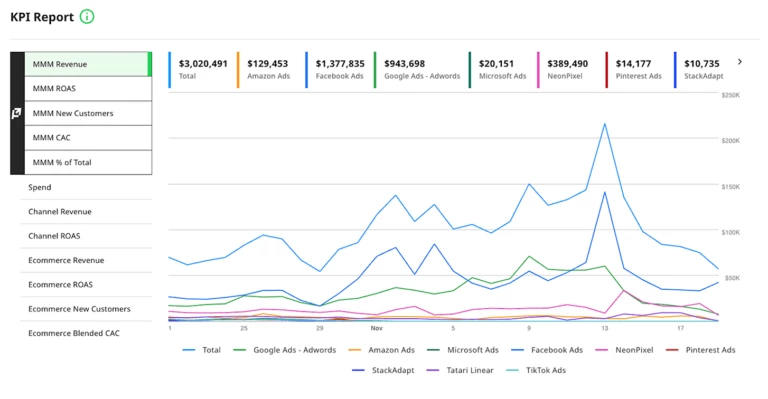
One of the most valuable things I got out of it was the ability to reassign the budget more strategically.
Through Prescient, I discovered that TikTok, a platform I had almost written off, was quietly driving high-intent traffic for my eCommerce campaign.
That insight alone helped justify a shift in spend that eventually improved ROAS across the board.
Pricing
- Pricing is available upon inquiry or demo request
What Users Say
Independent reviews are limited, but in a case study published by Prescient AI, Good American’s associate director of performance marketing, Avery Lewis, says the team connected its channels in just 16 minutes and received insights two days later that helped inform media spending.
She also describes using the platform’s recommendations to adjust the brand’s media mix.
Who's It For?
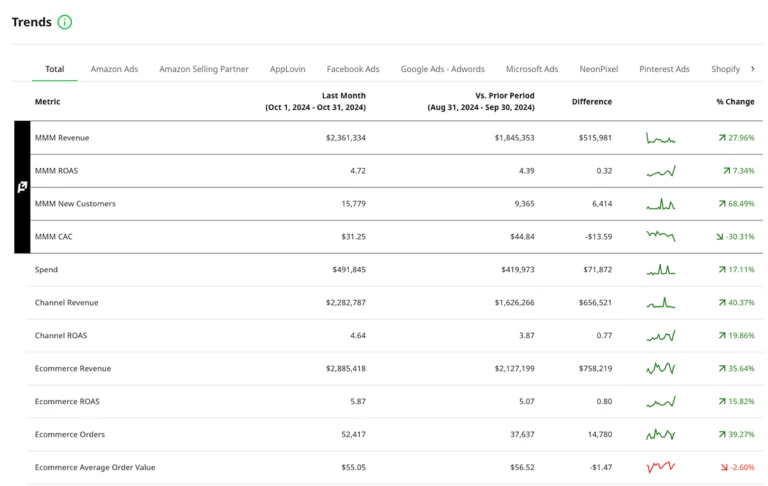
Prescient AI can deliver the most value to growth strategists, performance marketers, or media planners working across fragmented channels and high-ticket or long-cycle funnels.
If you're tired of your budget being dictated by last-click logic or inconsistent platform metrics, this AI digital marketing tool gives you the full picture.
Other Notable Features
- Predictive attribution modeling
- Halo effects attribution
- Multi-touch journey mapping
- Channel contribution analysis
- Budget allocation insights via forecast from historical performance
7. StoryChief: Best for AI-Powered Content Workflows
For editorial teams and agencies coordinating content across contributors and channels
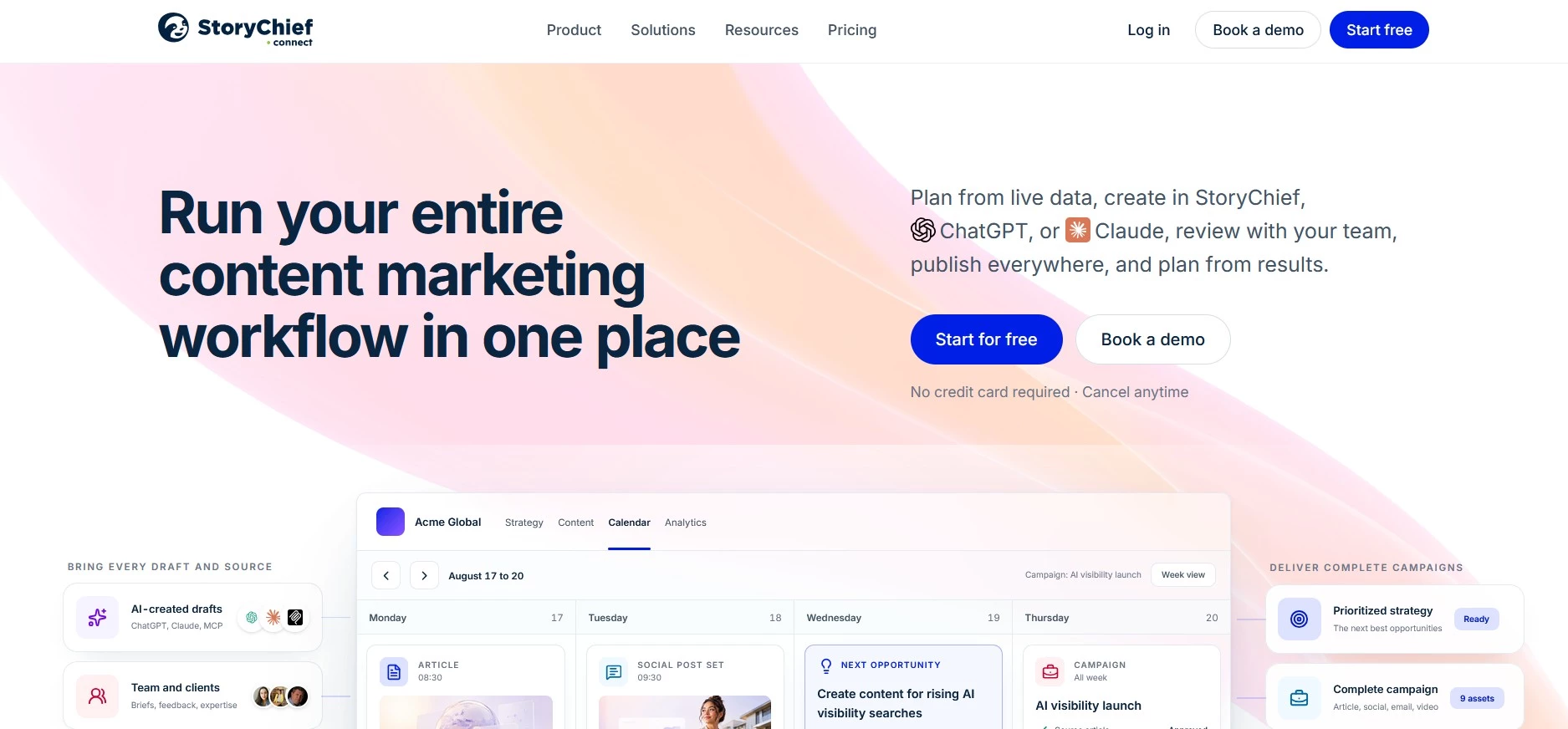
StoryChief brings content planning, production, review, publishing, and performance tracking into a combined workspace. It's a neat fit for teams that have outgrown spreadsheets, shared documents, and separate scheduling tools.
Content can begin with a structured brief based on the company’s strategy, brand voice, audience, and current SEO and AEO data. Writers then work in an editor that checks readability, search optimization, AI-search readiness, and gaps against the brief.
Pros:
- Combines briefs, assignments, editing, approvals, and publishing
- Provides real-time SEO, GEO, and readability guidance
- Supports separate workspaces for agency clients
- Publishes to websites, social platforms, and newsletters
- Keeps human review in the publishing process
Cons:
- Full editorial plans are billed per seat or client
- Lower-cost plans focus mainly on social media
- AI image and video generation require an add-on
- Some channels require Zapier rather than a native integration
- May offer more workflow features than solo creators need
Comments, suggestions, versions, and approvals remain attached to each piece of content to give editors and clients a clear place to review changes (no moving drafts between email threads and documents).
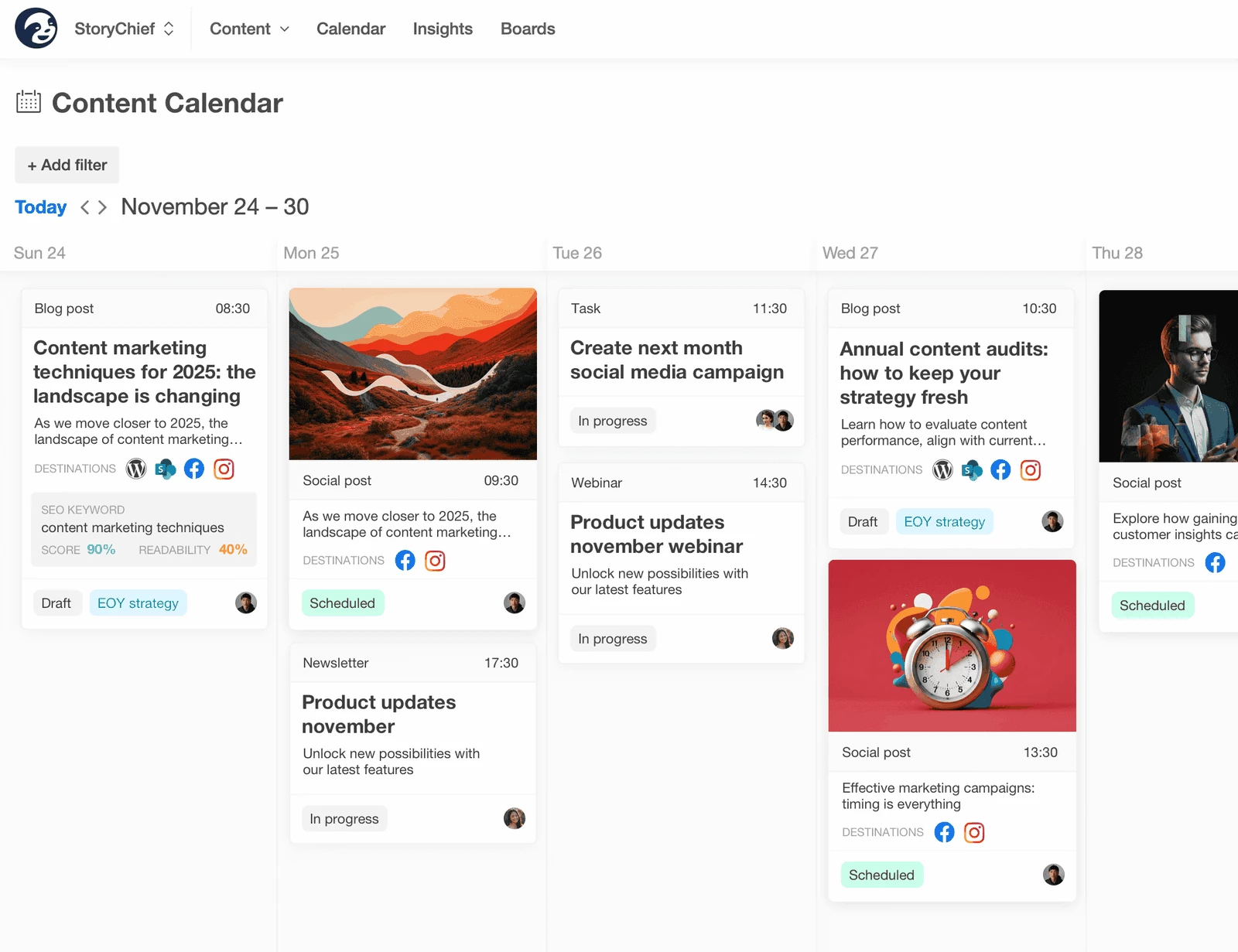
Once content is approved, StoryChief can publish it to connected content management systems, social accounts, newsletters, and syndication channels. Website, social, and search data can then feed back into future briefs and content decisions.
Agencies can keep each client’s brand information, permissions, channels, content, and reporting in a separate workspace to help prevent assets and feedback from becoming mixed across accounts.
Pricing
Free: Basic website, SEO, and social analytics
Social plans: From $22/month
Team Editorial: From $81 per seat/month
Agency Editorial: From $93 per customer/month
Enterprise: Custom pricing
Paid plans include a free trial without a credit card.
What Users Say
Users frequently praise StoryChief for centralizing content production, client reviews, SEO checks, and multichannel publishing.
Several users say the approval tools reduce the time spent collecting feedback from clients and contributors. There is some criticism around restrictive entry plans and missing native integrations for some channels, although Zapier can cover part of that gap.
Who’s It For?
StoryChief is a good fit for editorial leads, content marketing teams, and agencies that manage several writers, clients, or publishing channels.
It’s especially great when content moves through several stages before publication or when teams need to keep briefs, deadlines, feedback, approvals, and performance data together.
Solo marketers who mainly need AI-assisted drafting might only need a simpler and more economical writing tool.
Other Notable Features
- AI-generated content briefs
- Brand voice and audience profiles
- SEO, GEO, and readability guidance
- Editorial calendar and task assignments
- Comments, version history, and approval workflows
- Multichannel publishing and content analytics
8. Modash: Best for AI-Assisted Influencer Discovery
Modash suits B2C marketing teams looking for creators whose content and audiences match their campaigns.
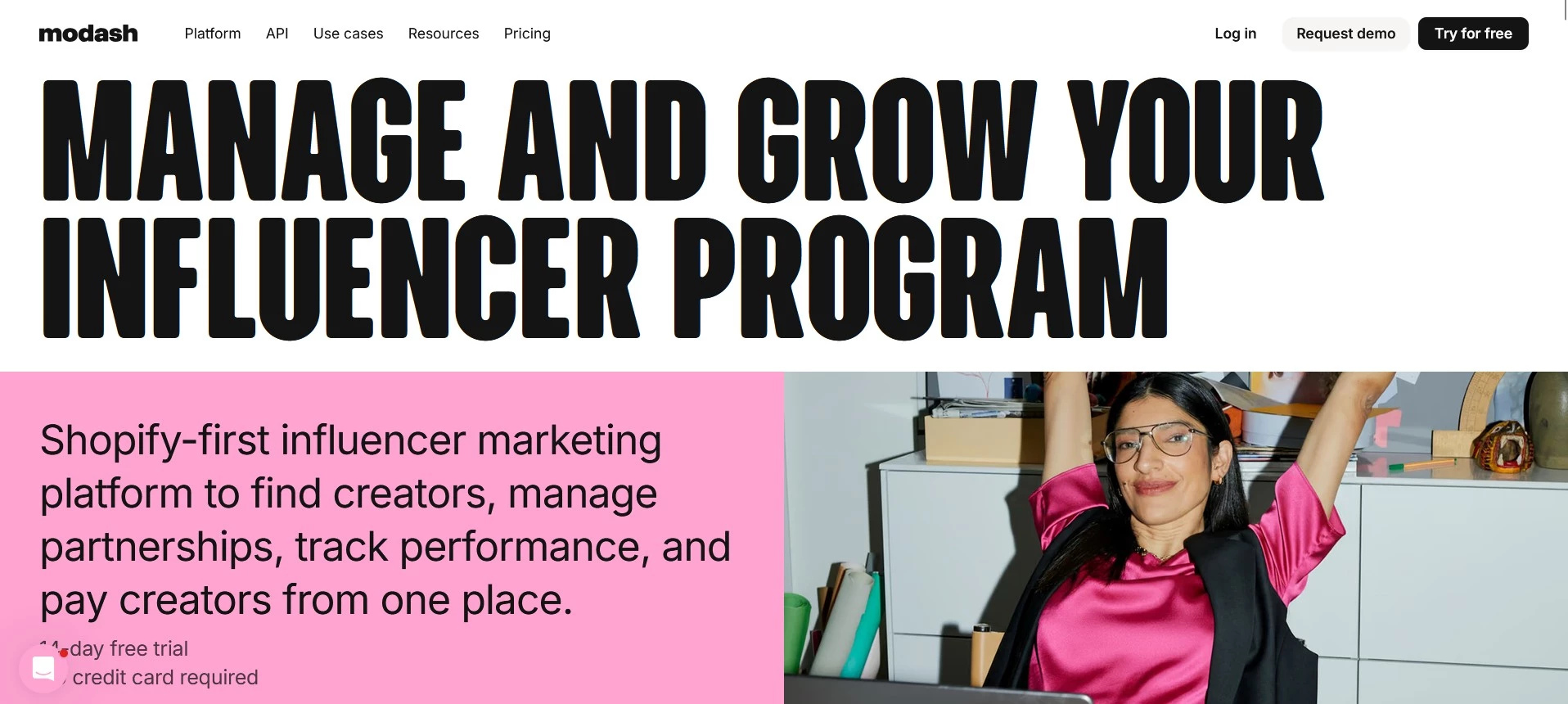
Modash helps marketers find and evaluate creators on Instagram, YouTube, and TikTok. Its database includes public profiles, giving brands access to creators beyond those who have registered with an influencer marketplace. Audience filters and engagement data help teams assess potential partners before making contact.
Pros
- AI search helps find creators by content theme and visual style.
- Audience analysis supports more targeted shortlists.
- Campaign tracking collects partner content and performance metrics.
Cons
- Essentials limits usage to 300 opened profiles and 150 email unlocks per month, with tracking for 100 creators.
- AI search needs separate audience filters to narrow results by follower demographics.
- Discovery and tracking focus on Instagram, YouTube, and TikTok, limiting its usefulness for campaigns on other platforms.
Its AI search accepts descriptions of the content or style a campaign needs and returns matching creators. Marketers can then narrow the results using filters. Audience demographics require separate filters; the AI search cannot interpret those requirements directly from a prompt.
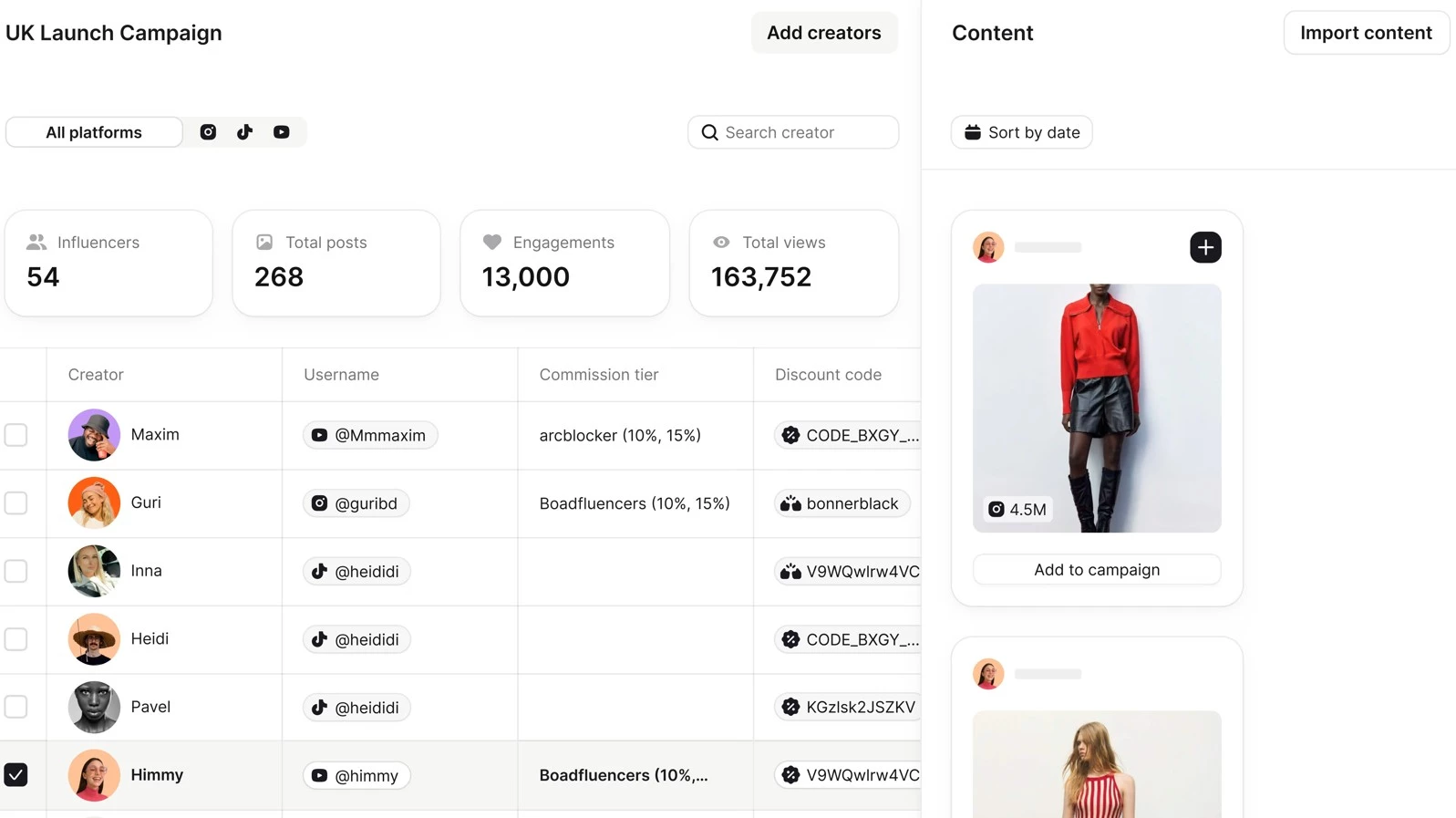
Once partnerships are underway, Modash collects campaign content and tracks performance. It also includes tools for managing creator relationships, with Shopify integrations for product gifting and, on higher plans, affiliate sales.
Pricing
- Essentials: From $199/month, billed annually
- Performance: From $499/month, billed annually
- Enterprise: Custom pricing
- Free trial: 14 days, no credit card required
What Users Say
Modash holds a highly positive rating from reviewers who praise its detailed discovery filters, ease of use, and customer support. Although some do raise concerns about cost, tracking allowances, and the presentation of reports. The review sample is small, and older comments could refer to features that have since changed.
Who's It For?
B2C brands with an ongoing creator program, particularly eCommerce teams that need to find relevant partners and track their posts. If your teams are only running occasional collaborations, they should weigh the subscription cost against how often they will use it.
Other Notable Features
- Gmail and Outlook inbox integrations for creator communications.
- Discovery of influential accounts already following a brand.
- Shopify product gifting, with affiliate management available on higher plans.
9. Syllaby: Best for AI-Based Multichannel Video Marketing
For lean marketing teams creating video content without an in-house studio
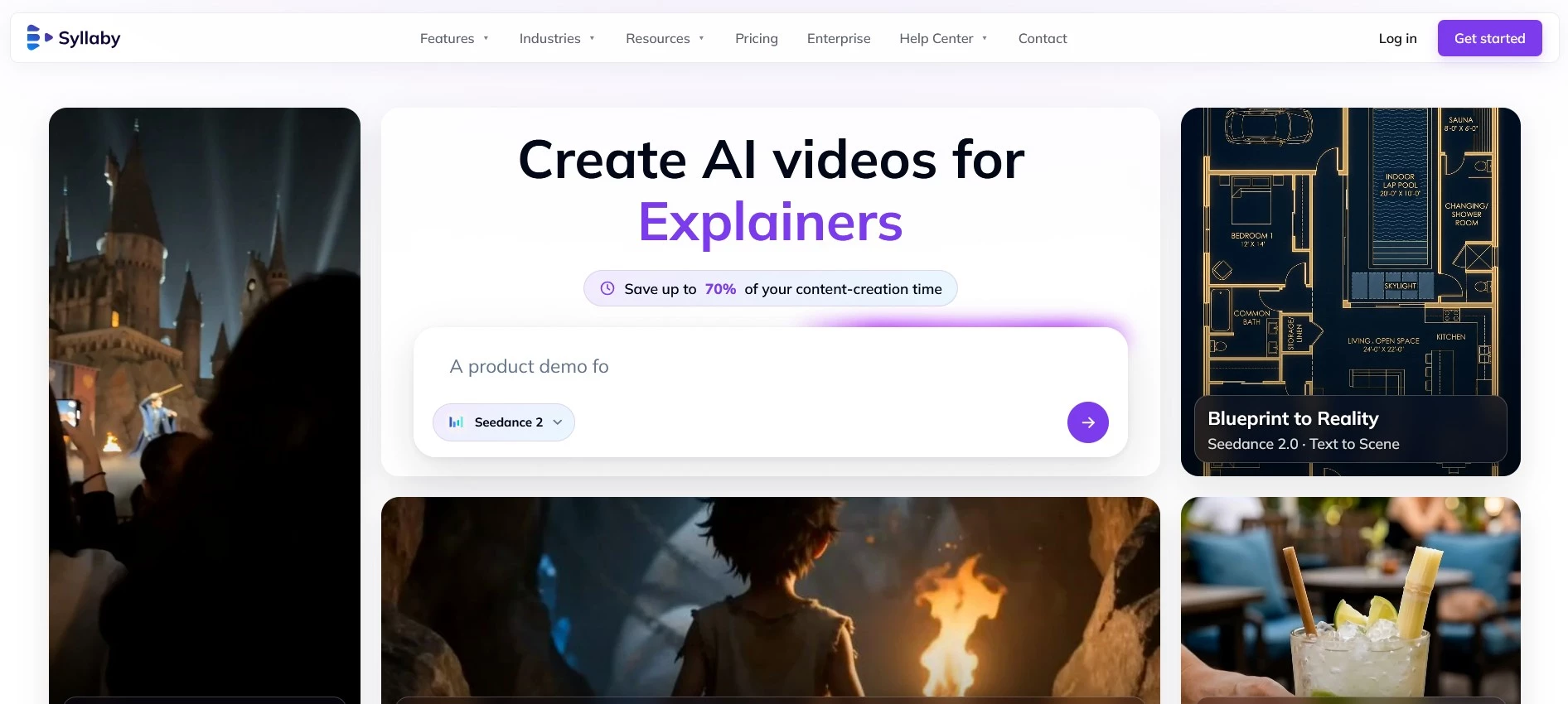
Syllaby groups scriptwriting, avatars, voice cloning, and scheduling behind a single interface.
Pros:
- Clean interface with easy AI tool access
- Generates personalized scripts with advanced language models
- AI voiceovers reduce the need for manual recording
- Centralized content repurposing and scheduling
Cons:
- Heavy automation can limit creative nuance
- Avatar customization is limited for niche brands
- Cloned voices may sound flat
- Rendering can lag on less powerful devices
I could jump into scriptwriting almost immediately, and the AI did a solid job of generating content tailored to the specific audiences I defined.
It used insights to shape the copy and its messaging for different customer journey stages.
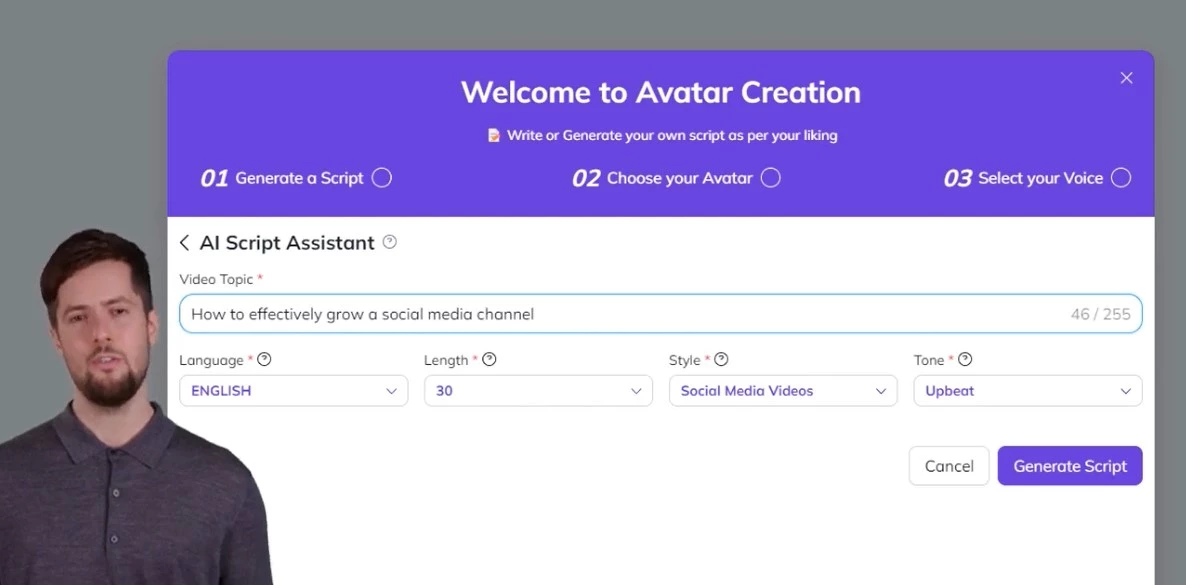
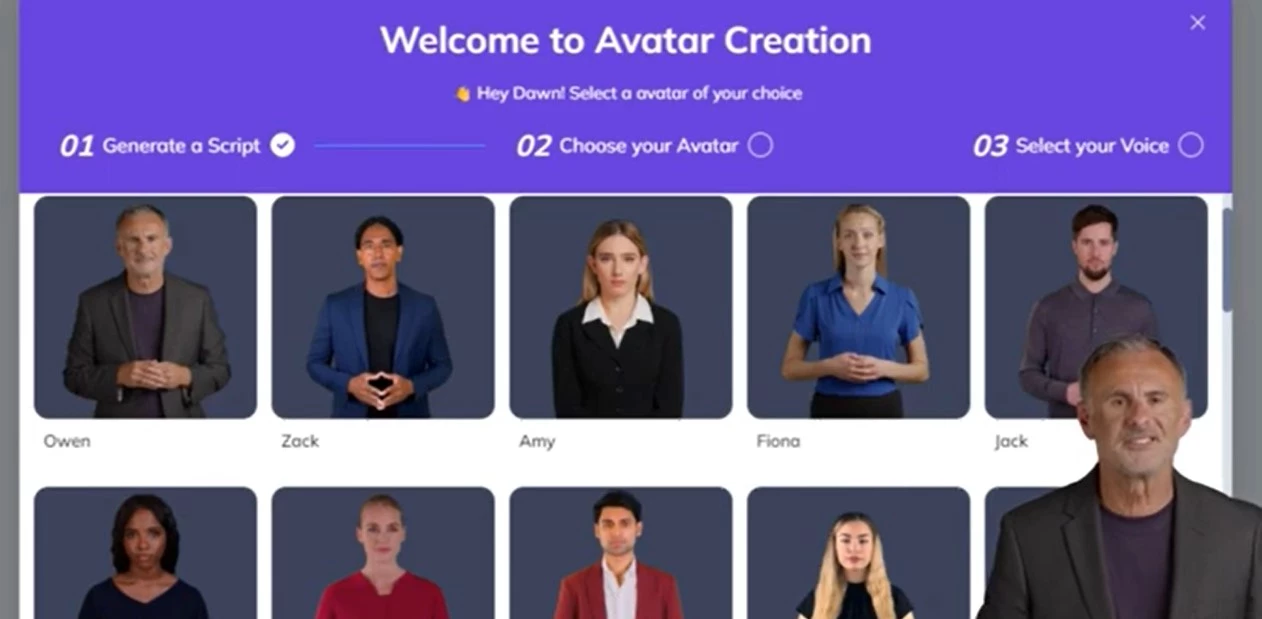
The video creation flow is where Syllaby started to feel like more than just a writing assistant. With features like voice cloning and AI avatars, I could produce full videos without stepping in front of the camera.
That alone made it easy to push content across email, socials, and landing pages, minus bottlenecking the creative process.
Pricing
- Starter: $9/month, billed monthly
- Basic: $24.67/month, billed annually
- Standard: $66.33/month, billed annually
- Premium: $130.08/month, billed annually
What Users Say
Feedback is somewhat mixed. Positive reviews describe the convenience of creating and scheduling videos without much editing experience. Negative reviews include complaints about inconsistent generated visuals, trial allowances, cancellation, and support. Other customers report helpful support, so service experiences are not uniform.
Who's It For?
Syllaby is an excellent choice for small to mid-sized marketing teams looking to streamline content production without needing a full in-house studio.
It could also benefit online educators, especially those using avatars to teach without appearing on camera.
Other Notable Features
- SEO optimization for video titles, tags, and descriptions
- Cloud-based video storage
- Campaign performance analytics
- AI-powered video editing
- Persona-based content recommendations
10. Plai: Best for Automated Multi-Platform Ads
For small businesses and agencies that need help creating, launching, and managing paid campaigns
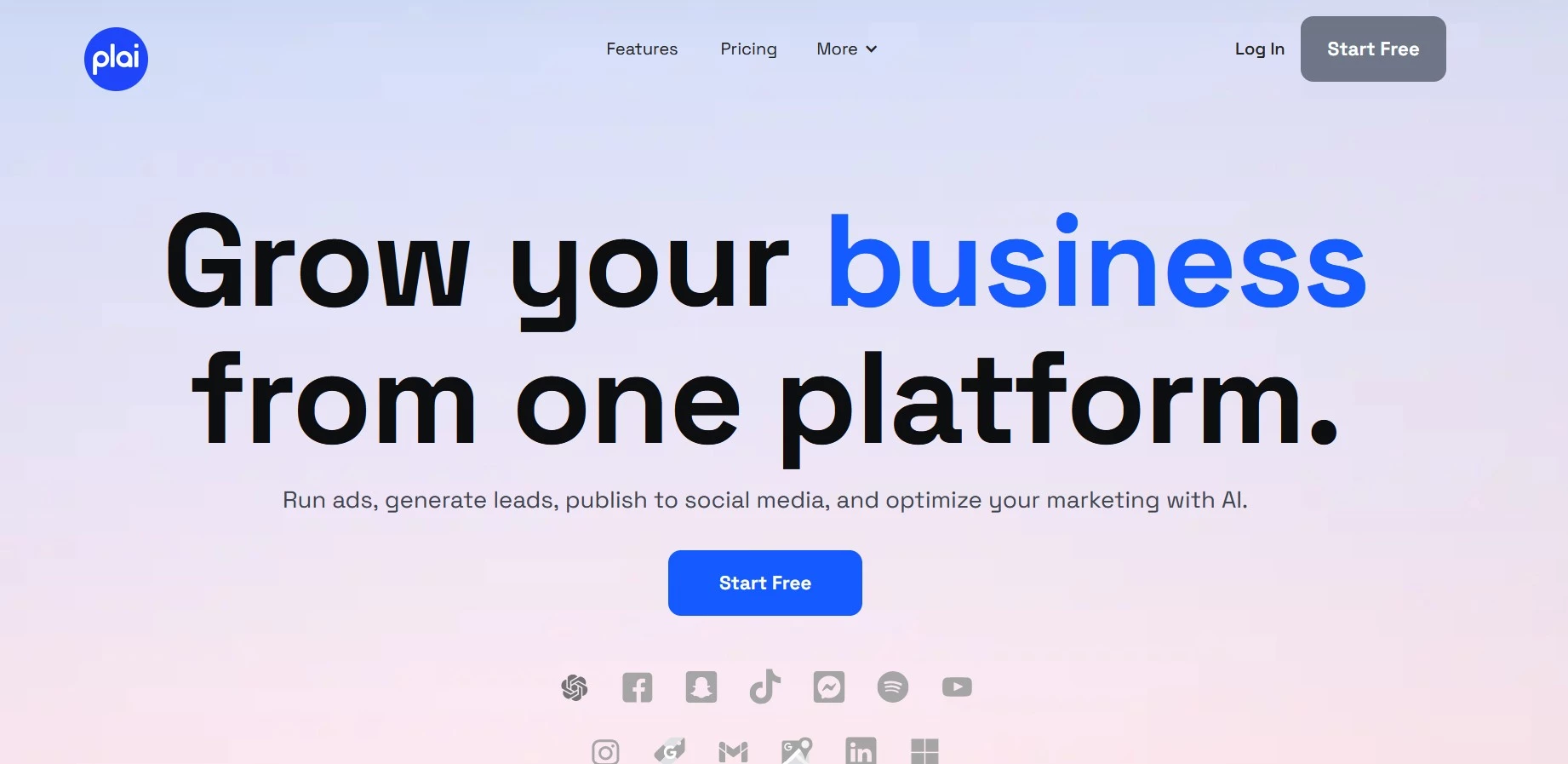
Plai handles campaign setup, creative production, and optimization across Meta, Google, TikTok, LinkedIn, and 11 other advertising platforms.
Brand Context takes product information, colors, language, and tone from a company website, from which Plai then generates editable copy, images, videos, targeting suggestions, and campaign variations based on your chosen goal and platform.
Pros:
- Free plan includes two campaigns and two optimizations per month
- Supports campaign creation across 11+ advertising platforms
- Generates editable copy, images, videos, and targeting suggestions
- Imports existing campaigns for centralized management
- Offers multi-campaign budget optimization
- Provides client workspaces and white-label options for agencies
Cons:
- Monthly plans charge 2.5% on Plai-managed ad spend above $20,000
- The $97 Brand plan is limited to Optimize for Me and 50 Creative Hub assets per month
- White-labeling, advanced targeting, and multi-ad-set creation require another plan or add-on
- Independent reviews are limited, and much of the coverage online comes from affiliates
Optimize for Me reviews Meta and Google campaigns daily, and can generate new creatives, remove underperforming audiences, placements, keywords, or locations, and direct more of the budget toward stronger results.
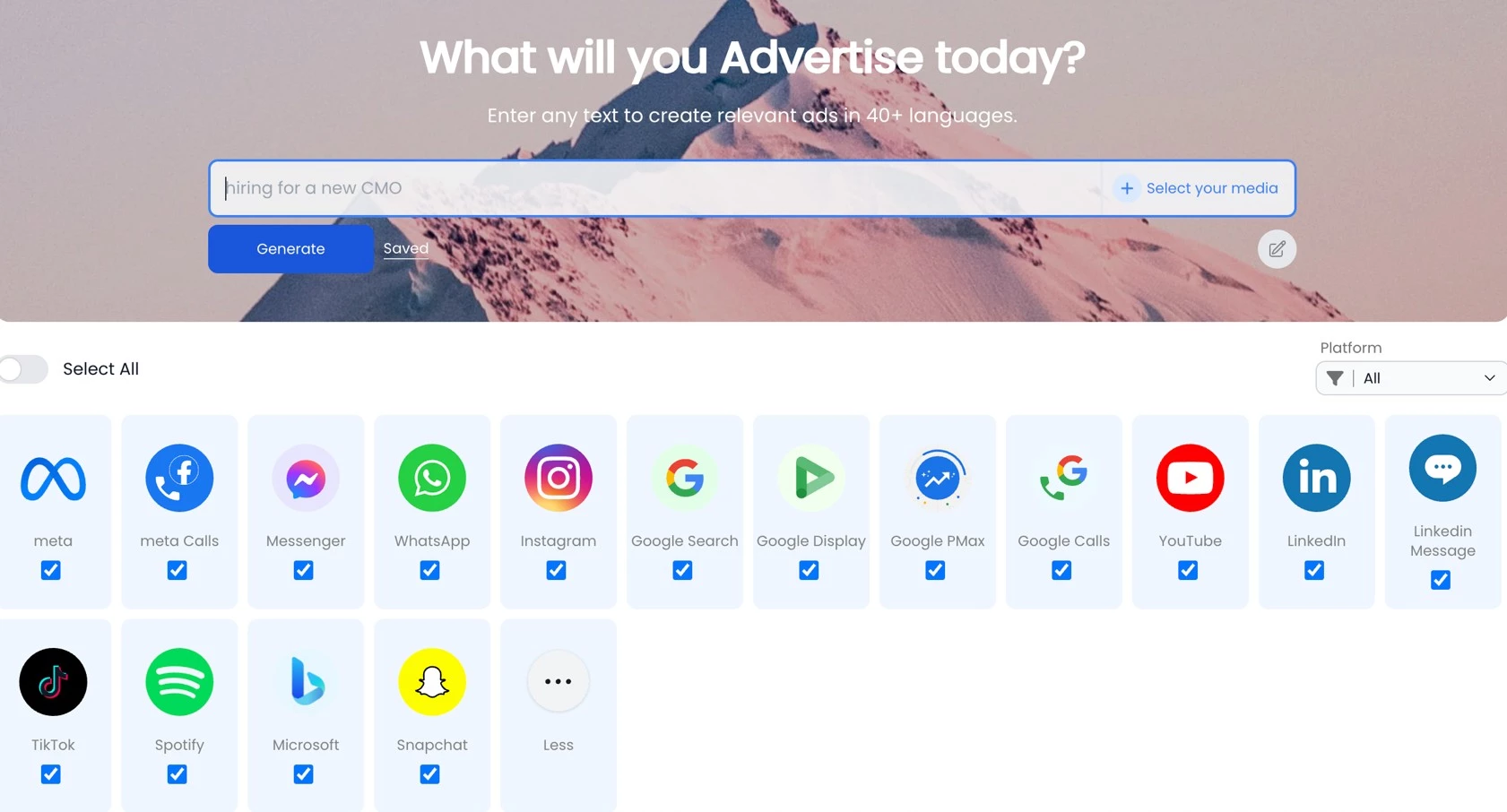
Optimization Folders work across campaigns to shift spend among better-performing ads on platforms such as Meta, Google, and TikTok. Existing campaigns can also be imported, edited, paused, and reviewed alongside those created in Plai.
Plai also documents support for launching ChatGPT Ads. Access requires a connected OpenAI advertiser account, and Ads Manager remains in beta (availability also varies by market).
Pricing
- Free: Limited campaigns and AI creatives
- Brand Builder: $790/year, equivalent to about $66/month
- Agency White-label: $2,490/year
- Monthly plans: From $97/month
What Users Say
User feedback is limited but positive about the straightforward campaign setup and accessibility for users with limited experience in native ad managers.
Criticism includes a dated interface, less polished campaign statistics, and isolated reports of reporting or Google Ads integration challenges.
Who’s It For?
Plai suits small businesses, lean marketing teams, and agencies that want support with ad creation and campaign setup as well as ongoing optimization. The free plan also gives occasional advertisers a practical way to test the workflow.
Agencies can use its workspaces, client billing, templates, and white-label tools to manage several accounts. Teams already spending $10,000 or more per month and looking primarily for predictive media optimization may find Pixis the more suitable option.
Other Notable Features
- ChatGPT Ads campaign setup
- Cross-platform campaign analytics
- UGC-style avatar videos
- Keyword and audience research
- Organic social media scheduling
- Landing-page creation
- Reusable campaign templates
- GoHighLevel and Stripe integrations
How To Choose an AI Marketing Tool
Most teams need a small group of specialist tools chosen around clear workflow gaps.
Ryan Hernandez, founder and CEO at WGA, identifies faster data analysis as one of AI’s main advantages:
“AI tools in digital marketing source and study a tremendous amount of data and information in seconds that would otherwise take us months.”
For buyers, the practical question is where that speed will help and what the tool requires in return.
Compare these five points before adding another platform:
- Start with the task. Look for depth in the area that needs improvement, such as content production, campaign management, attribution, or AI visibility.
- Check the data and integrations. Confirm that the tool works with the CRM, advertising platforms, and other data sources already in use.
- Set the level of control. Check whether marketers can review outputs, change settings, and override automated decisions when necessary.
- Account for the full commitment. Consider contact limits, user seats, add-ons, setup work, and the person responsible for managing the tool.
- Define how value will be measured. Choose a relevant baseline, such as production time, campaign performance, attribution clarity, or visibility in AI-generated answers.
Mo Sabri, co-founder and COO at Trust Outsourcing Solutions, makes the case for connecting AI tools to existing data systems rather than running them separately:
"By using APIs and integration platforms to make sure there is a solid connection established with your primary data storage, instead of using AI tools as stand alone apps, you can also set up a monitoring system to govern access control so things don't get out of hand.
A well trained admin with basic understanding of data filtering and data analysis can cover this for you if you have the right system set up."
He also notes where AI falls short:
"While AI can do an amazing job at qualifying leads and lead screening, it cannot yet replace the human element of closing a sale or performing a live demo on a feature or service [...]"
Final Thoughts on AI Tools for Digital Marketing
AI marketing tools are rapidly becoming part of everyday marketing workflows, helping teams generate content faster, analyze performance data, and automate repetitive tasks.
If you’re looking to combine AI capabilities with expert campaign planning and execution, working with experienced digital marketing agencies can help you get more value from these technologies.

Our team ranks agencies worldwide to help you find a qualified partner. Visit our Agency Directory for the top digital marketing agencies, as well as: