
AI Copywriting Tools: Key Findings
- AI adoption is outpacing accountability as only 41% of marketers in Jasper’s survey could confidently prove AI ROI.
- The real value of AI copywriting tools lies in solving defined problems involving brand governance, SEO, performance prediction, product content, sales outreach, or distribution.
- Dedicated software earns its keep when scale, integrations, and control are paramount. Occasional users may be better served by a general assistant and experienced human review.
The State of AI-Powered Copywriting Tools in 2026
Two years ago, AI copywriting was an experiment, but now it’s built into the operational infrastructure. And it certainly offers a powerful edge in the marketing game.

Salesforce's 2026 State of Marketing report found that 72% of high-performing marketers surveyed used generative AI in some form, while in underperformers that figure dropped to 56%.
Yet widespread adoption doesn't always mean measurable returns. Only 41% of Jasper’s surveyed marketers said they can confidently prove ROI from their AI investments, down from 49% the previous year. S&P Global’s 2025 survey found that 42% of companies abandoned most of their AI initiatives before production, up from 17% a year earlier.
Together, these findings suggest companies were often sold on AI’s promise before establishing the use cases and measurement discipline needed to prove the tools were earning their keep.
What AI Copywriting is Actually Good For
AI-powered copywriting is most useful for bounded tasks with clear inputs and a defined output. Common use cases include:
- First drafts based on detailed briefs
- Headlines, subject lines, CTAs, and ad variants
- Product descriptions, metadata, and other templated copy
- Rewrites for different audiences, channels, tones, or lengths
- Social and email copy adapted from longer content
AI copywriting software covers a range of specializations, from brand governance and SEO to sales emails, content repurposing, and workflow automation. The best AI for copywriting depends less on which model produces the smoothest sentence than on which workflow problem the platform solves.



10 AI Copywriting Tools Compared
AI copywriting tools are no longer interchangeable writing bots. The platforms below span drafting, rewriting, SEO, brand governance, performance prediction, CRM context, and distribution.
| Tool | Best for | Brand controls | Optimization or performance data | Automation or publishing | Starting price |
| Hubspot | CRM-connected content | ✅ | ✅ | ✅ | $10/seat/month |
| Jasper | Enterprise brand consistency | ✅ | ✅ | ✅ | $59/month |
| Anyword | Predictive marketing copy | ✅ | ✅ | ❌ | $39/month |
| Copy.ai | GTM workflow automation | ✅ | ❌ | ✅ | Workflows from $1,000/month |
| Writer | Governed enterprise content | ✅ | ❌ | ✅ | $29/user/month |
| Surfer AI | SEO content optimization | ✅ | ✅ | ❌ | $49/month |
| Describely | eCommerce product copy | ✅ | ✅ | ✅ | $0.75/product |
| Lavender | Sales email coaching | ❌ | ✅ | ❌ | $27/month |
| Munch Studio | Social content production | ✅ | ✅ | ✅ | $38/month |
| Hoppy Copy | Newsletters and lifecycle email campaigns | ✅ | ✅ | ✅ | $99/month |
1. HubSpot: Best for AI Copywriting Inside Your CRM and Marketing Stack
For HubSpot marketing teams that want AI-generated copy grounded in live CRM data and existing campaign workflows.
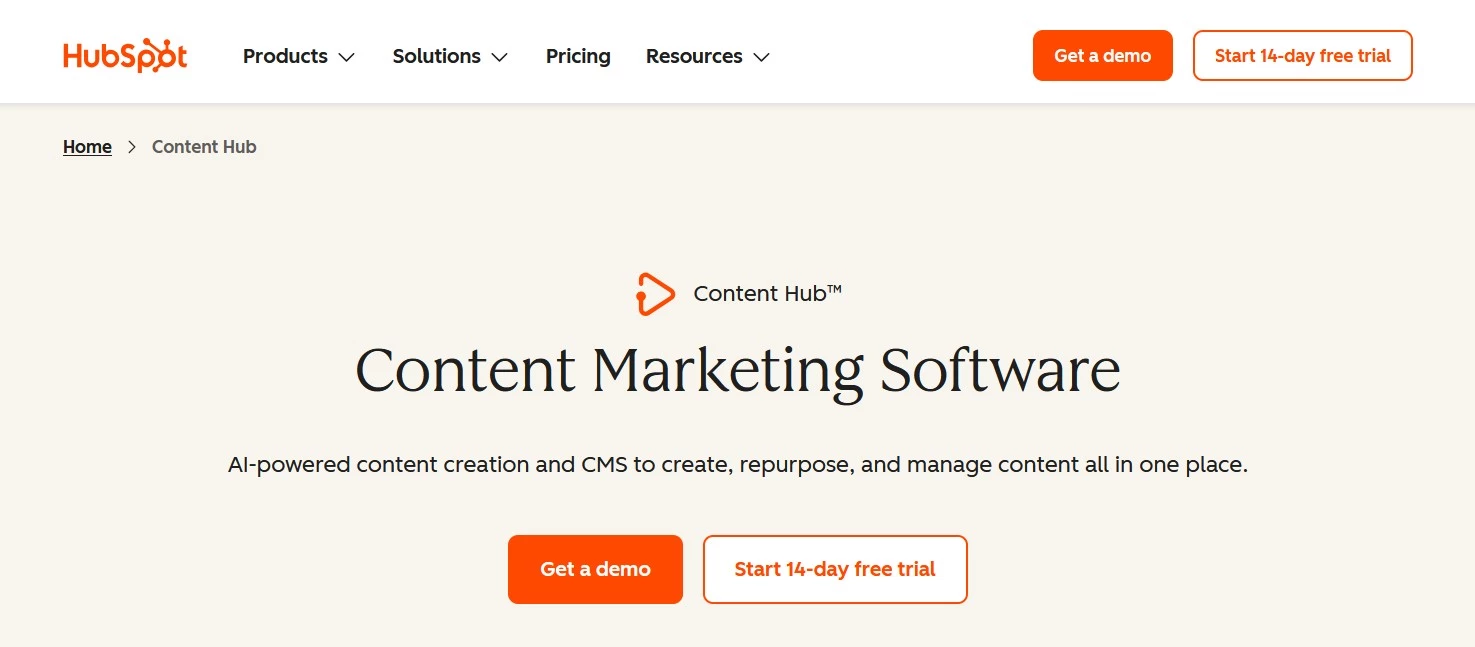
Most AI copywriting tools connect to a CRM. HubSpot's AI runs inside one with native, real-time access to deals, contacts, call recordings, emails, and behavioral data. Because the context already lives inside the platform, teams can avoid much of the field mapping and integration upkeep hassle needed for standalone tools.
Pros:
- Connects copy generation with CRM and campaign data
- Covers creation, repurposing, publishing, and reporting
- Supports personalized content across several channels
- Meaningful free entry point
Cons:
- Advanced AI functionality requires Professional
- Expensive if copywriting is the only requirement
- Best value depends on adopting the wider HubSpot ecosystem
Inside Content Hub, AI-powered blog tools generate ideas, outlines, paragraphs, and metadata. With Marketing Hub Professional and above, Brand Voice keeps tone consistent across a team of writers, and Content Remix adapts one asset into channel-appropriate variants without re-drafting each one manually.
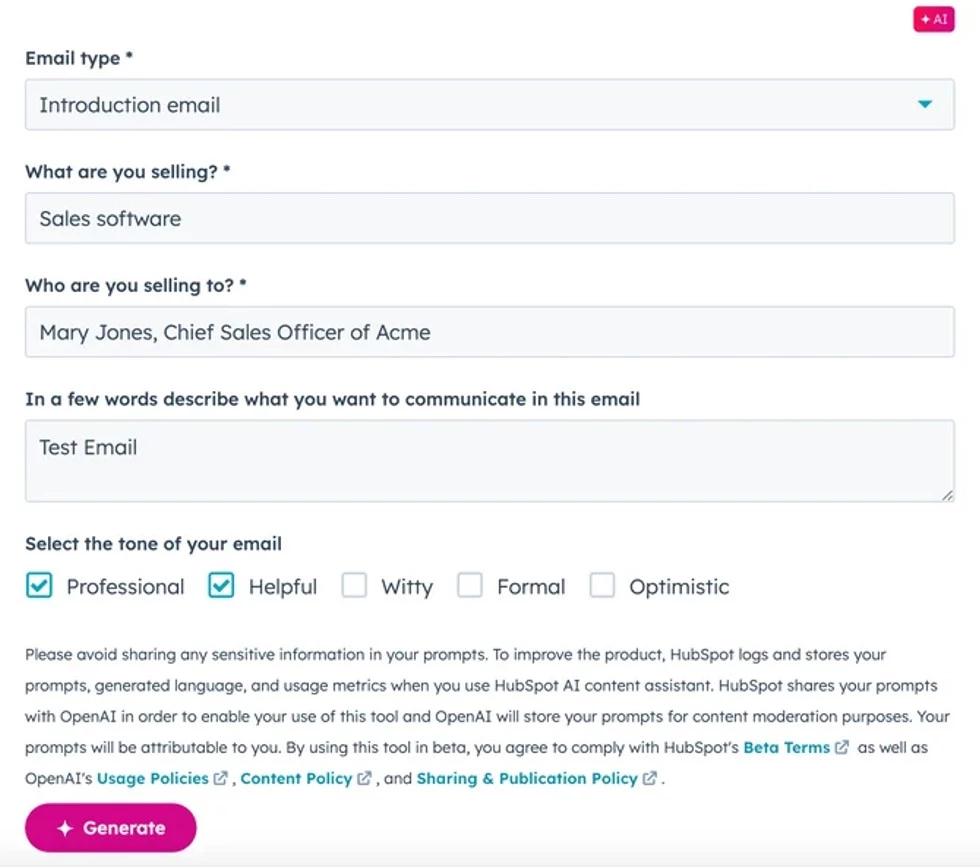
You can draft content, personalize it against segment data, publish it, and measure it without ever leaving the platform. So, for teams already running HubSpot, the operational payoff quickly compounds.
That workflow compression is worth more at scale than marginal generation-quality differences, since exporting copy between tools and reconnecting it to customer records adds friction to every content workflow.
The main caveat is that HubSpot's AI copywriting features aren't easily justifiable as a purchase on their own. The most powerful capabilities unlock at Marketing Hub Professional and above, which is a meaningful commitment.
That’s why it’s best for marketing teams that treat HubSpot as their central operating system and want AI copy generation, personalization, and performance measurement all running on the same underlying customer data.
Pricing:
- Free tier
- Starter: From $10/seat/month for eligible new customers
- Professional: From $500/month with three seats
- Enterprise: From $1,500/month with five seats
- 14-day premium trial available
What Users Say
Users consistently praise Content Hub for its integrated workflow and the way Breeze slots naturally into existing HubSpot processes rather than requiring a separate learning curve.
Pricing and per-seat costs at higher tiers remain the most cited reservations, alongside occasional friction around customizing Brand Voice for teams with highly specific tonal requirements.
Other Notable Features
- AI-powered blog, landing page, and email drafting inside Content Hub
- Brand Voice training via document upload and style examples
- Content Remix for cross-format adaptation (blog to social, video to email, and more)
- CRM-native personalization at the individual contact and segment level
- HubSpot AEO for AI-search visibility, included in Marketing Hub Professional and Enterprise or available as a dedicated purchase
- Built-in SEO recommendations and unified performance analytics
- Native publishing across HubSpot's CMS, email, and social tools
2. Jasper: Best for Enterprise-Grade, Brand-Consistent AI Copy at Scale
Built for high-output marketing organizations that need to keep brand voice consistent across writers, markets, and channels.
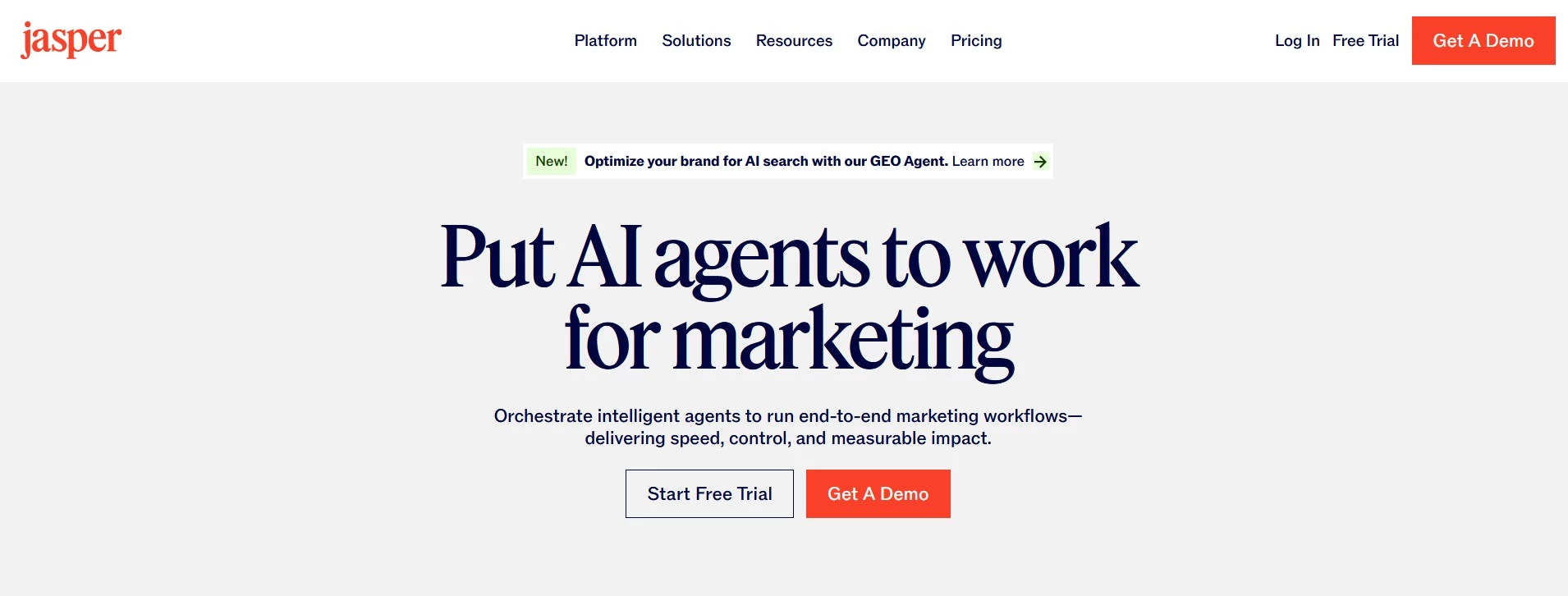
Most AI writing tools can imitate a brand voice when given the right prompt. Jasper’s differentiator is adding value to that content by making it reusable across an entire marketing organization.
Jasper IQ stores approved voice, terminology, audience profiles, product information, and source material in one shared layer. Jasper then applies that context across its editor, agents, and scaled production workflows instead of relying on every user to brief the model correctly each time.
Pros:
- Centralizes brand voice, audience, style, and product knowledge
- Supports repeatable content production across teams and markets
- Offers purpose-built agents for different marketing workflows
- Includes enterprise governance, integrations, and API access
Cons:
- Considerably more expensive than general-purpose AI tools
- Pro includes only one seat and limited brand and knowledge assets
- Advanced workflows and governance require a custom Business plan
- Output still needs editorial review and fact-checking
Inside Jasper IQ, Brand Voice defines how the company communicates, Audiences adjust messaging for different segments, and the Knowledge Base grounds copy in approved business information. Business customers can add formal style rules and visual guidelines to create a more controlled production environment.
Canvas handles everyday drafting and editing, and you can use Agents and Grid to turn repeatable marketing tasks into scalable content workflows.
Jasper offers persistent context that lets teams define their brand voice, audiences, and product knowledge once, then apply them across writers, channels, and markets.
That makes Jasper best for enterprises and high-output teams that need consistent execution at scale. For an individual producing occasional drafts, it may feel like an expensive layer over ChatGPT or Claude.
Pricing:
- Seven-day Pro trial available
- Pro: $59/month per seat (annual billing)
- Business: Custom pricing with a 12-month commitment
What Users Say
Capterra reviewers consistently praise Jasper’s ease of use, quick first drafts, and ability to reduce the time spent brainstorming and producing routine marketing content.
Price is the most common reservation, especially for smaller teams comparing Jasper with lower-cost general-purpose tools. Reviewers also caution that outputs can become repetitive, overly long, or generic, and that factual claims still need to be checked.
Other Notable Features
- Jasper IQ with Brand Voice, Audiences, and multimodal Knowledge
- Canvas editor with Jasper Chat and inline rewriting
- More than 100 purpose-built marketing Agents
- Jasper Grid for systematic, high-volume content production
- AI Studio for building custom agents and workflows
- Content generation and repurposing in more than 30 languages
- GEO, SEO, research, translation, and campaign workflows
- API access, integrations, admin controls, and user groups
Put Jasper’s brand consistency to the test with a seven-day Pro trial
3. Anyword: Best for Performance-Driven Ad and Marketing Copy
A strong fit for performance marketers using predictive data to prioritize which ad, email, landing-page, and social variants to test.
Anyword’s differentiator is not generating more copy, but helping teams identify which version is most likely to perform.
Its Data-Driven Editor assigns predictive performance scores based on factors such as the channel, audience, and campaign goal. Marketers can compare variants before launch and use the platform’s recommendations to strengthen weaker copy.
Pros:
- Predictive scoring for generated and manually edited copy
- Audience- and channel-specific copy variations
- Unlimited copy generation on paid plans
- Custom performance models available for larger teams
Cons:
- Performance scores can't replace live A/B testing
- Monthly prediction allowances vary by plan
- Historical benchmarking and custom models require a Business plan
- Less distinctive for editorial or thought-leadership content
Anyword is great for when a team has too many plausible options rather than too few. If you generate 20 headlines, subject lines, or CTAs, its scores provide a practical way to narrow the field before committing testing budget.
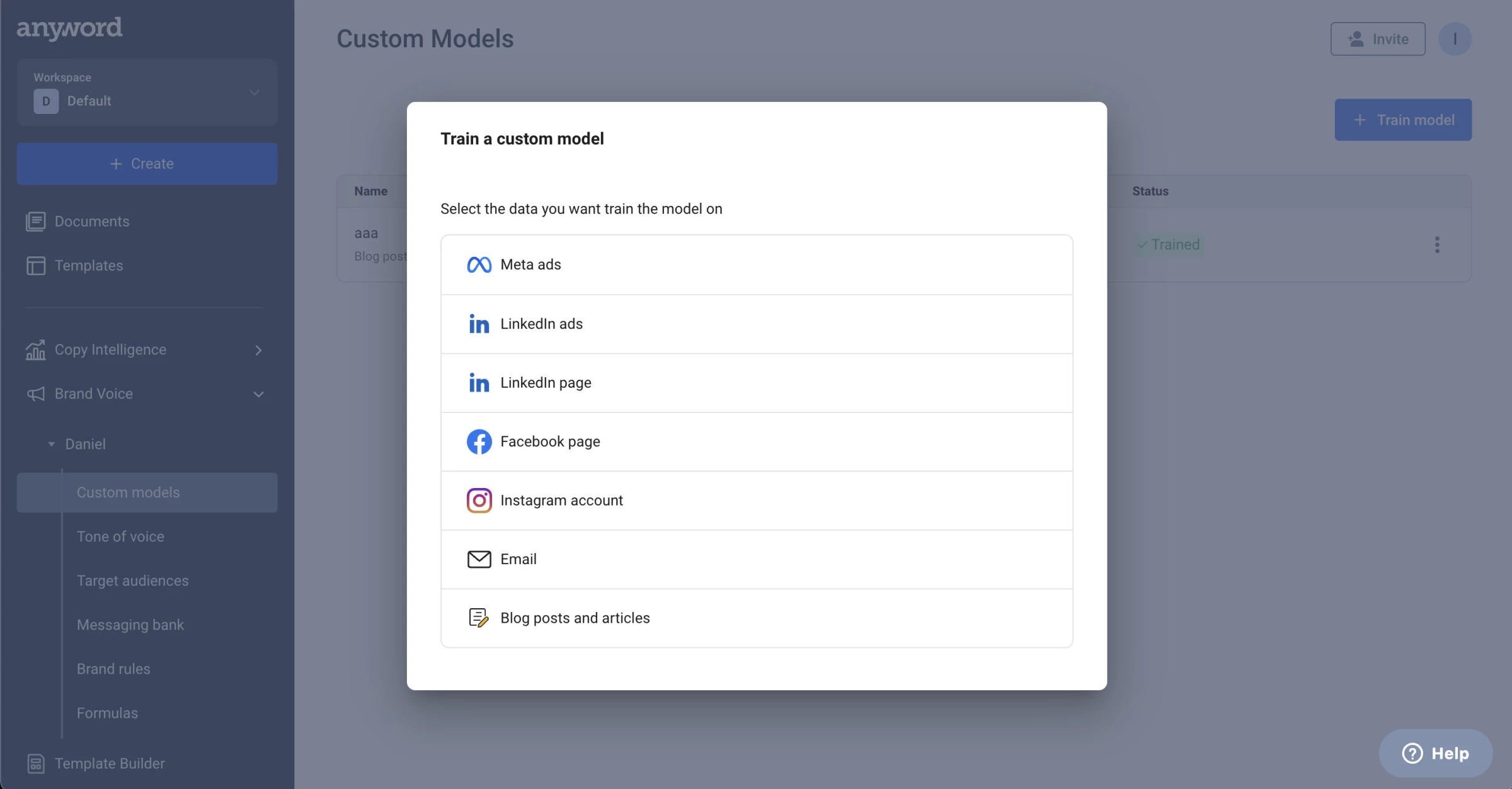
Business customers can connect historical campaign data through Content Intelligence and use it to train an agent on the organization’s best-performing messaging. Anyword then benchmarks new copy against published content, identifies effective patterns, and tailors future recommendations accordingly.
Actual results still depend on the offer, creative, placement, targeting, timing, and wider campaign context. Anyword helps as a hypothesis-ranking tool for deciding what deserves testing, then validating that judgment with real campaign data.
That makes Anyword best suited to performance marketing teams producing high volumes of measurable copy. For occasional blog drafting or general content creation, its predictive layer is probably an excessive additional cost over a general-purpose AI assistant.
Pricing:
- Starter: $39/month (billed annually)
- Data-Driven: $79/month (billed annually)
- Business: Custom pricing
- Enterprise: Custom pricing
- Seven-day free trial available
Annual billing reduces Starter to $39/month and Data-Driven to $79/month. Prediction allowances and access to performance data increase with higher plans.
What Users Say
Reviewers frequently praise Anyword’s intuitive interface, fast content generation, and ability to produce multiple usable variations for different audiences and platforms.
Pricing and prediction limits feature among recurring concerns. Some users also report that outputs occasionally miss the brief or require regeneration, reinforcing the need to treat Anyword as a decision-support tool rather than an autonomous copywriter.
Other Notable Features
- Content Intelligence and historical benchmarking
- Brand Voice and audience targeting
- One-click performance improvement
- More than 100 copy templates and prompts
- Blog Wizard with plagiarism checking
- Chrome extension
- Automated website messaging tests on Business plans
See what Anyword can do with a seven-day free trial!
4. Copy.ai: Best for Automating Go-to-Market Workflows
For B2B marketing or revenue teams that want to turn repeatable processes into automated workflows, rather than generate each asset separately.
Copy.ai has evolved beyond its original role as a writing assistant and now positions itself as a go-to-market AI platform for automating processes across marketing, sales, and revenue operations.
Chat handles one-off tasks while Workflows connects multiple steps into a reusable system. A team could turn a content brief into an article, supporting social posts, an email campaign, and sales enablement copy without prompting for each asset individually.
Pros:
- Automates multi-step content and go-to-market processes
- Connects company data, brand guidelines, and established playbooks
- Supports models from OpenAI, Anthropic, and Google
- Suitable for workflows spanning marketing, sales, and operations
Cons:
- Significant price jump between Chat and workflow-enabled plans
- Requires well-defined processes and quality controls
- Broader than necessary for teams that only need writing assistance
- Generated content still requires editing and fact-checking
The platform’s Infobase and Brand Voice features supply the context, while Tables organize data and Actions perform individual steps within a workflow. Copy Agents can then make bounded decisions within the rules a team establishes.
This structure makes Copy.ai useful for processes that recur at volume, like repurposing content, localizing campaigns, personalizing account-based marketing assets, or turning research into sales outreach.
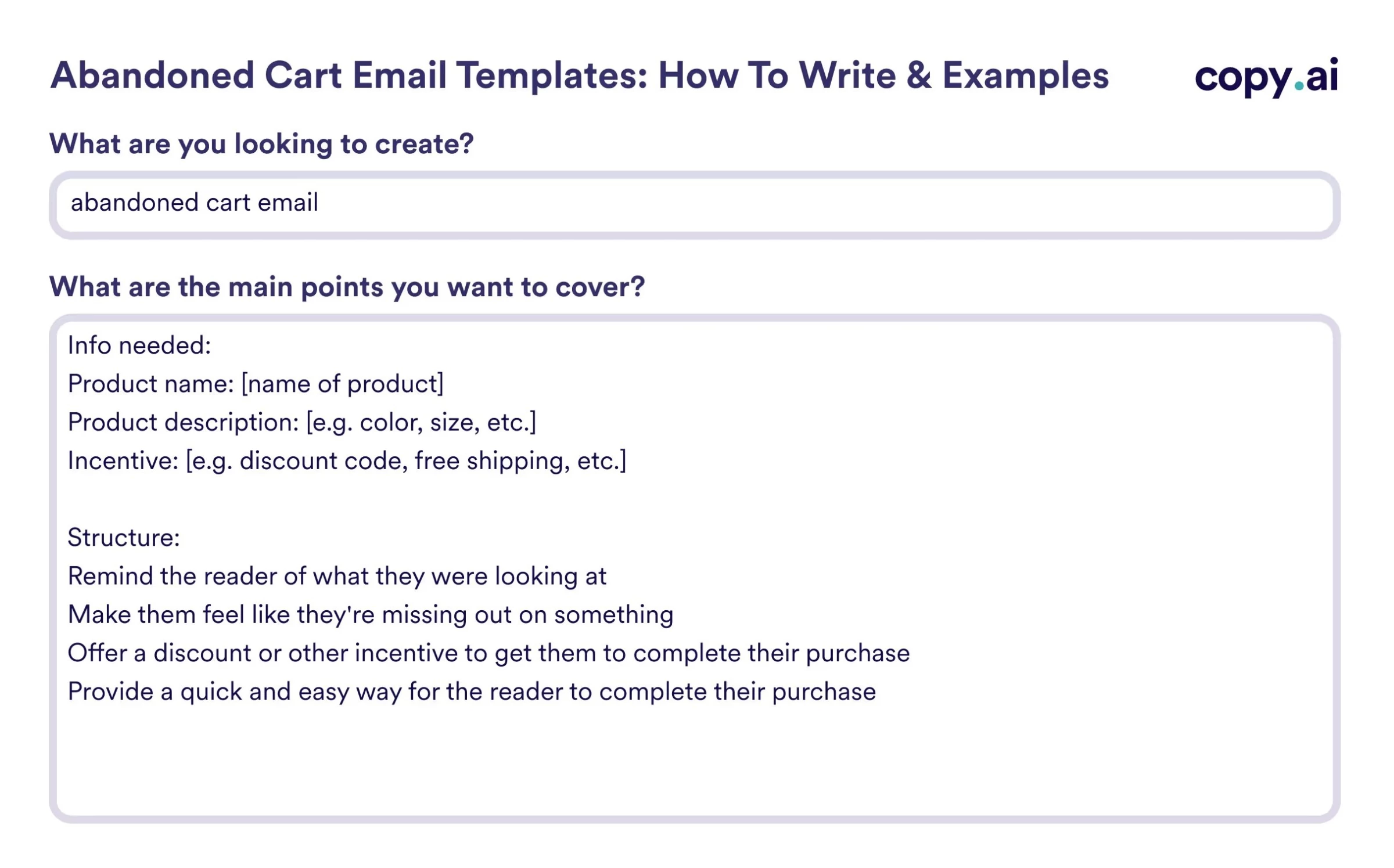
In the case of cybersecurity company Defendify Copy.ai used expert-created briefs as the starting point for a workflow that produced four blog posts and 66 LinkedIn posts in one month. Copy.ai reports estimated savings of more than $200,000, although the team retained human review at critical points to protect technical accuracy.
That reflects the platform’s real strength, which is when a team can codify how an entire content or campaign process should run.
Pricing:
- Chat: $29/month or $24/month billed annually
- Growth: $1,000/month, billed annually
- Expansion: $2,000/month, billed annually
- Scale: $3,000/month, billed annually
- Enterprise: Custom pricing
What Users Say
Users generally praise Copy.ai for its accessibility, fast idea generation, and range of templates. Reviews mention that it’s helpful for first drafts and overcoming creative blocks.
Criticism tends to focus on inconsistent tone, generic output, and the need for substantial editing. It’s also worth noting that many public reviews assess Copy.ai’s earlier writing-assistant iteration and not its newer enterprise workflow platform.
Other Notable Features
- Workflow Builder and customizable Copy Agents
- Infobase for company and product knowledge
- Brand Voice controls
- Account-based marketing workflows
- Translation and localization
- CRM enrichment and sales outreach automation
- More than 2,000 supported integrations
Request a demo of Copy.ai today!
5. Writer: Best for Governed Copy in Compliance-Sensitive Enterprises
For large or regulated organizations where governance, security, permissions, and auditability matter as much as output.
Writer is more of a controlled enterprise AI environment than a standalone copy generator. That means it helps organizations ground outputs in approved company knowledge and enforce rules around terminology, tone, data access, and review.
This makes it extremely relevant to financial services, healthcare, technology, and other industries where a false claim or improperly used term can become more than an editorial problem.
Pros:
- Centralized brand, terminology, and style controls
- Outputs grounded in approved company information
- Granular permissions, audit logs, and agent monitoring
- Enterprise security and privacy certifications
Cons:
- Advanced governance is restricted to Enterprise plans
- Requires more implementation than a typical writing assistant
- Excessive for freelancers and smaller content teams
- Limited volume of public user reviews
Writer’s Knowledge Graph connects its AI to internal documents and data to reduce reliance on general model knowledge. Personality profiles and Terms lists then shape how that information is expressed, including which terminology writers should use or avoid.
For repeatable work, Playbooks encode an approved process that teams can run again. An organization could create a product-launch workflow that draws from a verified brief, produces audience-specific messaging, applies required disclosures, and routes the result through designated approvals.
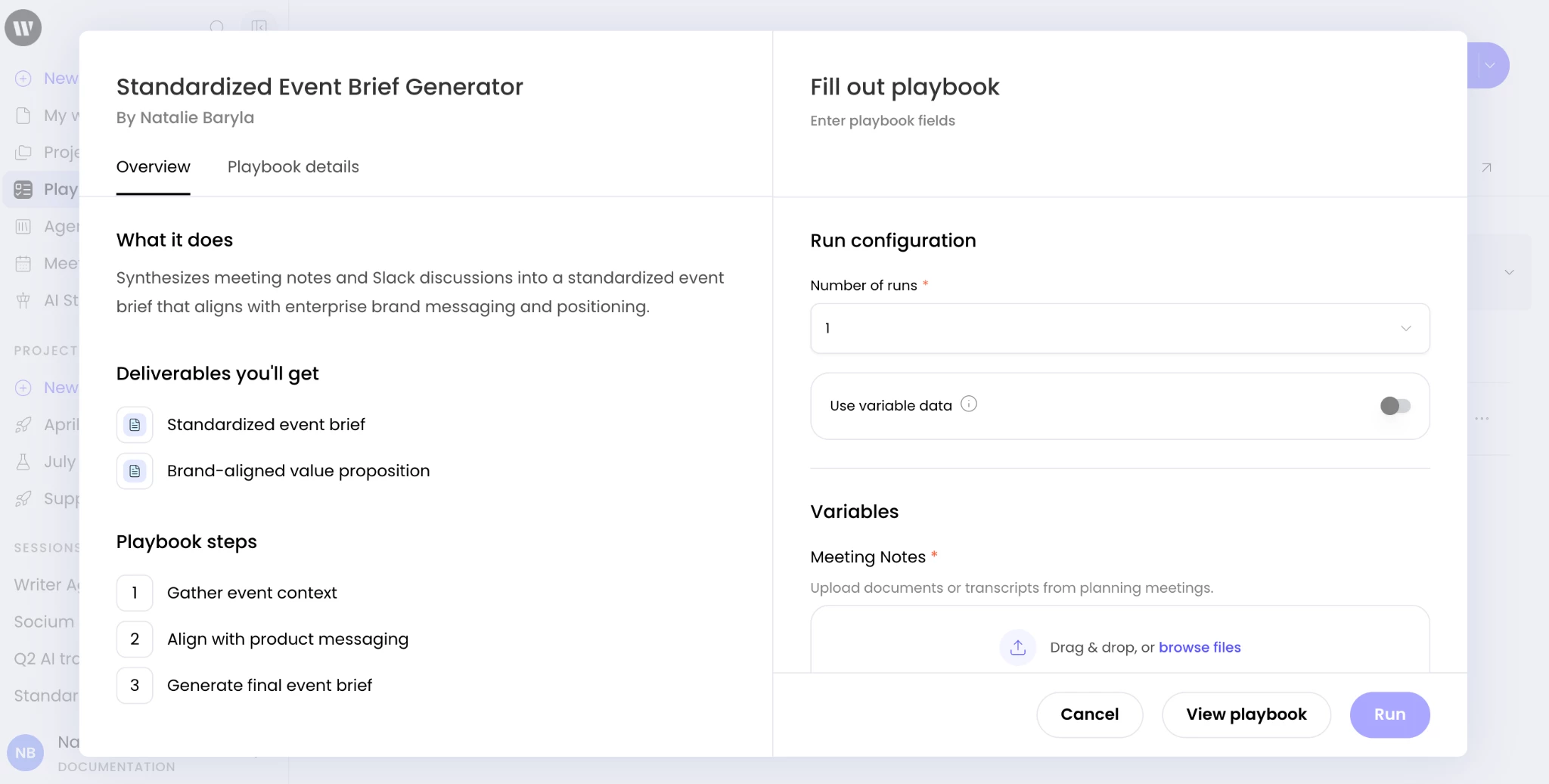
The platform can't guarantee that copy is legally compliant, but it can build the organization’s rules into the production process to make it less likely that every writer or department interprets them differently.
Writer is a good pick when content governance is an organization-wide operational concern. But the enterprise prices are difficult to justify for individuals who don’t need its administrative controls.
Pricing:
- Starter: $29 per user/month (annual billing)
- Enterprise: Custom pricing
- 14-day free trial available
What Users Say
Writer has positive ratings on Capterra, with reviewers highlighting its ease of use, writing assistance, and customer support.
However, the listing currently contains only a small number of reviews. Several also focus on Writer’s earlier proofreading and content-assistance features, so they provide limited evidence about the newer enterprise agent and governance platform.
Other Notable Features
- Writer Agent for research, analysis, and content production
- Playbooks for repeatable, governed workflows
- Knowledge Graph with source-grounded responses
- Proprietary Palmyra language models
- AI Studio for building custom agents
- Brand voice, style guide, and terminology enforcement
- Role-based access, approval flows, and audit logs
Explore Writer’s governed AI workflows with a 14-day free trial!
6. Surfer AI: Best for SERP-Data-Driven SEO Copy
Suited to SEO teams, content agencies, and publishers that want SERP data built into research, drafting, and optimization.
While most AI writing tools begin with a prompt, Surfer AI begins with the search results.
It analyzes the pages competing for a target keyword, proposes an outline, and generates a draft around the topics, entities, questions, and structural patterns appearing across those results.
The accompanying Content Editor then scores the article and provides real-time optimization guidance.
Pros:
- Combines AI drafting with SERP and competitor analysis
- Provides clear, real-time optimization guidance
- Supports custom knowledge, templates, and brand context
- Useful for both new articles and content refreshes
Cons:
- Content Scores do not guarantee rankings
- Recommendations can encourage formulaic or over-optimized copy
- Full AI articles require separate credits
- Less useful for content without a search objective
Before generating an article, users can select competitors, adjust the outline, add writing points, and supply proprietary information. It offers a great deal of control compared to asking a general-purpose model to write an SEO article from a keyword alone.
Once the draft is generated, Surfy can rewrite or expand specific passages, while one-click optimization addresses identified coverage gaps. The wider platform also supports internal linking, content audits, topical mapping, and AI-search visibility tracking.
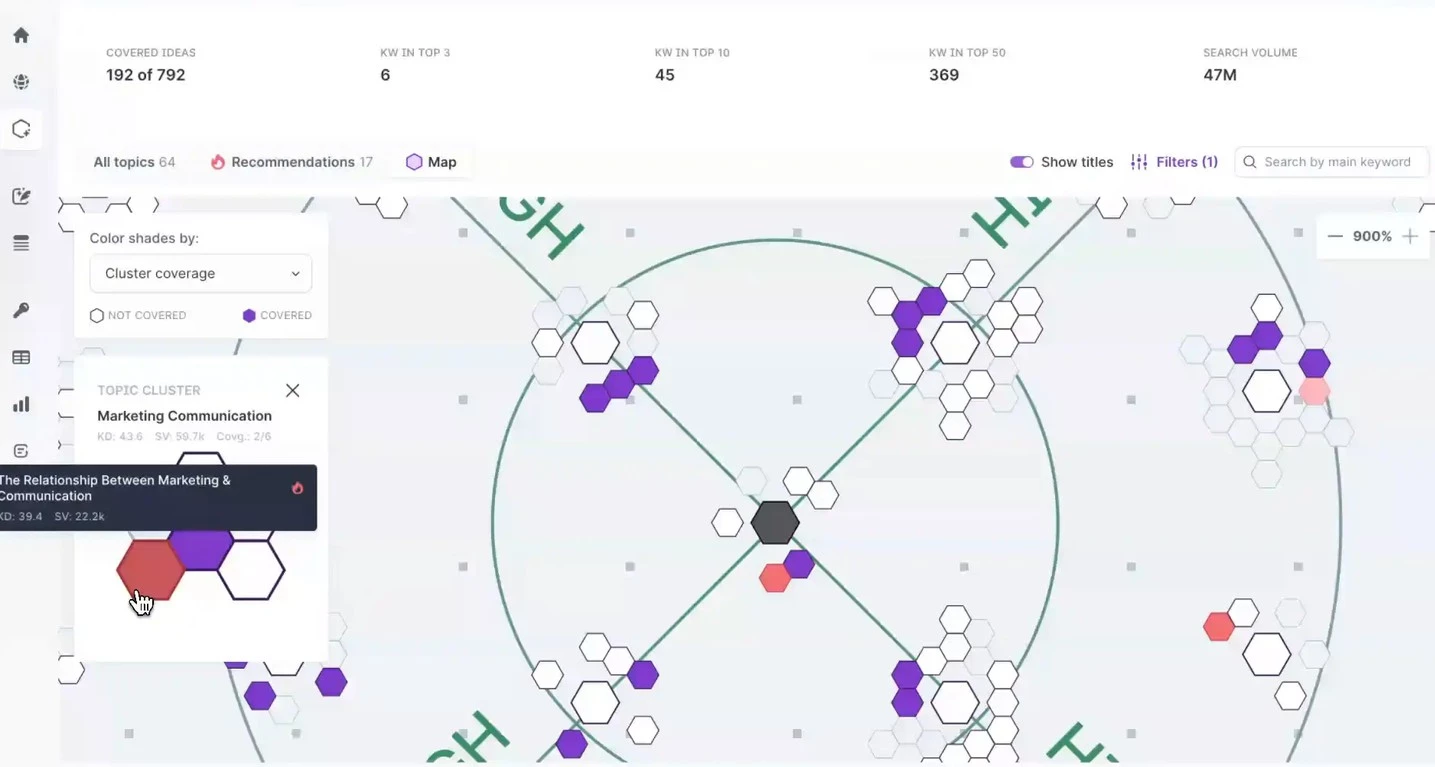
The Content Score is most useful as a quality-control checklist, not a target to maximize at any cost. Surfer’s recommendations reflect patterns found among pages that currently rank; they do not prove that every suggested term or structural choice caused those rankings.
Writers still need to exclude irrelevant competitors, remove forced keywords, verify claims, and contribute information that the existing results do not already contain. Otherwise, SERP-driven optimization can produce a more complete version of what is already ranking without giving readers a compelling reason to choose it.
That makes Surfer AI best for teams producing search-led content at volume. It’s far less differentiated for campaign concepts, brand storytelling, or persuasive copy where originality and audience insight are the focus rather than SERP coverage.
Pricing (billed annually):
- Discovery: $49/month
- Standard: $99/month
- Pro: $182/month
- Peace of Mind: $299/month
- Enterprise: From $999/month
What Users Say
Reviewers consistently identify the Content Editor as Surfer’s strongest feature. Its clear scoring system, competitor analysis, and ability to turn SEO requirements into actionable guidance for writers, also receive praise.
Common criticisms concern pricing, usage limits, and the temptation to treat the score as a box-ticking exercise. Some reviewers also find the wider SEO features less intuitive than the Content Editor itself.
Other Notable Features
- SERP-based outlines and writing points
- Content Score with real-time recommendations
- Surfy AI writing assistant
- Custom Knowledge and brand context
- Content Audit and ranking-drop alerts
- Topical Map and keyword research
- Internal-linking recommendations
- AI visibility tracking across major answer engines
Get started with Surfer for free!
7. Describely: Best for eCommerce Product Copy at Scale
For eCommerce teams that need to generate and maintain product descriptions, metadata, and marketplace copy across large catalogs.
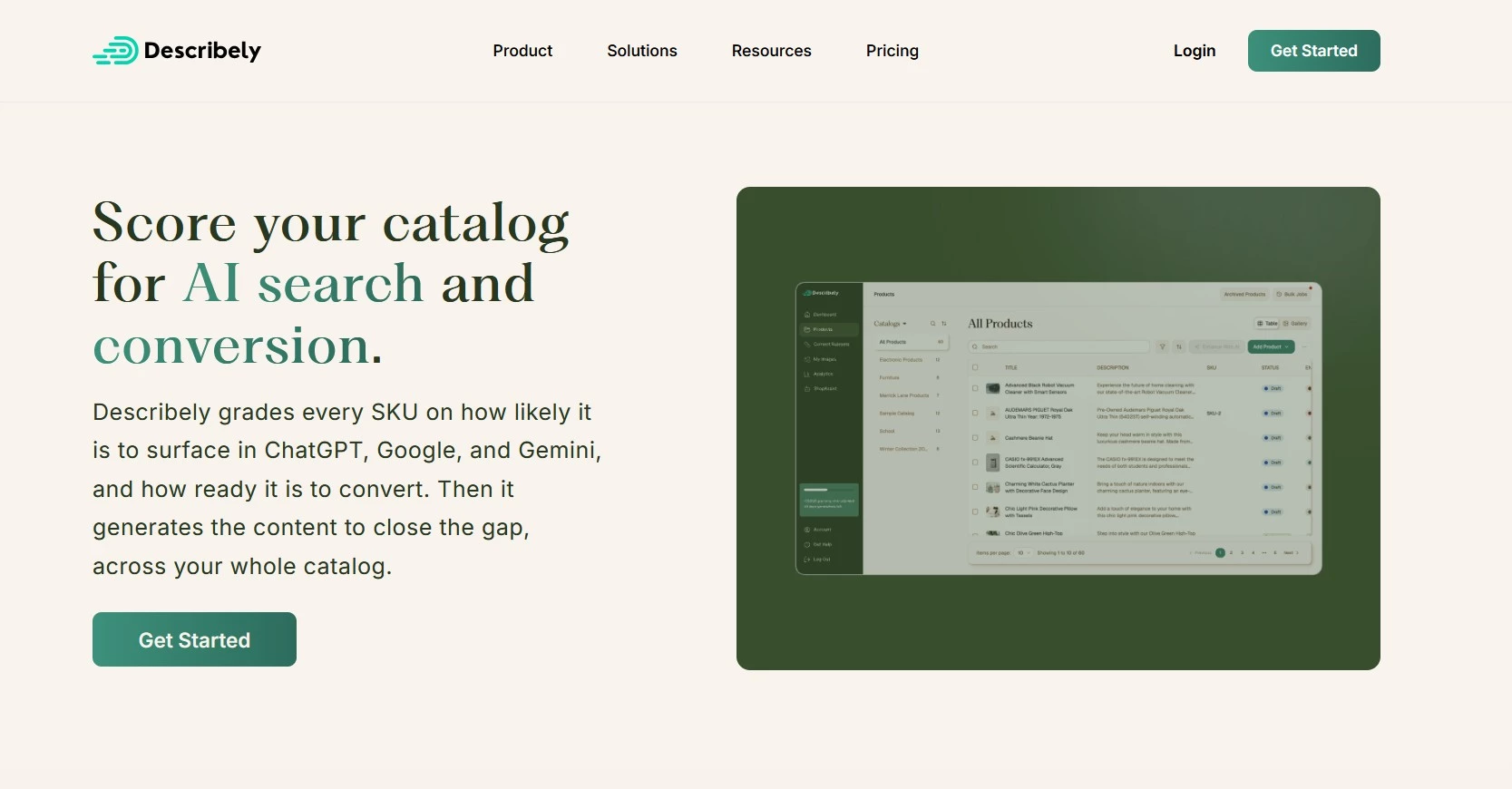
Describely is made especially for product content. It imports catalog data, fills missing attributes, and generates descriptions, titles, bullet points, tags, and metadata across hundreds or thousands of SKUs.
Unlike a general writing assistant, its workflow begins with structured product data and ends with reviewed copy ready to publish. Teams can import products through a store connection or spreadsheet, apply brand and channel rules, generate content in bulk, and sync approved changes back to their storefront.
Pros:
- Generates product content across entire catalogs
- Applies reusable rules for tone, structure, length, and language
- Enriches incomplete product data before writing
- Connects directly with major eCommerce platforms
Cons:
- Focused on product content rather than wider campaign copy
- Costs increase with catalog size and enrichment requirements
- Accuracy still depends on reliable source data
- Public user-review coverage remains limited
A general-purpose model given only a product name may produce vague copy or invent missing specifications. But Describely can enrich sparse catalog records using manufacturer, supplier, and other approved sources before generating the description.
Its Content Rules then provide control over how those details are expressed. Teams can define tone, length, structure, required information, and channel-specific conventions, with separate rulesets for different brands or catalogs.
The platform also audits existing listings for errors, inconsistent language, unsupported claims, and compliance with the selected rules. Its product-page audit adds GEO and conversion-readiness scores, although these should be treated as diagnostic guidance rather than proof that a listing will rank or convert.
While Describely doesn’t remove human oversight, it does change the job from drafting every product page individually to reviewing consistent batches of structured content.
Overall, it’s most valuable for retailers, marketplaces, and eCommerce agencies managing large or frequently changing catalogs. A store with a handful of products will probably find that a general-purpose tool does the job.
Pricing:
- Pay as you go: $0.75 per product for catalogs of up to 500 SKUs
- Data enrichment: $0.55 per credit
- Image processing: $0.05 per credit
- High-volume catalogs: Custom pricing
Free trial includes bulk generation and enrichment for five products
What Users Say
Describely doesn’t yet have many reviews available, but existing reviews praise its bulk-generation workflow, ease of use, and ability to produce product descriptions, metadata, and SEO copy much faster. The main issues are that costs can rise across very large catalogs and some users mention that they would like additional PIM integrations.
Other Notable Features
- Product descriptions, titles, bullet points, tags, and metadata
- Product-data enrichment from approved sources
- Custom Content Rules for different brands and catalogs
- Bulk content generation and auditing
- GEO and conversion-readiness scoring
- Shopify, WooCommerce, Wix, Squarespace, and Akeneo connections
- CSV, Excel, and Google Sheets support
- AI image generation and processing
Create your first product listings with a free Describely trial.
8. Lavender: Best for AI-Powered Sales Email Coaching
A practical choice for sales teams that want reps to improve one-to-one prospecting emails as they write.
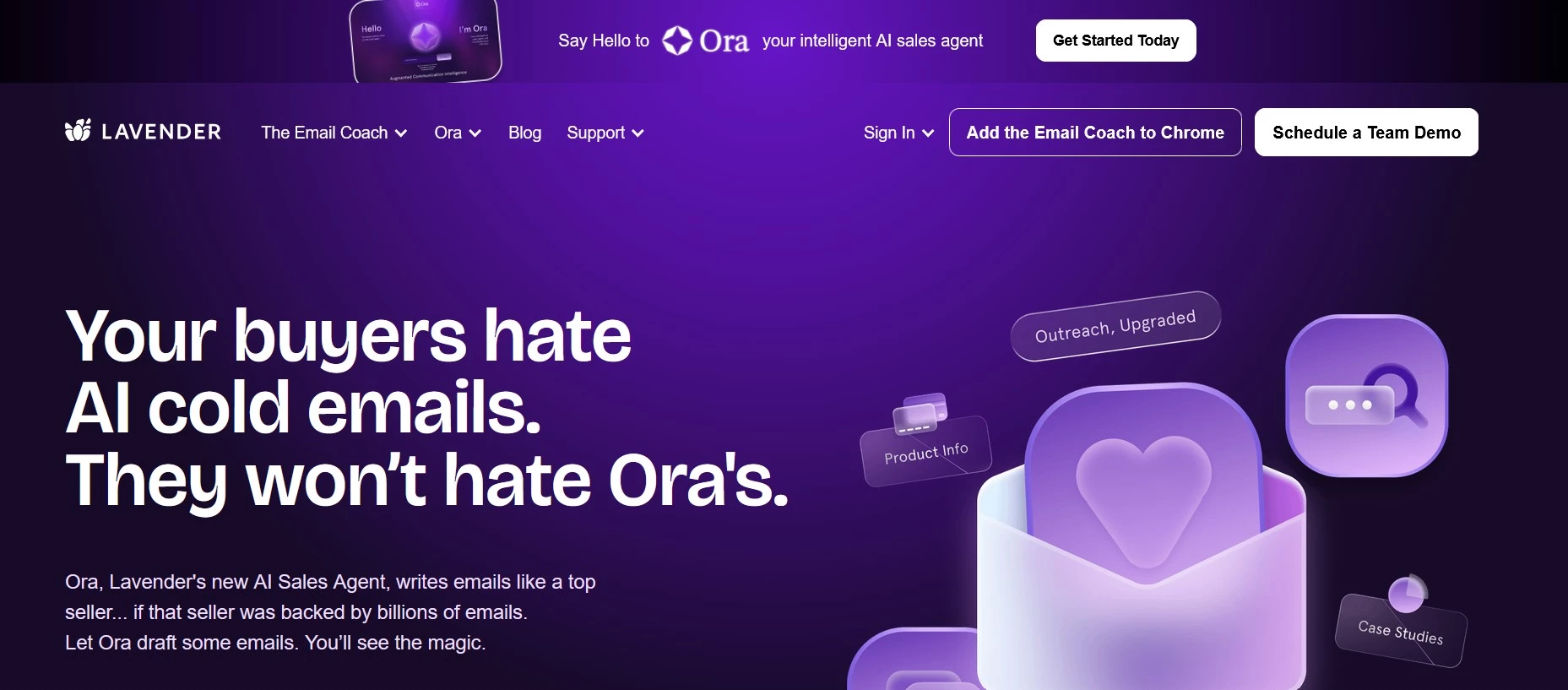
Lavender is an in-inbox writing coach built specifically for sales outreach. It scores each email, flags problems with length, readability, tone, subject lines, and mobile formatting, and recommends improvements before the rep hits send.
Its Personalization Assistant brings prospect research into the writing workflow, providing details such as recent news, social activity, work history, and podcast appearances. Reps can use that context to write their own opening or ask Lavender to generate some starting points.
Pros:
- Provides real-time feedback inside the seller’s existing workflow
- Combines email coaching with prospect research and personalization
- Gives managers visibility into recurring problems across reps
- Integrates with major inboxes and sales platforms
Cons:
- Limited primarily to one-to-one sales emails
- Scoring cannot judge whether the targeting or sales premise is right
- Team pricing is relatively high for a specialized tool
- Reviewers report occasional extension and integration glitches
Lavender is most useful at the team level where its Coaching Dashboard aggregates performance data, identifies where individual reps are struggling, and shows which messaging patterns are working across the organization.
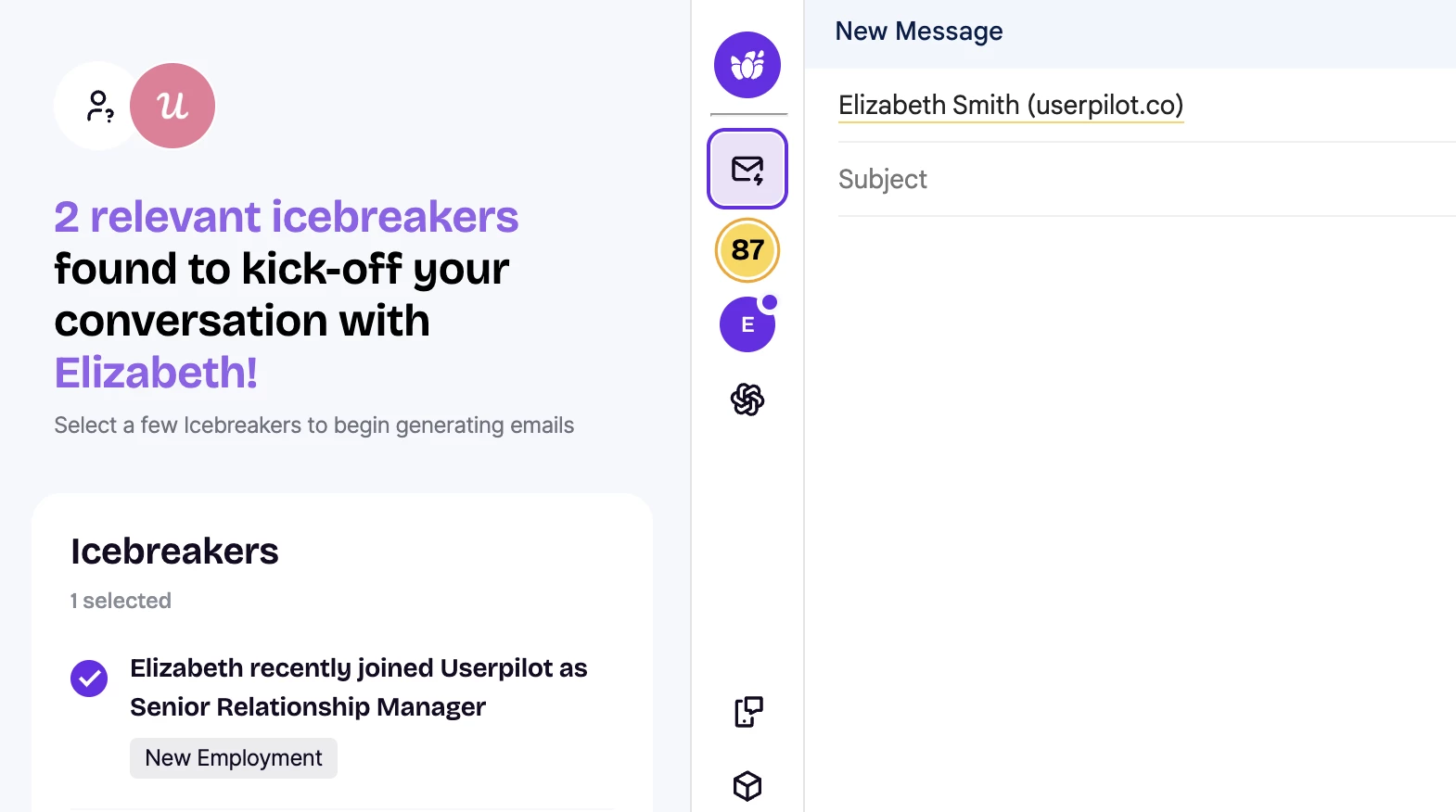
Instead of reviewing emails manually or offering advice based on isolated examples, sales managers can see recurring issues involving brevity, clarity, personalization, and structure.
Lavender’s score should be treated as a diagnostic signal rather than a guarantee of effectiveness. The platform can make an email clearer and easier to read, but not determine whether the prospect, timing, offer, or reason for reaching out is strategically sound.
Overall, Lavender is best for outbound teams that already have lead sourcing and sales-engagement systems but want stronger writing and more consistent coaching. Its not for writing newsletters, automated lifecycle campaigns, or marketing copy.
Pricing:
- Seven-day free trial available
- Basic: Free for five email analyses and five personalized emails per month
- Starter: $27/month, billed annually
- Individual Pro: $45/month, billed annually
- Team: $89/user/month, billed annually
What Users Say
Sales professionals say it helped them internalize fundamentals such as shortening emails, lowering the reading level, asking clearer questions, and formatting messages for mobile.
Others use Lavender to check templates, research account triggers, and work inside Salesloft, Outreach, and Gmail. This suggests its strongest value is coaching: it can shorten the learning curve for new reps and give teams a shared quality standard, while experienced sellers may find its daily value tapers off.
Other Notable Features
- AI Email Writer and Start My Email
- Personalization Assistant
- Template scoring
- Mobile email preview
- Team Coaching Dashboard
- Multi-inbox support
- Gmail, Outlook, HubSpot, Outreach, Salesloft, Apollo, and Gong integrations
- SOC 2 certification and GDPR compliance
Run your next sales emails through Lavender’s AI coach for free
9. Munch Studio: Best for Turning Brand Assets Into Social Content
Made for small businesses, lean teams, and agencies turning existing brand assets into a consistent social content calendar.
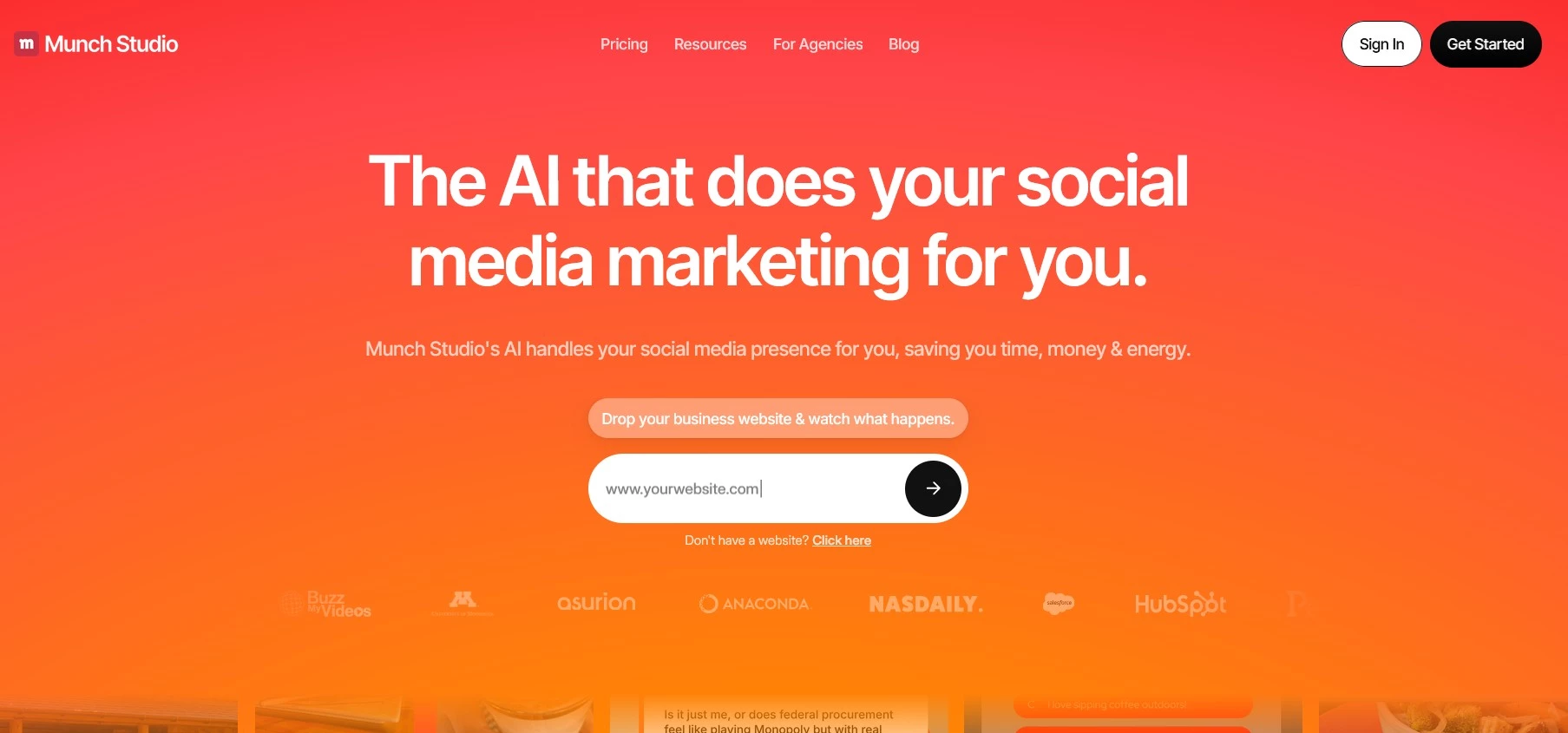
Munch Studio is broader than the video-clipping tool many marketers associate with the Munch name. It learns from a company’s website, existing posts, images, videos, and recordings, then uses those assets to generate a social strategy and the content to support it.
That content can include captions, carousels, graphics, video scripts, and repurposed clips. Users choose or edit the strongest options before scheduling them across Instagram, Facebook, LinkedIn, YouTube, and TikTok.
Pros:
- Generates social content from existing brand materials
- Covers copy, carousels, graphics, scripts, and video
- Combines content creation, scheduling, and analytics
- Offers multi-brand workspaces for agencies
Cons:
- Primarily useful for social media rather than wider copywriting
- Generated ideas and claims still require human review
- Entry plans impose limits on video generation and repurposing
- Public user-review coverage remains limited
Munch Studio’s main advantage is continuity. Instead of explaining the business in every prompt, teams can establish their brand context once and use it across an ongoing content calendar.
Its Smart Content Planner can organize activity over a week or quarter, while the performance dashboard tracks results across connected platforms. This makes it a more complete social workflow than a standalone caption generator.
However, automation works best when the source material already contains something worth repurposing. Munch Studio can distribute established ideas across formats, but doesn't replace the subject-matter expertise or original perspective needed to create those ideas in the first place.
Its useful when the bottleneck is maintaining a consistent publishing cadence, but not when you need carefully researched thought leadership, complex campaign messaging, or precise control over every creative decision.
Overall, Munch Studio is best for small businesses and agencies that want one system to turn their existing brand assets into a steady stream of social content.
Pricing:
- Essential: $48/month, or $38/month billed annually
- Premium: $75/month, or $60/month billed annually
- Studio: $148/month for up to five brands
- Scale: $398/month for up to 15 brands
- Seven-day free trial available
What Users Say
Reviews are still too scarce for a reliable consensus but two Product Hunt reviewers praise its straightforward setup, brand consistency, and ability to save time across planning, creation, and scheduling. Trustpilot shows seven mostly positive reviews, with some highlighting short-video creation and keyword-based clip selection.
Other Notable Features
- Tailored social media strategies
- Smart Content Planner
- Unlimited generated posters and carousels
- AI-generated video scripts
- Video generation and repurposing
- Cross-platform publishing
- Performance dashboard
- Separate workspaces for multiple brands
- Unlimited team members on Premium and multi-brand plans
Turn your brand assets into social content with a seven-day free trial
10. Hoppy Copy: Best for Newsletters and Lifecycle Email Campaigns
For creators and lean marketing teams that need recurring newsletters, nurture sequences, and campaign emails without stitching together separate writing, design, and sending tools.

Hoppy Copy supports one-to-many communication such as newsletters, launch campaigns, welcome flows, lead-nurture sequences, and post-purchase emails. It goes beyond generating email drafts by bringing writing, design, publishing, and automation into one email-focused platform.
Hoppy Copy can generate emails in a defined brand voice, develop newsletters and sequences, apply design themes, check for spam-triggering language, and publish campaigns. Built-in audience management, automations, forms, and analytics extend the workflow beyond writing.
Pros:
- Covers writing, design, publishing, and automation in one platform
- Purpose-built newsletter and email-sequence generators
- Stores brand voices, reference material, and reusable prompts
- Tracks competitor emails for campaign research and inspiration
- Can export to or integrate with established marketing platforms
Cons:
- Expensive if you only need occasional email drafts
- May duplicate features in an existing email marketing platform
- Generated copy still requires editing and campaign testing
- Independent review volume remains relatively limited
The most distinctive feature is competitor monitoring. Hoppy Copy provides access to a library of more than 10,000 emails and lets teams follow competing brands for new campaigns, offers, and messaging patterns.
Instead of guessing what others are sending, marketers can examine real campaign cadence, content themes, and promotional approaches before developing their own angle. The feature is most useful for market awareness rather than imitating individual emails.
Idea Feeds address another persistent email problem: maintaining a regular publishing schedule. They can draw from sources such as company blogs, RSS feeds, and web research to suggest and draft newsletter content each week.
The main question is how much of the workflow you want Hoppy Copy to own. Teams can export copy to platforms such as HubSpot, Mailchimp, Shopify, and Beehiiv, but businesses already running sophisticated email automation could find much of the wider platform redundant.
For creators and smaller marketing teams for whom email is an important channel but not yet a mature operation, Hoppy Copy is great, providing more structure than a general AI assistant and more campaign functionality than a standalone copy generator.
Pricing:
- Start: $99/month
- Platform: $199/month
- Enterprise: Custom pricing
- Seven-day free trial available
What Users Say
Users praise Hoppy Copy’s approachable interface, email-focused templates, and ability to generate different kinds of marketing copy. Some reviewers identify navigation and general UX as areas for improvement.
Maybe worth noting that some reviews assess Hoppy Copy’s earlier AI-writing experience rather than the broader email marketing and automation platform it offers today.
Other Notable Features
- AI newsletter and email-sequence creators
- Custom brand voices and knowledge assets
- Email design themes and spam-word checking
- Competitor monitoring and campaign alerts
- Audience segmentation, forms, and automations
- Integrations with HubSpot, Zapier, Shopify, Mailchimp, and other platforms
Build your next newsletter or nurture sequence with Hoppy Copy’s seven-day free trial.
The Pros and Cons of AI Copywriting Tools
AI makes it easier to produce more copy, but not necessarily copy with an original voice, clear point of view, or meaningful connection to the brand.
AJ Kohn, SEO expert and founder of Blind Five Year Old, warns us that AI copywriting can lose the “soul or uniqueness that brands strive to communicate”, especially with in-depth or brand-defining content.
“While AI can quickly produce content that might rank well temporarily, this strategy risks undermining long-term brand credibility and audience trust.”
That doesn’t make AI copywriting inherently good or bad. Its value depends on where it enters the workflow, how clearly it’s directed, and how carefully the output is reviewed.
Where AI Copywriting Tools Add Leverage
The biggest gains are operational, helping teams produce, test, and adapt content with less manual effort.
- Faster production: AI can reduce the time spent moving from a brief to a workable draft, particularly for routine or highly structured content.
- More room for testing: Teams can generate multiple headlines, CTAs, emails, or ad variations without multiplying the initial writing workload.
- Greater consistency at scale: Approved terminology, product information, and messaging frameworks can be applied across large volumes of content, provided the tool has clear guidelines.
- Easier repurposing: Existing material can be adapted for different formats, channels, audiences, or stages of the customer journey.
- More time for higher-value work: Automating repetitive drafting gives writers more capacity for research, strategy, interviews, creative direction, and refinement.
Cons of AI Copywriting Tools
The risks emerge when fluent output is mistaken for accurate, original, or strategically sound copy.
- Generic or diluted brand voice: Without strong source material and close direction, AI tends to produce familiar phrasing rather than a genuinely distinctive perspective.
- Confident inaccuracies: AI can invent facts, sources, product details, or quotations, making human verification essential.
- Limited strategic judgment: It can follow a positioning decision but is less reliable at determining which position a brand should take or what will genuinely persuade its audience.
- Hidden review costs: Producing more content is not necessarily efficient if editors must spend significant time correcting, fact-checking, and rewriting it.
- Legal and reputational risk: Unchecked output can introduce copyright, privacy, compliance, and credibility problems, particularly in regulated or high-stakes industries.
| Factor | Main advantage | Tradeoff to manage |
| Speed | Produces drafts and variations quickly | Faster output can create more review work |
| Scale | Supports high-volume content production | Quality may become uneven or generic |
| Consistency | Applies defined messaging across content | Requires clear and current brand guidelines |
| Creativity | Generates options and alternative angles | Rarely supplies a distinctive point of view by itself |
| Accuracy | Can organize supplied information efficiently | Facts and sources must be independently checked |
| Cost | Reduces effort on repetitive tasks | Editing, governance, and tool costs still apply |
How to Choose the Right AI Copywriting Tool
Most platforms can produce a competent paragraph. The meaningful differences lie in specialization, workflow fit, brand control, and how much work remains between the first draft and publication. When assessing AI tools for copywriting, start with the bottleneck you need the tool to remove.
- Decide if you actually need specialized AI copywriting software
- Match the specialization to your bottleneck
- Test with real work
Decide If You Actually Need Specialized AI Copywriting Software
Possibly not. A general-purpose assistant such as ChatGPT or Claude may be enough for occasional drafting, brainstorming, and rewriting, especially when you have an experienced writer go over every output.
Specialized software becomes more valuable when you need to:
- Produce the same content type repeatedly or at high volume
- Apply brand rules across multiple writers, teams, or clients
- Optimize copy for search, advertising, or sales outreach
- Connect generation to a CRM, CMS, or approval workflow
- Manage permissions, compliance, and governance centrally
The real reason to pay for a dedicated platform is a more controlled and repeatable workflow.
Match the Specialization to Your Bottleneck
Choose according to the job the tool needs to perform:
- Brand consistency: Look for style-guide controls, reusable brand profiles, and terminology rules.
- SEO content: Prioritize search data, content briefs, optimization guidance, and CMS integrations.
- Performance marketing: Look for variant generation, testing support, and performance insights.
- Sales outreach: Choose tools with email coaching, personalization, and CRM connectivity.
- Content repurposing: Focus on tools that can reliably turn longer assets into channel-specific copy.
- Workflow automation: Prioritize integrations, templates, approvals, and multi-step content processes.
Avoid paying for a broad feature set when only one specialized capability solves your problem.
Test With Real Work
Don't judge a tool by its sample outputs. Give each shortlisted platform the same brief, source material, brand guidelines, and finished example.
Then compare:
- Accuracy and adherence to the brief
- Brand fit before extensive editing
- Time required to reach an approved version
- Consistency across several outputs
- Ease of collaboration and review
The best-performing tool is the one that reduces the route to publishable copy, not merely the time to generate a draft.
Final Words: Choose the Tool That Fits the Workflow
The best tools for copywriters are the ones that remove the most costly friction from a real workflow. That’s the one that improves consistency, speeds review, or connects content to the systems where it’s published and measured.
Choose AI copywriting software according to the bottleneck it solves, then judge it by the quality of the finished work, not the volume it can generate.

If you need help automating your marketing processes, our team ranks agencies worldwide to help you find a qualified partner. Visit our Agency Directory for the top copywriting agencies, as well as:
- Top Content Marketing Companies
- Top Content Creation Companies
- Top Digital Marketing Agencies
- Top AI Marketing Companies
- Top Copywriting Agencies in New York City
Our design experts also recognize the most innovative design projects across the globe. Given the recent uptick in AI tools usage, you'll want to visit our Awards section for the best & latest in AI website designs.
AI Copywriting Tools FAQs
1. Does Google penalize copy created with AI copywriting tools?
Google doesn't penalize content simply because AI helped create it. Its systems prioritize helpful, reliable, people-first content, while mass-producing unoriginal pages primarily to manipulate rankings may constitute scaled content abuse.
AI-assisted copy therefore needs original insight, credible evidence, and editorial review rather than superficial rewriting.
2. Who owns copy produced by AI copywriting software?
Ownership depends on the jurisdiction and how much human authorship shaped the finished work. The U.S. Copyright Office says purely AI-generated material is not copyrightable, although original human selection, arrangement, and substantive revisions may qualify for protection.
Businesses should keep records of their briefs and edits, check each provider’s commercial-use terms, and clear important campaign assets for potential infringement.
3. How should you measure the ROI of an AI copywriting tool?
Measure the route to approved copy, not the number of words generated. Compare time from brief to final draft, editing and fact-checking hours, cost per approved asset, testing capacity, and any resulting conversion or revenue gains against the previous workflow.
Subscription, implementation, training, and review costs should all be included, since faster generation can still produce a negative return when cleanup increases.
4. Is it safe to upload confidential information to an AI copywriting tool?
Only when the provider’s data controls match the sensitivity of the information. Check whether inputs are used for model training, how long data is retained, who can access it, and whether deletion, encryption, and administrative controls are available.
Don't assume that consumer-facing or free AI copywriting tools are suitable for customer data, contracts, unpublished strategies, or confidential client material.
5. Can you use several AI copywriting tools together?
Yes, provided each tool has a defined role and the team maintains one source of truth for brand rules and approved claims. A business might use Surfer for SEO guidance, Describely for product copy, Lavender for sales emails, and a general assistant for ideation.
The best AI for copywriting may therefore be a small, complementary stack, but overlapping generators can quickly add cost, contradictory guidance, and unnecessary handoffs.
6. Do brands have to disclose AI-generated copy?
Not automatically in every market or format. Requirements depend on the jurisdiction and use: the EU AI Act ensures transparency duties for specified content, including certain AI-generated public-interest material, while U.S. advertising rules focus on whether claims are truthful, evidence-based, and nondeceptive.
Brands should establish an internal disclosure policy and label AI involvement whenever required by law, a platform, a client, or the risk of misleading the audience.