Our directory features top IT services companies that keep your systems secure and running smoothly. From cloud to cybersecurity, they ensure your business stays online, protected, and ready to scale.
We find, build and manage remote teams.
Away Digital Teams specializes in recruiting and managing top talent in Vietnam for businesses seeking to establish and oversee remote teams. Our comprehensive service ensures seamless team building and management, enabling companies to thrive in today's digital landscape...
Top Services:
- Digital Services
- Web Development
- Software Testing
- Mobile App Development
- Software Development
- Show more
- Location
- St Kilda, Australia
- Number of Employees
- 250 - 499
- Average Hourly Rate
- $25/hr
- Minimal Budget
- $25,000 - $50,000
- Portfolios Count
- 4 Projects Listed
Nationwide Digital Forensics, Cell Phone Forensics, Cyber Investigations & Expert Witness Services
Elite Digital Forensics is a Professional Digital Forensics and Cyber Investigative Company that provides services nationwide...
Top Services:
- Cybersecurity
- IT Services
- Business Consulting
- Location
- Daytona Beach, Florida
- Number of Employees
- Under 49
- Portfolios Count
- 7 Projects Listed
Enterprise Drupal, Simply Delivered.
Were passionate about what we do whether it is working with a new client on a strategic project, meeting users for UX testing, developing innovative solutions, or just coming together for a team lunch or social activity...
Top Services:
- Software Development
- Web Development
- Web Design
- Staff Augmentation
- Digital Services
- Show more
- Location
- Vancouver, Canada
- Number of Employees
- 50 - 99
- Average Hourly Rate
- $125/hr
- Minimal Budget
- $50,000 & Up
- Portfolios Count
- 6 Projects Listed
Product Design & Development Agency For SaaS And Fintech
Visiata is a design and development studio that helps businesses build intuitive digital products through integrated strategy, design, and engineering. The studio combines product strategy, UI/UX design, web and mobile development, and ongoing product support to create scalable, high-performance digital...
Top Services:
- Graphic Design
- Web Design
- Web Development
- AI Development
- Digital Services
- Show more
- Location
- Brentwood, California
- Number of Employees
- Under 49
- Average Hourly Rate
- $50/hr
- Minimal Budget
- $1,000 - $10,000
- Portfolios Count
- 6 Projects Listed
Come with an Idea. Leave with a Business.
WebYourMind along with it's skilled team and the most cutting-edge technologies to turn your ideas into a reality, beginning with the concept and ending with the launch. We are here to assist you in taking your company to the next level and bringing your aspirations into reality. Your company will benefit...
Top Services:
- IT Services
- Web Development
- Mobile App Development
- Location
- Dublin, Ireland
- Number of Employees
- Under 49
- Average Hourly Rate
- $150/hr
- Minimal Budget
- $1,000 - $10,000
- Portfolios Count
- 2 Projects Listed
Making Digital Accessibility, Usability, Inclusivity the Norm
A global Digital transformation company with over 20 years of experience, we identify gaps and fill them with state-of-the-art technology solutions...
Top Services:
- IT Services
- Mobile App Development
- Software Development
- Location
- San Jose, California
- Number of Employees
- 250 - 499
- Average Hourly Rate
- $80/hr
- Minimal Budget
- $25,000 - $50,000
- Portfolios Count
- 2 Projects Listed
Your Software Development Partner Where AI Innovation Meets Engineering Excellence
Founded in 2000, Radixweb is a global leader in AI-driven software, product engineering & digital transformation. With 25+ yrs, 650+ experts & 5,500+ projects for 3,000+ clients in 25+ countries, we deliver cloud & AI solutions across industries, driving innovation, agility & growth...
Top Services:
- Software Development
- Web Development
- eCommerce Development
- Mobile App Development
- IT Services
- Show more
- Location
- Ahmedabad, India
- Number of Employees
- 500 - 999
- Average Hourly Rate
- $25/hr
- Portfolios Count
- 24 Projects Listed
The Microsoft Cloud & Cyber Security Specialists
Stripe OLT are a multi-award-winning Managed Service Provider, specializing in IT, cloud & cyber security. With office in London Bristol, and Manchester, their team support and secure critical infrastructure throughout the UK...
Top Services:
- IT Services
- Managed Services
- Cybersecurity
- Cloud Consulting
- IT Compliance Solution
- Show more
- Location
- Bristol, United Kingdom
- Number of Employees
- 50 - 99
- Minimal Budget
- $1,000 - $10,000
- Portfolios Count
- 1 Project Listed
Transforming Your Ideas Into Technology
Workspace InfoTech Ltd. is one of the largest software companies in Bangladesh. Since 2008, we have been providing our services all around the world. Workspace IT provides incredible quality with support and love for the last 14 years. Constructing every dream in the digital sphere is what we love. We cover...
Top Services:
- Web Development
- eCommerce Development
- Web Design
- Software Development
- Mobile App Development
- Show more
- Location
- Dhaka, Bangladesh
- Number of Employees
- 50 - 99
- Average Hourly Rate
- $50/hr
- Portfolios Count
- 2 Projects Listed
Your Digital Partner
Founded with the vision of delivering world-class digital solutions, Dirox is a global IT company that combines local expertise with international management. Headquartered in Vietnam, we specialize in software development, IT outsourcing, and digital transformation services that empower businesses...
Top Services:
- Software Development
- Mobile App Development
- Web Development
- IT Services
- eCommerce Development
- Show more
- Location
- Paris, France
- Number of Employees
- 100 - 249
- Average Hourly Rate
- $49/hr
- Minimal Budget
- $1,000 - $10,000
- Portfolios Count
- 9 Projects Listed
23 Years Perfecting the Art of Ethical Hacking
A global cybersecurity leader with over 22 years of experience, offering advanced protection solutions to safeguard organizations against cyber threats. The agency combines expertise in ethical hacking, auditing, and AI-driven risk prediction to deliver unparalleled security...
Top Services:
- Cybersecurity
- Cloud Consulting
- IT Services
- IT Compliance Solution
- Business Consulting
- Show more
- Location
- Bogota, Colombia
- Number of Employees
- Under 49
- Average Hourly Rate
- $99/hr
- Minimal Budget
- $10,000 - $25,000
- Portfolios Count
- 5 Projects Listed
Building Next-Gen Enterprises
Mundrisoft is an IT training and IT services and consulting organization focused on building and delivering next-gen technology solutions. We have been delivering cutting-edge solutions for both large and small business. Our services bring innovation and high impact solutions for our clients...
Top Services:
- Software Development
- Mobile App Development
- Software Testing
- IT Services
- Staff Augmentation
- Show more
- Location
- St. Petersburg, Florida
- Number of Employees
- 100 - 249
- Average Hourly Rate
- $25/hr
- Minimal Budget
- $10,000 - $25,000
- Portfolios Count
- 6 Projects Listed
Tailored Custom Software And IT Solutions For Small Businesses
Aus NewTechs delivers custom software, Web, Mobile apps development, UI/UX design & prototyping, IT & T consulting for short-medium businesses (SMBs)-enabling business growth with flexible and scalable pricing...
Top Services:
- Web Development
- Mobile App Development
- Software Development
- IT Services
- Web Design
- Show more
- Location
- Bankstown, Australia
- Number of Employees
- Under 49
- Average Hourly Rate
- $30/hr
- Minimal Budget
- $1,000 - $10,000
- Portfolios Count
- 6 Projects Listed
Software Development Company In Maryland
PoloSoft Technologies is an innovative service provider for enterprise software, CRM, ERP, mobile applications, IoT, Digital Transformation, Cloud technologies, Web Services, e-Commerce, GIS, LiDAR & CAD. Our IT solutions make some glorious promises to our clients that give business empowerment, greater...
Top Services:
- Web Development
- eCommerce Development
- WordPress Website Design
- Software Development
- Mobile App Development
- Show more
- Location
- Essex, Maryland
- Number of Employees
- 100 - 249
- Average Hourly Rate
- $100/hr
- Minimal Budget
- $10,000 - $25,000
- Portfolios Count
- 8 Projects Listed
We make fast and reliable websites
Our sites are fast and we make them fast. If you need a modern and functional website that does not just exist, but solves your business problems, order a website from us...
Top Services:
- IT Services
- Creative Services
- Location
- Dnepr, Ukraine
- Number of Employees
- Under 49
- Average Hourly Rate
- $35/hr
- Minimal Budget
- $1,000 - $10,000
- Portfolios Count
- 2 Projects Listed
INTEGRATECH PTE LTD
Integratech Pte Ltd Established in 2003 with Headquarters in Singapore, specializes in delivering innovative customized and Industry standard web based enterprise solutions using the latest best proven practices. The talented designers and developers have come together to form Integratech...
Top Services:
- Web Design
- Software Development
- IT Services
- Location
- Singapore, Singapore
- Number of Employees
- Under 49
- Minimal Budget
- $10,000 - $25,000
- Portfolios Count
- 5 Projects Listed
Smarter IT. Stronger Business.
Zeta Sky set out to create a company of dedicated IT experts who could move businesses to the cloud and deliver greater flexibility and value. We provide secure, simple, and scalable solutions to meet your business needs and empower all teams, IT and non-IT alike...
Top Services:
- IT Services
- Cybersecurity
- Managed Services
- Cloud Consulting
- Show more
- Location
- Ontario, California
- Number of Employees
- Under 49
- Average Hourly Rate
- $14/hr
- Minimal Budget
- $10,000 - $25,000
Uncompromising Managed IT and Cybersecurity
LeeShanok Network Solutions is your partner in Business IT! Our security-first approach means we keep you protected AND connected. Whether you have 50 employees or 500, LeeShanok can enable your business through technology. See how we partner with your IT Team to deliver the best Managed Services for Arizona...
Top Services:
- IT Services
- Cybersecurity
- Managed Services
- Cloud Consulting
- Show more
- Location
- Phoenix, Arizona
- Number of Employees
- Under 49
- Average Hourly Rate
- $125/hr
- Minimal Budget
- $10,000 - $25,000
At Your Service!
We are a Nashville, TN-based IT Managed Services company that specializes in providing customized network management solutions for organizations of any size or industry in exchange for a predictable monthly fee. We also offer a robust set of "a la carte" IT support services for clients that prefer break/fix...
Top Services:
- IT Services
- Managed Services
- Cybersecurity
- Cloud Consulting
- Show more
- Location
- Murfreesboro, Tennessee
- Number of Employees
- Under 49
- Average Hourly Rate
- $120/hr
Empowering Business Through Technology
We provide reliable, professional and cost-effective IT support services to businesses across Hampshire & the UK. We strive to empower businesses through the use of technology to be able to achieve their goals...
Top Services:
- IT Services
- Cybersecurity
- Managed Services
- IT Compliance Solution
- Show more
- Location
- Winchester, United Kingdom
- Number of Employees
- Under 49
- Minimal Budget
- $1,000 - $10,000
Smart Engineering for an AI-Driven World!
SECL Group is a software engineering company specializing in developing and implementing AI-powered custom web solutions, as well as offering technical consulting services...
Top Services:
- Software Development
- Web Development
- eCommerce Development
- UI/UX Design
- Web Design
- Show more
- Location
- Amsterdam, Netherlands
- Number of Employees
- 50 - 99
- Average Hourly Rate
- $35/hr
- Portfolios Count
- 10 Projects Listed
Software Solutions Re-Imagined
ImagiNET Ventures, based in Chennai with a branch in Dubai, has been transforming innovative ideas into digital solutions since 2006. With over 1,450 successful projects, we specialize in custom software development, mobile apps, web design, eCommerce, digital marketing, branding and IT solutions...
Top Services:
- Software Development
- Mobile App Development
- IT Services
- Web Design
- Web Development
- Show more
- Location
- Chennai, India
- Number of Employees
- Under 49
- Minimal Budget
- Under $1,000
- Portfolios Count
- 27 Projects Listed
Government IT Made Effortless
Vintage IT Services offers enterprise-level Government IT and cloud solutions tailored for medium to large businesses. With a comprehensive service range and numerous accolades, we're your partner in seamless IT support and innovation...
Top Services:
- IT Services
- Managed Services
- Cloud Consulting
- Location
- Austin, Texas
- Number of Employees
- Under 49
- Portfolios Count
- 3 Projects Listed
Your Government IT Champion
CCS IT, a GSA-certified and minority-owned firm from South Florida, champions excellence in Government IT. With an ethos of trust, efficiency, and value, we bridge your path to digital transformation...
Top Services:
- IT Services
- Staff Augmentation
- Big Data Analytics
- Location
- Wesley Chapel, Florida
- Number of Employees
- Under 49
- Portfolios Count
- 3 Projects Listed
Experience and knowledge that helps!
At VEA, we comprehend the intricate workings of your business and the dedication it requires to operate efficiently. Entrust us with your enterprise, and we pledge to lead your transformation journey through meticulous strategy, business, and technology analysis...
Top Services:
- IT Services
- Video Production
- Big Data Analytics
- Location
- Washington DC, Washington DC
- Number of Employees
- Under 49
- Portfolios Count
- 3 Projects Listed
Engineering Tomorrow, Integrating Today.
Engineering Industries eXcellence (Engineering IndX) is the driving force of digital transformation in the industry. As an eminent division of the globally recognized Engineering Group, our role as system integrators shapes tomorrow's world...
Top Services:
- IT Services
- Software Development
- Mobile App Development
- Location
- Chicago, Illinois
- Number of Employees
- 1000 & Up
- Portfolios Count
- 3 Projects Listed
A Cutting-Edge It Service and Solution Provider
Technology Mindz is a cutting-edge IT service and solution provider that empowers enterprises to reshape their businesses in the digital era...
Top Services:
- CRM Consulting
- IT Services
- Software Development
- Web Development
- Managed Services
- Show more
- Location
- Cupertino, California
- Number of Employees
- 100 - 249
- Average Hourly Rate
- $35/hr
- Portfolios Count
- 5 Projects Listed
Let us handle the coding while you focus on making money.
AppWeb brings fresh ideas, unwavering dedication to quality, and a personal investment in every project. Leveraging cutting-edge technologies and driven by a desire to establish a strong reputation, our agency consistently exceeds expectations to deliver exceptional results and ensure client satisfaction...
Top Services:
- Web Development
- Web Design
- UI/UX Design
- eCommerce Development
- Mobile App Development
- Show more
- Location
- Mentone, Australia
- Number of Employees
- Under 49
- Average Hourly Rate
- $120/hr
- Minimal Budget
- $1,000 - $10,000
- Portfolios Count
- 8 Projects Listed
Web Company In Dubai and US. Rated #1 for Website Development
A leading Web Company in Dubai and US, we are also a Digital Agency that provides e-commerce, applications and SEO...
Top Services:
- eCommerce Development
- Web Development
- Web Design
- UI/UX Design
- Mobile App Development
- Show more
- Location
- Dubai, United Arab Emirates
- Number of Employees
- 50 - 99
- Average Hourly Rate
- $60/hr
- Minimal Budget
- $1,000 - $10,000
- Portfolios Count
- 3 Projects Listed
We build, grow, and manage software development teams to deliver on time and on budget.
We are a Colombian Nearshoring Dedicated development Teams Boutique, We build, grow, and manage software development teams to deliver on time and budget...
Top Services:
- Mobile App Development
- Software Development
- Web Development
- eCommerce Development
- IoT
- Show more
- Location
- Medellín, Colombia
- Number of Employees
- Under 49
- Minimal Budget
- $10,000 - $25,000
- Portfolios Count
- 9 Projects Listed
Possible Is The Attitude
The mission of Green Apex is to provide innovative and disruptive technological solutions using the Sprint concept and Agile 2.0. We are spread across 22+ countries and our headquarters is located in Ahmedabad, India...
Top Services:
- Software Development
- Mobile App Development
- IT Services
- AI Development
- Web Development
- Show more
- Location
- Ahmedabad, India
- Number of Employees
- 100 - 249
- Average Hourly Rate
- $25/hr
- Minimal Budget
- $10,000 - $25,000
- Portfolios Count
- 8 Projects Listed
Transforming Ideas Into Digital Solutions
We offer development for web & mobile apps, product integration, custom-made software, extended development teams (nearshore), IT, Web Design, CMS solutions, UX/UI design, branding, SEO and social media content...
Top Services:
- Web Design
- IT Services
- Mobile App Development
- Branding
- SEO
- Show more
- Location
- Hermosillo, Mexico
- Number of Employees
- Under 49
- Minimal Budget
- $1,000 - $10,000
- Portfolios Count
- 8 Projects Listed
Let's Explore And Transform Tech Together!
We empower startups and SMEs to transform ideas into high-impact digital products - delivered fast, built to scale, and designed to stand out. JUPI PLUS continues to grow, combining innovation, human-centric design, and technical excellence to help our partners succeed. We're not just building software...
Top Services:
- Software Development
- UI/UX Design
- Web Development
- Mobile App Development
- DevOps Consulting
- Show more
- Location
- Wilanów, Poland
- Number of Employees
- Under 49
- Average Hourly Rate
- $35/hr
- Minimal Budget
- $1,000 - $10,000
- Portfolios Count
- 7 Projects Listed
Automation To Scale, AI To Thrive
At Atomic Actions, were all about making your business run smoother and smarter. We help companies multiply revenue and cut operational costs through automation and AI We mix technical expertise with business mindset to smooth out what's holding you back...
Top Services:
- AI Development
- Software Development
- CRM Consulting
- ERP Consulting
- IT Services
- Show more
- Location
- Alexandria, Virginia
- Number of Employees
- Under 49
- Average Hourly Rate
- $40/hr
- Minimal Budget
- $1,000 - $10,000
- Portfolios Count
- 6 Projects Listed
AI-First & IP-Enabled Innovation Ecosystem
Tntra is an AI-First, IP-Led Innovation & Engineering company helping organisations transform ideas into innovation, IP, & real-world impact through our proprietary i3 framework & platforms...
Top Services:
- IT Services
- Location
- Vadodara, India
- Number of Employees
- 50 - 99
- Average Hourly Rate
- $35/hr
- Minimal Budget
- $1,000 - $10,000
- Portfolios Count
- 7 Projects Listed
Born To Build ERP
Mostly MicroDreamIT build scaleable software. MicroDreamIT developed Tiles ERP, LPG ERP, Service Based Accounting Software. MicroDreamIT mostly develop management Software. MicroDreamIT uses backend framework Laravel, Django, php and python. For frontent they use Vue, NuxtJs, ES6...
Top Services:
- Software Development
- Web Design
- Mobile App Development
- Web Development
- eCommerce Development
- Show more
- Location
- Jessore, Bangladesh
- Number of Employees
- Under 49
- Average Hourly Rate
- $25/hr
- Minimal Budget
- $1,000 - $10,000
- Portfolios Count
- 3 Projects Listed
Empowering Businesses to Thrive Globally
Future Factory Global is a business consulting and innovation advisory driving meaningful change. With deep expertise in digital innovation, transformation, strategy, and product development, we help organisations innovate, scale, and bring pioneering products to market...
Top Services:
- Business Consulting
- Market Research
- Software Development
- Mobile App Development
- Big Data Analytics
- Show more
- Location
- Sofia, Bulgaria
- Number of Employees
- Under 49
- Minimal Budget
- $10,000 - $25,000
- Portfolios Count
- 2 Projects Listed
We Keep Your Technology Healthy.
Complete IT Services for Long Island and NY Tri-state Area businesses specializing in healthcare and dental practices, law firms, and general small- to medium-sized businesses for over 25 years...
Top Services:
- Cybersecurity
- Managed Services
- Cloud Consulting
- IT Services
- Show more
- Location
- Central Islip, New York
- Number of Employees
- Under 49
AI-native Azure consulting, development & modernization services
CIGen is a global digital transformation partner focused on modernizing and scaling essential business applications with cloud-powered solutions across Europe and North America...
Top Services:
- Web Development
- UI/UX Design
- Cloud Consulting
- Mobile App Development
- Software Development
- Show more
- Location
- Lviv, Ukraine
- Number of Employees
- 50 - 99
- Average Hourly Rate
- $40/hr
- Minimal Budget
- $25,000 - $50,000
- Portfolios Count
- 9 Projects Listed
Qa Automation solutions custom built for start-ups and small companies.
At Ask Your Qa, our primary objective revolves around facilitating companies in embracing the Shift to Left software development approach, aiming to consistently deliver high-quality software punctually. Central to this mission is the establishment of a robust and reliable fast feedback loop, ensuring that...
Top Services:
- IT Services
- Software Testing
- Cybersecurity
- IT Compliance Solution
- DevOps Consulting
- Show more
- Location
- Cluj-Napoca, Romania
- Number of Employees
- Under 49
- Average Hourly Rate
- $42/hr
- Minimal Budget
- $1,000 - $10,000
- Portfolios Count
- 4 Projects Listed
Your Trusted IT Partner
ELIFTECH thrives on taking a business idea and transforming it into a high-tech product. ELIFTECH designs, builds, tests, and launches software technology for a variety of industries. The company successfully creates software that connects people, devices, systems, and data in a seamless process...
Top Services:
- Software Development
- UI/UX Design
- Web Design
- eCommerce Development
- Mobile App Development
- Show more
- Location
- Lviv, Ukraine
- Number of Employees
- 100 - 249
- Average Hourly Rate
- $40/hr
- Minimal Budget
- $25,000 - $50,000
- Portfolios Count
- 10 Projects Listed
Makes your Vision a Reality
Ecosmob offers VoIP Software Development, Staff Augmentation Services, QA Services, DevOps, AI/ML and Mobile app development services...
Top Services:
- IT Services
- Staff Augmentation
- Web Development
- Mobile App Development
- Show more
- Location
- Vancouver, Canada
- Number of Employees
- 250 - 499
- Average Hourly Rate
- $25/hr
- Minimal Budget
- $1,000 - $10,000
- Portfolios Count
- 1 Project Listed
Co-Creating a SMART Future
Engineering customer-centric solutions through trusted relationships & technology that bridge the legacy of the past with the landscape of the future...
Top Services:
- Software Development
- Mobile App Development
- IoT
- Software Testing
- AI Development
- Show more
- Location
- Prague, Czech Republic
- Number of Employees
- 1000 & Up
- Average Hourly Rate
- $40/hr
- Minimal Budget
- $10,000 - $25,000
- Portfolios Count
- 8 Projects Listed
Transforming Ideas into Impactful Digital Solutions.
Rivo Agency is a leading custom software development firm dedicated to delivering innovative web and mobile solutions. With a focus on industries like healthcare, e-commerce, and construction, our expert team harnesses the latest technologies to create secure, scalable applications that drive business...
Top Services:
- Web Development
- Mobile App Development
- Software Development
- WordPress Website Design
- eCommerce Development
- Show more
- Location
- Citrus Heights, California
- Number of Employees
- Under 49
- Average Hourly Rate
- $45/hr
- Minimal Budget
- $1,000 - $10,000
- Portfolios Count
- 2 Projects Listed
Driven by Strategy, Powered by Results.
Flink Sol empowers businesses with Digital Marketing, SEO, Web Development, Management, and Social Media. Delivering result-driven strategies that boost visibility, engagement, and growth through creativity, technology, and tailored digital solutions...
Top Services:
- Web Design
- Branding
- Software Development
- Mobile App Development
- eCommerce Development
- Show more
- Location
- Falls Church, Virginia
- Number of Employees
- 50 - 99
- Average Hourly Rate
- $50/hr
- Minimal Budget
- $1,000 - $10,000
- Portfolios Count
- 2 Projects Listed
tuned to technology
Quarks Systems is a top web and mobile app creation company with its headquarters in India. It was founded in 2013. We work with great businesses, brands, and non-profits in India and around the world to make great mobile apps and digital experiences. We have a track record of giving our customers...
Top Services:
- Mobile App Development
- eCommerce Development
- IT Services
- Location
- Ahmedabad, India
- Number of Employees
- Under 49
- Average Hourly Rate
- $35/hr
- Minimal Budget
- $50,000 & Up
- Portfolios Count
- 10 Projects Listed
Life-changing software services
DO OK is a technology consultancy and software development company. It delivers value-driven products and services for future leaders of financial innovation, smartresource management, logistics, and IoT. The company is driven by its mission to help create a sustainable future, which it believes will be...
Top Services:
- Software Development
- Mobile App Development
- IoT
- Web Design
- IT Services
- Show more
- Location
- Wroclaw, Poland
- Number of Employees
- 50 - 99
- Average Hourly Rate
- $50/hr
- Minimal Budget
- $10,000 - $25,000
- Portfolios Count
- 6 Projects Listed
We Make Things Look Easy
We deliver modern software systems, transforming your ideas into innovative products with the highest quality, modern design, and cost-effective solutions. We are dedicated to providing trusted partnerships, whether you need help on an existing software project or with creating a new product from scratch...
Top Services:
- Software Development
- Software Testing
- UI/UX Design
- Big Data Analytics
- IT Services
- Show more
- Location
- Sarajevo, Bosnia and Herzegovina
- Number of Employees
- 100 - 249
- Portfolios Count
- 11 Projects Listed
Marketing That Shows Its Work
Beast Creative Agency helps brands grow through AI-enhanced digital marketing, bold creative strategy, and data-driven campaigns built to generate measurable results...
Top Services:
- SEO
- IT Services
- Mobile App Development
- CRM Consulting
- Cloud Consulting
- Show more
- Location
- Helotes, Texas
- Number of Employees
- Under 49
- Average Hourly Rate
- $200/hr
- Minimal Budget
- $1,000 - $10,000
- Portfolios Count
- 1 Project Listed
Technology With Soul. Strategy With Fire
Where Vision Meets Execution and Innovation Has Purpose. We believe technology should do more than just function it should fuel transformation, unlock hidden potential, and create a meaningful impact. With over a decade of experience, we specialize in delivering custom-built, high-performance solutions across...
Top Services:
- Software Development
- AI Development
- Mobile App Development
- DevOps Consulting
- eCommerce Development
- Show more
- Location
- Lewes, Delaware
- Number of Employees
- 100 - 249
- Average Hourly Rate
- $25/hr
- Minimal Budget
- $1,000 - $10,000
- Portfolios Count
- 5 Projects Listed














-Ltd-logo-listing-webp.webp)























IT Services Specializations
- AWS
- Data Science
- Enterprise Architecture Technology
- Finance
- Google Apps
- Government
- Hadoop Consulting
- Healthcare
- IBM
- IT Consulting
- IT Outsourcing
- Marketing Automation
- Master Data Management
- Microsoft Office 365
- Microsoft SharePoint Consulting
- MongoDB
- NetSuite Consulting
- OpenText
- Productivity & Collaboration
- SAP Consulting
- Startups
- System Integrator
Services Related to IT Services
Popular Services
Everything You Need to Know About IT Companies
How do IT services benefit your business?
IT services companies benefit your business by improving operational efficiency, employee productivity, and customer experience through tailored digital solutions that support business activities.
In practice, IT companies can help you:
- Reduce operating cost and accelerate cycle time by automating repeatable work through workflow automation tools and AI-assisted processes.
- Improve employee and customer experiences through reliable and frictionless digital journeys and modern apps.
- Improve data quality and reporting consistency through core platform integration, including ERP, CRM, finance, and HR systems.
- Strengthen security and compliance by implementing controls like multi-factor authentication, access governance, zero-trust principles, and vulnerability management.
- Increase business resilience through backup and disaster recovery, incident response processes, and reliable engineering that reduces downtime.
- Enable organizations to innovate safely by piloting emerging tech with defined governance, measurable ROI, and a path to production.
In fact, multiple studies highlight how digital maturity correlates with profitability and growth.
According to McKinsey's research, AI-mature organizations outperform competitors by 2-6x in total shareholder returns.
Moreover, companies that commit to comprehensive AI and digital transformation see an EBIT (earnings before interest and taxes) increase of 10%-20%.
These benefits are not limited to AI adoption. MIT's study highlights that enterprises with digitally mature management and employees are 26% more profitable and attain 12% higher market valuations.
How to choose the best provider for your business?
To choose the best IT services provider for your business, weigh your business outcomes, risk constraints, and technical requirements against their expertise and proven outcomes. Consider the following steps:
- Define your project scope
Specify business goals (e.g., 20% reduction in process time or improve uptime by 99.9%), success metrics, key integrations, compliance requirements, and risk tolerance. - List providers with relevant experience
Seek IT companies that specialize in your industry, service type, and system requirements by reviewing their case studies for measurable outcomes. - Assess provider reputation
Read client reviews and speak to 2-3 client references to understand the IT provider's delivery reliability and quality, and how they handle issues. - Send a request for proposal
Issue an RFP to your top 3-5 candidates, and include your project scope, budget range, timeline constraints, and service level objectives. Compare their proposals and shortlist those that provide the best value for money. - Schedule an interview
Meet with the actual tech team to learn about their end-to-end development process, project approach, security measures, and project management style. - Choose your service provider
Select an IT services company that shows domain understanding and governance maturity. Also, choose one that is transparent, communicative, a strategic partner, and aligns with your company culture.
Why People Trust DesignRush
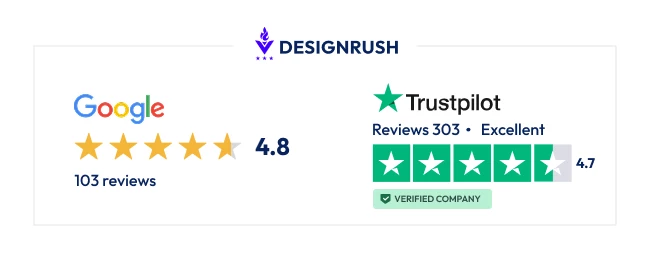
Rated 4.8 on Google and 4.7 on Trustpilot, DesignRush Agency Directory is a reliable resource for finding top IT services companies. We owe this to our executive selection team, which follows a strict screening process when featuring agencies on the platform, assessing key performance indicators, like portfolio, client reviews, and industry reputation.
Learn more about DesignRush Agency Ranking Methodology.
Sources
DesignRush sustains a directory of over 40,000 agencies categorized by service category, location, expertise, and reviews. We build our database in two ways:
- Our dedicated team of agency experts actively searches the web for top-performing companies. We then pull information from their websites, online presence, and client testimonials to verify their status and qualifications prior to listing.
- The agencies listed get notified of their profiles on the website and they can choose to claim it or not, which suggests their availability for more collaborations.
Agencies can also reach out to DesignRush and must go through the verification process prior to being listed.
Frequently Asked Questions About IT Services
What industries do IT companies commonly serve?
IT companies serve most industries, tailoring their services to the needs, security requirements, and mission-critical systems of each organization. According to industry research, the following are the major verticals investing in IT services:
- IT and telecom: Offering engineering support, cloud-native builds, site reliability engineering, and legacy modernization.
- Finance: Building banking apps, fraud and risk analytics, payment programs, blockchain solutions, and ensuring strong cybersecurity and data governance across digital operations.
- Healthcare: Creating compliant and secure patient portals, electronic health record (EHR) systems, telehealth solutions, and advanced medical devices and diagnostic tools.
- Government: Engineering public-facing apps and websites, and providing digital transformation and data management services to improve agency efficiency and community service.
- Retail: Tailoring and optimizing eCommerce platforms, online marketplaces, inventory management solutions, point of sale (POS) systems, and other commerce solutions to improve customer experiences, sales, and internal efficiency.
- Manufacturing: Devising industrial Internet of Things (IIoT) solutions, material requirements planning software, and real-time performance dashboards to optimize resource utilization and the manufacturing process.
What tech stacks do they use?
IT services providers are proficient in multiple tech stacks. However, the right stack will depend on your existing systems, security requirements, time-to-market goals, and team capabilities to support the product in the long-term. Common tech stacks include:
- JavaScript web stacks (MEAN/MERN stacks): Popular for modern web applications and SaaS products, especially when you want a single language across the back end and front end.
- .NET (ASP.NET and C#): A Microsoft-based developer ecosystem used for cross-platform application development, making it ideal for Microsoft-heavy enterprise applications, APIs, internal tools, and Azure-based systems.
- Python-Django (PyCharm, HTML, CSS, JavaScript, MySQL, Apache): Commonly used for web apps, data-heavy products, analytics, and machine learning programs.
- LAMP/PHP stack: One of the first open-source software, providing time-tested reliability to many digital solutions. This is often used for content sites, CMS-driven experiences, and many eCommerce implementations.
How long do IT projects take?
A small, well-scoped digital product can take 3-12 months to build. On the other hand, complex, integration-heavy software may require over a year. Below is an approximate timeline for each phase of the software development lifecycle:
- Discovery and planning (2-6 weeks): Defining the project goals, success metrics, scope and constraints, risks, and delivery plan.
- Design and architecture (2-5 weeks): Establishing UX flows, system design, integration approach, and security requirements. It may also include proof of concepts (PoCs) for high-risk segments.
- Build in iterations (8-52+ weeks): Building the product incrementally with regular demos or releases. It often involves server-side logic, database management, system integration, and back-end and front-end work.
- Quality assurance and testing (3-6+ weeks): Aims to uncover and resolve issues, bugs, and defects in the system before launching. This typically includes functional, usability, regression, and performance testing and typically occurs throughout the development process rather than as a separate phase.
- Launch (1-3 weeks): Ensuring product readiness through final system checks, providing change management, training, rollout plan, and go-live.
- Post-launch support (2-6 weeks): Refining the product after launch, including fixing bugs and refining UI/UX design.
The timeline of your IT project will be dictated by your deployment frequency, system complexity, data migration readiness, security and compliance approvals, and feedback cycle.
Who are the top IT service providers on DesignRush?
We have curated a list of top IT services companies on DesignRush across multiple price points, so you can identify a top vendor within your budget.
| High budget: $50,000+ |
|
| Low budget: $25,000-$50,000 |
|
Beyond budget, our agency directory allows you to filter agency profiles by location, area of expertise, agency reviews, client types, team size, and hourly rates.
About The Author and Expert Reviewer

Selina Garcia has authored 500+ articles and edited 50+ published books in economics, law, and history. Her unique blend of experiences allows her to approach content creation from a well-rounded perspective. Currently, Selina applies her expertise to producing insightful articles on IT, software, and applications for DesignRush.

Sergio is a technology leader with over six years of experience managing global teams and delivering projects across fintech, sportstech, and B2B platforms. At DesignRush, he drove product growth and development execution, building tools that speed up processes by 95% and cut costs by 35% while maintaining full uptime.
Latest Trends Related to IT Services